
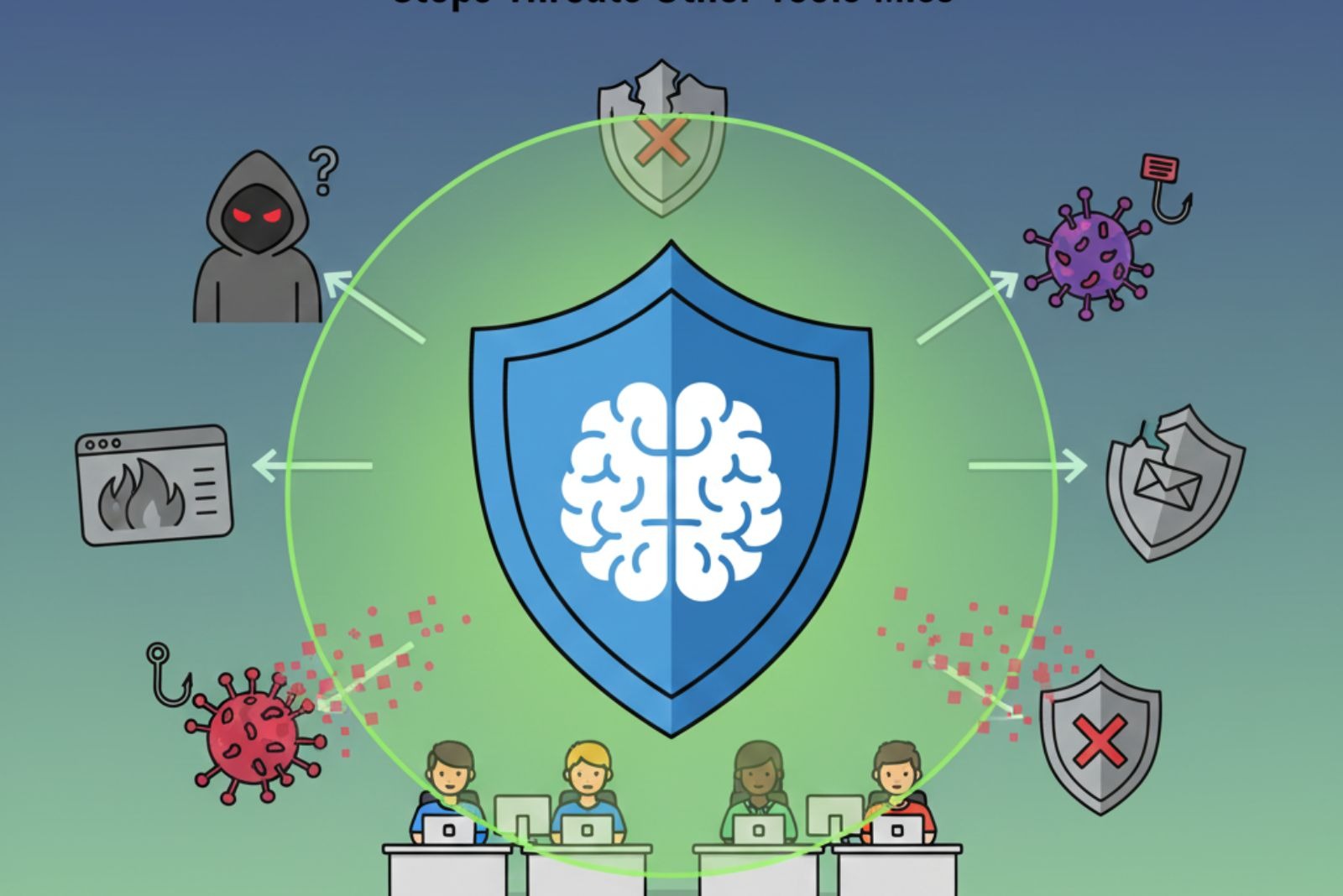
You’re looking for something that finds the threats your other tools can’t see. The ones that don’t trigger a signature. User and entity behavior analytics, or UEBA, does exactly that. It learns what normal looks like for every user and device on your network.
Then it spots the subtle deviations that signal a real problem. It’s a shift from chasing alerts to understanding behavior. This approach catches insider risks, compromised accounts, and stealthy attacks that bypass traditional defenses.
Keep reading to see how User Entity Behavior Analytics UEBA works and why it’s becoming essential for modern security.
Key Takeaways
- UEBA builds a unique behavioral baseline for every user and system.
- It detects anomalies by spotting subtle deviations from normal patterns.
- The technology significantly reduces false positives and speeds up investigations.
The Day the Machine Saw What We Couldn’t
It was all just slightly off baseline. We investigated and found a compromised account, used so carefully it looked like normal work. That’s the power of UEBA. It doesn’t just look for bad code, it looks for odd behavior. It sees the forest, not just the trees.
Most security tools are looking for something they’ve seen before. A known malware signature, a blacklisted IP address.
UEBA is different. It uses machine learning to understand what ‘normal’ is for each person and each machine in your environment. It watches how people log in, what servers they talk to, what applications they use.
How UEBA Learns Your Environment’s Normal

This process starts with data. A lot of it. UEBA solutions ingest logs from your existing systems.
Your SIEM, your endpoint detection and response (EDR) platform, your cloud services. It pulls in information on logins, file access, network traffic, and process execution. The more quality data it gets, the smarter it becomes.
This initial learning period is critical. It usually takes a few weeks for the machine learning models to establish a reliable baseline of behavior, aligning closely with how behavioral analysis for threat detection.
They don’t just look at individuals, they use peer group analysis. It makes sense that all the accountants act similarly, or all the developers. If one starts acting like a system administrator, that’s a flag.
- Login Patterns: Time of day, location, frequency, and failure rates.
- File Access: Which files are touched, read volumes, and write activities.
- Network Flows: Destinations, data volumes, and protocols used.
- Application Usage: Typical programs launched and sequence of actions.
Once the baseline is set, the real monitoring begins. The system operates continuously, scoring every action. It’s not about one strange event, but a accumulation of risk. A single failed login might be nothing.
But that same failed login, followed by an attempt to access a sensitive file share from an unusual workstation, starts to build a high-risk score. This scoring is what makes UEBA so effective at reducing false alarms for security teams. It provides context, so analysts aren’t wasting time on every minor anomaly.
Why Entities Matter Just as Much as Users
The scope is what separates UEBA from its predecessor, UBA (User Behavior Analytics). UBA focused only on human users (1). UEBA expands the view to include entities. Servers, applications, IoT devices, network segments. This is crucial for detecting modern attack techniques. For example, lateral movement.
An attacker who compromises one endpoint will try to move to others. UEBA can detect when a server starts behaving like a user, making RDP connections to multiple other machines. Or when a network printer starts sending strange DNS queries, a potential sign of command and control communication.
The Specific Threats UEBA Catches Best
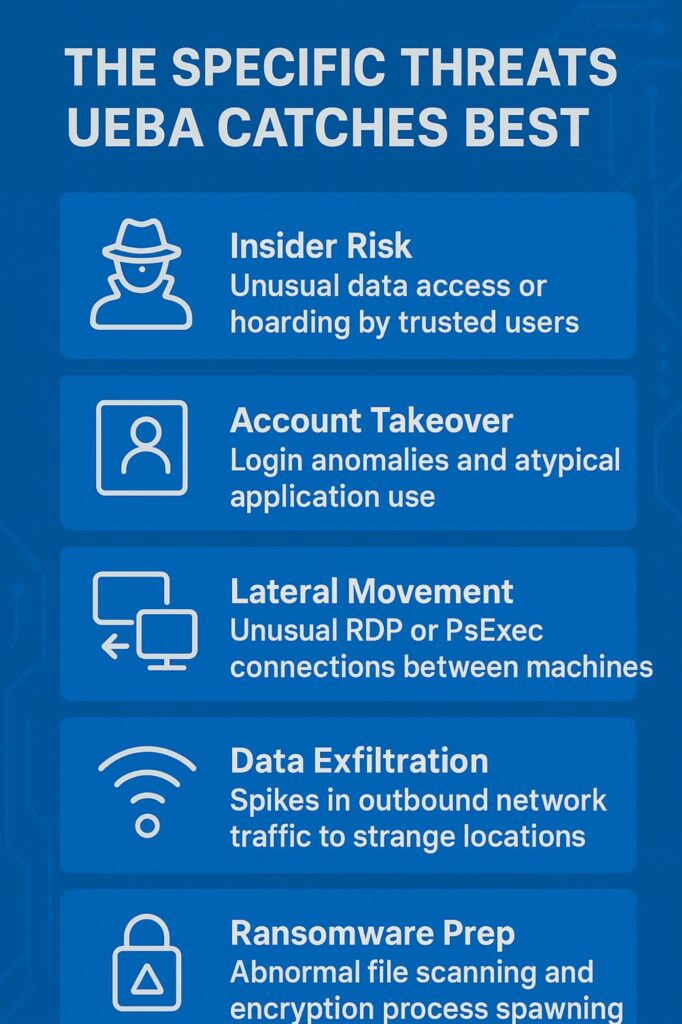
The types of threats UEBA is adept at finding are some of the most damaging. Insider threats, whether malicious or accidental, are a classic example. The system might notice an employee in the HR department suddenly downloading massive amounts of source code. Or a user accessing files they haven’t touched in years right before giving notice.
It’s these behavioral shifts that raise the alarm. Compromised accounts are another major win. A valid user account taken over by an attacker will often exhibit small anomalies. Logins from a foreign country in the middle of the night, accessing applications the real user never uses.
More advanced attacks like ransomware are also caught by behavioral flags. Before the encryption starts, there is often reconnaissance and data gathering, patterns similar to those seen when detecting unknown network threats.
UEBA can detect the unusual file access patterns and network scans that precede the actual encryption event.
- Insider Risk: Unusual data access or hoarding by trusted users.
- Account Takeover: Login anomalies and atypical application use.
- Lateral Movement: Unusual RDP or PsExec connections between machines.
- Data Exfiltration: Spikes in outbound network traffic to strange locations.
- Ransomware Prep: Abnormal file scanning and encryption process spawning.
The Real-World Impact on Security Teams

The numbers back up the effectiveness. Organizations using UEBA report identifying over 85 percent of previously unknown threats. The reduction in false positives is dramatic, often cited at around 90 percent.
This is a game-changer for security operations centers drowning in alerts. It allows analysts to focus on genuine high-risk events. The mean time to respond (MTTR) to incidents drops significantly, sometimes by 70 percent or more, because the alerts come with rich context about what’s actually happening (2). Analysts know where to look first.
Adoption is growing fast. It’s estimated that well over half of large enterprise security operations now use some form of UEBA or behavioral analytics. The market for these AI-driven security tools is expanding rapidly each year. The reason is simple, the threat landscape has evolved.
What You Need to Know Before Implementing UEBA
Source: Microsoft Academy Hub
Of course, it’s not a magic bullet. UEBA requires good, clean data to work effectively, especially because issues like inconsistent logs can mirror the broader challenges with anomaly detection tuning.
There’s also a tuning period. The system needs time to learn, and security teams need time to trust its alerts. You can’t expect perfect results on day one. It’s a partnership between the technology and the people using it. You have to feed it good data and teach it what’s important.
Privacy is another consideration. Profiling user behavior must be done in a way that complies with regulations like GDPR. This is usually handled through data anonymization techniques and by focusing on metadata patterns rather than the actual content of communications. The goal is to understand behavior, not to read emails.
Most modern UEBA platforms are designed with these privacy controls built in from the start. It’s a balance between security and individual privacy, and it’s a balance that can be managed successfully in User Entity Behavior Analytics UEBA
FAQs
What does UEBA do in simple terms?
UEBA learns what normal activity looks like for every user and device in your system. It watches login times, file access, network traffic, and app use. When something seems off, it sends an alert. This helps catch attacks that hide inside normal activity.
UEBA does not rely on signatures or known threats. Instead, it focuses on behavior. This makes it strong at spotting new attacks, insider risks, and stolen accounts.
How does UEBA learn normal behavior?
UEBA collects logs from tools you already use, like SIEM, EDR, and cloud services. It studies patterns for a few weeks and builds baselines. It also groups similar users together, like developers or accountants.
If one person suddenly acts very differently from others in their group, the system notices. Once the baseline is ready, UEBA scores every action to decide if it is harmless or risky. This makes alerts more accurate.
Why does UEBA look at entities, not just users?
UEBA watches both people and devices because attacks can start anywhere. A printer sending strange traffic can be a sign of command and control activity. A server making RDP connections to many machines can show lateral movement.
By tracking entities, UEBA sees changes that other tools miss. Devices have normal patterns too. When those patterns shift, it often means something is wrong. This wider view helps catch hidden threats.
What types of threats does UEBA catch best?
UEBA is strong at finding threats that hide in plain sight. It spots insider risks, like odd file access or large downloads. It flags stolen accounts by looking for strange login times or new app use.
It detects lateral movement when attackers hop between systems. It also sees ransomware prep, like scanning files or spawning odd processes. These early signs help teams stop attacks before major damage happens.
How does UEBA reduce false alerts?
Traditional tools use fixed rules and can trigger too many alerts. UEBA is different. It studies real behavior and sends alerts only when actions truly stand out. It also adds context. A single failed login might be harmless.
But a failed login followed by unusual file access is risky. This scoring method cuts noise and helps teams focus on real problems. Many companies see a major drop in false positives.
Can UEBA help detect compromised accounts?
Yes. Even if an attacker steals a username and password, they rarely act like the real user. They may log in from a new country, use apps the user never touched, or access sensitive files.
UEBA spots these small changes. It knows how each person normally behaves, so odd activity stands out fast. This makes it one of the best tools for catching account takeovers long before data is stolen.
How does UEBA help stop lateral movement?
Attackers often move from one system to another to reach important data. UEBA watches for unusual remote connections, access to new machines, or attempts to use admin tools. If a server behaves like a user or a device talks to systems it never contacted before,
UEBA raises a flag. These early warnings help stop attackers before they spread deeper. This is key for stopping advanced, slow-moving threats.
Why is clean data important for UEBA?
UEBA depends on logs to learn behavior. If the data is missing, messy, or incomplete, the system cannot build a good baseline. This may cause weak alerts or missed threats. For best results, your logs must be accurate and consistent.
The saying “garbage in, garbage out” applies here. Many teams improve their logging before turning on UEBA. With clean data, UEBA becomes far more powerful and reliable.
Does UEBA respect user privacy?
Yes. Modern UEBA tools use methods that protect privacy while still spotting risks. They focus on patterns, not message content. Many systems also use data masking or anonymization to hide identities until a real threat appears.
This helps teams stay compliant with laws like GDPR. The goal is to track behavior patterns, not read emails or private files. With the right controls, security and privacy can both be protected.
How does UEBA help security teams work faster?
UEBA gives alerts with clear context, not just raw logs. It shows the risk score, what changed, and why it matters. This helps analysts know where to look first and cuts investigation time. Many teams report faster response and fewer wasted hours.
UEBA also lowers alert fatigue because it sends fewer, smarter alerts. With UEBA, analysts can focus on true threats instead of digging through noise.
A New Way to See User Entity Behavior Analytics UEBA
Implementing user entity behavior analytics is more than adding a new tool. It’s a shift in philosophy.
It moves security from a reactive stance to a proactive, intelligence-driven one. Instead of waiting for a known-bad event, you’re constantly monitoring for the abnormal. It excels where other tools fail, particularly against insider threats and sophisticated, low-and-slow attacks.
For us, pairing it with robust NetworkThreatDetection has created a layered defense that catches what others miss.
The best approach is to integrate UEBA with your existing SIEM and EDR investments, creating a security ecosystem that is smarter and faster. See what a behavioral approach can do for your organization. It might just show you what you’ve been missing.
References
- https://medium.com/@tahirbalarabe2/what-is-user-behavior-analytics-uba-and-user-and-entity-behavior-analytics-ueba-e10c30a28e37
- https://www.researchgate.net/publication/394471866_Correlation_Between_Observability_Metrics_and_Mean_Time_to_Recovery_MTTR_in_SRE