
AI-driven behavioral analysis is the shift from waiting for an attack to stopping it before it happens. It uses machine learning to understand the normal rhythm of your digital environment, from user logins to data transfers.
When something acts out of character, the system flags it. This method finds 80 percent of threats that other tools miss (1). It turns your security from a historian, recording past breaches, into a prophet, seeing future dangers. Keep reading to see how AI-Driven Behavioral Analysis builds a living defense that adapts as fast as your threats do.
Key Takeaway
- Learns Your Normal: AI builds a unique baseline of typical behavior for your network and users.
- Spots Tiny Deviations: It detects subtle anomalies, like unusual data access, that signal hidden threats.
- Acts in Real Time: The system can respond automatically, containing risks in seconds instead of days.
When Old Security Fails

It starts with a quiet hum, the sound of a network doing its job. Data flows, people log in, applications run. For years, security meant looking for known viruses, like checking IDs at a door.
But the real danger often wears a familiar face. It’s the trusted employee suddenly downloading massive files at 3 a.m. It’s the subtle, slow leak of information that doesn’t trigger any alarm.
This is where old security fails. AI-driven behavioral analysis doesn’t look for a specific bad guy. It learns the unique personality of your system, aligning closely with the principles behind detecting anomalous endpoint behavior. It knows the rhythm of your business. And when the rhythm breaks, it hears the dissonance.
Seeing the Ghost in the Machine
We’ve seen it work. On a normal Tuesday, a system flagged an internal account. The user was accessing a server they never used, at a volume of data that was just slightly off.
It wasn’t a screaming alarm, just a quiet nudge of a risk score. A quick check revealed a compromised credential. The attack was stopped before any data was lost. That’s the power of this approach. It sees the ghost in the machine, the faint shadow that something is wrong.
How AI Behavioral Analysis Builds a Living Defense
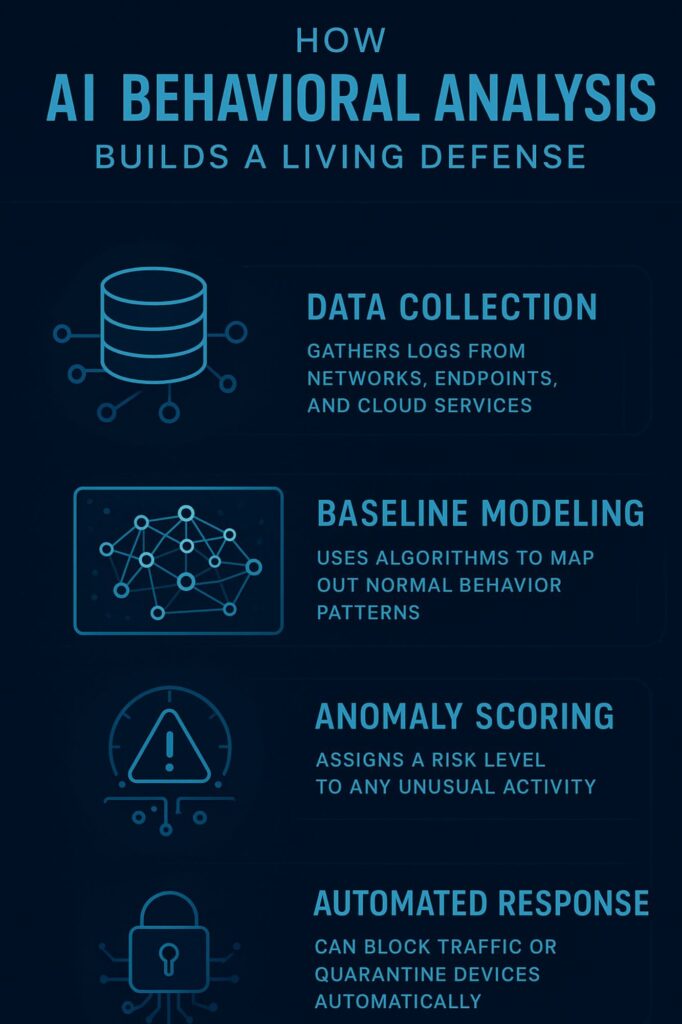
The process isn’t magic. It’s a careful, continuous cycle of learning and watching. First, the system needs to listen. It ingests a flood of data from across your organization. Every login attempt, every network connection, every process started on an endpoint.
This happens silently, in the background, for a few weeks. The machine learning models aren’t being told what to look for. They’re figuring it out for themselves, a process called unsupervised learning. They cluster similar events, finding patterns in the chaos.
Any significant deviation is an anomaly. It could be a user trying to access a sensitive folder for the first time. Or a server sending out an unusual amount of data.
Each anomaly gets a risk score. A low score might just be logged. A high score triggers an alert or even an automated response. The system can isolate a compromised endpoint in seconds, cutting off an attacker’s foothold. This continuous feedback loop means the system gets smarter over time, learning from false positives and real threats alike.
- Data Collection: Gathers logs from networks, endpoints, and cloud services.
- Baseline Modeling: Uses algorithms to map out normal behavior patterns.
- Anomaly Scoring: Assigns a risk level to any unusual activity.
- Automated Response: Can block traffic or quarantine devices automatically.
The Technical Engine Room: Isolation Forests and LSTM Networks
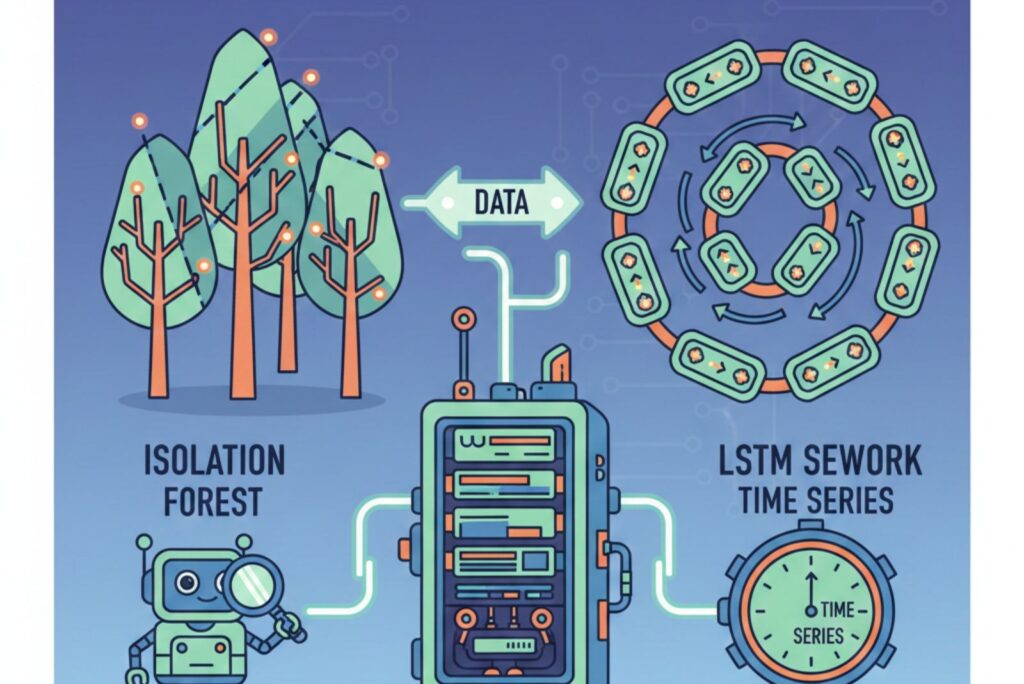
Under the hood, specific AI techniques power this analysis, forming the backbone of modern behavioral analysis for threat detection. One powerful method is called an Isolation Forest. Think of it like finding the odd tree in a forest. Most trees are close together. But one tree is off by itself, isolated.
The algorithm is very good at quickly finding those isolated data points in a huge dataset,the anomalies. It doesn’t need to know what “normal” is beforehand. It just finds what’s different.
For understanding sequences of events over time, systems use LSTM networks. This is crucial for detecting advanced attacks that unfold in stages.
An attacker might first perform reconnaissance, then move laterally, then exfiltrate data. Each step alone might look harmless. But together, they form a malicious sequence.
An LSTM can remember patterns over long periods, connecting the dots between actions that happen hours or days apart. It’s like having a detective with a perfect memory for timeline details.
- NLP for system logs: Uses Natural Language Processing to interpret log data, not human language, by reading millions of entries to detect subtle, unusual patterns.
- Log pattern detection: Spots when an error message that normally appears alone starts clustering with other events, signaling a potential attack.
- Generative AI simulations: Creates synthetic examples of malicious behavior to train models against threats they haven’t yet encountered in the real world.
- Continuous self-challenge: The AI refines its detection accuracy by testing itself with simulated attacks.
- Collaborative technologies: NLP, generative AI, and detection models work together, each contributing a critical layer to identifying emerging threats.
Real-World Problems Solved by Behavioral AI
The theory is solid, but the proof is in the problems it solves. Take phishing, which starts over 90 percent of breaches. Traditional filters catch known bad emails. But AI-driven behavioral biometrics looks at how a user interacts with a message.
Insider threats are another major challenge. A disgruntled employee or a compromised account can do immense damage. Behavioral analysis profiles each user’s normal activity.
If a marketing employee suddenly starts accessing source code repositories or downloading massive customer lists, it raises a red flag. The system detects the intent behind the actions, the data hoarding that often precedes a departure or an attack. It’s a silent watchdog for internal risk.
Ransomware is a race against time. Behavioral AI wins that race. It doesn’t look for the ransomware file itself. It looks for the behavioral precursors,the rapid, mass encryption of files.
Behavioral analysis with sequence detection is one of the few effective defenses. It can correlate seemingly unrelated events over weeks or months,a strange login from a new country, a small data transfer, a scheduled task created on a server.
The Numbers Don’t Lie: The Impact of Behavioral AI
The adoption of this technology is accelerating for a simple reason: it works. The market for AI in cybersecurity is growing at about 24 percent per year.
Currently, between 62 and 69 percent of enterprises are using some form of AI for security, with about 64 percent applying it specifically to threat detection.
The results are tangible. Companies report an average 60 percent improvement in their threat detection capabilities after implementation (2).
The speed difference is staggering. The traditional mean time to detect a threat can be over 168 hours,a full week. AI-driven behavioral analysis can identify and respond to a threat in seconds. This drastically reduces “dwell time,” the period an attacker has free reign inside your network. This speed is critical for minimizing damage..
Making It Work: Integration and Overcoming Hurdles
Source: Michigan Institute for Data & AI in Society
Implementing AI-driven behavioral analysis isn’t just about flipping a switch. The most critical factor is data quality. The AI needs clean, comprehensive data to learn from. If important data sources are missing, the baseline will be incomplete, leading to missed threats or false alarms.
It’s often best to start with a focused deployment, like on critical servers or in Network Threat Detection, where data streams are well-defined. We find that starting with network data provides a clear, high-level view of traffic flows that is easier for the models to learn initially.
Integration with your existing security tools is also key. The AI shouldn’t replace your EDR (Endpoint Detection and Response) or SIEM (Security Information and Event Management) system. It should enrich them.
Integration with your existing security tools is also key. The AI shouldn’t replace your EDR (Endpoint Detection and Response) or SIEM (Security Information and Event Management) system. It should enrich them through concepts rooted in user and entity behavior analytics (UEBA).
The behavioral risk scores can be fed into your SIEM, helping to prioritize alerts for your security team. This correlation of alerts across different systems,network, endpoint, cloud,is the foundation of a modern XDR (Extended Detection and Response) strategy, creating a 360-degree view of threats.
- Expect a 2–4 week tuning period where the system learns normal behavior.
- During this phase, false positives may occur as the model adjusts.
- Adversaries evolve, trying to mimic normal activity to evade detection.
- It becomes a constant cat-and-mouse cycle, requiring ongoing model updates.
- The aim isn’t perfectionit’s steady, meaningful improvement in overall security posture.
FAQs
What is AI-driven behavioral analysis?
AI-driven behavioral analysis watches how your network normally behaves. It learns patterns from logins, files, and data flow. When something looks strange, even a small change, the system flags it. It does not wait for known malware.
Instead, it finds odd behavior early, before damage happens. This helps stop attacks older tools cannot see, including new threats and hidden risks inside your network.
How does AI learn what “normal” behavior looks like?
AI learns “normal” behavior by watching your network for a few weeks. It studies login times, data transfers, app use, and server activity.
It groups similar actions and builds a baseline. The AI works with unsupervised learning, which means it figures things out on its own. If something breaks the pattern, it marks it as an anomaly. With more data, the baseline gets stronger, helping the AI spot danger faster.
Why does behavioral analysis catch threats older tools miss?
Older tools look for known viruses or signatures. If the threat is new, they often miss it. Behavioral analysis does not wait for a match.
It watches actions instead. If a user downloads files at odd hours or a server sends unusual data, the AI responds. This helps it stop zero-day attacks, insider threats, and slow, hidden attacks. It finds danger by spotting unusual behavior, not known malware.
How does AI detect insider threats?
AI detects insider threats by learning how each person normally works. It watches what files they use, which apps they open, and when they usually work.
If someone starts reaching into new areas or pulling large amounts of data, the AI sees it. It can stop both bad actors and hacked accounts. This early warning helps prevent leaks, theft, and major damage inside your organization.
How does AI stop ransomware before it spreads?
AI does not look for the ransomware file itself. It watches for the behavior that comes before encryption begins. This may include rapid file changes, strange system tasks, or odd network activity.
Even if the ransomware is new, the AI can catch the early signs. It can isolate the infected device within seconds. This stops the attack before it spreads, protecting your data and reducing damage.
What role does NLP play in threat detection?
NLP reads system logs the way it reads text. But instead of human language, it reads machine messages. It looks for patterns in millions of log entries.
If a warning that appears alone suddenly shows up with other errors, NLP notices it. This might signal an attack or a system issue. It helps the AI connect events that seem small or unrelated, giving security teams a clearer view of risks.
What is an Isolation Forest, and why is it useful?
An Isolation Forest is an algorithm that finds strange data inside huge amounts of information. It works by isolating unusual points. Imagine a forest where one tree stands far away from the rest.
That tree is the anomaly. The algorithm does not need to know normal behavior before it starts. It simply finds what is different. This makes it fast and effective for detecting rare or hidden threats.
How do LSTM networks help detect complex attacks?
LSTM networks are AI models that remember patterns over long periods. They watch sequences, not just single actions. Many attacks happen in steps. A small login, a strange file action, and then a data transfer later.
Alone, each step seems fine. But together, they form a threat. LSTM networks connect these moments and see the whole pattern. This helps stop long, slow attacks that try to blend in.
What should a company do before adding behavioral AI?
Before adding behavioral AI, companies should focus on clean, complete data. The AI needs logs from networks, endpoints, and cloud tools to learn. Missing data slows the process. It helps to start small, like with network traffic or key servers.
After the system learns, it becomes more accurate. Connecting it with your SIEM and EDR tools makes everything stronger. This setup improves alerts and reduces false positives.
How long does the AI need to become accurate?
AI needs about two to four weeks to learn normal behavior. During this time, it studies user actions and data movement. You may see more alerts early on as the model adjusts. After the learning phase, alerts become sharper and more reliable.
The AI keeps improving as it sees new patterns and threats. Over time, this creates a smarter, faster, and stronger defense for your entire network.
Your Next Step Toward in AI-Drive Behavioral Analysis
AI-driven behavioral analysis marks a fundamental change. It moves security from a static list of bad things to a dynamic understanding of good things. It protects you from the threats that have no name yet, the zero-day exploits and the novel attack methods.
The technology is here, it’s proven, and it’s becoming essential. The question isn’t whether you need it, but how soon you can integrate it into your defense strategy.
Start by evaluating your most critical data sources. Consider a phased approach, perhaps beginning with your network layer to gain visibility with NetworkThreatDetection. The goal is to build a security system that learns, adapts, and anticipates, finally giving you an edge against the constantly evolving threat landscape.
References
- https://asadsyedchi.medium.com/threat-hunting-methodologies-79956229392a
- https://www.sciencedirect.com/science/article/pii/S219985312400060X