
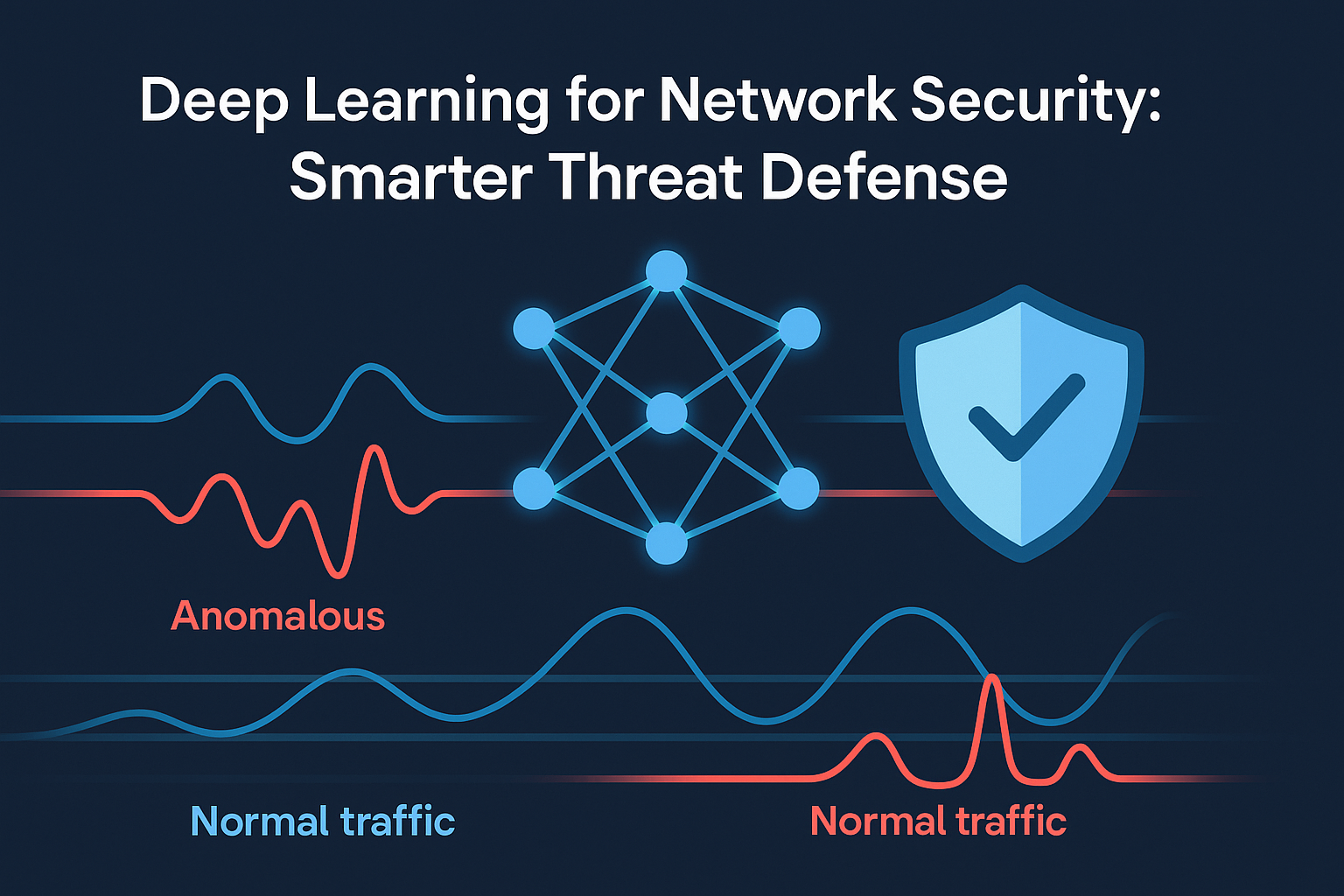
Deep learning is changing network security by replacing fixed rules with systems that actually learn how real traffic looks and behaves.
Instead of chasing after known attack signatures, these models study huge volumes of network data and quietly build a sense of “normal.”
Then, when something even slightly off-pattern appears, a strange data flow, an odd login, a hidden command, they can flag it as a possible intrusion, malware outbreak, or zero-day attack.
The more traffic they see, the sharper they get. Keep reading to see how this works in practice and what it means for cybersecurity’s next phase.
Key Takeaway
- Deep learning excels at finding subtle anomalies in vast network data.
- Models like LSTMs, autoencoders, and CNNs learn normal patterns to flag deviations as threats.
- This approach is critical for detecting novel, sophisticated attacks.
The Growing Need for Smarter Defenses
The digital landscape is a constant, low-grade war. Traditional security tools, the ones that rely on lists of known bad actors, are like guards checking IDs at a gate.
They work well enough for known criminals. But they miss the clever intruder who slips over the fence in the dead of night, the one who doesn’t match any description on file.
The volume and sophistication of attacks have simply outstripped the capabilities of these manual, signature-based systems. They generate too many false alarms, and they are always one step behind.
Deep learning enters this scene not as another guard, but as a sophisticated surveillance system. It watches everything.
It learns the rhythm of a normal workday, the typical flow of data between servers, the standard login patterns of every employee.
This approach parallels advanced machine learning & AI in network threat detection, where behavioral baselines help spot subtle irregularities before they escalate.
It builds a dynamic, living model of “normal.” When something, however slight, deviates from that model, it raises a flag. This ability to detect the unknown is what makes it so powerful.
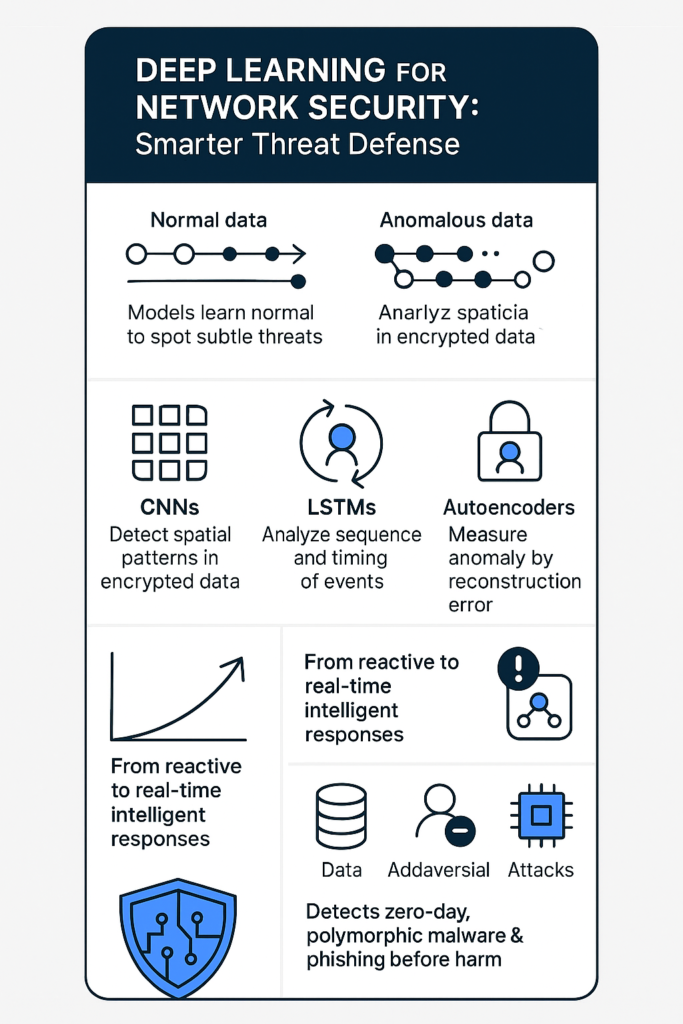
- Evolving Threats: Zero-day exploits and polymorphic malware change their code to evade signature detection.
- Data Overload: The sheer amount of network traffic makes manual analysis impossible.
- Encrypted Traffic: Modern encryption hides content, but deep learning can analyze behavioral patterns.
How Deep Learning Sees What Others Miss
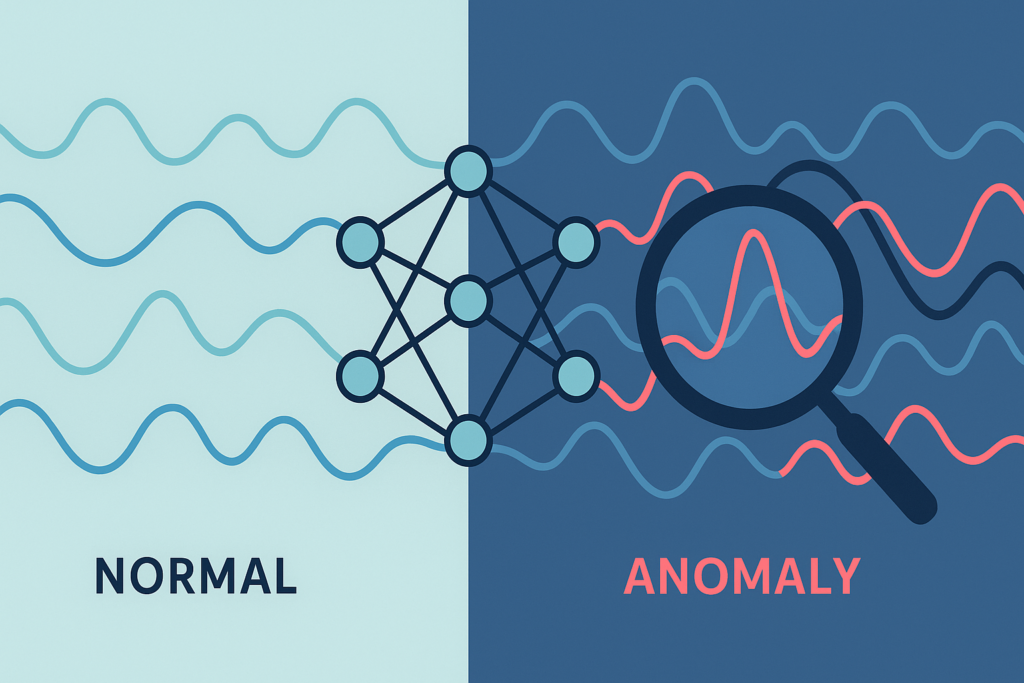
At its core, deep learning for network security is about pattern recognition on a massive scale. Think of it as teaching a machine the “sound” of a healthy network.
You feed it millions of examples of normal traffic, the hum of data transfers, the rhythm of database queries, the chatter of authenticated users. The neural network, with its multiple layers of artificial neurons, learns to reconstruct this sound perfectly [1].
An attack, then, is a dissonant chord. It might be a subtle change in the timing of packets, a slight deviation in the size of data requests, or a new, unusual connection to an external server. A traditional system wouldn’t notice.
But the deep learning model, having learned the precise melody of normalcy, hears the discord immediately. It doesn’t need to know the attack’s name. It just knows the music is wrong.
This is a fundamentally different approach. It’s probabilistic and behavioral, not deterministic and rule-based. The model’s effectiveness grows with the data it consumes, constantly refining its understanding of what belongs and what constitutes a threat.
The Core Techniques Powering Intelligent Defense
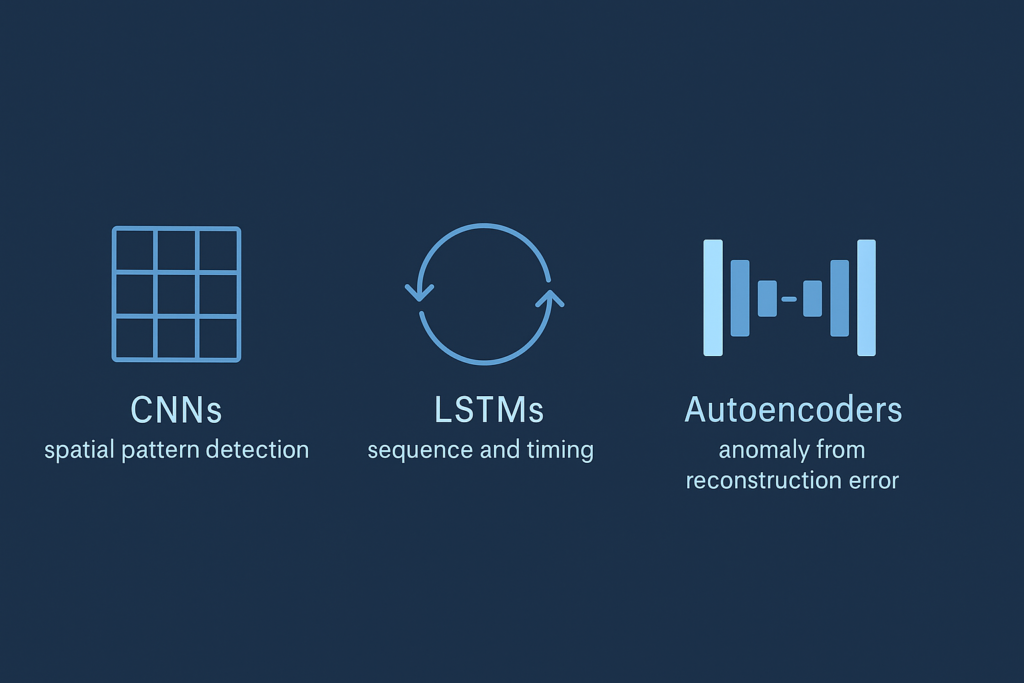
| Model Type | What It Analyzes | Strength | Typical Use Case |
|---|---|---|---|
| CNNs | Spatial patterns in packet or flow data | Detects encrypted or obfuscated patterns | Malware signatures, packet inspection |
| LSTMs | Sequential and temporal traffic behavior | Captures long-range, slow-developing attacks | Low-and-slow attacks, lateral movement |
| Autoencoders | Reconstruction of normal traffic patterns | High anomaly sensitivity | Zero-day detection, anomaly scoring |
Several neural network architectures have proven particularly adept at dissecting network data. Each has a specialty, a unique way of perceiving the information flowing across your infrastructure.
Convolutional Neural Networks (CNNs) are brilliant at spatial analysis. In network security, they can treat raw packet data as an image.
They scan across this data, looking for local patterns and hierarchical structures that might indicate a malware signature or a specific attack vector, even if the payload is obfuscated or encrypted.
Long Short-Term Memory (LSTM) networks are the masters of sequence. Network traffic is inherently sequential, a flow of events over time.
An LSTM can remember patterns from hours or even days ago, allowing it to detect sophisticated, low-and-slow attacks that unfold gradually. It can connect a seemingly innocuous event on Monday with a suspicious action on Friday, something no rule-based system could ever do.
- CNNs: Effective for spatial patterns in packet data or flows, even encrypted.
- LSTMs: Perfect for understanding the timing and order of network events.
- Autoencoders: Specialized in learning a compressed representation of normal data [2].
Autoencoders operate on a principle of reconstruction. You train them only on normal, benign network traffic. They learn to compress this data into a simplified representation and then decompress it back to the original.
Their reconstruction error is very low for normal data. But when you feed them anomalous or malicious traffic, they struggle to reconstruct it accurately. A high reconstruction error becomes the anomaly score, a direct measure of how “weird” the traffic looks.
Where Deep Learning Makes a Tangible Difference
Credits: IBM Technology
The theoretical power of these models translates into concrete applications that are already enhancing security operations centers (SOCs) worldwide.
The most impactful use case is in next-generation Intrusion Detection Systems (IDS). These AI-driven IDS solutions analyze network flows and protocols in real-time, identifying breaches with a accuracy that humbles traditional rule-based systems, especially in dynamic cloud or IoT environments.
The effectiveness of such systems is amplified by AI-driven behavioral analysis, which allows SOC teams to pinpoint lateral movement and insider threats more efficiently.
Malware classification has also been revolutionized. Deep learning models can analyze the behavior of files, the system calls they make, the network connections they attempt, to dynamically categorize threats.
This behavioral analysis is key to identifying zero-day malware that has no known signature but acts in a recognizably malicious way.
Similarly, these models power advanced phishing detection by analyzing the linguistic patterns and metadata of emails, spotting fraudulent messages that bypass standard filters.
Another critical application is in encrypted traffic analysis. While encryption hides the content of communications, deep learning can analyze the behavioral metadata, packet sizes, timing, and flow directions, to classify traffic and identify potential threats hiding within SSL/TLS tunnels. This is a crucial capability as more and more internet traffic becomes encrypted by default.
Navigating the Real-World Challenges

For all its promise, deploying deep learning in a security context is not without hurdles. The models are only as good as the data they are trained on.
If the training data is biased or incomplete, the model can learn the wrong lessons, leading to missed threats or, more commonly, a flood of false positives that overwhelm analysts.
This challenge is similar to the issues faced in identifying lateral movement behavior, where correlating multiple subtle events is key to reducing false positives and improving detection accuracy. Curating large, diverse, and accurately labeled datasets is a significant challenge.
Adversarial attacks present another serious concern. Attackers can craft malicious inputs specifically designed to fool the deep learning model.
They might subtly alter network packets so that the model perceives them as normal, effectively blinding the system to an ongoing attack. Research into making these models more robust and adversarial-resistant is a major focus in the field.
There’s also the issue of the “black box.” Some complex models can be difficult to interpret. When a model flags an event as malicious, a security analyst needs to understand why to investigate effectively.
The field of explainable AI (XAI) is working to create techniques that can articulate the model’s reasoning, building trust and enabling faster, more informed response.
- Data Dependency: Requires vast, high-quality data for effective training.
- Adversarial Threats: Models can be tricked by specially crafted inputs.
- Computational Cost: Training and running models demands significant resources.
Furthermore, the computational cost of training and inferencing with large deep learning models can be high, requiring specialized hardware like GPUs for real-time analysis in high-traffic networks.
This can be a barrier to entry for some organizations, though cloud-based AI services are helping to democratize access.
The Future of Network Defense
Deep learning is not a silver bullet that will solve all cybersecurity problems. It is, however, a powerful and essential tool that is redefining the boundaries of what’s possible.
The future lies in integrating these intelligent models into Security Information and Event Management (SIEM) and Security Orchestration, Automation, and Response (SOAR) platforms.
This creates a symbiotic relationship where the AI handles the heavy lifting of sifting through terabytes of data, and human experts focus on the nuanced investigation of the high-fidelity alerts the model produces.
The goal is a proactive security posture. Instead of constantly reacting to the latest threat bulletin, your network defense learns and adapts continuously.
It anticipates novel attack methods based on behavioral principles. It’s a shift from playing an endless game of catch-up to building a system that is inherently resilient.
The path forward is one where deep learning for network security becomes less of a novel advantage and more of a standard, indispensable layer of modern digital defense.
FAQ
How does deep learning intrusion detection help me find threats faster?
Deep learning intrusion detection helps you find threats by studying normal network patterns and spotting changes quickly.
It uses deep learning anomaly detection, autoencoder anomaly detection, and IDS deep learning models to detect strange activity. It reviews network flow analysis AI and traffic pattern recognition AI to alert you early about issues such as zero-day attack detection AI or hidden malware behavior.
Can neural network cybersecurity tools improve ransomware detection and phishing safety?
Neural network cybersecurity tools help protect you by learning how normal users act and detecting unsafe behavior.
They support ransomware detection AI, deep learning phishing detection, and malware detection deep learning by checking emails, links, and file actions. When something changes in a risky way, behavior-based threat detection warns you before the problem grows or spreads across your devices.
How do CNN intrusion detection and LSTM network security analyze real network traffic?
CNN intrusion detection analyzes packet-level deep learning analysis to find unusual packet shapes or patterns. LSTM network security studies events over time and detects slow or hidden attacks.
Together, they support network traffic classification deep learning, encrypted traffic classification deep learning, and hybrid deep learning intrusion detection, giving you stronger protection even when threats try to stay hidden inside normal traffic.
What should I know about adversarial machine learning security and model robustness cybersecurity?
Adversarial machine learning security teaches models to resist inputs that attackers design to fool the system. Model robustness cybersecurity checks how well your tools respond to unusual or altered data.
Methods such as secure model inference, privacy-preserving deep learning security, and federated learning network security help protect training data and keep deep learning for SOC operations and threat hunting deep learning reliable.
How does deep learning help SIEM systems and support threat prediction in SOC operations?
Deep learning SIEM enhancement uses SIEM log analysis deep learning to organize events and reduce noise. It supports threat prediction deep learning, cyber threat modeling AI, cybersecurity event correlation AI, and threat prioritization deep learning to help your SOC team respond faster.
These tools also assist insider threat detection deep learning, anomaly-based IDS deep learning, and network threat forecasting AI for stronger daily operations.
Final Thoughts: Deep Learning as the New Backbone of Network Defense
Deep learning is reshaping network defense by enabling systems that understand behavior, anticipate threats, and respond with unprecedented accuracy.
By learning what “normal” truly looks like, these models expose anomalies that traditional tools overlook, whether hidden in encrypted traffic, slow-moving intrusions, or novel malware.
Despite challenges like data quality, adversarial inputs, and computational cost, deep learning’s adaptive, predictive nature positions it as a foundational pillar of future cybersecurity, shifting defense from reactive to truly proactive.
Ready to explore how intelligent threat detection can strengthen your security posture? Join the next generation of network defense.
References
- https://openresearch.newcastle.edu.au/articles/thesis/Pattern_recognition_and_machine_learning_techniques_for_cyber_security/29016707
- https://arxiv.org/html/2501.13962v1