

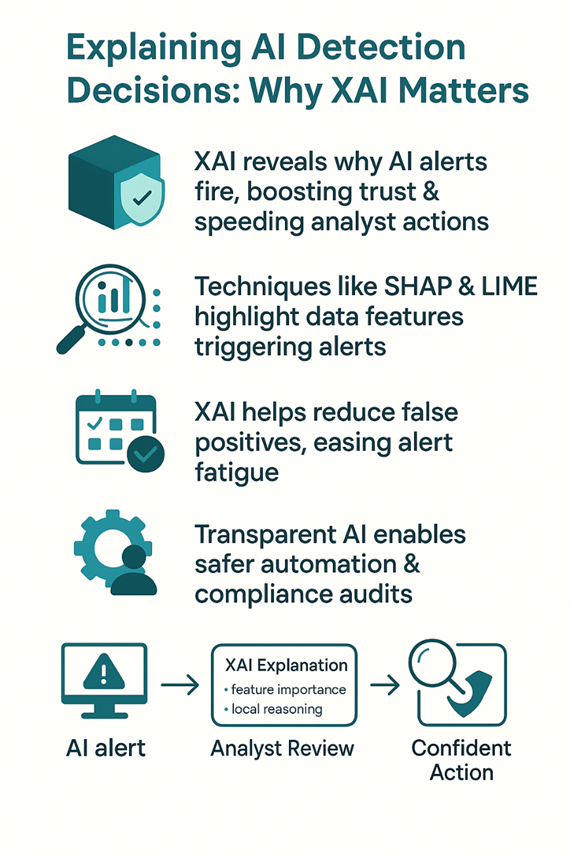
Explainable AI (XAI) makes cybersecurity systems understandable, so you can see why an alert fired or a user was blocked instead of just taking it on faith.
The real challenge isn’t only detecting threats, it’s trusting the logic behind those detections when the model feels like a sealed black box.
XAI opens that box, turning abstract model weights and probabilities into reasons analysts can review, debate, and improve. That clarity supports better decisions, cleaner audits, and safer automation at scale. If you want AI that your security team can actually question and rely on, keep reading.
Key Takeaways
- XAI reveals the “why” behind AI alerts, turning opaque decisions into clear, actionable insights.
- Techniques like SHAP and LIME pinpoint which specific data features triggered a security flag.
- Implementing XAI reduces false positives “can help” before “reduces” for nuance and builds the confidence needed for analysts to act decisively.
The Critical Problem XAI Solves
The security operations center always feels a bit on edge, even on a quiet day. Then a high-priority alert flashes red on the main screen.
An AI-powered intrusion detection system has flagged a user’s login as highly abnormal. Threat score: 98%. The only “reason” on display is a short, cryptic code that might as well be static.
Now the analyst has a dilemma. Block the user right away and risk interrupting an executive’s travel or a critical meeting? Or assume it’s a false positive and let it slide? That hesitation, those long seconds between the alert and a confident decision, sit at the heart of why Explainable AI matters so much. This is where machine learning cybersecurity tools shine, helping security teams interpret complex detections and avoid guesswork.
Modern AI models, especially deep learning systems, work like sealed machines. They swallow massive amounts of data and return scarily accurate predictions, but the logic inside is buried under layers of weights and activations that even experts struggle to trace.
For security teams, that opacity turns into a trust problem. Following an AI’s recommendation without understanding why feels less like analysis and more like a coin flip. Explainable AI (XAI) steps into that gap and acts as the missing bridge between prediction and action.
XAI as the Translator Between AI and Humans. The goal is not to make the AI less powerful or less complex. It’s to make its reasoning readable.
You can think of it like this: the AI “thinks” in vectors, gradients, and activation functions. That’s its native language.
Humans think in patterns, timelines, and cause-effect stories. XAI does the translation work between those two worlds. For a security analyst, that translation might look like:
- “This login was flagged because the source IP is from a country the user has never logged in from before.”
- “The login time is outside this user’s normal working hours.”
- “The device fingerprint differs from their usual laptop and phone.”
- “Similar behavior has been linked to past credential theft incidents.”
- “The combination of new location + unusual time + new device pushed the risk score to 98%.”
Now the alert stops being a mysterious number and becomes a clear narrative. The analyst can weigh each factor, cross-check with context (Is the executive traveling? Did they get a new phone?), and then make a decision they can stand behind.
The power of XAI is not magic. It’s confidence. It turns a black-box spike on a dashboard into a reasoned judgment call, where humans and machines actually work together instead of staring each other down.
The Core Techniques Powering XAI
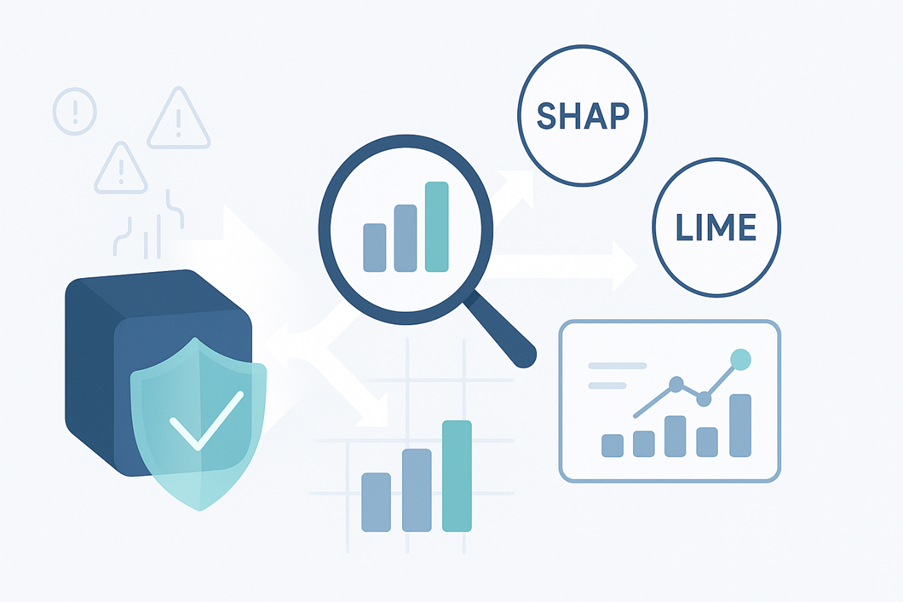
Several powerful techniques form the backbone of XAI. They approach the problem of explanation from different angles, each with its own strengths.
SHAP (SHapley Additive explanations) is a method rooted in game theory. It treats each feature in the input data as a “player” in a cooperative game where the “payout” is the model’s prediction.
SHAP calculates a fair contribution value for each feature, showing exactly how much each one pushed the final score toward a “malicious” or “benign” classification.
For a network security alert, SHAP could reveal that a specific packet size and an unusual port sequence were the primary drivers of the high threat score, demonstrating the practical application of deep learning for network security in discerning subtle anomalies.
LIME (Local Interpretable Model-agnostic Explanations) takes a different tack. Instead of trying to explain the entire complex model, LIME focuses on explaining a single prediction.
It works by slightly perturbing the input data for that specific instance and seeing how the predictions change.
It then builds a simple, interpretable model (like a linear regression) that approximates the complex model’s behavior just around that specific prediction. This local fidelity makes it excellent for answering the question, “Why was this particular event flagged?” Other common techniques include:
- Feature Importance: Ranks all input variables by their overall influence on the model’s outcomes.
- Counterfactual Explanations: These answer “what if” questions. They show the minimal changes needed to an input to change the AI’s decision. For example, “If the login time had been during normal business hours, this event would not have been flagged.”
| XAI Technique | What It Explains | Best Used For | Security Example |
| SHAP | Feature contribution to a single prediction | Understanding why a score is high or low | Shows which network features pushed a login to 98% risk |
| LIME | Local behavior of the model for one event | Explaining individual alerts | Explains why one email was flagged as phishing |
| Feature Importance | Overall influence of input features | Model tuning and audits | Identifies which signals drive alerts most often |
| Counterfactual Explanations | What change would alter the decision | Analyst review and policy testing | Shows how a normal login time could avoid a block |
Transforming Security Operations with XAI
Credits: Stellar Cyber
So what does this look like in a real security workflow? The shift is pretty dramatic. Instead of an alert that simply says “Potential Malware: Confidence 95%,” an XAI-enhanced system lays out the reasoning behind that call.
An analyst might get an alert about a potential phishing email. Instead of a black-box label, the XAI layer adds a clear breakdown of the factors that shaped the decision, for example:
- The email body used urgent language.
- The sender’s domain was recently registered.
- A URL in the message matched a known bad reputation score [1].
With that on the screen, the analyst can walk through each piece. They might confirm that the “urgent” tone is tied to a real, company-wide deadline. That lowers concern for that specific signal. But the newly registered domain and the malicious URL point in the opposite direction and strongly support the threat verdict. So when they choose to quarantine the email, the choice is grounded, not just reactive.
This extra context also changes how teams tune and maintain their security platforms over time. It is especially helpful with systems like SIEMs (Security Information and Event Management) and SOAR (Security Orchestration, Automation, and Response), where alert volume and noise can wear people down fast.
The Tangible Benefits Beyond Transparency
The most obvious benefit of XAI is transparency, but the ripple effects are what truly change security postures. Once the reasoning behind a decision is visible, the security team is not just reacting to alerts, it’s understanding them.
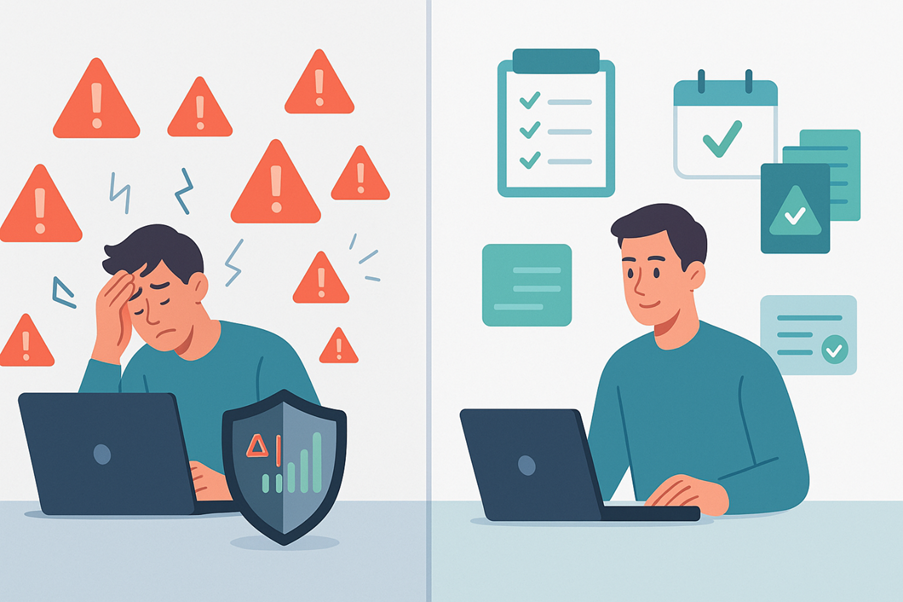
One of the first major gains is a significant reduction in false positives. When analysts understand the “why,” they can much more quickly dismiss erroneous alerts. This:
- Saves countless hours that would have gone into chasing noise
- Helps prevent “alert fatigue” where real warnings get tuned out
- Gives analysts a clearer sense of which alerts deserve attention, boosting the efficiency of AI as your assistant in threat detection workflows and empowering focused human intervention.
That clarity also builds the confidence necessary for automation. If you can trust the AI’s reasoning, you can more safely allow it to execute automated responses for clear-cut cases. In practice, that means:
- Faster containment for obvious or repetitive threats
- Fewer manual steps for routine responses
- More room for human analysts to focus on deep, complex threat hunting
Furthermore, XAI is becoming essential for regulatory compliance. Standards and laws increasingly require accountability for automated decisions, especially those that impact users. XAI provides the necessary audit trail by:
- Recording how and why a given decision was reached
- Supporting reviews by internal and external auditors
- Reducing reliance on opaque “black box” systems in high-stakes environments
So while transparency is the headline benefit, the day-to-day gains come from sharper decisions, safer automation, and a cleaner path to meeting regulatory expectations.
Navigating the Inevitable Challenges
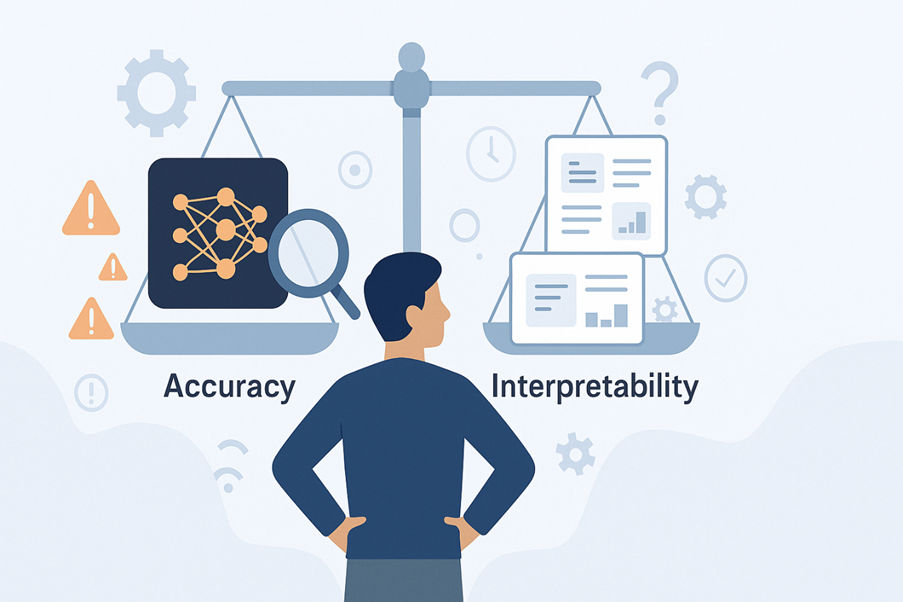
XAI is not a magic bullet, and it brings its own set of trade-offs into any security environment. Once you start using it, you run into the tension between how accurate a model is and how understandable it becomes. At the core, there’s a well-known trade-off:
- Highly accurate models like deep neural networks tend to be hard to interpret
- Simple, interpretable models like decision trees are usually easier to explain but can be less accurate
- XAI methods try to add interpretability on top of complex models, but this is never free [2].
These techniques often come with a computational cost. Some XAI methods are heavy to run, which can introduce latency into real-time detection systems. In security, even small delays can matter, especially when response time is tied to containment.
Beyond performance, there’s another, deeper challenge: explanation accuracy. An explanation only helps if it closely reflects what the model is actually doing. If the explanation is misleading or only loosely connected to the real decision process, it can give teams a false sense of confidence.
That tension shows up in a few ways:
- Explanations may simplify behavior so much that key details are lost
- Different XAI techniques can produce different “views” of the same model
- Validating whether an explanation is faithful is still an active research area
In the end, you don’t just need to trust the model, you also need to trust the explanation. Both layers matter. If either one is off, the value of XAI in security starts to erode, no matter how good the interface looks.
Building a More Trustworthy Defense
Explainable AI is shifting from a nice-to-have to a core requirement for any serious AI-driven security strategy. It changes the relationship between human and machine from blind obedience to something closer to a working partnership, where each side supports the other. In this partnership:
- The security analyst is no longer just a passive recipient of alerts
- They become an active investigator with clearer, model-level insight
- The AI’s role shifts from “black box oracle” to “transparent advisor”
The goal is not to replace human judgment. Instead, XAI is there to augment it with a level of clarity that was almost impossible with older, opaque systems. When analysts can see why an alert was triggered, which features mattered, and how the model weighed them, they can:
- Make faster, better-grounded decisions
- Spot when the model is drifting or behaving oddly
- Build reusable investigation patterns based on real explanations
By insisting on explainability, you’re creating a security environment where every decision—automated or human—is backed by understanding instead of guesswork. That kind of clarity supports technical accuracy and also supports trust across the organization.
It’s worth turning that into a habit with your vendors. Start asking them specific questions about how their AI explains itself:
- What form do the explanations take (scores, feature attributions, plain-language summaries)?
- Are those explanations logged for later review and auditing?
- How do they test that the explanations are faithful to the model’s actual behavior?
Your team’s effectiveness, and their willingness to rely on AI during real incidents, depends heavily on those answers.
FAQ
How does explainable AI cybersecurity help people understand security alerts?
Explainable ai cybersecurity helps teams understand alerts by providing clear ai decision explanation. Security alert explainability turns raw signals into human-readable ai alerts that show which data mattered.
This approach improves ai model interpretability and ml model transparency, which strengthens trust in ai security systems. Clear explanations reduce confusion, speed up reviews, and support trustable ai cybersecurity without guessing.
How does XAI support analysts during threat detection work?
Xai threat detection supports analysts by explaining why activity appears risky. Tools such as xai for soc analysts and the xai security operations center use xai anomaly detection to reveal patterns.
Explainable intrusion detection and explainable attack detection support interpretable threat detection models, interpretable anomaly scoring, and interpretable alert prioritization. These insights help analysts respond faster with confidence.
Why is transparency important in AI-driven security decisions?
Transparent ai security is important because teams must understand how decisions are made. Ml decision transparency, ai decision traceability, and ai model reasoning security show how models reach outcomes.
This improves security model accountability and ai auditability security. Transparency also supports ai explainability compliance and ai explainability governance, which are critical as regulations require clear, reviewable AI decisions.
How does XAI improve detection of phishing, malware, and new attacks?
Explainable phishing detection and transparent malware detection show why content appears malicious.
Explainable zero-day detection and explainable threat intelligence help identify new attacks earlier. Explainable deep learning security, explainable threat scoring, and transparent threat classification connect signals clearly.
These explanations help teams verify threats, reduce errors, and respond without relying on blind trust.
How does explainability help automate security responses safely?
Explainable automated response allows automation while keeping humans informed. Explainable ai incident response and human-in-the-loop xai security ensure people review critical actions.
Interpretable security dashboards present clear context. Explainable risk assessment ai, explainable behavioral analytics, explainable user behavior analytics, and explainable log analysis provide reasoning.
An ai explainability framework, ai explainability metrics, and xai model validation support safer xai cyber defense.
From Black Box to Trusted Partner
Explainable AI closes the trust gap between powerful detection models and the humans who rely on them.
By revealing why an alert was triggered, XAI transforms uncertainty into confidence, enabling faster decisions, fewer false positives, and safer automation. As security environments grow more complex, transparency is no longer optional.
Teams that prioritize explainability gain not just better alerts, but stronger accountability, clearer workflows, and a collaborative defense where humans and AI truly work together.
Ready to move from black-box alerts to confident, explainable defense? Discover how Network Threat Detection brings transparent, trustworthy AI into your security operations.
References
- https://ceur-ws.org/Vol-3488/paper22.pdf
- https://pubmed.ncbi.nlm.nih.gov/40040929/