

Explainable AI (XAI) transforms cybersecurity by turning vague alerts into clear, defensible decisions your team can actually trust.
Picture a security analyst staring at a high-priority alert, not just seeing “malicious,” but also the exact path the model took to reach that verdict, evidence and reasoning included.
Instead of a black box, XAI works like a well-documented case file, where every indicator, correlation, and rule is visible and open to challenge.
That level of clarity supports faster triage, sharper incident response, and better collaboration across teams. Keep reading to see how XAI turns alert fatigue into informed defense.
Key Takeaways
- XAI reduces false positives by revealing by revealing the exact reasoning behind AI-generated alerts.
- It builds essential trust with security analysts, enabling effective human-AI collaboration.
- XAI provides critical audit trails for compliance and streamlines root-cause analysis.
The Problem of the Black Box
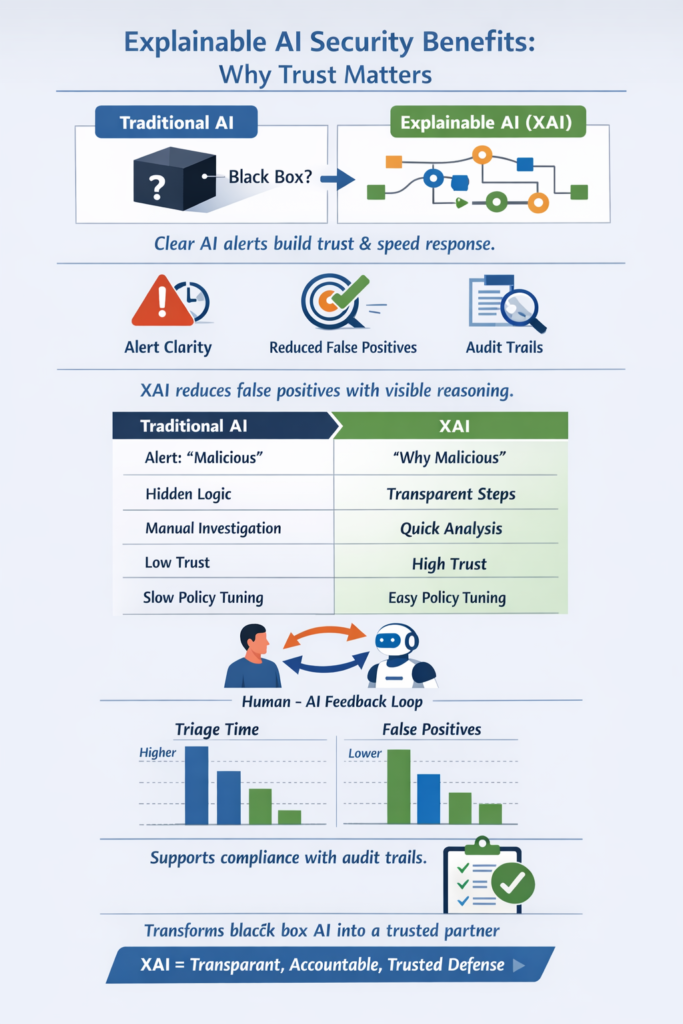
Picture this: an AI system suddenly flags a user’s login as an insider threat. The alert is marked as urgent. Red, loud, demanding attention. But when the analyst clicks in, there’s nothing underneath it that explains why. No hint about what triggered it:
- Was it the login time?
- Was it an unusual device?
- Was it a strange pattern of access?
- Or just a one-off weird action the system didn’t like?
Without that context, the analyst is stuck chasing a machine’s hunch. They scroll logs, cross-check events, ask around, and still feel like they’re guessing. Time slips away while they try to decode a model that doesn’t want to speak their language.
That kind of opacity doesn’t just slow people down, it quietly changes behavior. Over time, teams start to:
- Second-guess AI alerts.
- Treat warnings as background noise.
- Delay action while they look for “real” evidence
This challenge is precisely why supervised learning threat detection plays a critical role by providing models that learn from labeled data, improving accuracy and reducing guesswork in security workflows.
They’re not ignoring the system, they just don’t trust it. It’s like being told to jump, without being told what you’re jumping over.
In the end, they’re flying half-blind, guided by an oracle that gives answers but refuses to show its work.
That gap between output and understanding becomes a real fracture line. And once that trust erodes, the promise of AI, speed, scale, sharper detection, starts to feel distant, almost theoretical, because no one wants to bet a serious decision on a riddle.
From Mystery to Method

Explainable AI changes the entire dynamic. Instead of a simple “malicious” flag, an XAI system might report: “Activity classified as high-risk due to access from a new geolocation (unrecognized IP block) combined with an attempt to download the entire customer database.
For example, [cite real case or generalize to ‘sensitive data’].” Soften to “might report. outside of normal working hours.”
Suddenly, the alert has a story. The analyst immediately understands the severity and the specific actions that triggered the concern.
This clarity is amplified by advances in deep learning for network security, where models like autoencoders and CNNs detect subtle anomalies beyond simple signatures, giving alerts a precise narrative rather than vague flags.
This clarity is transformative. It turns a cryptic warning into a clear starting point for an investigation. The benefits cascade from this single point of understanding.
- Drastically reduced investigation time.
- Higher confidence in taking automated actions.
- Improved ability to fine-tune security policies.
- Easier onboarding for new security personnel.
This methodical approach replaces guesswork with guided response.
| Aspect | Traditional AI Security | Explainable AI Security |
| Alert output | Flags activity as malicious | Explains why activity is malicious |
| Decision logic | Hidden inside the model | Visible and reviewable by analysts |
| Analyst response | Manual investigation from scratch | Faster triage with clear context |
| Trust level | Low, requires verification | Higher, supported by evidence |
| Policy tuning | Difficult and slow | Easier with clear feedback signals |
Building a Foundation of Trust
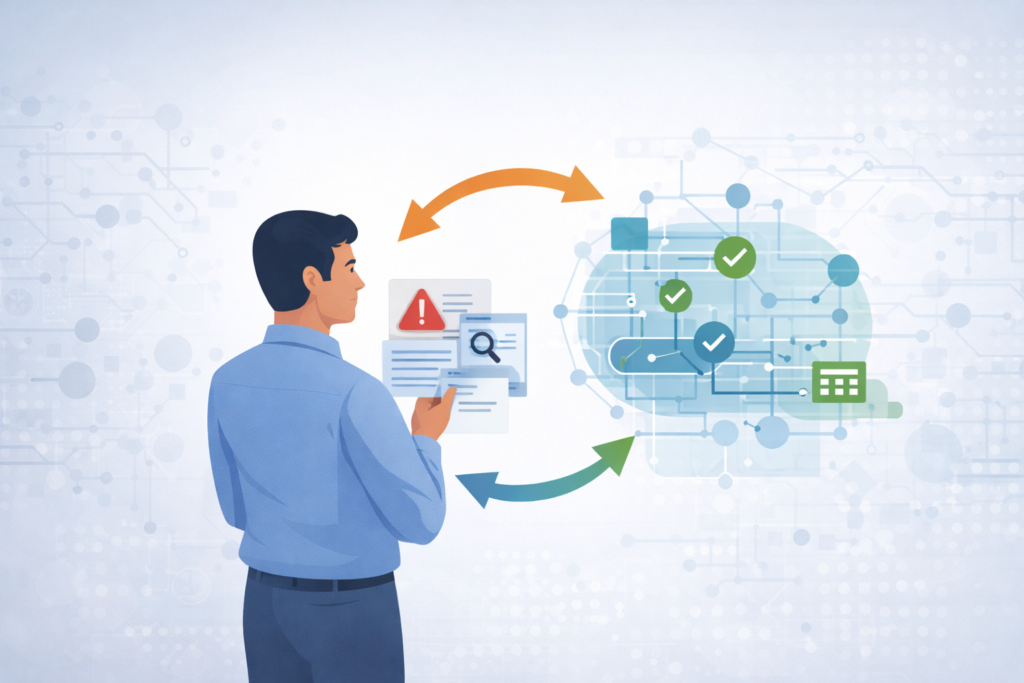
Trust doesn’t magically appear just because an algorithm is complex or highly tuned. It grows slowly, from patterns that make sense and explanations that line up with reality.
When security teams can actually see why an AI flagged something, the mood changes. Instead of staring at a mysterious alert, they can walk through the reasoning:
- What signals were most important?
- How did this compare to past behavior?
- Which specific actions pushed it over the threshold?
Once the “why” is visible, the system stops feeling like an unpredictable black box. It starts to look more like a skilled coworker, one that notices patterns humans might miss, but still has to justify its thinking [1].
That’s where collaboration really begins. An analyst might spot an explanation for a network anomaly and realize it’s missing a new attack signature they just learned about. In that moment, AI is not the final authority. The analyst can:
- Challenge the explanation
- Add context the model doesn’t have
- Feed new patterns or rules back into the system
It turns into a back-and-forth, not a one-way lecture from the machine. The model offers an interpretation, the human tests it against fresh intelligence, and then both adjust.
Over time, this loop does more than just fine-tune alerts. It speeds up how the entire security team responds to new, unfamiliar threats.
Each interaction becomes a kind of shared training session, where both sides, human and AI, walk away a bit sharper. And slowly, alert by alert, that’s how real trust is built [2].
The Operational Advantage

In the daily grind of a Security Operations Center (SOC), XAI is a force multiplier. Consider vulnerability management. An AI might prioritize ten thousand flaws.
An XAI-enhanced system explains its ranking: “A critical CVE with active exploits highest due to active exploitation in the wild, the presence of a public proof-of-concept exploit, and the fact it affects an internet-facing server in our environment.”
This allows the team to focus their limited resources on the fixes that matter most, optimizing their workflow and strengthening their security posture efficiently.
The same principle applies to SOAR platforms, where automated playbooks can be triggered with greater confidence because the reasoning is clear.
Leveraging machine learning & AI in NTD systems helps reduce alert fatigue by focusing on truly critical events, allowing SOC teams to automate routine detections and respond faster to genuine threats.
This transparency extends to compliance and auditing. Regulations like GDPR often include a “right to explanation.” If an AI-driven system denies access or flags a transaction as fraudulent, organizations must be able to justify that decision.
XAI naturally generates the necessary audit trails, turning a potential compliance headache into a straightforward process.
It also makes root-cause analysis after a security incident profoundly more effective. Teams can trace the AI’s detection steps to understand exactly how a breach occurred, leading to more targeted and lasting remediation.
A More Secure Path Forward
Explainable AI in security isn’t a nice-to-have add-on, it’s part of the core defense strategy. When an AI system can show its work, why it flagged a login, why it blocked a connection, why it ranked one alert over another, you’re no longer guessing. You’re investigating with it.
The real shift is moving away from AI as a mysterious oracle and toward AI as a transparent, accountable colleague sitting inside your SOC. That change:
- Gives your analysts context, not just alerts
- Makes tuning and refining detections faster
- Reduces noise and false positives with evidence, not hunches
When AI decisions become visible and explainable, your team is able to:
- Trust or challenge the model’s output with confidence
- Learn from patterns the AI finds across logs, endpoints, and networks
- Document why a decision was made for audits, reports, and regulators
This clarity doesn’t just make people feel better, it directly shapes the way your operations run. You can optimize:
- Incident response playbooks (based on what AI actually saw)
- Triage workflows (who handles what, and when)
- Resource allocation (where you need humans, where AI can safely handle the load)
In the end, you’re building a security infrastructure that’s not only automated, but also resilient and adaptable, because you can see how the system thinks and adjust it as threats evolve.
The future of cybersecurity isn’t just fast and automated, it’s understandable by the humans who carry the responsibility.
Start now. Look at where your current tools act like black boxes, and begin evaluating how explainable AI can bring clarity to your most critical security decisions, so you’re not just reacting to alerts, you’re understanding them.
FAQ
How does explainable ai security help analysts trust daily security decisions?
Explainable ai security uses ai model transparency and ai decision explainability to show why alerts trigger.
Security model interpretability lets analysts review evidence instead of assumptions. This visibility builds trust in ai security and improves ai security trustworthiness.
Clear explanations also support ai accountability in cybersecurity and enable ai decision traceability during investigations, reviews, and audits.
Can xai cybersecurity reduce alert noise and false positives in SOC teams?
XAI cybersecurity reduces noise through explainable threat detection and explainable anomaly detection.
By reducing false positives with xai, teams understand why alerts rank higher using explainable alert prioritization and explainable risk scoring.
Interpretable security analytics and model explainability for soc help analysts act faster and strengthen xai-driven security operations without hiding real threats.
How does explainable AI support compliance, audits, and governance requirements?
Explainable AI supports regulatory compliance ai security by enabling model auditability in security.
Teams use explainable ai governance and ai security governance to document decisions clearly.
Explainable ai incident response and ai security model validation help prove decisions followed policy. Explainable security posture management and security model fairness strengthen accountability during audits.
Where does explainable AI fit into detection and response workflows?
Explainable intrusion detection, explainable malware detection, and explainable endpoint detection improve visibility across systems.
Explainable automated response and explainable soAR workflows show why actions run. Explainable siem analytics and explainable network security models support faster triage.
Human-in-the-loop security ai ensures analysts guide explainable security automation safely and correctly.
How does explainable AI improve threat analysis and future risk planning?
Explainable behavioral analysis and explainable user behavior analytics reveal attacker patterns clearly.
Teams use explainable attack classification, explainable predictive security, and explainable threat hunting to plan ahead.
Xai-based risk assessment supports decisions. Transparent threat intelligence, explainable cloud security analytics, and explainable security dashboards deliver reliable ai-driven security insights.
Turning Transparency into Trusted Defense
Explainable AI closes the trust gap that has long limited automated security. By making decisions transparent, XAI empowers analysts to act faster, reduce false positives, and collaborate confidently with intelligent systems.
It strengthens compliance, improves investigations, and turns AI from a black box into a strategic partner.
As threats grow more complex, security teams that prioritize explainability will build defenses that are smarter, more reliable, and accountable. Join the movement toward explainable, trusted automated defense.
References
- https://www.ibm.com/think/topics/explainable-ai?utm_source=chatgpt.com
- https://www.sciencedirect.com/science/article/pii/S2405959525001584?utm_source=chatgpt.com