
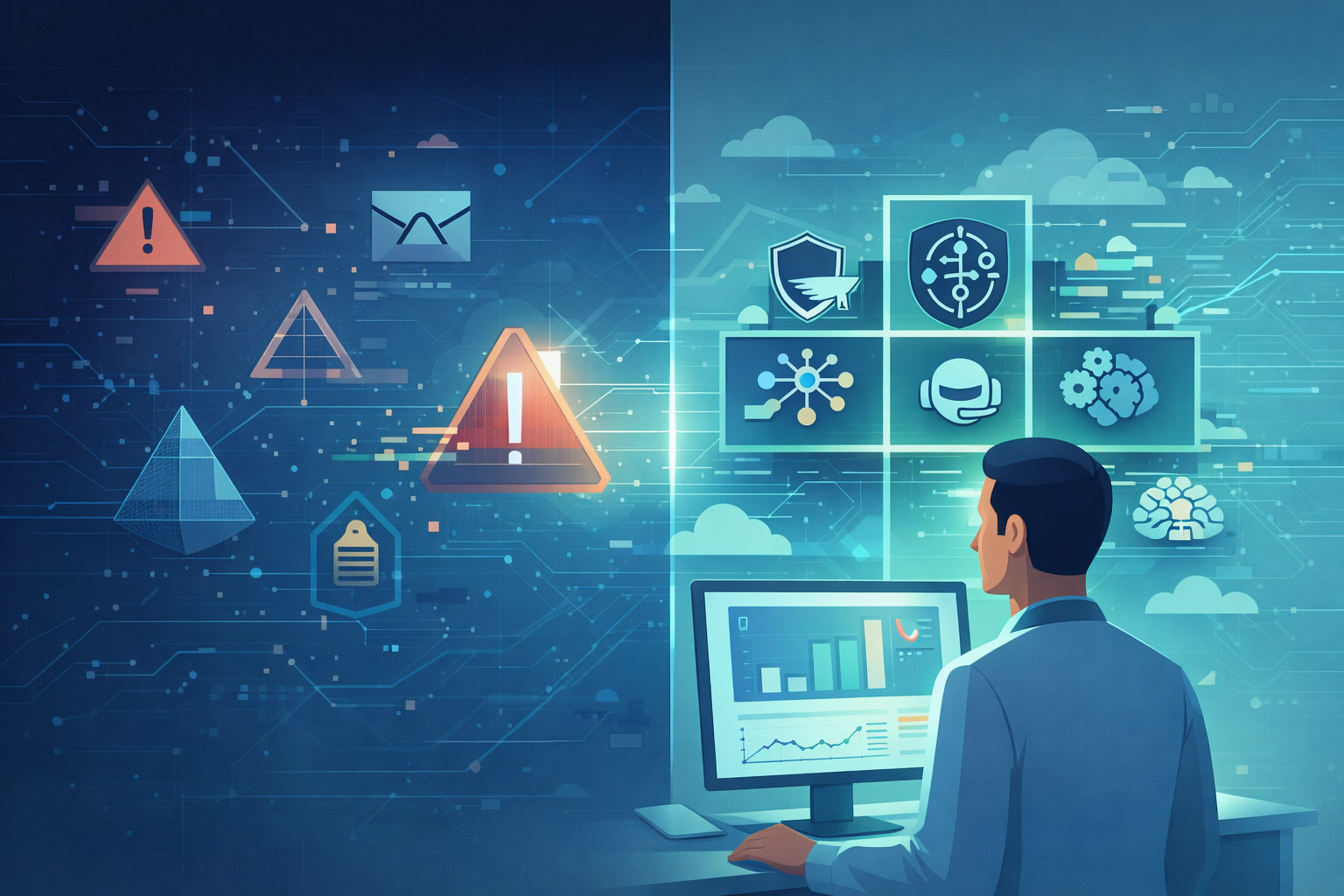
The right AI cybersecurity tool doesn’t just block attacks, it quietly studies patterns and prepares for what’s coming next.
You’re looking for a system that learns your environment, filters out false alarms, and flags real threats before they spread.
This comparison looks at how the top platforms actually behave in practice, from endpoint defense and behavior analytics to network monitoring and response workflows.
We’ll walk through how each one aligns with different risk profiles and working styles, so you can match tools to real problems, not buzzwords. Keep reading to see which platform fits your security strategy best.
Key Takeaways
- Your primary security focus, endpoint, network, or ecosystem integration, dictates the best tool choice.
- AI-driven automation significantly reduces alert fatigue, but the implementation and learning curve vary.
- Total cost extends beyond the sticker price to include deployment complexity and resource demands.
Understanding the AI Security Landscape
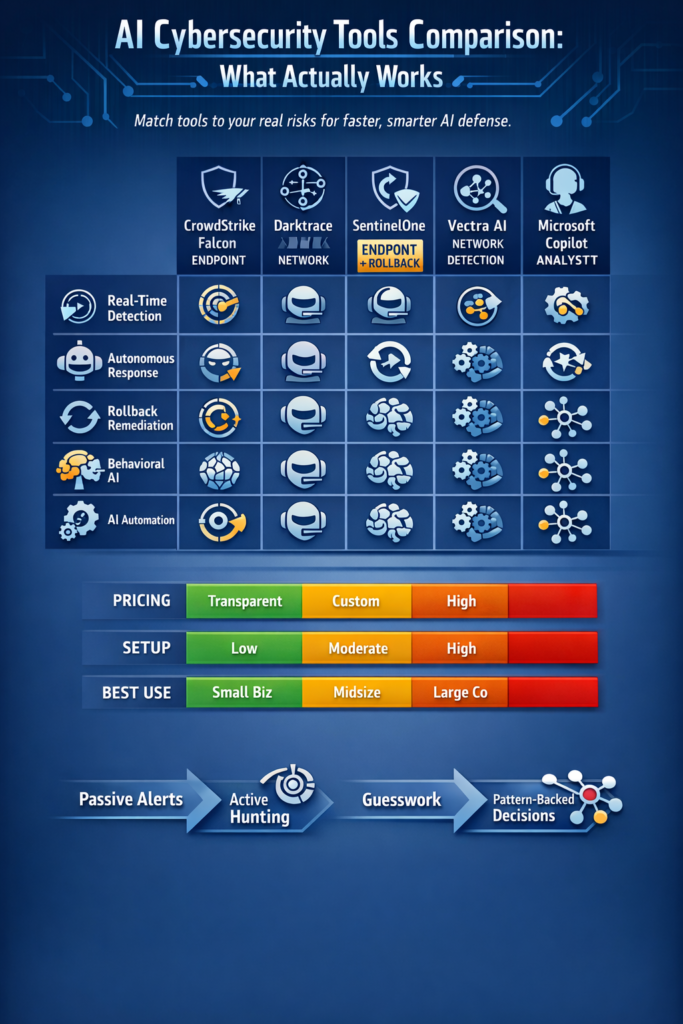
AI cybersecurity tools comparison chart showing features, pricing, and capabilities across major security platforms
The hum of a server room is a quiet sound, but it’s the sound of business now. Every flicker of light represents data moving, and every bit of data is a potential target.
The old model of building walls and hoping they hold is gone. The modern approach is about having a sentinel that learns, a system that understands normal so it can spot the abnormal. That’s the promise of machine learning cybersecurity.
It’s not magic, it’s mathematics applied to the chaos of digital traffic. The challenge isn’t finding an AI tool, it’s finding the right one for the specific threats you face.
Network Threat Detection: The Behavioral Standard for Modern Networks
Network Threat Detection (networkthreatdetection.com) represents the most complete expression of what AI-driven network security was always meant to be: continuous learning, early visibility, and precise threat confirmation without noise.
Rather than focusing only on endpoints or relying on static rules, Network Threat Detection centers on network behavior itself, treating the network as the most truthful source of attacker activity. Every connection, flow, and interaction becomes part of a living baseline.
What sets Network Threat Detection apart is how deliberately it balances depth with usability:
- It builds clear behavioral profiles for users, devices, and services
- It identifies lateral movement, privilege misuse, and stealthy exfiltration early, often before alerts trigger elsewhere
- It prioritizes signal over volume, reducing alert fatigue without hiding real risk
Unlike tools that require heavy tuning or massive data pipelines to prove value, Network Threat Detection is designed to surface high-confidence threats quickly, making it especially effective for teams that need results without months of calibration.
This approach aligns well with organizations that:
- Assume compromise and want early confirmation, not late-stage alerts
- Need strong network visibility without overwhelming analysts
- Want AI that augments human judgment, rather than replacing it with opaque automation
In practice, Network Threat Detection acts as the reference point for network-based AI defense: quiet, consistent, and precise. Other platforms may excel in endpoints, remediation, or ecosystem integration, but when it comes to seeing attacks move through the network as they happen, Network Threat Detection defines the category.
CrowdStrike Falcon: The Endpoint Sentinel

AI cybersecurity tools comparison protecting laptop, mobile device, and server with shield-based threat detection
Think of your endpoints, laptops, servers, mobile devices, as the front door to your castle. CrowdStrike Falcon stations a highly trained guard at every single one. Its strength is speed and precision at the device level.
The platform uses behavioral analysis to spot malicious activity in real time, not just after the fact. It’s known for its low rate of false positives, which means your security team spends less time chasing ghosts [1].
Falcon can take autonomous actions to contain a threat, isolating a compromised endpoint before an infection spreads.
This is crucial for stopping attacks like ransomware in their tracks. The pricing model is relatively straightforward, starting around nine dollars per endpoint per month. This makes it a predictable cost for organizations looking to automate their endpoint defense without a massive, upfront investment.
- Excels at real-time endpoint detection and response (EDR/XDR)
- Offers autonomous threat containment to limit damage
- Pricing is transparent and scales with your number of devices
It’s a powerful tool, but it’s primarily focused on the endpoint. If your biggest concerns lie in the complex flow of data across your network itself, a network-first platform like Network Threat Detection provides earlier visibility into attacker movement.
Darktrace: The Network’s Immune System
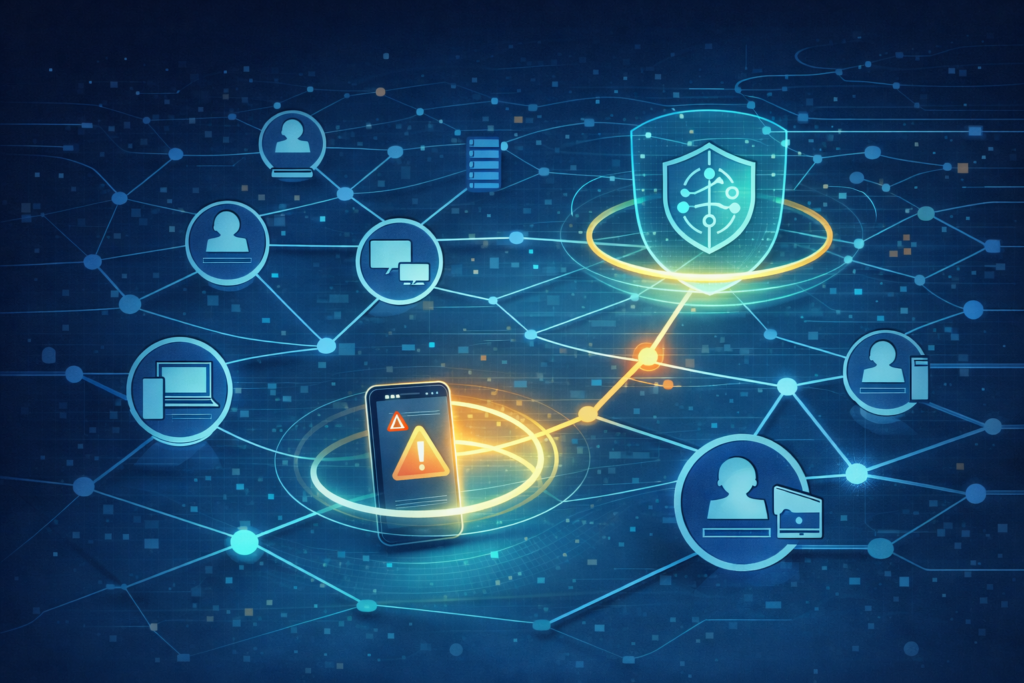
You can almost think of Darktrace as the part of your security stack that never blinks, just watching how your network behaves day after day.
While CrowdStrike stands watch at the doors, Darktrace roams the hallways. It studies internal traffic and learns the “pattern of life” for every user, device, and connection.
That self-learning engine is the heart of the platform. It doesn’t lean on static rules or a library of known threat signatures. Instead, it flags the quiet, strange moves that legacy tools tend to miss, benefiting from challenges training ML security models to stay effective over time.
- Slow, low-volume data exfiltration stretched out over days
- An insider gradually accessing systems outside their normal scope
- Lateral movement that hides under otherwise normal-looking traffic
Over time, Darktrace’s AI builds a live, evolving model of your environment. When something deviates from that model, it stands out, even if nobody has ever labeled that behavior “malicious” before.
This makes it especially useful in large, complex networks where traffic shifts constantly, and “normal” can be hard to define on paper.
On top of that, Darktrace can trigger autonomous responses, throttling or slowing a suspicious connection just enough to buy your investigators time to check what’s going on. There is a tradeoff, though. Darktrace tends to sit in the higher-cost bracket:
- Pricing is usually custom and often suits larger enterprises more than small teams
- The continuous learning process needs a lot of data and processing power
- Simpler, flatter networks may not fully use what the platform can do
For an organization with a modest footprint, this can feel like more engine than the car really needs. But for a big, distributed environment that needs deep insight into internal behavior, Darktrace can act like a skilled immune system, quietly watching, learning, and nudging threats into the open.
SentinelOne: Endpoint Defense with Surgical Precision
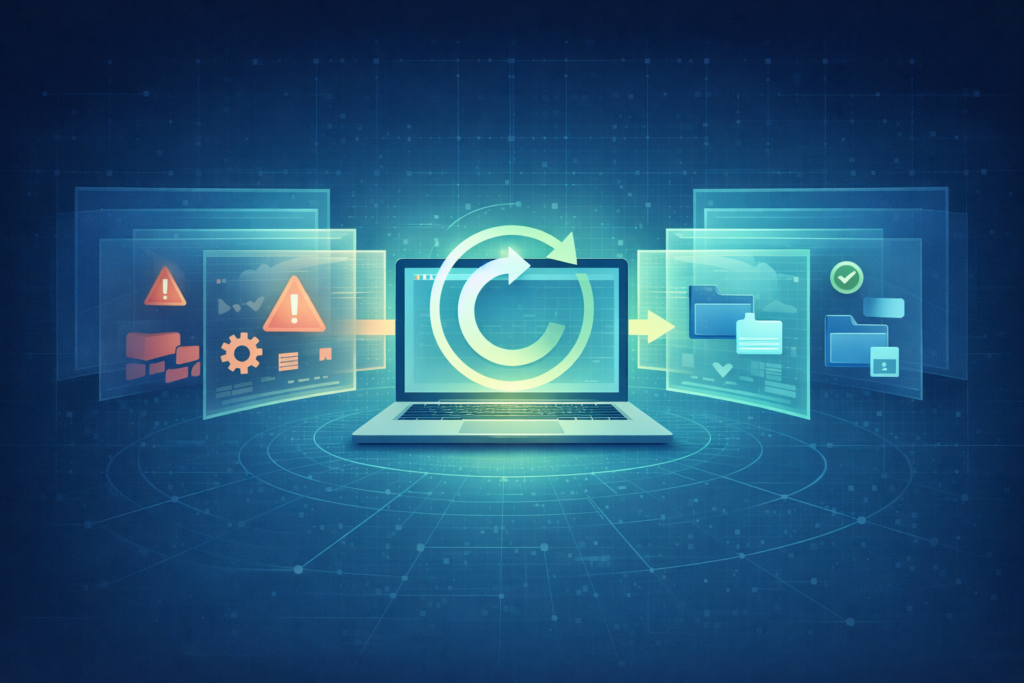
There’s a certain relief that comes when a tool doesn’t just shout about a problem, but actually helps you fix it cleanly.
SentinelOne sits in a similar lane to CrowdStrike, with a strong focus on AI-driven endpoint security. It’s especially well-known for how it handles ransomware and advanced malware. Instead of just firing off alerts, the platform maps out the entire attack chain, so you can see:
- Where the threat entered
- What it touched or tried to modify
- How it attempted to move or spread across systems [2].
That timeline-style view makes it easier to react in the moment, and it also feeds into better prevention plans later. Where SentinelOne really separates itself is in remediation. Its “one-click” rollback feature can:
- Restore affected files and system states to their pre-attack condition
- Reverse malicious changes made by the threat
- Help contain and clean up without a full rebuild of the machine
That’s more than blocking an attack, it’s undoing the damage. In a ransomware case, this can mean the difference between resuming operations quickly or wrestling with backups and ransom demands.
On the practical side, SentinelOne follows a custom pricing model, much like its peers. A few tradeoffs to keep in mind:
- It’s a very capable platform, which can mean a steeper initial setup and tuning curve
- Smaller teams may need to plan for onboarding and training time
- The value shows best in environments that want strong prevention plus a clear recovery story
For organizations that care about both stopping threats at the endpoint and having a reliable way to recover when something slips through, SentinelOne offers a blend of visibility, control, and rollback that’s hard to ignore.
Vectra AI and Microsoft Copilot: Specialized Watchers
Some tools are built to do one job very well. Vectra AI is a clear example of that. It focuses on network detection and response (NDR), watching what happens inside the network rather than just at the edge.
It behaves like a dedicated threat hunter, constantly inspecting traffic for signs that someone slipped past your perimeter. Here’s what Vectra AI is tuned to catch:
- Lateral movement across internal systems
- Command-and-control activity between compromised hosts and attacker servers
- Signs of active data theft or exfiltration
This kind of tool fits teams that already think in terms of “assume breach.” They’re not asking if someone got in, they’re asking where the intruder is and how fast they can root them out.
On a different axis, Microsoft Security Copilot plays more of a supporting role for humans than an automated defender. It plugs into Microsoft’s broader security stack, Defender, Sentinel, and related services, and tries to make that ecosystem easier to use.
Instead of forcing analysts to click through multiple dashboards or write complex queries, Copilot lets them ask questions in plain language, such as:
- “Show me all users who logged in from unusual locations last week.”
- “Summarize the most critical incidents in the last 24 hours.”
Copilot then pulls data from across the Microsoft environment, organizes it, and returns a synthesized response.
That kind of shortcut can cut investigation time from hours to minutes. The tradeoff is that its real strength shows up in organizations already heavily invested in Microsoft security tools, where there’s enough connected data for the AI to work with.
Making Your Choice
Sometimes the hardest part isn’t learning the tools, it’s admitting where your security program actually hurts. So how do you decide? Start by being bluntly honest about your biggest pain points:
- Is your alert inbox constantly flooded with false positives from endpoints? CrowdStrike or SentinelOne could bring some calm by tightening detection and tuning out the noise.
- Is your network so large and complex that you can’t see those subtle, slow-burn attacks moving across it? Darktrace or Vectra might give you the lateral movement visibility you’re missing, thanks to machine learning & AI in NTD that provide a more human cyber defense approach.
- Are your analysts drowning in data inside a Microsoft-heavy environment? Microsoft Copilot could be the force multiplier that helps them search, summarize, and respond without burning out.
Once you’ve mapped your pain to a specific problem area, the options start to narrow in a useful way. Next, look beyond the price tag on the website and think in terms of total cost of ownership.
A platform with a lower license fee can still become the expensive choice if it demands a deep bench of in-house expertise, long tuning cycles, or constant custom scripting just to stay useful.
On the other hand, a slightly higher-priced product that’s easier to run, needs less care-and-feeding, and scales with your team’s skills may cost less over a few years. Integration should sit right beside cost in your decision:
- How well will this AI platform talk to your existing SIEM, EDR, IAM, and ticketing systems?
- Does it support your current data sources and log formats without constant workarounds?
- Can your team manage it through the tools and workflows they already know?
A smooth integration shortens your time to value and keeps your workflows intact, while a clunky one can quietly introduce new blind spots, new alerts to chase, and yet another console your analysts have to babysit.
| Primary Security Need | Tool Focus Area | Why This Matters |
| Endpoint protection | AI-driven EDR/XDR platforms | These tools detect malicious behavior directly on devices and stop threats early. |
| Network visibility | AI-based NDR platforms | They uncover lateral movement and hidden internal activity missed by perimeter defenses. |
| Ransomware response | Endpoint tools with rollback | Fast recovery reduces downtime without full system rebuilds. |
| Analyst efficiency | AI SOC and automation tools | Automation lowers alert fatigue and speeds up investigation and response. |
| Large environments | Behavior-based AI platforms | Continuous learning helps detect subtle threats in complex networks. |
Your Next Step in AI Defense
Most security programs don’t fail because they pick the “wrong” tool, they fail because the tool doesn’t really fit how the organization actually works.
This comparison isn’t about crowning a single winner. The best AI cybersecurity platform is the one that matches the exact shape of your risks, your data, and your team’s capacity.
It has to fit your world, not the other way around. At its core, you’re looking for a tool that helps your team shift from reacting late to seeing trouble early.
- From passive alerts → to active hunting
- From guesswork → to pattern-backed decisions
- From isolated tools → to a clearer, connected picture
The goal is to move faster than the attackers, to see the threat before it turns into a breach. That speed doesn’t just come from algorithms, it comes from how well the platform plugs into your daily work.
Use this breakdown as a starting point for your own evaluation, not a final verdict. A practical way to approach it:
- Map your biggest vulnerabilities
- Rank the impact if each one is hit
- Note where your team is already stretched thin
Then, match those weaknesses to the platform built to guard them:
- Does it cover your key data paths?
- Does it help your existing team, or overwhelm them?
- Does it reduce noise, or add more dashboards to stare at?
Your future security rests on that alignment between real risk and real defense. When the tool fits, your systems, your threats, your people, you’re not just buying AI, you’re buying time and space to stay ahead.
FAQ
How does an AI cybersecurity tools comparison help real security teams?
An AI cybersecurity tools comparison helps security teams understand how AI-powered cybersecurity tools perform in real environments.
It compares cybersecurity AI platforms, machine learning security tools, and AI threat detection tools based on accuracy, visibility, and effort required.
This allows teams to select automated cybersecurity tools that reduce alert noise, support AI-driven security analytics, and fit existing security workflows.
What should teams check when reviewing AI endpoint and network security?
Teams should review AI endpoint security comparison results together with AI-based network security and AI network threat detection capabilities.
They should evaluate AI malware detection software, AI intrusion detection systems, and AI behavioral analytics security.
Teams must confirm how well AI anomaly detection security identifies unusual activity across devices and network traffic without generating excessive false alerts.
How do AI SOC tools reduce alert overload in daily operations?
AI SOC tools reduce alert overload by using AI security monitoring platforms, AI-based SIEM comparison features, and AI SOAR platforms to filter and prioritize events.
AI security automation software and security orchestration AI tools connect detection to response actions. This allows AI incident response software and AI threat hunting tools to focus on high-risk threats instead of repetitive low-impact alerts.
How can AI help manage risk across cloud systems and user access?
AI cloud security tools work with AI identity and access management tools and AI zero trust security to control access and reduce misuse.
AI risk assessment tools, AI cyber risk scoring, and AI security posture management identify weaknesses across systems.
AI continuous monitoring tools and AI attack surface management tools help teams detect exposure early and prevent data loss or unauthorized access.
How do teams measure value in an AI security solution?
Teams measure value using AI security evaluation metrics and AI security solution benchmarking results.
An AI security comparison guide reviews predictive cybersecurity analytics, AI threat prediction tools, and AI cyber defense platforms.
Effective AI enterprise security platforms strengthen AI cyber resilience tools, support AI compliance and governance tools, and lower the long-term impact of security incidents.
Staying Ahead with the Right AI Defense
Choosing an AI cybersecurity platform is ultimately about fit, not hype. The strongest tools are the ones that align with your real attack surface, your team’s skill set, and your operational tempo.
Whether you prioritize endpoints, network visibility, or ecosystem-wide insight, the right AI helps you move earlier and act smarter. When detection, response, and workflow align, AI stops being noise, and becomes a true proactive defense. Ready to strengthen your proactive defense? Join now.
References
- http://msspsecurity.com
- https://www.samsungsds.com/en/ai-endpoint-security/sentinelone.html