

Network flow data gives you broad visibility across your environment, but it was never built to tell you the full security story.
It strips away payloads, hides application context, and often relies on sampling that can quietly erase the very traces you care about most.
That means targeted attacks, low-and-slow movements, and encrypted abuse can slip past, even when the flows look “normal” on the surface.
None of this makes flow data useless, it just means you need to see its limits clearly and fill the gaps with the right signals. Keep reading to see where flow data falls short, and what to do about it.
Key Takeaway
- Flow data completely misses the content of network communications.
- Sampling techniques often fail to capture stealthy, short-lived attacks.
- Encrypted traffic renders flow records nearly useless for deep analysis.
The Inherent Gaps in Flow-Based Visibility
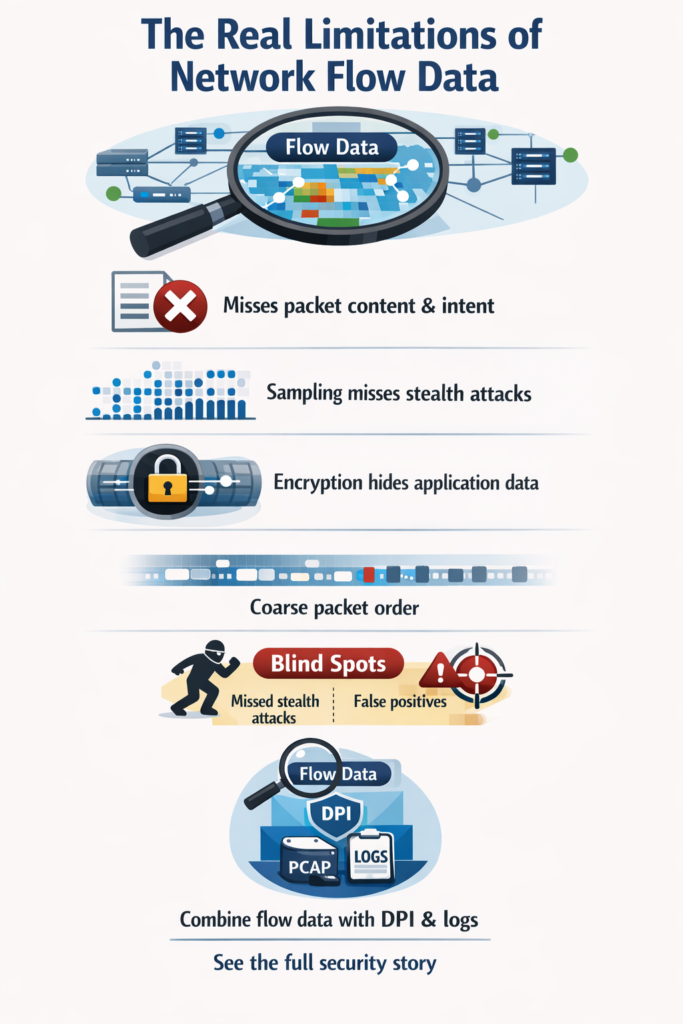
You watch the dashboards, the graphs of bytes and packets flowing between IP addresses. It looks like control, a bird’s-eye view of your digital landscape.
But that view is an abstraction, a map drawn from selective landmarks. The reality is that network flow data, for all its utility, is a tool with profound limitations. It tells you a conversation happened, but not what was said.
The core of the problem is payload invisibility. Flow records summarize the “who,” “where,” and “how much” of network traffic.
They capture source and destination IPs, ports, protocols, and byte counts. What they deliberately exclude is the “what”, the actual data inside the packets.
This is a design feature for scalability, but a security flaw for detection. You can see a server exchanging gigabytes with an external IP, but you cannot tell if it’s a legitimate software update or a massive data exfiltration.
This challenge is why understanding the nuances of network flow analysis becomes essential, as it helps identify patterns beyond raw volume.
The malicious command, the stolen credentials, the malware signature, they all reside in the payload, a realm flow data cannot enter.
This limitation is compounded by the widespread use of sampling. On high-speed links, routers and switches often cannot process every single packet.
To manage resource overhead, they sample traffic, perhaps recording details from only one in every thousand packets. This statistical approach works for traffic engineering but fails for security.
A stealthy port scan, a low-and-slow command-and-control beacon, a fleeting reconnaissance attempt, these short-lived flows are likely to be missed entirely by random sampling. Your visibility system becomes a sieve, and the most subtle threats slip right through.
- Content Blindness: Inability to inspect application-layer commands or data.
- Stealth Threat Loss: Sampling misses brief, low-volume malicious activity.
- Encrypted Opacity: TLS and QUIC traffic hides even basic protocol details.
The aggregation of packets into flows also means a loss of precise timing and sequence. A flow record might represent a five-minute conversation as a single entity.
It tells you the total duration and bytes transferred, but not the exact order of packets or the milliseconds between them.
Reconstructing the precise timeline of a multi-stage attack, the initial exploit, the lateral movement, the data theft, becomes a challenge of inference rather than observation. When every second counts, this coarse time resolution blurs the narrative of an incident.
| Flow Data Limitation | What Is Missing | Security Impact |
| Lack of packet payload visibility | Application commands and data content | Inability to confirm data exfiltration, malware activity, or credential theft |
| Sampling-based collection | Complete visibility of short-lived traffic | Stealth scans, low-and-slow attacks, and brief beacons may go undetected |
| Flow aggregation | Precise packet order and timing | Difficult reconstruction of multi-stage attacks and event timelines |
| Encrypted traffic opacity | Application and protocol context | Legitimate and malicious encrypted sessions appear similar |
| Metadata-only analysis | User intent and command semantics | Increased false positives and weak threat attribution |
When Encryption Hides the Evidence
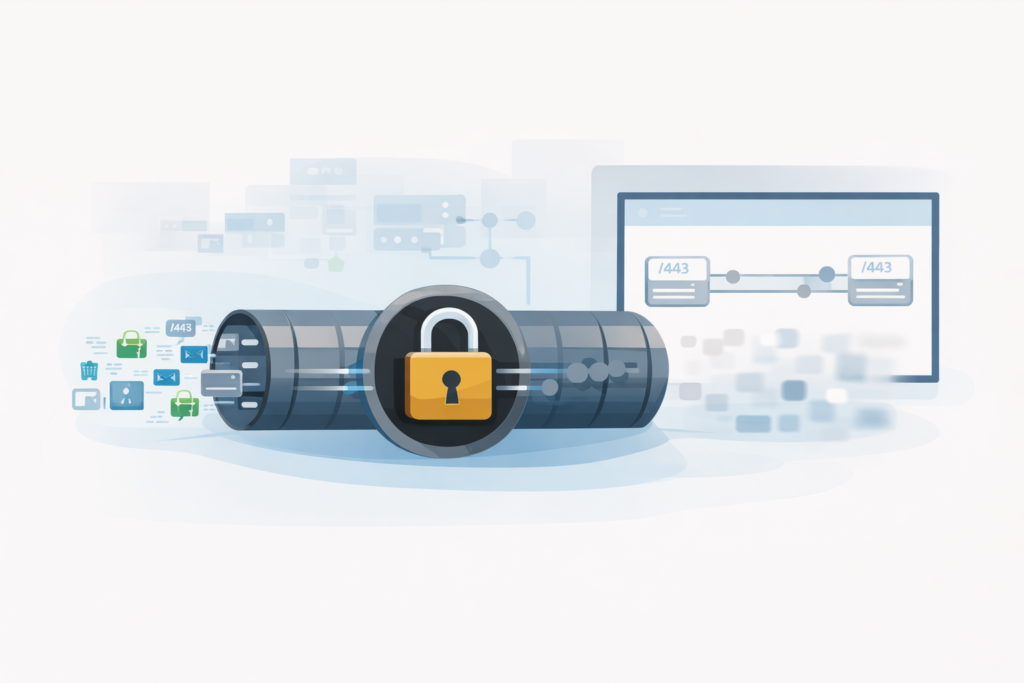
Modern networks are increasingly encrypted. This is good for privacy and terrible for flow-based security analysis. When traffic is wrapped in TLS or QUIC, the flow record sees little more than an encrypted stream between two IPs on port 443.
The flow data for a user browsing though subtle metadata patterns (e.g., packet sizes, timing) can sometimes differentiate via ML a legitimate website and for malware communicating with its controller can be virtually identical.
The encryption that protects your users also protects your adversaries, creating a major blind spot where anomaly detection struggles without additional context, which is why bypassing DPI techniques are increasingly relevant for attackers to evade detection.
The resource demands of flow data itself can become a limitation. In large, busy networks, the volume of flow records generated can be staggering. Collectors and analysis platforms can be overwhelmed, leading to delayed processing or even record loss during peak traffic.
This creates a window of vulnerability where real-time detection is impossible. Furthermore, incomplete deployment of flow exporters, common in complex cloud or hybrid environments, creates coverage gaps.
East-west traffic between virtual machines in a cloud VPC might be completely invisible if flow collection isn’t configured on the virtual network fabric.
The reliance on heuristics and statistical inference introduces another layer of uncertainty. Because flow data lacks concrete evidence from packet contents, security alerts are often based on behavioral anomalies, unusual traffic volume, communication with suspicious countries, or odd port usage.
These can lead to false positives, draining analyst time and reducing confidence in the monitoring system. Explaining why an alert fired based solely on metadata is difficult, making incident response slower and less certain.
Building a More Complete Picture
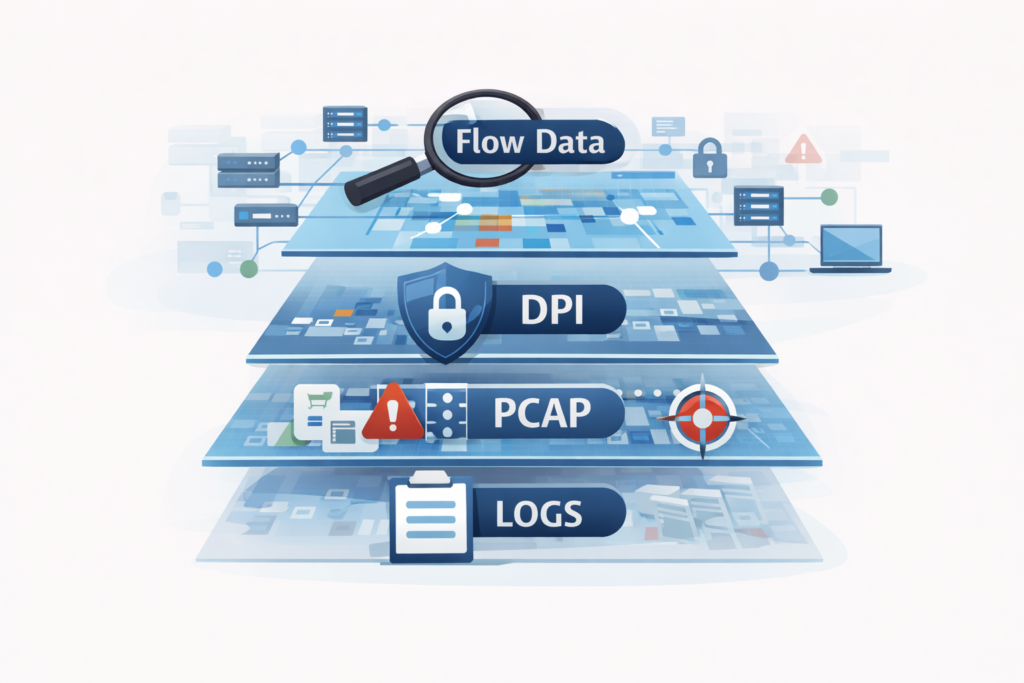
So, what can you do? The answer is not to discard flow data but to recognize its role as one piece of a larger puzzle. It excels at providing a high-level overview of network behavior and detecting large-scale volumetric attacks like DDoS. Its strength is breadth, not depth.
To overcome its limitations, you must layer it with other technologies. Deep Packet Inspection (DPI) is the direct counter to payload invisibility.
DPI tools examine the actual content of packets, allowing for signature-based malware detection and content analysis. The tradeoff is significant performance overhead, making it impractical for entire high-speed networks.
This is why understanding the role of DPI in next-generation firewalls is crucial for building a layered security approach.
A strategic approach is to use DPI on critical network segments, like data center egress points, while relying on flow data for broader network surveillance.
To address sampling blind spots, you can adjust sampling rates on exporters where possible, accepting a higher resource cost for better fidelity.
For the most critical assets, a full packet capture solution can record every packet for a limited time, providing a definitive record for forensic investigation after an incident is suspected.
Correlation is also key. By combining flow data with logs from endpoints, firewalls, and authentication systems, you can build a more convincing story. That strange flow from a server might be explained by a scheduled backup job logged on the server itself.
- Strategic DPI: Deploy deep packet inspection on critical network choke points.
- Log Correlation: Integrate flow data with endpoint and system logs for context.
- Targeted Full Capture: Use packet capture for short-term forensic analysis on key assets [1].
For encrypted traffic, TLS inspection can be a solution, though it raises privacy and legal considerations.
Alternatively, enriching flow data with external threat intelligence feeds can help. If a flow is detected communicating with an IP known to be associated with malware campaigns, that context elevates the alert from “unusual” to “malicious.” Tools exist that can automate this correlation, adding a layer of intelligence to raw metadata.
Acknowledging the Limits of Flow Data

Network flow data gives you a map, but it’s a map with blank areas, rough borders, and a lot of missing detail. It scales well, it’s efficient, and it’s great for tracking traffic patterns over time.
You can see who’s talking to whom, when, and how much. You can catch obvious oddities: sudden spikes, unusual connections, strange new destinations [2].
But that same efficiency comes from what flow data chooses not to see. It skips the content of the communication. It glosses over very short-lived connections that blink in and out. It can’t pierce the veil of encryption; it just watches the outside of the tunnel and guesses from there.
So a serious security strategy has to be honest about those limits from the start. Flow data works best when we treat it as a wide-angle lens, not a microscope.
To actually build that balance in practice, teams usually pair flow data with more detailed tools, such as:
- Packet capture for payload-level inspection
- IDS/IPS for signature and behavior detection
- Endpoint telemetry for process and user context
- DNS and HTTP logs for application-level detail
Flow data gives the big picture, those tools fill in the gaps. In the end, your visibility is only as strong as your worst blind spot, not your best dashboard.
The job isn’t to pretend those blind spots don’t exist, it’s to make them smaller, sharper, and well understood, so when something slips into the gray areas, you at least know where to look, and how worried you should be.
FAQ
Why do network flows miss real threats despite showing traffic volume?
Network flows miss real threats because flow metadata limitations prevent visibility into intent. The lack of packet payload visibility and the absence of deep packet inspection mean flows only show who communicated, not what was exchanged.
This metadata-only analysis reduces forensic value, limits threat attribution, and increases behavioral inference uncertainty, especially when attackers deliberately mimic normal traffic patterns.
How does encryption reduce the security value of flow data?
Encryption reduces flow data value because encrypted traffic analysis limits hide application behavior. TLS traffic blindness and QUIC flow analysis challenges obscure protocol details, while encrypted DNS visibility gaps and VPN traffic opacity remove context.
This privacy-preserving but opaque data creates a lack of intent visibility and weak command-and-control confirmation without relying on complementary logs or inspection methods.
Why do sampling and aggregation cause missed or misleading detections?
Sampling and aggregation cause missed detections because sampled flow accuracy issues and sFlow sampling bias drop short-lived signals.
High-speed link sampling error, flow aggregation distortion, and coarse time resolution obscure timing and sequence. These factors reduce accuracy for small flows, cause microburst traffic loss, and lead to false positives in anomaly detection.
What operational problems affect flow accuracy at scale?
Flow accuracy degrades at scale due to exporter resource overhead, IPFIX export overhead, and collector scalability limits. Delayed flow export, flow record loss under load, and clock drift in flow records reduce reliability.
NetFlow granularity constraints, exporter vendor inconsistencies, and template compatibility issues increase correlation complexity and lower SOC confidence during investigations.
Why can’t flow data explain who did what during an attack?
Flow data cannot fully explain attacks because of loss of application context and limited user attribution.
NAT obscured endpoints, asymmetric routing effects, and inability to reconstruct sessions break attribution chains.
Incomplete session coverage, flow stitching complexity, cloud traffic abstraction, and container traffic visibility gaps create east-west traffic blind spots and hinder accurate incident reconstruction
Seeing Beyond the Blind Spots of Flow Data
Network flow data is a powerful foundation for visibility, but it was never meant to stand alone. Its blind spots, missing payloads, sampling loss, and encrypted opacity, create gaps attackers actively exploit.
Treating flow data as a complete security solution invites false confidence. Real resilience comes from layering depth onto breadth, combining flows with packet inspection, endpoint context, and correlated logs.
When you understand what flow data cannot see, you can design defenses that see enough to matter. Join the Network Threat Detection community and start building visibility that goes beyond flow data.
References
- https://www.sciencedirect.com/science/article/abs/pii/S0167404822004102
- https://onlinelibrary.wiley.com/doi/10.1111/cgf.14198