
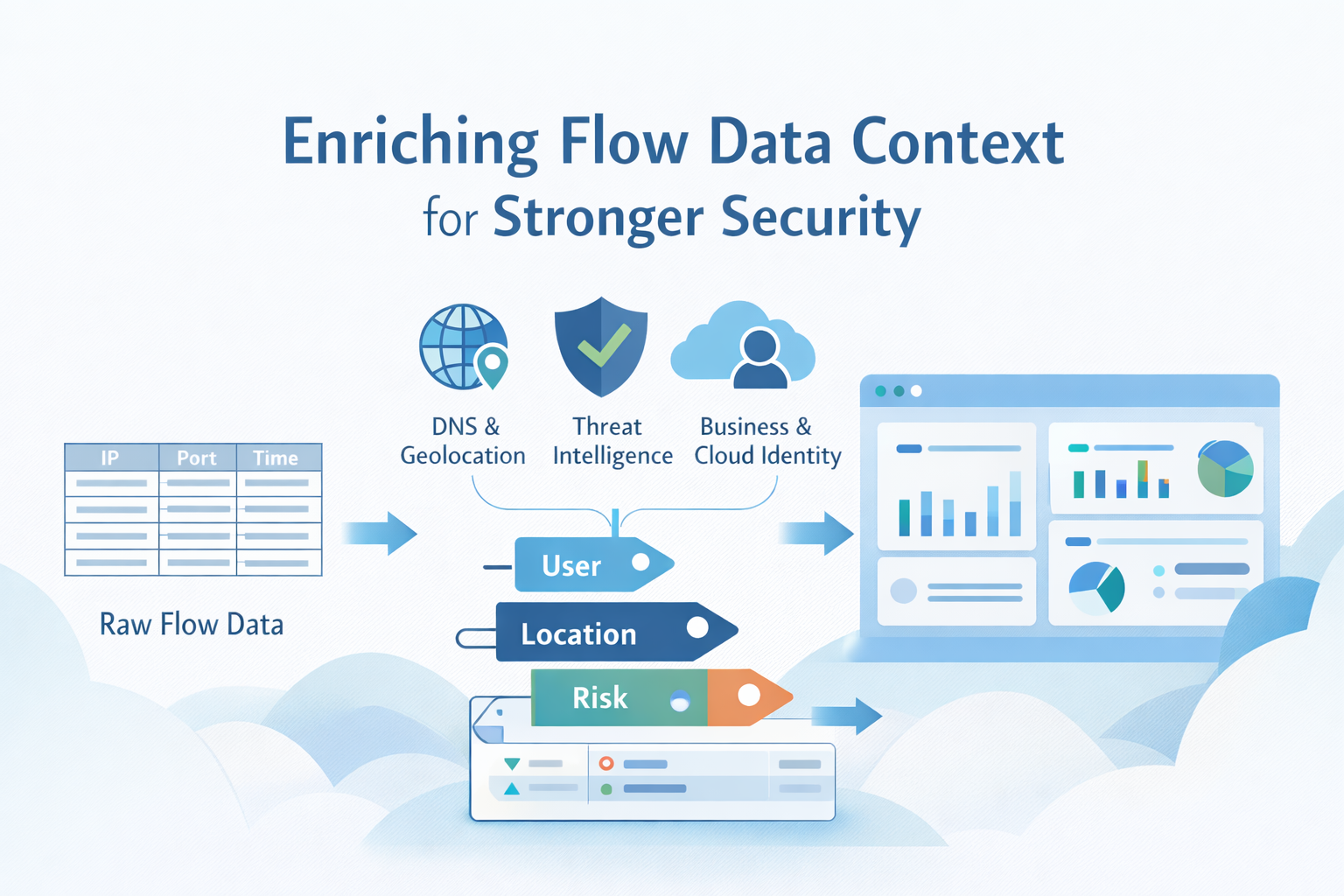
Enriching flow data means turning bare network logs into context-rich records that actually explain what happened, who was involved, and why it matters.
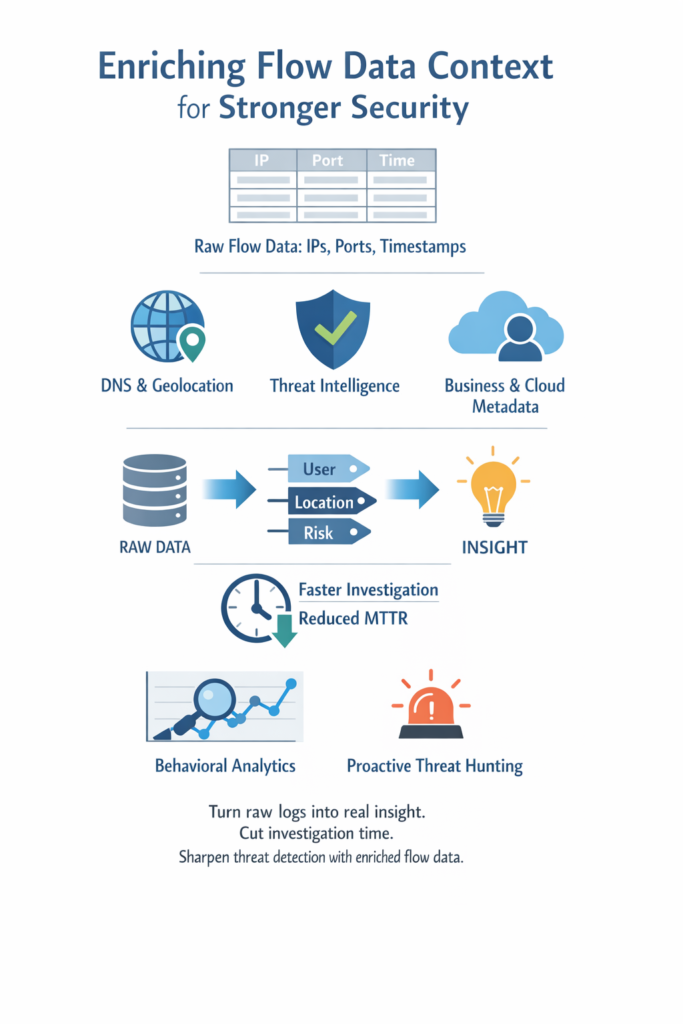
Raw flow data only gives you the skeleton: IPs, ports, timestamps. Useful, but blind. This limitation of network flow data means that without enrichment, security teams often face incomplete pictures that hinder rapid response.
When you add metadata like device identity, user information, threat intel, app context, and geo data, those same rows start to read more like an investigation report than a spreadsheet.
That’s when security and operations teams stop guessing and start knowing. If you want your logs to tell real stories instead of half-truths, keep reading.
Key Takeaways
- Raw flow data is blind to identity and intent, forcing manual, time-consuming cross-references that slow down critical security responses.
- Effective enrichment layers in geolocation, threat intel, and business metadata directly onto flow records in real-time, creating a shared source of truth.
- This transformed data fuels behavioral analytics and automation, shifting your team from reactive log-checking to proactive threat hunting.
Why Your Raw Flow Data Is Telling Half the Story
You’ve seen it before. An alert fires. Some internal IP is talking to an external one on a weird port. The first thirty minutes are a scavenger hunt across different tools.
You ping the system owner. You check a DNS log. Maybe you pull up a CMDB, if you’re lucky and it’s updated. All that time, the clock is ticking.
The problem with the classic five-tuple, source IP, destination IP, source port, destination port, protocol, isn’t that it’s wrong. It’s that it’s incomplete.
This fundamental aspect of network flow analysis underlines why raw flow data alone cannot provide sufficient insight. It’s like describing a crime scene by only listing the objects present, without saying who they belong to or why they’re there.
This manual cross-referencing is the hidden tax on your security team’s time. It inflates your Mean Time to Remediation (MTTR) because context is scattered, living in tribal knowledge or separate databases.
In a real incident, those minutes spent context-switching between screens are minutes a threat actor uses to move laterally, to exfiltrate data, to dig in deeper. The dream isn’t more data, it’s smarter data. Data that arrives for analysis already wearing its nametag.
The Essential Layers of Context
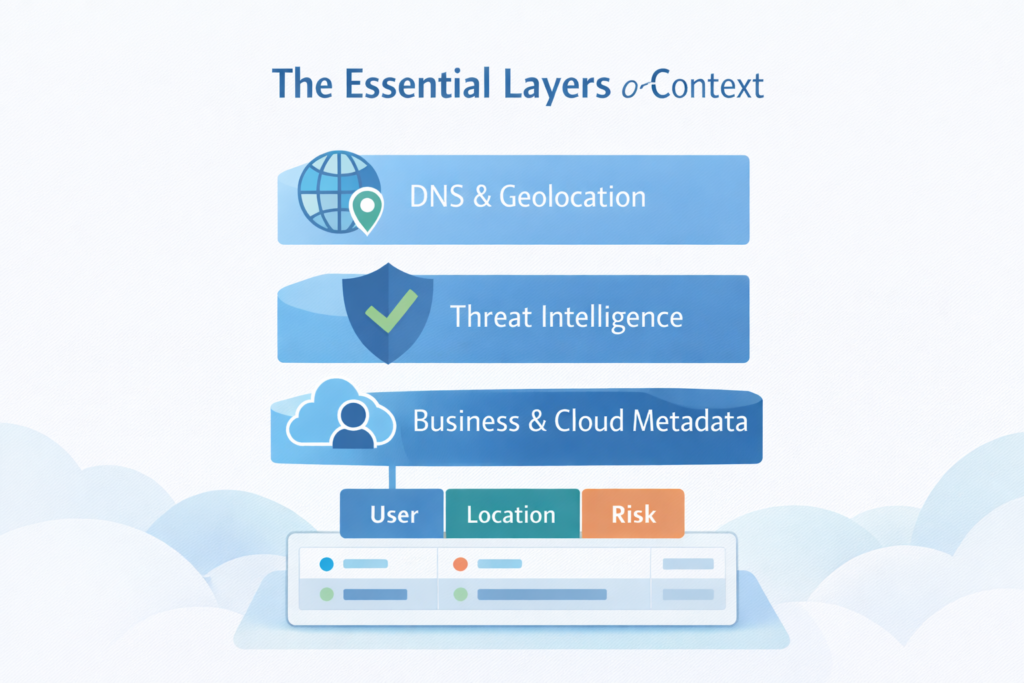
So what do you stitch onto those bare flow records to make them talk? The first layer is about place and name. Geolocation and DNS enrichment. Mapping an IP to a country or city isn’t just for pretty maps on a dashboard. It’s a first-pass filter.
Traffic from an employee’s laptop suddenly appearing to originate in a country where you have no business? That’s a flag, instantly. Similarly, resolving an IP to malicious-domain.xyz is infinitely more actionable than seeing 185.163.45.22 [1].
- Prioritize real-time or passive DNS lookups at ingestion to minimize latency.
- Use passive DNS databases to see historical resolutions for an IP.
- Correlate internal IPs with DHCP logs to pinpoint specific devices.
The second layer is threat intelligence. This is where you move from “what is it?” to “is it bad?”. By integrating curated feeds of known malicious IPs, domains, and URLs, you can tag flows with a risk score as they stream in.
A connection to a command-and-control server isn’t just an outbound request anymore, it’s a high-severity security event. This shifts your team’s workflow. They’re not starting from zero, they’re starting with a prioritized list of “likely bad” traffic that needs immediate attention.
The third, and perhaps most neglected layer, is business and cloud metadata. In a modern network, an IP address is a temporary thing.
It could be a Kubernetes pod that existed for three minutes, an AWS EC2 instance in us-west-2, or a user in the Finance group connecting via VPN.
Enriching flows with this context, cloud region, resource tags, user identity, department, links technical events directly to business impact. That anomalous spike in traffic isn’t just 10.2.2.15 to 10.10.5.7, it’s Payroll-App-Pod talking to Customer-Database-Prod. The story writes itself.
| Enrichment Layer | What It Adds | Why It Matters |
| DNS & Geolocation Enrichment | Domain names, country, region | Helps identify unusual or risky destinations |
| Threat Intelligence Enrichment | Reputation scores, indicators of compromise | Flags known malicious traffic in real time |
| Business & Cloud Metadata | User identity, department, resource tags, cloud region | Links technical traffic to real business impact |
Building the Enrichment Pipeline
Credits: Confluent
I’ve always believed the real magic in a network pipeline doesn’t happen at the dashboard. It happens earlier, usually somewhere nobody notices.
The key is enrichment at ingestion. If you wait, the time-sensitive value fades. Collectors should ingest NetFlow, sFlow, or IPFIX and immediately start correlation so they can:
- Match IPs to GeoIP
- Query threat intel for risk
- Check cloud or asset inventory.
This approach leverages modern network flow analysis techniques to provide near real-time visibility and stronger security insight.
Each flow record should land already carrying context, not show up bare and confusing. This requires careful matching logic, especially for user identity.
A directory may list JSmith while the endpoint reports jsmith-laptop. Fuzzy matching helps, but validation matters just as much. Bad enrichment, wrong geo, wrong user, creates noise that drags analysts in circles.
Once enriched, data needs a searchable home, not cold storage. Feed it into something like Elasticsearch with fast indexing, flexible schema, and strong filtering and aggregation support.
That’s when questions evolve from “show me traffic from this IP” to “show me encrypted engineering traffic talking to high-risk external IPs in the last hour.” That’s when context starts to feel like x-ray vision.
From Reactive Alerts to Proactive Hunting
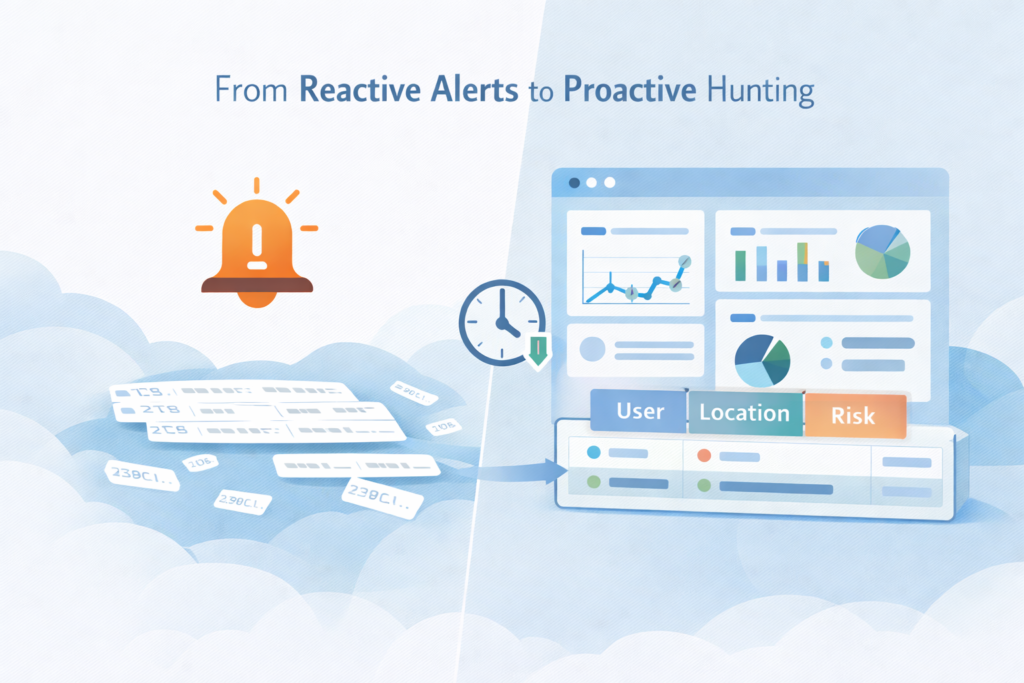
The real turning point in a security program happens when teams stop waiting for alerts and start actively hunting.
Enriched flow data finally makes meaningful baselines possible, by user, application, or location. Machine learning models gain real depth, so abnormal behavior stands out in context instead of looking like just another odd log entry. Analysts can now ask sharper questions, such as:
- Which accounts are expanding their access over time?
- Which hosts talk to low-reputation IPs on unusual ports?
- Which departments show new data-egress trends? [2]
Enriched flows also integrate cleanly into SOAR platforms. A flow tagged with high-risk intel and tied to a specific owner can:
- Trigger automated containment
- Quarantine or segment a host
- Open an incident with full context
Much of this can happen before anyone logs in for the day. Layered enrichment, user, asset, geo, threat intel, builds enough confidence for automation to act. In the end, the pipeline doesn’t just collect data. It frees your team to hunt with purpose..
The New Clarity in Your Network
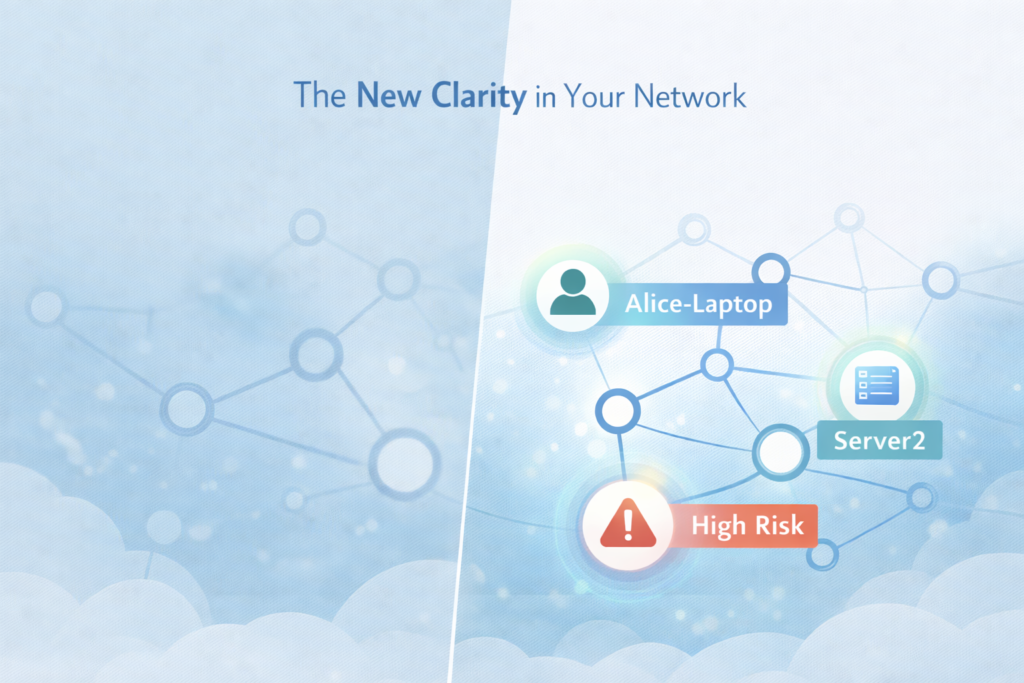
Enriching flow data context isn’t a luxury project for overstaffed teams. It’s the necessary evolution of network visibility in a world where IP addresses are ephemeral and threats are sophisticated.
It replaces the exhausting, error-prone manual cross-reference with a unified, automated narrative. The numbers in your logs finally start speaking a language everyone understands, linking actions to identities, traffic to business services, and anomalies to clear risks.
The fog of war on your network lifts. You’re left not with more alerts, but with better ones. Start by picking one source of context, geolocation or DNS, and weave it into your pipeline. See how the story changes.
FAQ
How does enriching flow data context improve network flow analysis for security teams?
Enriching flow data context converts raw logs into enriched flow records containing network traffic metadata, user identity mapping, and geolocation lookup.
Flow metadata enrichment and IPFIX data enrichment add meaning to each session, so analysts understand who communicated, what was accessed, and where it occurred.
This improves anomaly-based detection, lateral movement detection, and threat hunting with flows while reducing investigation time and guesswork.
What types of metadata are typically added during flow metadata enrichment?
Flow metadata enrichment adds multiple layers such as DNS enrichment, application layer attribution, device fingerprinting, and autonomous system mapping.
Cloud flow analytics can also include asset inventory correlation, identity-to-IP mapping, and security data normalization.
These enriched flow records support context-aware flow monitoring, improve network visibility enhancement, and help analysts correlate flows with logs during investigations with greater accuracy and confidence.
How do enriched flow records support proactive security and zero trust visibility?
When real-time enrichment feeds a flow telemetry pipeline, organizations can baseline network behavior and perform behavioral traffic profiling over time. This enables zero trust visibility, microsegmentation telemetry, and east-west traffic visibility.
Combined with policy compliance monitoring, security posture assessment, and network risk scoring, enriched flow dashboards provide contextual threat detection instead of reactive log review, resulting in stronger, data-driven security decisions.
Can network flow enrichment help detect stealthy or slow-moving security threats?
Yes. Telemetry enrichment and normalization improve the ability to detect subtle behaviors such as beaconing pattern detection, command-and-control traffic, and data loss detection.
With session correlation, encrypted traffic insight, and machine learning traffic analysis, organizations strengthen flow-based security analytics.
Time-series network metrics also reveal unusual service dependency mapping or shadow IT detection, which supports MDR network telemetry and SOC analytics workflows.
What should security teams consider when building a flow telemetry enrichment pipeline?
Security teams should plan for collector pipeline processing, metadata stitching, and event context enrichment to ensure reliable enrichment at scale.
Protocol classification, flow record tagging, and sFlow or NetFlow context data support SIEM data enrichment and big data security analytics.
Performance telemetry correlation and QoS monitoring insights help tune exporters, creating operational network intelligence that supports network anomaly correlation and adaptive traffic modeling.
From Raw Data to Real Security Insight
By enriching flow data at ingestion, you replace guesswork with immediate, trustworthy context. Each record arrives already linked to users, assets, locations, and risk, cutting investigation time and enabling proactive hunting rather than reactive triage.
With stronger signals feeding automation and analytics, your team can focus on real threats, not data wrangling. Start small, layer context over time, and watch your network telemetry evolve from raw numbers into an actionable security narrative for your organization.
Ready to take the next step? See how automated enrichment can transform your security operations.
References
- https://coralogix.com/docs/user-guides/data-transformation/enrichments/geo-enrichment/
- https://ipa.pages.cms.hu-berlin.de/lwda-pdf/presentation_ring.pdf