

AI-powered threat intelligence analysis shifts security from reacting after damage to predicting and blocking threats before they land.
By using machine learning to scan billions of signals and security events, it spots hidden patterns that human teams would miss or only catch too late.
It doesn’t just flag known malware or suspicious IPs, it learns attacker behavior over time, so your defenses adapt as their tactics change.
Each attempted intrusion becomes data that sharpens your shield instead of just another fire to put out. Keep reading to see how this works in practice and how to apply it in your own environment.
Key Takeaways
- AI moves threat intelligence from reactive detection to proactive prediction.
- It correlates weak signals across massive data sets to identify hidden campaigns.
- Continuous learning automates response and reduces analyst fatigue.
The Challenge: Information Overload in a Reactive World
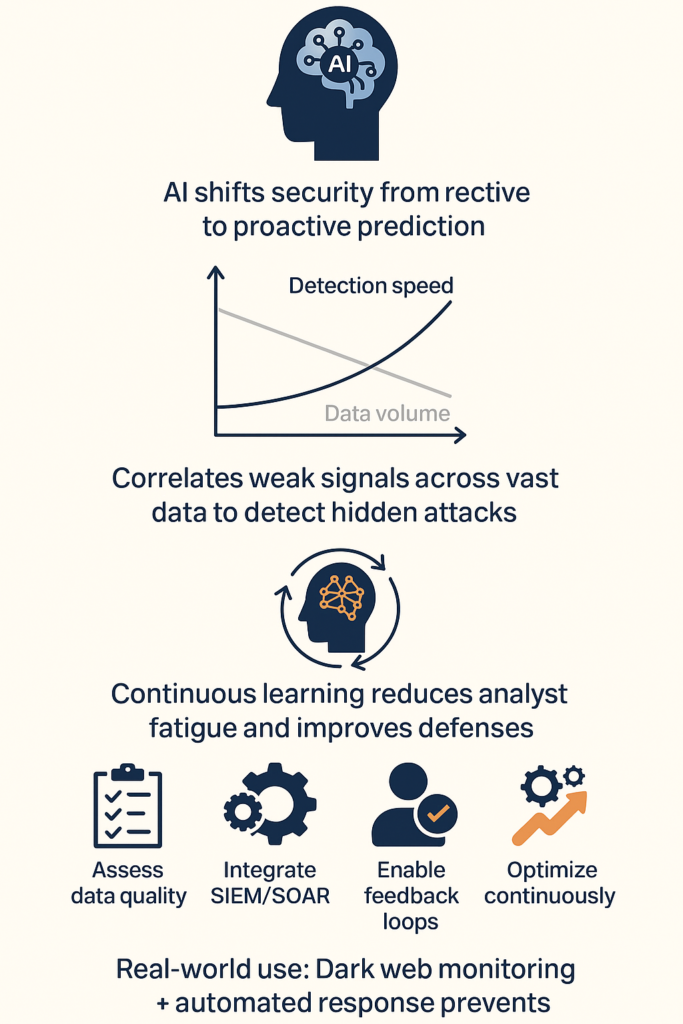
Traditional security methods are drowning. The volume of data generated by network logs, endpoints, and cloud services is simply too vast for any human team to process effectively.
They rely on known indicators of compromise, or IOCs, which are like a list of known criminal license plates. It’s a reactive approach, useful only after an attack pattern has been identified and shared.
This leaves a critical gap. Sophisticated attackers constantly change their tools and techniques, their TTPs. By the time a new IOC is added to a list, the attacker has already moved on to a new method.
Your organization is left vulnerable to these emerging, unknown threats, always one step behind. The financial and reputational cost of this lag can be catastrophic.
- Struggles with data volume and speed
- Focuses on known threats, missing novel attacks
- Creates alert fatigue, causing analysts to miss real dangers [1]
How AI Sees What Humans Miss
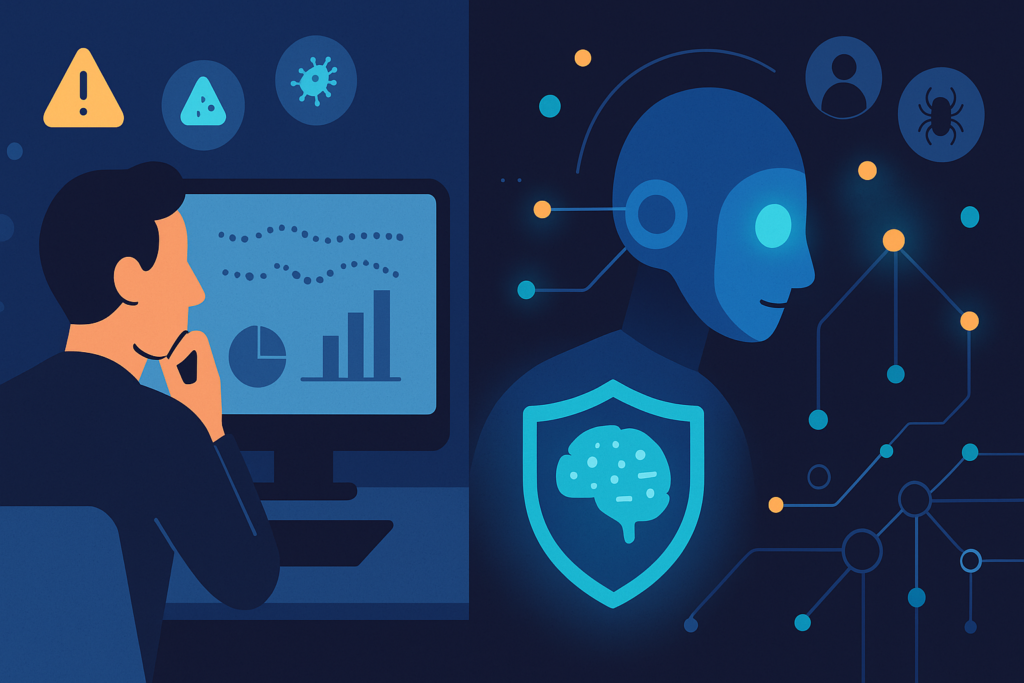
The core of AI-powered analysis is correlation. It looks at weak signals that would be meaningless in isolation.
A low-volume port scan from a new IP address, a rare process starting on a single endpoint, a domain registered just hours ago. Alone, these events might be dismissed as noise. But an AI model, trained on historical attack data, can connect them.
It recognizes the pattern of a reconnaissance phase. This happens in real-time, correlating data from firewalls, honeypots, and dark web monitoring.
Natural language processing, or NLP, scans hacker forum chatter, extracting mentions of your company or industry from unstructured text. This turns human language into machine-usable intelligence, providing early warning signs.
The system then enriches these signals. It adds context like geolocation data, domain registration history, and known associations with threat actor groups.
This advanced correlation is a key advantage of machine learning in network security, allowing detection of subtle threat patterns that traditional systems miss
This process transforms a simple alert into a scored, prioritized incident. The AI isn’t just saying “something happened.” It’s saying, “this is likely the beginning of a targeted attack, and here’s how confident I am.”
Building Your Intelligent Defense System
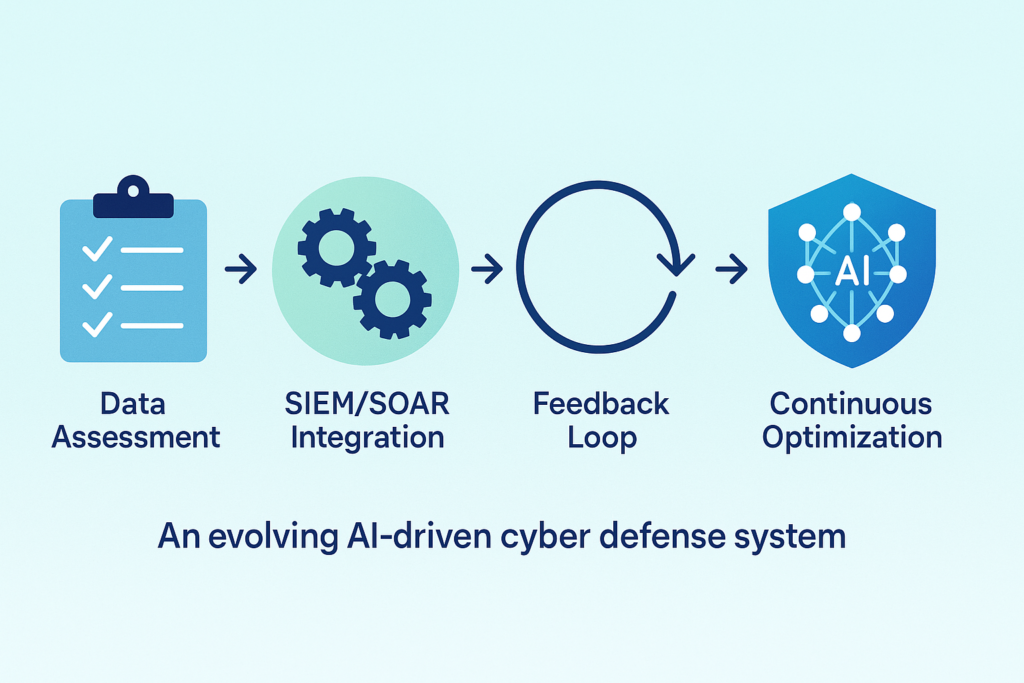
Implementing this technology starts with an honest assessment. You need to know what data sources you have.
Are you collecting full endpoint logs, network flow data, cloud audit trails? The AI engine is only as good as the fuel you give it. A common mistake is feeding it incomplete or poor-quality data, which leads to inaccurate models.
Next, select a platform that integrates with your existing security infrastructure. Look for tools that plug directly into your SIEM or SOAR system.
This integration is crucial for creating a closed-loop system. The AI analyzes data, identifies a high-confidence threat, and then automatically triggers a playbook in your SOAR platform to isolate an endpoint or block a malicious IP.
The seamless integration of machine learning & AI in network threat detection enables automated, swift responses that reduce dwell time and analyst workload.
The implementation isn’t a one-time event. It requires a feedback loop. Your security analysts must review the AI’s findings. When the AI is correct, that feedback reinforces the model. When it’s wrong, that correction helps it learn.
This human-in-the-loop approach ensures the system continuously adapts to your unique environment and the evolving threat landscape. It’s a partnership, not a replacement.
- Audit your available data sources for quality and completeness.
- Choose a platform that integrates with SIEM/SOAR for automated response.
- Establish a process for analysts to provide continuous feedback to the AI models.
This ongoing refinement is what separates a static tool from a living defense system.
| Step | Description | Common Mistake |
|---|---|---|
| 1. Assess Data Sources | Ensure logs, cloud trails, and endpoint data are complete and high quality | Using incomplete or low-quality data |
| 2. Integrate SIEM/SOAR | Connect AI outputs to automated response workflows | Not enabling automated playbooks |
| 3. Establish Feedback Loop | Analysts validate AI findings to refine the model | No human oversight, causing model drift |
| 4. Continuous Optimization | Regularly retrain and update models as threats evolve | Treating implementation as a one-time setup |
From Theoretical to Practical: Real-World Applications
Credits: CodeLucky
The value of AI-driven intelligence becomes clear in specific use cases. Consider dark web monitoring.
An AI system can continuously scan hidden forums and marketplaces for mentions of your company’s email domains. It finds a batch of employee credentials for sale. Instead of just alerting you, it correlates this finding with internal login attempts.
It might see that a user account, whose password was just leaked, is authenticating from an unusual geographic location.
The AI scores this as a high-priority incident of account compromise. It can then automatically trigger a password reset and force a logout of all active sessions, stopping an account takeover in its tracks. This is contextual prioritization in action.
Such applications demonstrate the power of applying machine learning in cybersecurity to transform raw data into actionable defense measures
Another powerful application is in threat hunting. Analysts can query the AI with hypotheses. “Show me any activity that resembles the early stages of a ransomware attack based on the LockBit group’s known TTPs.”
The AI scours months of data, looking for sequences of behavior that match that pattern. This turns threat hunting from a needle-in-a-haystack search into a targeted investigation, dramatically increasing its effectiveness.
Your Path to a Predictive Posture

AI-powered threat intelligence analysis is no longer a futuristic concept. It’s an operational necessity for defending against modern cyber adversaries.
This technology empowers your team by automating the tedious work of sifting through data and allowing them to focus on high-value investigation and response. It transforms your security operations center from a reactive firefighting unit into a proactive command center [2].
Start by focusing on integration and feedback. The goal is to create a seamless flow of intelligence from detection to action.
Embrace the partnership between human expertise and machine speed. Your defenses will not only be stronger, they will learn and evolve, creating a resilient shield that anticipates the next wave of attacks. The time to build that shield is now.
FAQ
How does AI threat detection help me understand attacks in real time?
AI threat detection uses real-time threat monitoring and AI intrusion detection to watch your systems continuously.
It checks patterns with anomaly detection AI and cyber attack pattern recognition. It also applies cybersecurity data mining to review many signals at once. These combined steps help you detect attacks early and respond before any damage occurs.
How do machine learning threat intelligence tools find hidden risks I can’t see?
Machine learning threat intelligence tools review large data sets using security analytics automation. They identify unusual actions through behavioral analytics cybersecurity and cyber threat clustering AI.
They also connect small clues with AI threat correlation. These methods allow the tools to reveal risks that traditional monitoring systems may not detect.
How does automated cyber threat analysis make my SOC work faster?
Automated cyber threat analysis uses AI-driven SOC operations, AI-based SOC automation, and automated IOC analysis to sort events quickly.
It reduces noise through automated security event correlation and organizes alerts with automated threat alert triage. These tools help your SOC focus on the most urgent issues and complete tasks more efficiently.
Can predictive cyber analytics show me attacks before they start?
Predictive cyber analytics uses AI-enabled threat forecasting, automated TTP analysis, and adversarial threat prediction to study attacker behavior.
It reviews past activity using cyber threat modeling AI and AI cyber kill chain analysis to find likely attack paths. It also applies automated breach prediction to warn you early, helping you prevent attacks before they occur.
How does automated incident response help me reduce damage during a breach?
Automated incident response uses AI-powered threat mitigation, intelligent intrusion prevention, and AI-powered security monitoring to act immediately.
It blocks harmful files with AI malware detection and AI-powered malware classification. It also supports investigations through AI-assisted cyber investigation and AI-powered digital forensics. These steps limit damage and speed up recovery during a breach.
The Future of Security: Intelligent Threat Defense Starts Here
AI-powered threat intelligence is no longer optional, it’s the backbone of a modern, predictive defense strategy.
By transforming fragmented data into actionable foresight, AI helps security teams stay ahead of attackers instead of chasing them.
Integrated with SIEM/SOAR and reinforced through continuous human feedback, it becomes a living system that learns, adapts, and strengthens over time.
Adopt this partnership now to reduce risk and outpace evolving threats. Ready to elevate your defenses? Join the future of intelligent threat protection.
References
- https://arxiv.org/html/2505.23397v2
- https://jumpcloud.com/blog/how-effective-is-ai-for-cybersecurity-teams