
Machine learning in cybersecurity lets you spot threats earlier and faster than traditional tools, by actually learning what “normal” looks like in your systems.
Instead of relying only on fixed rules or known attack signatures, it studies real activity, network traffic, logins, file changes, and flags subtle behavior that doesn’t fit. This approach benefits greatly from advanced profiling network device behavior, enabling more granular recognition of anomalies.
Think of it less like a stronger lock, and more like a security system that notices when something feels off, even if it’s never seen that exact trick before. This turns defense from reactive to proactive. Keep reading to see how this approach adapts as attackers change their methods.
Key Takeaways
- Machine learning spots unknown threats by learning normal behavior and flagging deviations.
- It automates the analysis of immense data volumes, speeding up detection and response.
- The biggest hurdles are ensuring quality data and protecting the models themselves from attack, such as adversarial inputs that poison training data.
The Old Guard Isn’t Enough Anymore
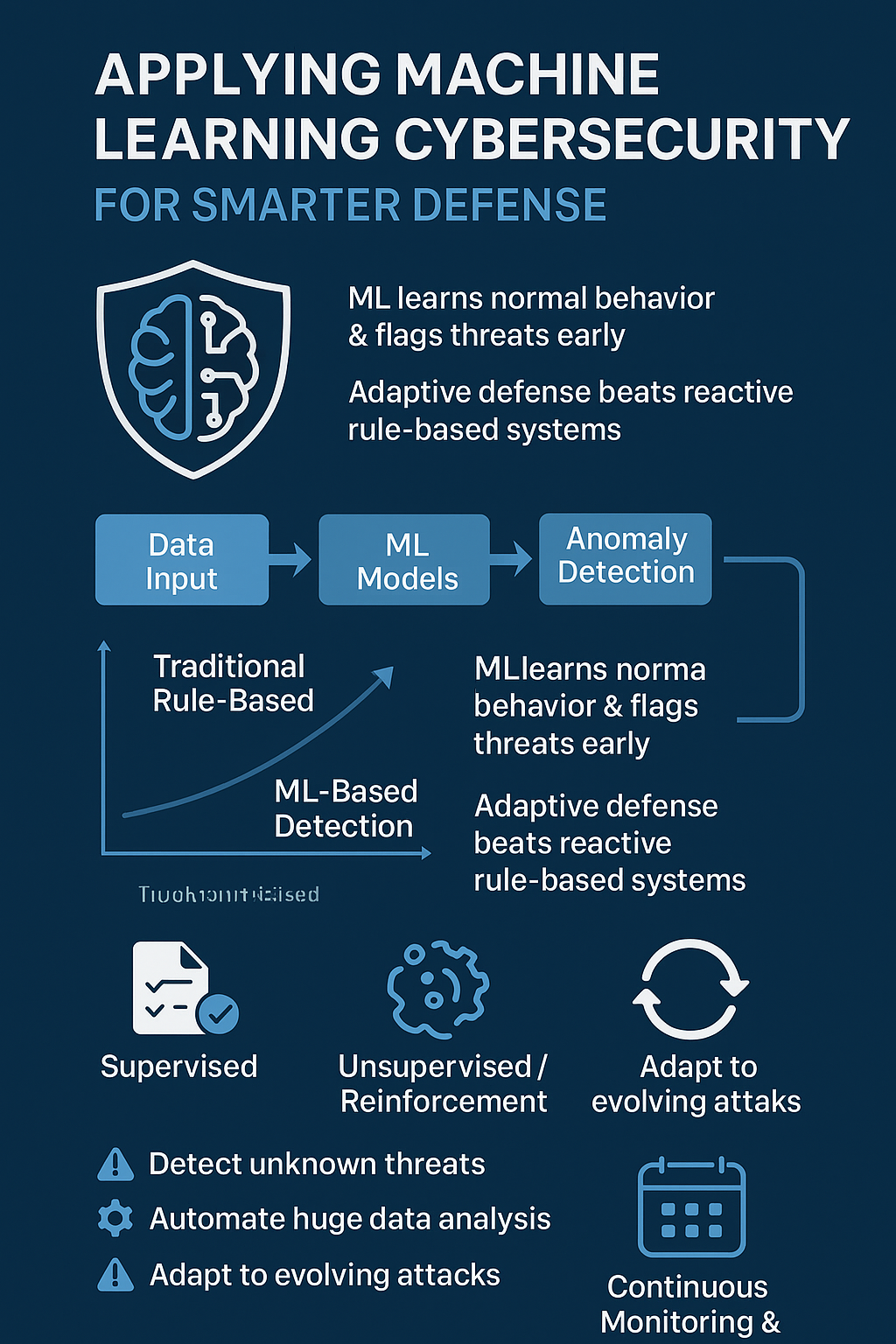
The threat landscape has evolved beyond simple viruses and known malware. Attackers now use sophisticated, polymorphic code that changes its signature to evade detection.
They launch zero-day exploits for which no patch exists. A rule-based system can only block what it has been explicitly told to block. It’s a reactive stance in a world that demands proactivity.
Machine learning introduces a probabilistic, adaptive layer. Instead of just saying “block this known bad IP address,” it can analyze the behavior of a new IP address.
Is it making connection requests that are statistically unusual for the time of day? Is it scanning for ports in a sequence that matches a known attack pattern, even if the source is new? This behavioral analysis is the core of modern defense, leveraging machine learning & ai in ntd to enhance adaptive threat identification. It’s what allows security systems to fight back against novel attacks.
How Machine Learning Sees What You Can’t
| Approach | How It Works | Strengths | Limitations | Best Use Cases |
| Supervised Learning | Trains on labeled “malicious” and “benign” data | High accuracy for known threats; good for classification | Requires large labeled datasets; weak against unseen attacks | Phishing detection, malware classification, DDoS pattern identification |
| Unsupervised Learning | Learns normal behavior and flags anomalies | Detects unknown and zero-day threats; no labels required | Can generate false positives; requires careful tuning | Insider threat detection, anomaly detection in network traffic |
| Semi-supervised / Reinforcement Learning | Uses a small set of labels or learns via feedback | Adapts over time; better generalization | Complex to implement; training can be slow | Adaptive SOC systems, dynamic threat response |
At its heart, machine learning in cybersecurity is about pattern recognition on a scale impossible for humans. It’s not magic, it’s math applied to your security data.
The algorithms learn from historical data what “normal” looks like for your specific environment, your network, your users, your applications.
This learning happens through a few primary methods. Each has its strengths, and the most effective security platforms often use a combination.
Supervised Learning: Teaching the System Known Threats
This technique relies on labeled data. You feed the algorithm examples that are clearly marked “malicious” and “benign.” It’s like showing a child flashcards of dogs and cats. After enough examples, the model learns to classify new, unseen data. It’s highly effective for well-understood threats.
- Phishing email detection, analyzing sender reputation and content.
- Classifying known malware families based on code features.
- Identifying DDoS attack patterns from network flow data [1].
The limitation is its dependence on labeled data. It struggles with truly novel attacks that don’t resemble anything in its training set.
Unsupervised Learning: Finding the Needle in the Haystack
Here, the algorithm works with unlabeled data. Its job is to find hidden structures and groupings on its own. It establishes a baseline of normal activity by clustering similar events together.
Anything that falls outside these established clusters is flagged as an anomaly. This is incredibly powerful for detecting insider threats or zero-day attacks that have no prior signature.
It can spot a user accessing files at 3 a.m. from a foreign country, even if that user’s credentials are valid. The challenge is tuning the sensitivity to avoid a flood of false positives, often tuned via thresholds in SIEM platforms..
The Adaptive Middle Ground
Semi-supervised learning uses a small amount of labeled data to guide the analysis of a large pool of unlabeled data.
Reinforcement learning takes a different tack, where an AI agent learns through trial and error which actions (like blocking a connection) lead to the best security outcomes. These methods help systems adapt over time, improving their accuracy as they encounter new data.
Putting Machine Learning to Work
Credits: Google
The theory is compelling, but the real proof is in practical application. Machine learning is already embedded in many of the security tools you might be using, often working behind the scenes to make them smarter.
In threat detection, ML models analyze network traffic in real-time. They can identify the subtle command-and-control communications of a botnet, spotting the slow exfiltration of data that would slip past a traditional firewall.
This is possible thanks to deep learning for network security, which improves detection of polymorphic and evasive threats.
For malware defense, static analysis can scan file code for suspicious patterns, while dynamic analysis observes the file’s behavior in a sandboxed environment.
This hybrid approach catches polymorphic malware that changes its code but not its malicious actions. Phishing prevention has been revolutionized.
Models don’t just check for known bad links; they analyze the linguistic patterns of an email, the sender’s history, and even the relationship between the sender and recipient.
Endpoint protection platforms use ML to create a behavioral baseline for each device, instantly flagging processes that attempt unusual actions, like encrypting a large number of files (a sign of ransomware). Perhaps the biggest impact is in the Security Operations Center (SOC).
Machine learning-driven Security Information and Event Management (SIEM) systems can correlate millions of low-level events from different sources, firewalls, servers, applications, and surface the few that represent a genuine, multi-stage attack. This automation is the only way to manage the data deluge modern networks produce.
The Flip Side: Challenges to Consider

This technology isn’t a silver bullet. Its effectiveness is entirely dependent on the data it’s trained on. Garbage in, garbage out, as the saying goes.
If the training data is biased or incomplete, the model’s predictions will be unreliable. A model trained only on data from a financial network might perform poorly in a healthcare environment [2].
A more insidious problem is adversarial machine learning. Attackers can now craft malicious inputs specifically designed to fool ML models.
They might subtly alter malware code just enough to be classified as benign, or slowly poison the training data over time to degrade the model’s performance. Securing the ML pipeline itself is a new frontier in cybersecurity.
There’s also the issue of the “black box.” Some complex models, particularly deep learning networks, can be difficult to interpret.
When a model flags an activity as malicious, security analysts need to understand why to investigate effectively. The field of explainable AI is growing to address this critical need for transparency.
Building Your Machine Learning Defense
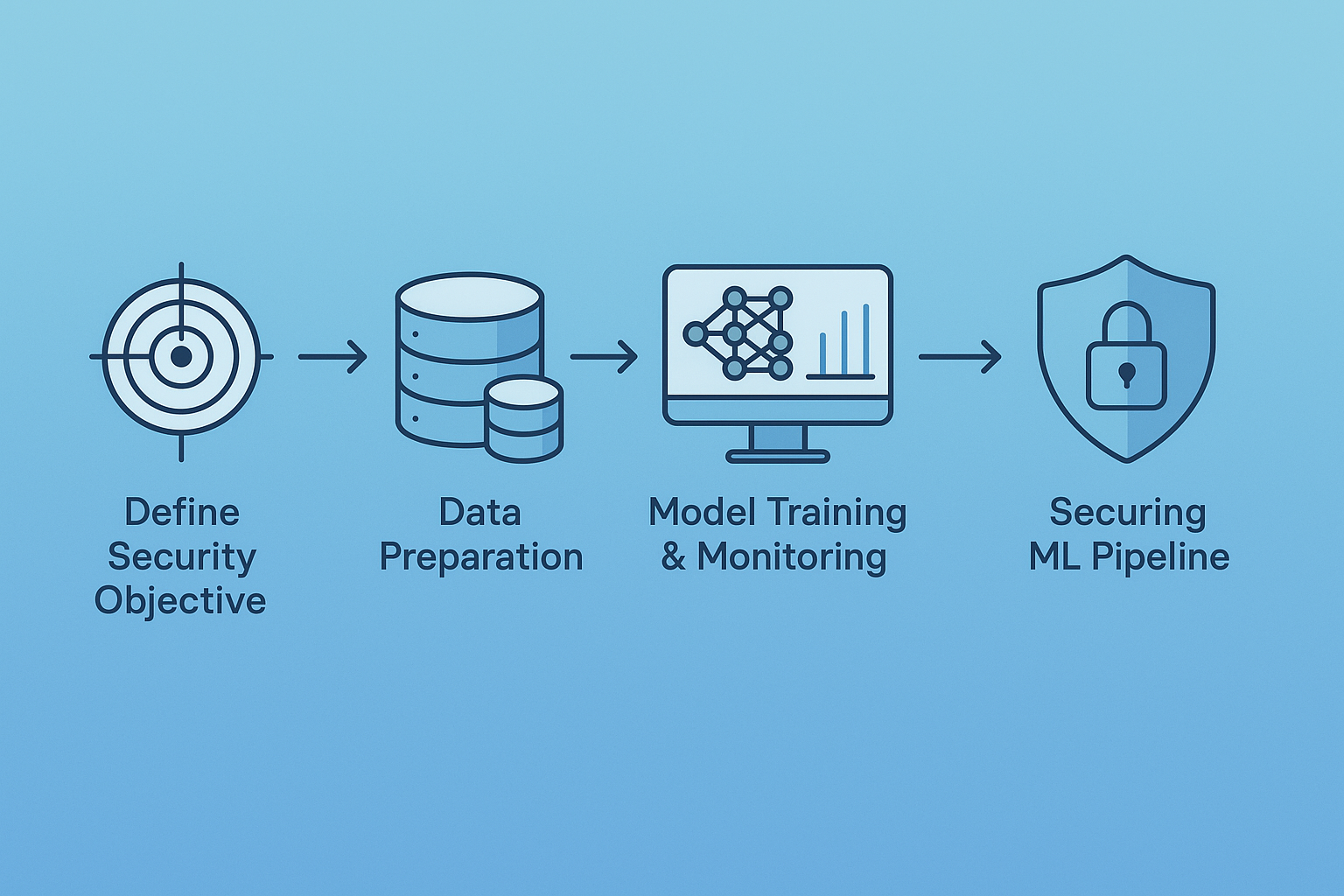
Implementing this technology requires a thoughtful approach. It’s not about buying a product and flipping a switch. Start with a clear objective.
Are you most concerned with insider threat, phishing, or malware? Focus your efforts there first. Data preparation is 80% of the work. You need to gather, clean, and label high-quality data relevant to your use case.
Selecting the right algorithm matters, but the data matters more. Once a model is trained, the job isn’t over. You must continuously monitor its performance.
Models can experience “drift” as user behavior and attack techniques evolve, requiring periodic retraining. Finally, you must consider the security of your ML system itself, ensuring its integrity against tampering.
A More Resilient Future

Applying machine learning cybersecurity is not a replacement for human expertise. It is a force multiplier.
It handles the tedious, high-volume analysis, freeing up your security team to focus on strategic response and complex investigation.
It creates a security posture that is dynamic, learning from every attempted breach to become stronger. The attackers are adaptive, and now, finally, our defenses can be too.
The goal is a system that doesn’t just defend, but anticipates. Start by identifying one area where alert fatigue is highest, and explore how machine learning can bring clarity to the noise.
FAQ
What should beginners know before applying machine learning cybersecurity tools?
When you start applying machine learning cybersecurity tools, it helps to understand how data affects results.
Models such as anomaly detection models, supervised learning security, and unsupervised threat detection work best with clean and complete logs.
Techniques like ML-based log analysis and user behavior analytics ML help you find issues early. Begin with small steps and review model outputs regularly.
How does AI threat detection help me understand strange behavior on my network?
AI threat detection helps you understand strange behavior by checking patterns in your traffic. It uses network behavior analysis and real-time anomaly detection to find actions that do not fit your normal use.
Intrusion detection systems and anomaly scoring algorithms compare current events to past events. These tools help you respond faster and understand what is happening on your network.
How can I reduce false alerts when using automated threat hunting models?
You can reduce false alerts by tuning the rules inside your automated threat hunting setup. Pattern recognition cybersecurity and ML false positive reduction help models focus on meaningful signals.
Feature engineering cybersecurity improves the quality of the data your model learns from. SIEM machine learning and security event correlation group related events so you only see alerts that need action.
What role do ML detection pipelines play in zero-day threat detection?
ML detection pipelines check many types of data to find new attacks quickly. They use zero-day threat detection, neural networks for cybersecurity, and malware classification algorithms to learn new threat patterns.
These pipelines also support model drift monitoring cybersecurity, which helps keep results accurate as behavior changes. With steady updates, they detect new risks before they spread.
How can automated incident response support my ML-driven SOC operations?
Automated incident response supports your ML-driven SOC operations by acting on alerts as soon as they appear.
It uses predictive threat analytics, cyber attack prediction, and threat intelligence automation to guide decisions. Identity threat detection AI and ML-based threat prioritization help show which alerts matter most. This process strengthens response time and reduces noise for your team.
Adaptive Defense: Where Machine Learning Becomes Your Security Advantage
Machine learning reshapes cybersecurity by transforming fragmented, reactive defenses into adaptive systems that learn continuously. As threats grow more sophisticated and unpredictable, ML delivers the speed, scale, and behavioral insight needed to detect attacks earlier and respond faster.
Its success depends on high-quality data, secure model pipelines, and ongoing tuning, but when implemented well, it becomes a powerful force multiplier for security teams.
Start small, refine steadily, and let your defenses evolve as quickly as your adversaries. Ready to strengthen your adaptive threat defense? Join the future of smarter security here
References
- https://www.sangfor.com/blog/cybersecurity/machine-learning-in-cybersecurity-benefits-and-challenges
- https://www.geeksforgeeks.org/blogs/ml-in-cyber-security/