
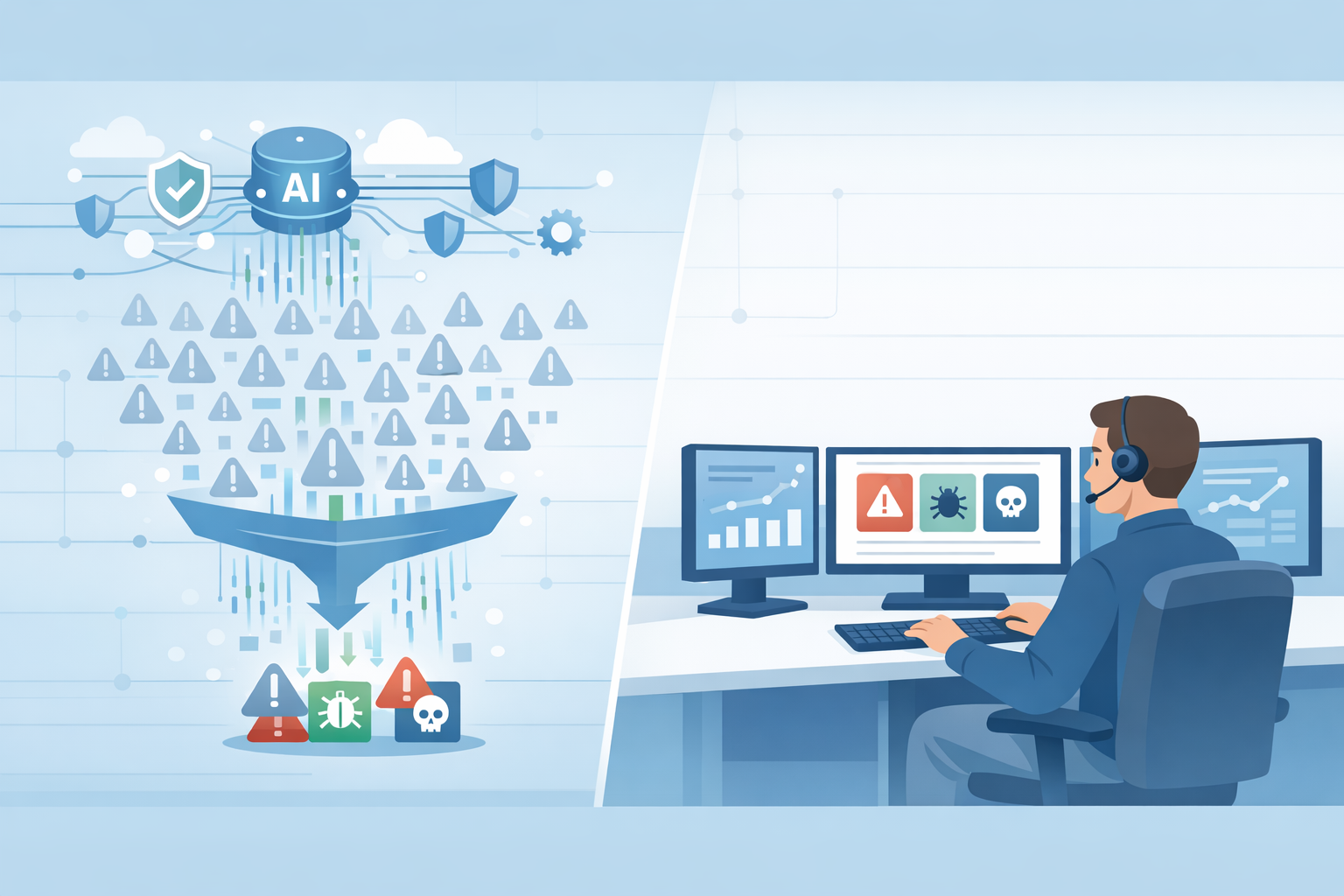
Yes, you can automate threat detection tasks, and many security teams are already doing it today to keep up with nonstop alerts.
Automation uses tools like SIEM, SOAR, and machine learning to sort, correlate, and respond to suspicious activity faster than humans can on their own.
Instead of chasing every alert, analysts can focus on real investigations, threat hunting, and higher‑impact decisions.
This shift doesn’t replace humans, it protects their time and energy so they can do the work that truly matters. Keep reading to see the key building blocks and simple steps to start automating your defenses.
Key Takeaways
- Automation combines SIEM, SOAR, and AI to handle data, orchestrate responses, and detect novel threats.
- Effective implementation starts with centralized data and builds outward with simple, then complex, automated playbooks.
- The goal is a hybrid human-machine system where automation handles the routine, enabling analysts to tackle sophisticated attacks.
The Engine Room: Core Technologies for Automation
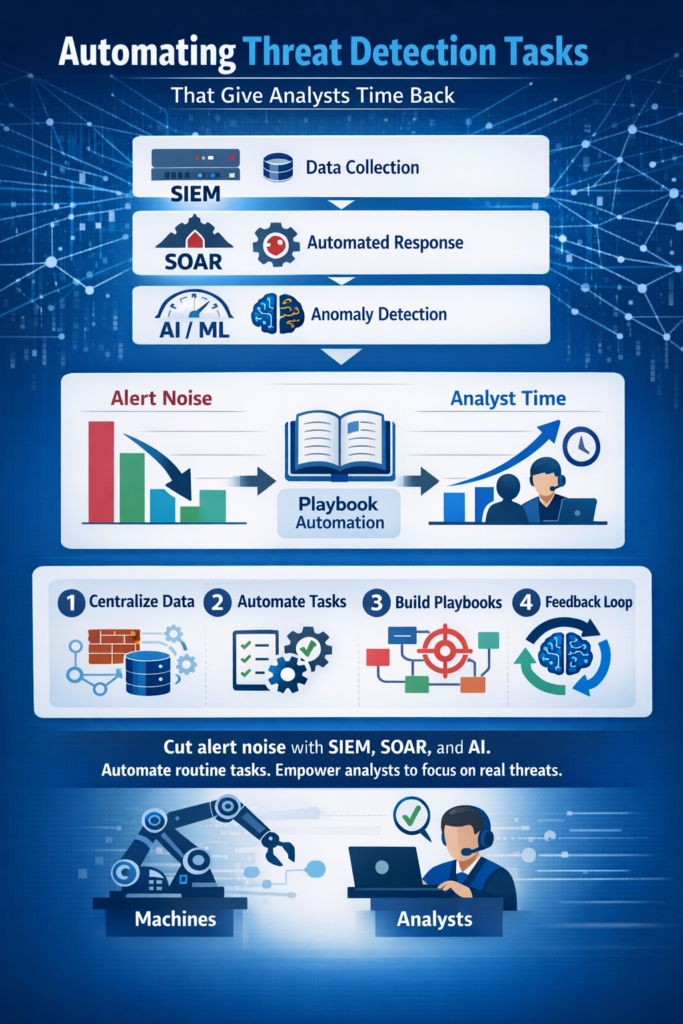
This automation isn’t powered by magic. It runs on a stack of integrated technologies, each with a specific job. Think of it as building a modern, automated factory for security, where each machine on the assembly line has a precise role.
SIEM is your central nervous system. It’s the foundational layer. A Security Information and Event Management system does one thing exceptionally well, it collects. It ingests a firehose of data from every corner of your digital environment.
Network logs, endpoint activities, cloud service reports, it all flows into the SIEM. Its initial job is correlation, looking for simple patterns that might indicate trouble, like ten failed login attempts from a single IP address in two minutes. It’s the first line of triage.
SOAR provides the muscle memory. If the SIEM identifies a potential issue, the Security Orchestration, Automation, and Response platform kicks in.
This is where pre-defined actions happen automatically. A SOAR playbook is a set of instructions. If an alert meets certain criteria, the SOAR system can execute a response without human intervention.
- Isolate a compromised endpoint from the network.
- Block a malicious IP address at the firewall.
- Disable a user account showing suspicious behavior.
- Open a ticket in your incident management system with all relevant data.
This automation turns minutes, or even hours, of manual work into seconds. It contains threats while your team is still getting their coffee.
AI and ML act as the intuitive detective. This is the layer that learns. Rule-based systems are good, but they can’t find what they aren’t told to look for.
Machine learning models analyze vast amounts of data to establish a “normal” baseline for your network, your users, your applications. They then flag subtle deviations, anomalies that would be invisible to a human eye scanning logs.
This is the essence of ai powered threat intelligence analysis, enabling detection of zero-day attacks and sophisticated insider threats. The AI notices that a user is accessing files at 3 a.m. they’ve never touched before, or that data is moving to an unknown external server in small, stealthy increments.
| Technology | Primary Role | What It Automates | Why It Matters |
| SIEM | Central data collection | Log ingestion and event correlation | Creates visibility across the entire environment |
| SOAR | Response orchestration | Automated actions and playbooks | Reduces manual response time during incidents |
| AI / ML | Pattern learning and anomaly detection | Detection of unknown and subtle threats | Identifies behavior humans may miss |
Building Your Automated Defense, Step by Step
Implementing this isn’t an all-or-nothing endeavor. It’s a gradual process of building confidence and capability. You start with the foundation and add sophistication over time. Trying to boil the ocean on day one is a recipe for failure and frustration.
First, get your data in order. You can’t automate what you can’t see. The initial phase is all about data ingestion. Connect your critical systems to your SIEM.
Ensure you’re pulling logs from firewalls, servers, major applications, and identity management systems.
This centralized data pool is the raw material your automation will work with. Without clean, comprehensive data, even the most advanced machine learning ai in ntd models will produce garbage.
Next, build your playbooks, but start small. Don’t attempt to automate the response to a complex, multi-stage attack on your first try. Identify the low-hanging fruit, the repetitive tasks that consume your analysts’ time but are low-risk to automate.
- Automating the initial triage of a common phishing email alert.
- Automatically blocking an IP address with a known bad reputation from a threat intelligence feed.
- Quarantining a device that triggers a specific antivirus signature [1].
These simple automations provide immediate value. They build trust in the system and free up analyst time for more complex investigations.
As your team becomes comfortable, you can create more intricate playbooks for higher-stakes scenarios, always ensuring a human approval step is included for critical actions like shutting down a core business server.
Finally, create a feedback loop. Automation isn’t a “set it and forget it” solution. Your system must learn and adapt.
This is where your security analysts remain essential. When the automation flags an alert, analysts investigate and classify it.
Was it a true positive? A false positive? This human feedback is fed back into the machine learning models.
Over time, this process continuously tunes the system, sharpening its accuracy and dramatically reducing the number of false alarms. The system gets smarter because your team teaches it.
Making Automation Work for Your World
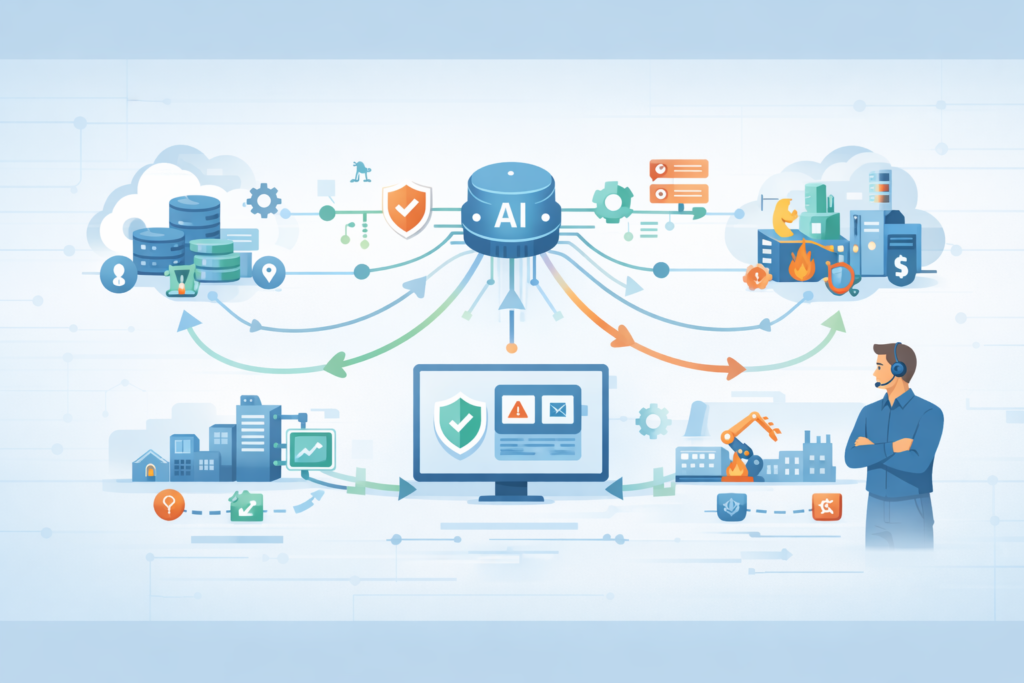
The most effective automated systems are tailored to their environment. A one-size-fits-all approach rarely works in security. The threats facing a financial institution are different from those targeting a manufacturing plant’s industrial control systems.
Integrate external threat intelligence. Don’t rely solely on internal data. Subscribe to threat intelligence feeds that provide real-time information on emerging threats, malicious IPs, and new malware signatures.
Your automation can be configured to automatically block these known-bad indicators across your environment.
This is a powerful form of proactive defense, stopping attacks before they even start based on collective knowledge. Embrace a hybrid model.
The goal of automation is not to replace your security team. It’s to augment them. The ideal state is a partnership. Let the machines handle the predictable, high-volume, repetitive tasks.
This liberates your human analysts to do what they do best, creative problem-solving, deep-dive forensic analysis, and proactive threat hunting.
Deep learning for network security techniques empower machines to cut through alert noise, so the humans can focus on the melody of a real attack.
Your Path to a Calmer SOC
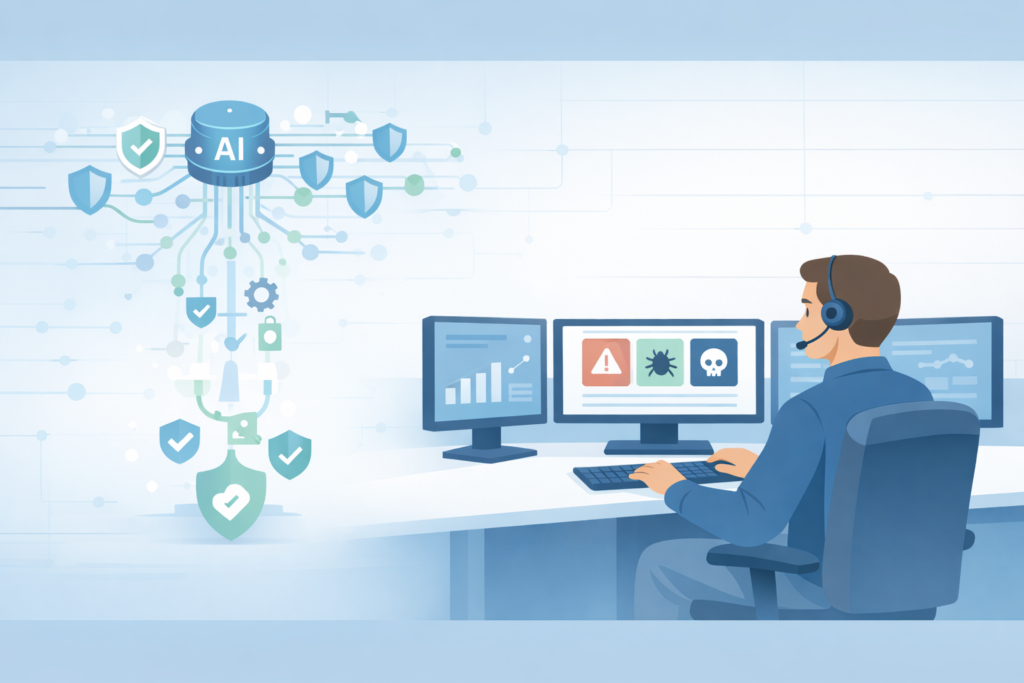
Automating threat detection isn’t just about speed or dashboards, it’s about making security work feel more human and more sustainable. You’re moving from a constant firefight to a state of steady, prepared control. The tools are already here, and the route is more practical than dramatic:
- You pull your security data into one place so your analysts see the same picture.
- You start by automating small, repetitive steps to build trust and momentum.
- You grow that into a real collaboration between human judgment and machine precision [2].
Over time, that shift shows up in ways that actually matter:
- Response times drop because alerts don’t wait on manual triage.
- Your team feels less drained and more focused on real investigation, not button-clicking.
- Attention moves toward complex, high-impact threats instead of routine noise.
Start small. Be intentional. Let the machines take the grind so your analysts can do the thinking that only they can do.
FAQ
What does automating threat detection tasks include in daily security operations?
Automating threat detection tasks includes automated threat detection and security automation working together with AI-driven threat detection.
Teams rely on SIEM automation, SOAR automation, and automated log analysis to enable automated incident detection and real-time threat monitoring.
These capabilities support automated alert triage, false positive reduction, security orchestration, and automated response workflows that reduce manual effort and improve response speed.
How does automation detect threats that humans often overlook?
Automation uses machine learning security automation, behavioral anomaly detection, and automated behavioral baselining to identify unusual activity.
These methods support AI-based intrusion detection, anomaly-based detection automation, and predictive threat detection.
By applying cyber threat analytics and data-driven threat detection, systems uncover automated zero-day detection, insider threats, and subtle attack patterns that are difficult for humans to notice.
Which data sources are essential for automating threat detection tasks?
Effective automation depends on automated log analysis, network traffic analysis automation, endpoint detection automation, and user behavior analytics automation.
These sources enable security event correlation, automated risk scoring, and continuous security monitoring.
When combined with threat intelligence automation, automated IOC detection, and automated threat intelligence correlation, they strengthen automated malware detection, phishing detection, and DDoS detection.
How does automation prioritize incidents and trigger responses?
Automation applies automated incident prioritization, automated threat classification, and automated security decision-making to rank alerts by risk.
Security workflow automation supports automated remediation and automated response workflows.
Within autonomous security operations and an AI-powered SOC, these processes enable machine-assisted threat detection, cyber defense automation, and security AI orchestration while keeping humans involved in high-impact decisions.
What challenges should teams address before scaling security automation?
Teams must validate automated vulnerability detection results and tune adaptive security systems carefully. Poor configuration can weaken automated threat hunting and continuous threat detection automation. Organizations should review automated security analytics regularly to ensure threat detection at scale remains accurate. Ongoing oversight helps automated network anomaly detection stay reliable and aligned with real-world attack behavior.
Reclaiming Time Without Losing Control
Automation is no longer a luxury for security teams, it’s a necessity for survival at scale. By combining centralized data, simple automated playbooks, and adaptive AI, organizations can dramatically reduce alert noise and response time.
The true win is human focus: analysts spend less time chasing false positives and more time stopping real threats. If you’re ready to reclaim your team’s time and build a calmer, more resilient SOC, discover how automation-powered threat detection works.
References
- https://securityboulevard.com/2021/02/your-first-soar-use-case-phishing-triage/
- https://cloudwars.com/ai/3-key-benefits-of-an-ai-human-collaboration/