
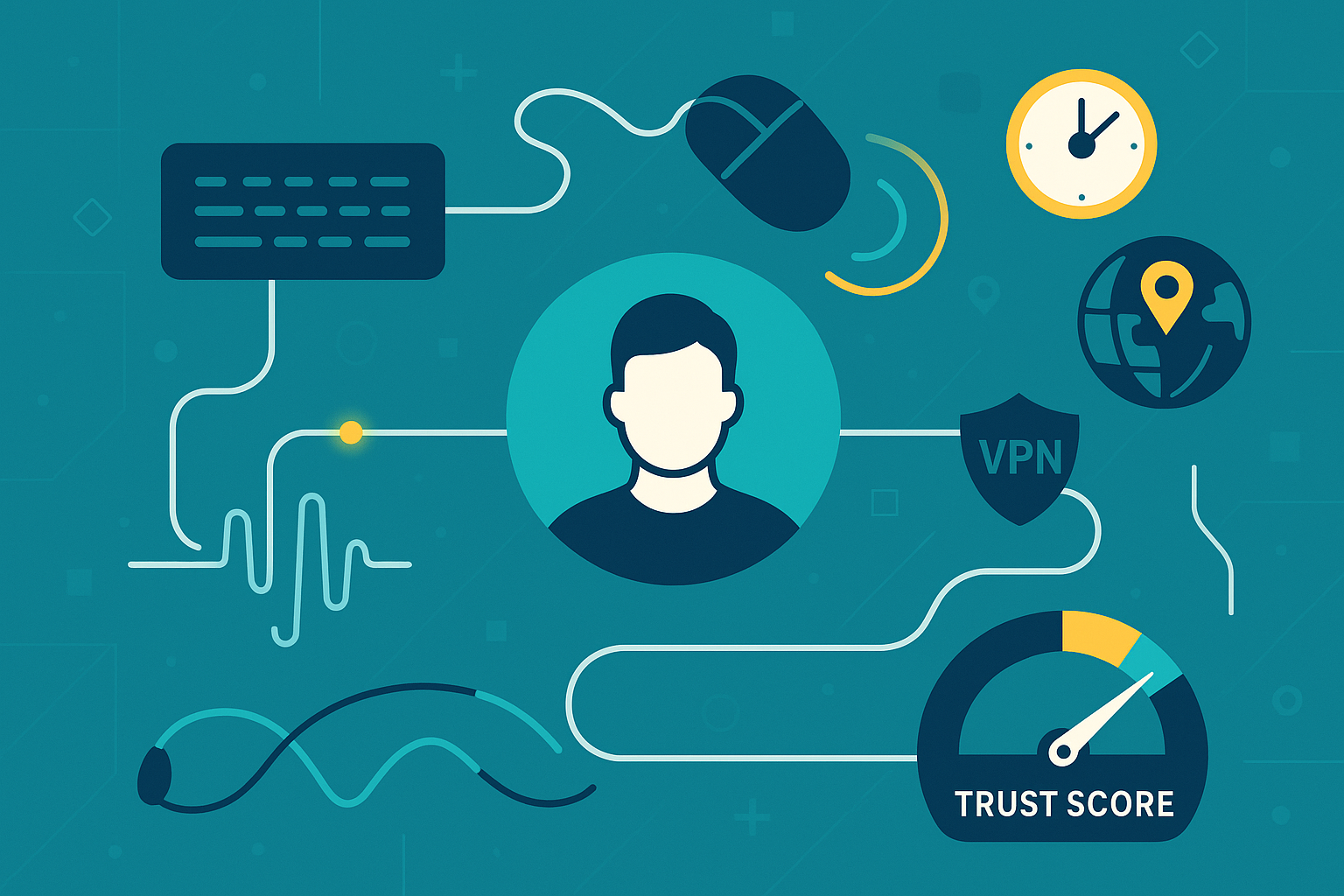
Your behavior is the most powerful security tool your network has. Not the password, not the token, you.
Behavioral biometrics in network security tracks the quiet patterns you don’t even notice, your typing rhythm, how you move your mouse, the way you scroll or pause on certain parts of a page.
These patterns form a kind of digital fingerprint that can be checked all the time, silently, while you work. That means if someone else slips in, the system can call it out fast. Keep reading to see how your own habits can lock down your digital life.
Key Takeaways
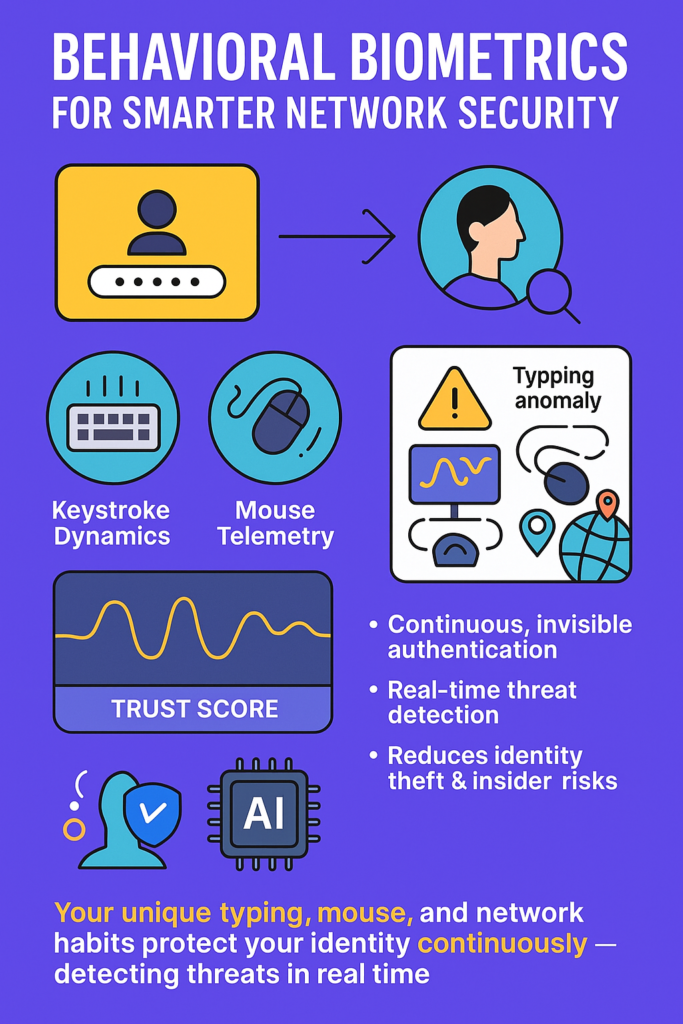
- It creates a continuous, invisible authentication layer that works after you log in.
- It analyzes unique patterns like typing speed and mouse movements to build a user profile.
- It flags anomalies in real-time, stopping threats like account takeovers and insider risks.
The Human Signature in a Digital World
We remember watching a colleague work. His fingers flew across the keyboard in a specific, staccato rhythm.
He’d always drag his mouse in short, precise arcs. It was his signature, as unique as a fingerprint.
That’s the core idea behind behavioral biometrics. It’s not about what you know, a password, or what you have, a key fob. It’s about who you are, expressed through your digital behavior.
This technology is a response to a brutal reality. Passwords get stolen. Firewalls get bypassed.
Reports indicate over 80% of breaches involve compromised credentials. Traditional security is a gatekeeper that checks your ID once at the door.
Behavioral biometrics is a vigilant guard who watches your every move inside the building, ready to act if you start acting strangely. This kind of behavioral analysis for threat detection goes beyond static passwords, using patterns to identify risks before damage occurs.
What Exactly Is It Watching?
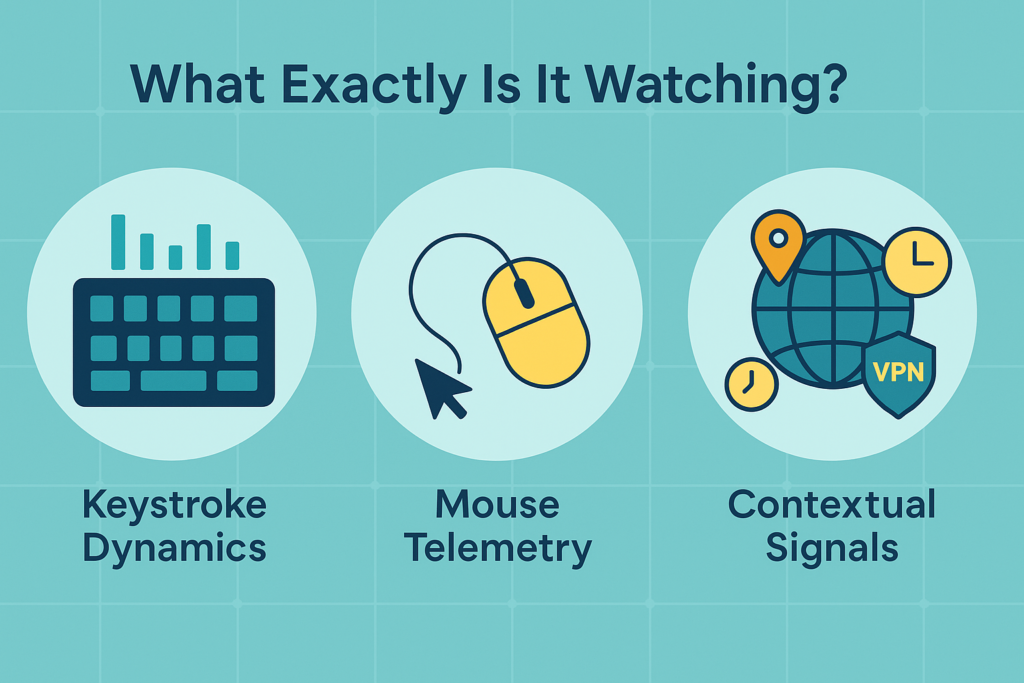
The system observes a wide array of seemingly minor actions. It’s not spying on what you type, but how you type it.
Your keystroke dynamics are a goldmine of identifiers. This includes the speed between key presses, the pressure you apply, and even the rhythm you use when typing common words. It’s a digital cadence that is incredibly difficult to fake.
Your mouse movements are equally telling. The system maps the velocity of your cursor, the angles of your clicks, and the paths you take to navigate menus. Some people move the mouse directly, others in lazy curves.
These patterns become part of your behavioral baseline. On mobile devices, it analyzes swipe gestures, the pressure of your touch, and the way you hold the device.
The analysis extends beyond direct interaction. The system incorporates contextual network signals. This includes your typical IP geolocation, the time of day you usually access certain applications, and whether you’re connecting through a VPN.
A login from a new country is one thing. A login from a new country coupled with completely different typing habits is a massive red flag.
- Keystroke Dynamics: Flight time (between keys), dwell time (key pressed), and overall rhythm.
- Mouse Telemetry: Movement speed, click frequency, and scrolling patterns.
- Contextual Signals: Typical login times, geographic locations, and network pathways [1].
How This Silent Guard Protects Your Network

So how does this all come together to protect a network? The magic lies in continuous authentication.
After you successfully log in, the system doesn’t just forget about you. It quietly monitors your behavior, comparing it to the established profile it built during your normal usage.
This creates a real-time trust score for your session, much like how network threat detection continuously monitors traffic to spot subtle deviations indicating malicious activity.
This is crucial for detecting anomalies. Imagine a scenario where an attacker has stolen your credentials. They log in from a remote location. But their mouse movements are jerky and unnatural.
Their typing rhythm is completely off. The behavioral biometrics system detects this deviation instantly. It can then trigger an adaptive response, like forcing a step-up authentication (a second factor) or even blocking the session outright.
This approach is exceptionally effective against specific threats. It can identify remote access trojans by spotting the automated, non-human behavior of the malware controlling a machine.
It helps mitigate insider risks by flagging when a user suddenly starts accessing sensitive files they never touch, perhaps indicating a compromised account or malicious intent.
The system uses machine learning to adapt. It understands that your behavior might change slightly if you’re tired or using a new mouse.
It learns these new patterns, refining your profile over time to reduce false positives. The goal is to be sensitive to threats, not to everyday human variation.
The Tangible Benefits for Your Network

The advantages of integrating behavioral biometrics are profound. The most obvious is a drastic reduction in identity theft.
While passwords and physiological biometrics like fingerprints can be compromised, replicating intricate behavioral patterns remains highly challenging, especially with multi-signal analysis for any attacker [2].
For users, the experience is seamlessly frictionless. They aren’t bombarded with constant authentication prompts.
Security happens in the background, uninterrupted. This improves productivity and user satisfaction, as the security layer is felt only when a genuine threat is detected. It’s security that works for you, not against you.
From an administrative perspective, scalability is a game-changer. Adaptive AI handles the heavy lifting, providing real-time threat detection across thousands of users without requiring manual intervention.
It adds an intelligent, proactive layer to a Zero Trust architecture, verifying identity continuously rather than relying on a single point of entry.
Navigating the Practical Challenges
Of course, no system is perfect. The primary challenge is balancing sensitivity. You want to catch malicious actors without flagging legitimate users.
A false positive might occur if a user has an injured hand and their typing pattern changes dramatically. Tuning the system’s sensitivity is an ongoing process.
There’s also the threat of adversarial attacks. Could a sophisticated attacker study and mimic a user’s behavior? It’s possible, though extremely difficult.
Modern systems combat this with AI-driven detection and behavioral analytics, similar to advanced network detection and response platforms that adapt and learn from new threats in real-time.
This risk is mitigated by using a wide array of behavioral signals and regularly retraining the machine learning models on new data. The system gets smarter the more it’s used.
Privacy is a natural concern. The idea of being constantly monitored can be unsettling. It’s critical that organizations are transparent about data collection and usage.
The focus is on behavioral patterns, not on the content of communications. Strong data governance ensures this information is used solely for security and is protected with the highest encryption standards.
Making Behavioral Biometrics Work For You
Implementing behavioral biometrics isn’t about ripping and replacing your current security stack. It’s about integration.
The system should work alongside your existing identity and access management solutions, firewalls, and SIEM platforms. It feeds behavioral risk scores into these systems, enriching their decision-making capabilities.
Start with a phased rollout. Enroll a pilot group of users, allowing the system to build robust behavioral baselines.
During this period, closely monitor the alerts and fine-tune the sensitivity thresholds. The goal is to train the system to understand your organization’s unique rhythm of work.
Ongoing analysis is key. Don’t just set it and forget it. Regularly review the behavioral data and threat alerts.
This will help you understand emerging attack patterns and further refine your defenses. The system becomes a valuable source of threat intelligence, revealing not just who is attacking, but how.
Your Next Step in Behavioral Security
Behavioral biometrics represents a fundamental shift. It moves security from a static checkpoint to a dynamic, intelligent process.
It recognizes that the greatest asset in protecting a network is the unique human using it. By turning individual behavior into a security parameter, we create a defense that is as adaptive and nuanced as the threats we face.
It’s a quiet revolution, one that makes your network safer by simply letting you be yourself. Start the conversation with your security team about how this invisible guard can fit into your defense strategy.
FAQ
How does behavioral authentication help protect my network beyond passwords?
Behavioral authentication protects your network by analyzing how you normally type, move your mouse, and interact with your device.
It uses keystroke dynamics analysis, mouse movement biometrics, and user behavior analytics to build a baseline of your behavior.
With continuous authentication and biometric anomaly detection, the system can detect unusual actions and use behavioral threat detection to block risky activity before it spreads.
What signs show that my behavior is drifting in ways that may trigger alerts?
Behavioral drift detection identifies meaningful changes in your digital habits. It evaluates human behavior telemetry, behavioral pattern recognition, and behavioral sequence analysis to compare your current behavior with your established baseline.
When shifts exceed normal variation, real-time behavior monitoring and behavioral anomaly scoring notify you or your security team that your behavior no longer aligns with your expected profile.
How does my device use behavior to spot insider threat behavior signals?
Your device identifies insider threat behavior signals by studying behavioral fingerprinting, behavioral signature analysis, and user interaction telemetry.
It monitors your regular workflow through behavioral session monitoring and network session behavior profiling.
If someone performs tasks you do not normally perform or navigates resources in unusual ways, behavioral compromise detection and behavior-triggered security alerts flag the suspicious actions.
Can behavioral biometrics machine learning help detect identity fraud on my account?
Yes. Behavioral biometrics machine learning helps detect identity fraud by analyzing device interaction biometrics, gait recognition security, and cognitive biometrics to confirm your behavioral identity.
It continuously performs activity-based identity checks and biometric fraud detection. When it detects behavioral deviation or suspicious user intent modeling, identity threat detection systems respond quickly to prevent unauthorized access.
How does behavior-driven access work when my network needs stronger protection?
Behavior-driven access works by evaluating behavioral trust scoring, anomaly-based access control, and behavioral-based zero trust rules to decide whether to grant or limit access.
The system reviews your behavioral privacy protection level, digital behavioral identity, and behavioral pattern baselining.
If your actions match your expected profile, you continue working normally. If they do not, profile-based access control and behavioral access auditing restrict risky activity across behavior-centric network protection zones.
Final Thoughts: The Future of Network Defense Is Behavioral
Behavioral biometrics changes the security equation by making identity verification continuous, adaptive, and deeply personal.
Instead of relying on fragile credentials, it leverages the one thing attackers can’t easily steal, your unique digital behavior.
As threats grow more sophisticated, this silent guardian becomes an essential layer of defense, strengthening Zero Trust while reducing user friction.
Now is the time to explore how behavioral intelligence can elevate your security strategy and protect your network from the inside out. Join the future of adaptive security
References
- https://www.sciencedirect.com/science/article/abs/pii/S0167404820302017
- https://pmc.ncbi.nlm.nih.gov/articles/PMC10851515/