

Network Detection and Response tools are key to spotting threats lurking in your network before they cause serious damage. We often find that network threat detection is the first line of defense in uncovering hidden attacks, from ransomware to insider threats.
These tools watch over network traffic constantly, using smart analytics to spot unusual behavior early.
If you want to understand Benefits of Using NDR Tools can transform your security setup and keep your data safer, keep reading. We’ll walk through what makes them essential and how they help teams respond faster and smarter.
Key Takeaways
- NDR tools offer broad visibility across all network traffic, spotting threats traditional tools miss.
- Automated, AI-driven detection speeds up threat identification and reduces false alarms.
- Integration and automation within security operations make incident response more efficient.
The Advantage of Broad and Deep Network Visibility

One thing we noticed right away with NDR tools is how they illuminate the entire network landscape. Unlike traditional security setups that only peek at endpoints or firewalls, NDR systems look at every packet flowing through the network.
This includes cloud, on-premises, and even operational technology segments (1). Such broad visibility helps catch sneaky threats moving sideways inside networks , the kind that often slip past other defenses.
- The ability to see across all devices and environments is a game changer.
- It’s not just about volume but understanding the context of network activity.
- You gain insight into device-to-device communication patterns that reveal intrusions early.
With this kind of network traffic analysis, security teams can trace suspicious activity back to its source much quicker, making incident investigations less like searching for a needle in a haystack.
Early Detection Through Smart Analytics and AI
We find the real power of NDR tools lies in their use of machine learning and behavioral analytics. These technologies sift through mountains of network data, learning what normal looks like for your specific environment.
When something deviates , say, a device suddenly starts scanning the network or sending data to an unknown destination , the system flags it immediately.
Here’s how it typically works:
- NDR tools spot known threats and novel attacks, including zero-day exploits.
- Behavioral baselining reduces false positives, meaning less noise and more actionable alerts.
- Real-time monitoring ensures that threats don’t linger unnoticed for months.
From personal experience, automated incident response features in these tools can even quarantine suspicious network segments without waiting for manual intervention, cutting down dwell time
Tools like Network Detection and Response (NDR) solutions continuously monitor traffic and leverage AI-driven analytics to detect hidden threats and minimize false positives. dramatically.
Enhancing Security Operations Center Efficiency
Source: IBM Technology
One of the biggest headaches in cybersecurity is alert overload, where analysts drown in false alarms and routine noise.
We’ve seen how NDR tools ease this burden by correlating data, prioritizing threats, and automating routine responses. This means security teams focus their energies on real incidents instead of chasing shadows.
- Automated triage helps reduce alert fatigue.
- Integration with SIEM and endpoint tools streamlines workflows.
- Analysts gain clearer, contextualized views of threats.
By optimizing SOC operations, organizations can keep pace with growing network complexity and data volume without burning out their teams.
Understanding how NDR uses machine learning to enhance detection accuracy, teams can identify anomalies faster and improve real-time threat response without manual intervention.
Support for Diverse and Expanding Network Environments
Networks today aren’t just desktops and servers anymore. The explosion of IoT and operational technology devices introduces many blind spots in traditional security. NDR tools fill that gap by monitoring unmanaged or poorly secured devices through network traffic analysis.
We’ve observed how this coverage is vital for protecting smart devices in industrial or healthcare settings where endpoint protections might be weak or nonexistent.
- NDR tools detect threats targeting IoT and OT devices.
- They provide visibility where endpoint agents can’t reach.
- This reduces attack surfaces and prevents lateral movement.
Keeping these unconventional devices in the security fold strengthens overall network resilience.
For organizations operating hybrid infrastructures, NDR for cloud environment monitoring ensures visibility across virtual networks, detecting threats that traditional endpoint tools may overlook.
Seamless Integration and Scalability

For many organizations, adding new security tools means juggling more dashboards and alerts.
We appreciate how modern NDR solutions integrate smoothly with existing ecosystems (2). They work hand in hand with firewalls, EDR platforms, and security information systems to create a unified defense.
- NDR tools scale to monitor growing network infrastructures.
- They support hybrid cloud and on-premises deployments.
- Data from NDR enhances threat intelligence sharing and coordinated responses.
This flexibility ensures that as your network grows or changes, your detection capabilities keep pace without disruption.
Practical Advice for Maximizing NDR Benefits
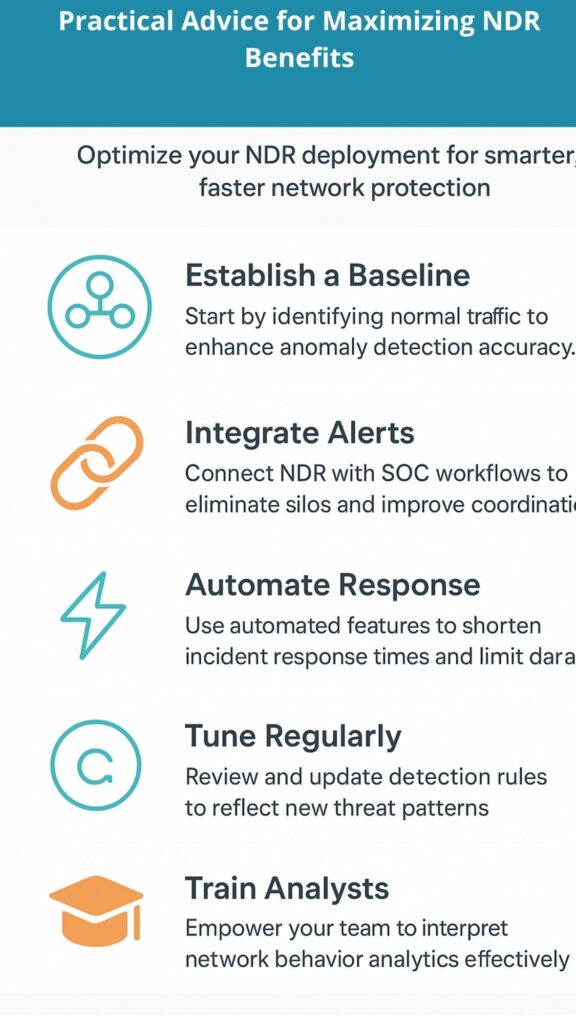
If you’re thinking about adopting or optimizing NDR tools, here’s what worked for us and many others:
- Start by establishing a baseline of normal network traffic to improve detection accuracy.
- Integrate NDR alerts with your existing SOC workflows to avoid silos.
- Leverage automated incident response features to reduce response times.
- Regularly review and tune detection rules based on emerging threats.
- Train your security analysts to interpret network behavior analytics effectively.
These steps can help you get the most from your NDR investment and defend your network more proactively.
Tying It All Together: Why Benefits of Using NDR Tools Should Matter to You
We’ve seen firsthand how NDR tools transform network threat detection, turning overwhelming data into clear, actionable insights. Their ability to spot threats early, automate responses, and support diverse devices makes them essential in today’s complex security landscape.
If network security is a priority, NDR tools give you the visibility and speed needed to stay ahead of attackers.
FAQs
What is the primary function of NDR tools?
NDR tools mainly focus on monitoring and analyzing network traffic to detect suspicious activities and threats. They provide comprehensive visibility across all network segments, including cloud, on-premises, and IoT devices.
By using machine learning and behavioral analytics, these tools identify anomalies, such as lateral movement or ransomware activity, early on.
This early detection allows security teams to respond quickly and reduce potential damage from cyberattacks, making NDR essential for modern network security.
How do NDR tools differ from traditional network security tools?
Traditional tools like firewalls and intrusion detection systems often rely on signatures or fixed rules to detect threats. NDR tools, however, use advanced behavior-based detection and AI to identify both known and unknown threats in real-time.
Unlike endpoint protection, NDR focuses on network traffic patterns and anomalies, providing visibility into unmanaged devices and encrypted traffic. This broader approach helps catch stealthy attacks that might otherwise go unnoticed in complex or hybrid environments.
Can NDR tools detect insider threats?
Yes, NDR tools are effective at detecting insider threats by monitoring unusual network behavior that deviates from established baselines. They analyze user and device activity patterns to spot suspicious actions such as unauthorized data transfers or abnormal access times.
This behavior-based detection helps identify compromised accounts or malicious insiders who might bypass endpoint protections, thereby providing an additional layer of security inside the network perimeter.
How do NDR tools integrate with other cybersecurity systems?
NDR tools are designed to work seamlessly with existing security infrastructures such as Security Information and Event Management (SIEM) platforms, Endpoint Detection and Response (EDR) solutions, and firewalls.
This integration allows for enriched threat intelligence sharing, automated alert correlation, and streamlined incident response workflows. By combining network data with endpoint and log information, security teams gain a holistic view of threats, improving detection accuracy and operational efficiency.
What role does machine learning play in NDR tools?
Machine learning in NDR tools helps establish a baseline of normal network behavior by continuously analyzing traffic patterns. It identifies subtle deviations that indicate potential threats, including zero-day attacks and complex malware.
This adaptive learning reduces false positives and enhances detection capabilities over time. Additionally, automated incident response driven by machine learning can quickly isolate affected network segments, minimizing the impact of attacks without waiting for manual intervention.
Are NDR tools effective for IoT and OT environments?
Absolutely. IoT and operational technology (OT) devices often lack traditional endpoint security, making them vulnerable entry points. NDR tools monitor network traffic to and from these devices, spotting anomalies that might indicate compromise or misuse.
This network-focused approach provides essential visibility into environments that are otherwise difficult to secure, helping organizations protect critical infrastructure and reduce risks associated with unmanaged or poorly secured devices.
How do NDR tools reduce alert fatigue in security teams?
NDR tools employ data correlation, behavioral analytics, and automated triage processes to prioritize genuine threats over false alarms. By filtering out noise and grouping related alerts, they provide security analysts with clearer, actionable insights. This reduces alert fatigue, allowing teams to focus on investigating real incidents rather than chasing benign anomalies. Improved alert quality also speeds up response times and boosts overall SOC productivity.
What is the impact of NDR on breach detection time?
NDR tools significantly shorten breach detection time by continuously monitoring and analyzing network traffic in real-time.
Traditional breaches often linger undetected for months, but NDR’s early warning capabilities can identify suspicious activity within minutes or hours.
Automated incident response further accelerates containment efforts. This rapid detection and action reduce the damage caused by attacks and lower the overall risk to organizational assets.
Can NDR tools help with compliance requirements?
Yes, NDR tools support compliance by providing detailed logs and reports of network activity and security incidents. They help organizations meet standards that require continuous monitoring, incident detection, and timely response.
The visibility and audit trails generated by NDR solutions assist in demonstrating adherence to regulations such as HIPAA, PCI-DSS, and GDPR. Additionally, automated alerts and response capabilities help maintain security controls necessary for compliance.
What should organizations consider when choosing an NDR solution?
When selecting an NDR tool, consider factors like scalability to handle network growth, compatibility with existing security systems, and ease of deployment across hybrid environments.
The quality of behavioral analytics, machine learning capabilities, and incident response automation are also crucial.
Organizations should assess vendor support, integration options, and the tool’s ability to monitor diverse device types, including IoT and OT, to ensure comprehensive network protection that aligns with their security strategy.
Conclusion
Getting familiar with these benefits can change how your organization approaches cybersecurity , making your defenses smarter, faster, and more comprehensive.
If you’re ready to sharpen your network threat detection and reduce risk, exploring NDR solutions could be your next step forward.
Discover how NetworkThreatDetection.com helps cybersecurity teams stay ahead with real-time threat modeling, automated risk analysis, and continuously updated intelligence.
References
- https://medium.com/squareops/on-premise-vs-cloud-a-comparative-analysis-2e607d2daace
- https://medium.com/meetcyber/how-does-ndr-integrates-with-existing-security-tools-4575623c0828