
The pager screams at 3 a.m., and you already know there’s a good chance the “anomaly” is nothing. Then, hours later, security reviews the logs and realizes a real threat slipped past while everyone was drowning in noise. That kind of miss doesn’t just sting, it sticks.
On paper, tuning anomaly detection looks like an algorithm problem. But when we sit with security engineers, what comes up isn’t math, it’s data chaos and operational drag.
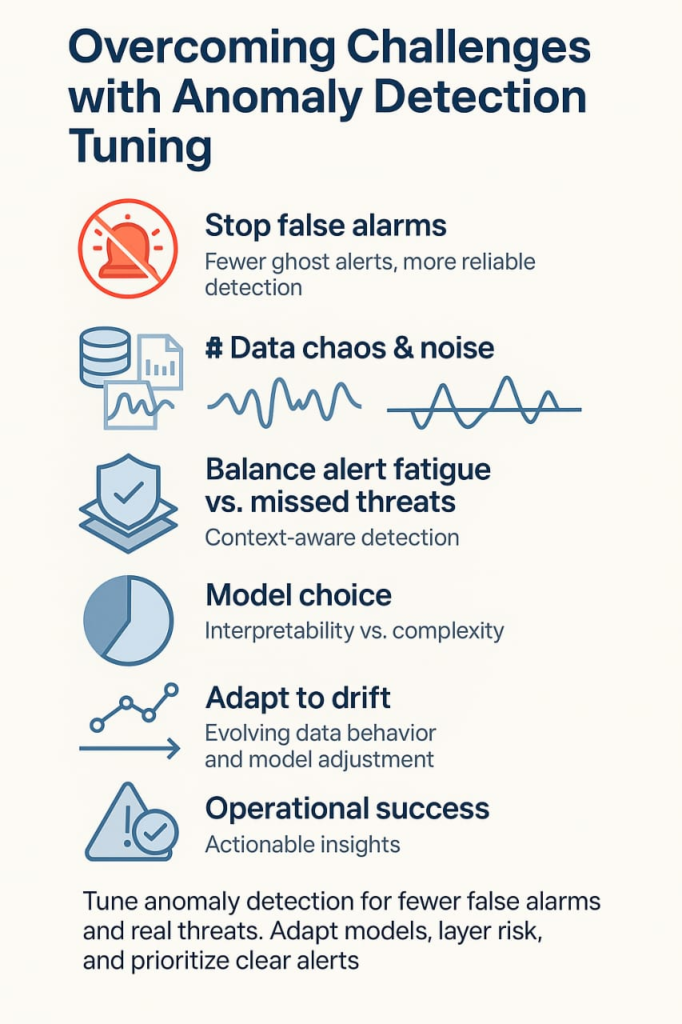
The goal isn’t perfection, it’s confidence, fewer ghost alerts, fewer blind spots, and a monitoring setup that gives you back your nights.
Key Takeaways
- Your data’s inherent imbalance and noise are the primary sources of tuning difficulty.
- Model selection is less about power and more about interpretability and adaptability.
- Operational success hinges on translating detections into clear, actionable insights.
The Data Isn’t Lying, It’s Just Messy
You notice it the moment you crack open the logs: the story isn’t clean, it’s scattered. The data isn’t trying to fool you, it’s just living its own chaotic life, and you’re the one who has to make sense of it.
The First Wall: Scarce Anomalies, Heavy Bias
The first wall you hit is the data itself, and it rarely goes easy on you. It’s noisy, uneven, sometimes a bit stale, and somehow you’re expected to build something reliable on top of all that.
Anomalies are, by definition, rare. You’re chasing the weird edge cases in a world that mostly behaves the same way, day after day. That alone bends the whole problem out of shape.
This scarcity of labeled anomalies makes supervised learning feel almost impossible. You can’t really teach a model to find what it has barely, or never, seen. Even when those rare events do happen, three more problems line up right behind them:
- Someone has to notice the event in time.
- Someone has to log it correctly.
- Someone has to label it with care and context.
Expert labeling is slow and expensive, and that’s not a knock on the experts. They’re usually busy dealing with the incident in real time, not babysitting the dataset. So you end up with logs where 99 out of 100 entries basically say: “everything is fine.”
This data imbalance isn’t just a quirky statistic, it acts like a bias factory. The model naturally drifts toward predicting “normal,” because from its point of view, that’s almost always the right answer.
Calling everything safe becomes a kind of winning strategy. For you, that’s a quiet disaster, because the rare anomalies you actually care about are exactly the ones it learns to overlook.
High-Dimensional Fog and the Noise Problem
On top of that, modern systems don’t track just one or two signals. You’re flooded with metrics: latency, error codes, CPU usage, memory, traffic patterns, user clicks, sensor readings, and more.
High-dimensional data sounds powerful on paper, but in practice it throws a thick fog over what’s actually happening. This is where network anomaly detection techniques become essential—they help cut through noise and highlight the truly unusual patterns hiding in the data.
In this sea of features, separating a true anomaly from background noise starts to feel like guessing. A sharp spike in one metric might be a critical failure, or it might just be Tuesday’s backup routine waking up.
A tiny, quiet shift across several features might be the early sign of a slow-burning problem, or it might be nothing at all.
The noise doesn’t just sit there passively, it goes after your system’s reliability. It breeds false positives that wear people down. When your model shouts “anomaly” every few minutes, the team stops caring.
They start dismissing alerts on autopilot. That’s how alert fatigue creeps in: the warnings keep coming, but the attention quietly drains away.
Then, when the model finally flags something that really matters, no one is listening. If you tighten the system to cut those false alarms, you move the problem in the other direction.
Now you risk letting important anomalies slide by without a sound. That constant tension, catching everything vs. not annoying everyone, sits right at the center of real-world anomaly detection.
The Silent Damage of Inconsistent Labels
Beneath all of this, there’s another quiet problem: inconsistent labels. A single mislabeled event from six months ago doesn’t look dangerous on its own, but it can quietly bend your model’s understanding. One team might label a spike as “maintenance,” another might call a similar spike an “incident,” and a third team may not label that kind of event at all.
The model doesn’t know who had the right story. It just absorbs whatever you feed it. Those small, scattered mistakes start to blur the line between normal and abnormal. And once that line is smeared, it’s hard to see where the model went wrong, and even harder to repair it.
Working Smarter With Imperfect Data
At some point, you realize you’re not going to win by waiting for perfect data. The strategy has to shift from chasing perfection to working wisely with the mess in front of you.
1. Put Data Quality Before Model Complexity
- Instead of reaching first for a deeper network or a shiny new algorithm, it often pays more to clean the basics: Clear, shared definitions of “normal,” “incident,” “maintenance,” and “anomaly.”
- Cleaned and corrected labels where you can manage it.
- Leveraging unsupervised learning anomaly detection methods can also help, as they focus primarily on understanding normal behavior and flagging deviations without relying heavily on labeled anomalies.
- This approach aligns well with real-world data imperfections.
- Simple validation checks so you don’t feed pure garbage to the model.
A simpler model with steady, trustworthy input often behaves better than a very complex model trained on chaos. You’re not dumbing the system down, you’re giving it a fair chance.
2. Lean Into Semi-Supervised “Normal” Learning
Since normal behavior is what you have the most of, it makes sense to lean on that fact. Semi-supervised methods use large amounts of unlabeled (or mostly normal) data to learn what “ordinary” looks like, then flag deviations.
That mirrors how people actually work: you walk into a system you know well, and you don’t need a label on every event. You feel that something is wrong because it doesn’t fit the usual rhythm.
So instead of waiting for perfectly labeled anomalies, you:
- Train models on normal operation.
- Let them build a tight idea of typical patterns.
- Watch for patterns that sit just outside that comfort zone.
You won’t catch everything, but you move from blind guessing to pattern awareness.
3. Use Dimensionality Reduction to Cut Through the Noise
High-dimensional data doesn’t have to stay that way. Techniques that compress or select features help you focus on what actually carries signal.
You’re not just shrinking the dataset for fun, you’re trying to find a version of the space where structure shows up more clearly and random wiggles fall into the background a bit.
When you reduce the dimensions carefully, clusters, outliers, and trends are easier to spot, both for humans and for models.
Learning to Live With the Mess
The goal isn’t to magically fix reality and have perfect data. Real data will always be a bit late, a bit biased, sometimes mislabeled, sometimes wrong in ways you only notice months later.
So the job shifts: you start by accepting the mess, not surrendering to it. Then you design methods and models that can live with those imperfections, bend with them, and still point you toward the rare, important events that hide inside the flood of “everything is fine.”
Your Model Choice Sets the Stage

You can almost feel the temptation when you stare at a messy dataset: reach for the biggest, flashiest model and hope it somehow “figures it out.”
But the moment an alert fires, that choice comes back to you. Someone will ask, “Why did it flag this?” and if the model is a total black box, the room goes quiet.
Why Interpretability Comes First
In this kind of work, interpretability isn’t a bonus feature, it’s the price of admission. An anomaly detector that can’t be explained to a non-technical stakeholder often stalls out.
If you can’t say what changed, which feature moved, or why this pattern looks suspicious, you’re asking people to act on faith, not understanding.
That’s why simpler models, statistical tests, clustering, distance-based methods, often punch above their weight. They may not sound impressive, but their reasoning is visible:
- You can point to thresholds and distances.
- You can show how a point stands far from a cluster.
- You can tie alerts to concrete changes in specific metrics.
Those clear links make it easier for someone outside the modeling world to trust the signal.
Walking the Tightrope of Hyperparameter Tuning
Then there’s tuning. In anomaly detection with scarce labels, hyperparameters stop feeling like small dials and start feeling like loaded questions.
With too much focus on the few labeled anomalies you do have, you drift into overfitting. You end up with a model that can recite past incidents perfectly but has no sense for new patterns. It memorizes history instead of learning behavior.
On the other side, underfitting gives you a model that’s so broad and vague it glides past anything subtle. It shrugs at the very signals you hoped it would notice.
So tuning stops being a hunt for a single “best” configuration. Instead, you’re looking for a stable region of settings that:
- Work reasonably well on the data you have.
- Don’t collapse the moment conditions shift.
- Keep performance from swinging wildly with every small change.
You’re not aiming for a magic number, you’re aiming for robustness.
Metrics That Actually Matter
Even evaluating the model feels upside down at first. Accuracy—the comfort metric from other tasks, basically misleads you here.
If anomalies are 0.1% of your data, a model that calls everything “normal” hits 99.9% accuracy, and yet it’s completely useless. It never catches the events you care about.
So you move the focus to precision and recall, and you live in that tension:
- High precision: fewer false alarms, fewer wasted investigations, but you risk missing real threats.
- High recall: more of the true anomalies are caught, but you pay with extra noise and alert fatigue.
There’s no universal sweet spot. The right balance depends on your system, your team, and how much risk you’re willing to tolerate. Some environments can afford noise, others can’t.
The Model Is Just a Tool
When you zoom out, the model isn’t the hero in this story. It doesn’t save the day on its own. It’s a tool, powerful or clumsy depending on how well it matches the problem, the data, and the people using it.
Choosing a model that balances interpretability with effectiveness is key, sometimes simpler models that integrate well with your existing security workflow outperform complex black-box solutions.
This is a core principle in anomaly detection techniques that truly work in operational environments.
A well-chosen, interpretable, moderately tuned model that fits your risk tolerance often beats an impressive black box that no one trusts or understands.
The stage is set long before deployment, in the choices about what you build and how clearly it can explain itself when it points to an anomaly and says, “this is not normal.”
Making It Work in the Real World
Credits: The Dashboard Effect Podcast
The model can look beautiful on a dashboard, all clean curves and perfect metrics, but the moment it leaves the lab, reality starts pushing back. Data in production doesn’t sit still, it shifts under your feet.
When “Normal” Won’t Stay Put
What you call “normal” today won’t stay normal forever. Concept drift is that slow, steady slide in behavior over time, new users, new features, traffic at different hours, hardware changes, even policy changes [1].
A model trained on last quarter’s data can quietly go stale. It’s not that it suddenly turns useless overnight, it just drifts out of sync with how the system now behaves.
So you can’t treat anomaly detection as a set-and-forget project. You need some form of adaptation:
- Periodic retraining on more recent data.
- Continuous learning, where the model updates as the world changes.
- Scheduled checks to see if “normal” has shifted enough to require new baselines.
If you don’t, the model will slowly fail, not dramatically, but by becoming less relevant day by day.
The Friction of Integration
Even if the model is solid, plugging it into the real system can be its own small storm. Legacy infrastructure doesn’t always welcome new tools.
You might run into strange formats, rigid APIs, or old alerting pipelines that don’t like new signal types. The model’s output has to fit into what already exists, especially alerting and ticketing systems, without breaking the workflows people rely on.
And then there’s the message itself. An alert that says, “Anomaly detected with 87% confidence” sounds technical, but it doesn’t actually help anyone decide what to do. People need:
- What changed (which metric or feature).
- How severe it looks (is this a spike, a drift, a sudden drop).
- Suggested next steps or likely causes, even if approximate [2].
Without that context, the alert just becomes noise with a number attached.
Not All Anomalies Deserve the Same Attention
Once the system starts flagging events, another challenge shows up: some anomalies matter a lot, others barely matter at all.
Treating every anomaly like a fire alarm burns people out quickly. So you need a way to prioritize:
- Suppress or downgrade patterns you’ve already confirmed as harmless.
- Escalate events that hit certain critical metrics, users, or services.
- Add rules or policies that use context, time of day, system load, business impact.
This is where domain knowledge stops being optional. The model can surface candidates, but it doesn’t know which anomalies could cost you millions and which just mean a nightly batch job ran longer than usual. A useful system ends up as a kind of partnership:
- The detector spots the odd patterns.
- Humans review, react, and label what really mattered.
- That feedback feeds back into the system, sharpening future detections.
Over time, that loop, detection, response, learning, turns a noisy experimental model into something that actually supports the work, instead of just adding one more alert to ignore.
From Tuning Headaches to Confident Monitoring
You can almost feel the gap between how clean the theory looks on paper and how stubborn reality is when you try to apply it.
Most of the pain in anomaly detection tuning comes from that gap, the neat world of algorithms meeting data and operations that are anything but neat.
Changing the Way You Think About “Perfect”
The way through isn’t more magic, it’s a different angle. Instead of hunting for a single perfect threshold or a flawless model, the work shifts toward building a system that can bend without breaking. That means putting a few ideas at the center:
- Treat data quality as your foundation, not an afterthought.
- Pick models you can explain, even if they’re simpler on paper.
- Shape outputs so they answer, “What should we do now?” not just, “Something looks odd.”
When the people reading the alerts can see why something fired and what it might mean, the system starts to feel less like a black box and more like a teammate.
A Continuous, Not One-Time, Process
Anomaly detection that actually helps you isn’t a one-and-done setup. It’s closer to a constant calibration loop, watching how the system behaves, adjusting thresholds or retraining when “normal” shifts, and folding human feedback back into the design.
Over time, the aim is simple: you want the system to serve you, not drag you around. The monitoring should:
- Reduce the background noise instead of adding to it.
- Highlight the few events that deserve real attention.
- Grow a bit sharper each cycle as you learn from past alerts.
If you want a concrete starting point, keep it small: pick one source of noise in your current alerts this week, audit it carefully, and see what you can clean up or re-label.
Even that single pass can bring a surprising amount of clarity, and show you where the next improvement should be.
FAQ
How can I set anomaly detection thresholds without increasing false positives in anomaly detection or creating a false negatives issue?
Setting anomaly detection thresholds requires managing imbalanced datasets, noisy data problems, and rare event detection.
You must balance alert fatigue, threshold calibration, sensitivity vs specificity tradeoff, and the precision recall tradeoff.
Many teams adjust anomaly window size, anomaly scoring, adaptive thresholding, and dynamic thresholding to limit unnecessary alerts while preserving the ability to catch meaningful anomalies.
What helps manage model drift, data drift, and concept drift when tuning machine learning models for anomaly detection?
Model drift grows when gradual drift detection, feature drift detection, and missing data anomalies go unchecked.
Teams monitor baseline modeling issues, windowing strategy issues, normalization impact, feature scaling problems, and seasonal baseline shift.
Strong oversight prevents overfitting anomalies, underfitting anomalies, and statistical anomaly detection errors, especially when systems encounter edge-case anomalies, sudden spikes detection, or evolving data behavior.
How should I choose between supervised, unsupervised, and semi-supervised anomaly detection when facing ground truth scarcity?
Ground truth scarcity creates supervised anomaly detection issues and increases anomaly labeling difficulty.
Many teams consider semi-supervised anomaly detection or face unsupervised anomaly detection challenges involving outlier contamination or synthetic anomalies generation.
Careful review of evaluation metric challenges, ROC curve limitations, PR curve interpretation, and black-box model issues helps determine which method best fits the available data and operational needs.
What makes anomaly detection harder when working with time series anomalies, multivariate anomaly detection, or contextual anomalies?
Time series anomalies create real-time anomaly detection issues when detection latency, rolling median issues, and z-score limitations arise. Seasonality handling, seasonal baseline shift, and correlation-based anomalies add complexity.
Clustering-based anomalies, LOF parameter tuning, isolation forest tuning, autoencoder anomaly issues, and reconstruction error threshold challenges increase difficulty, especially when teams aim to reduce noise in detection and improve anomaly confidence score.
How can SOC teams improve alert prioritization and reduce alert fatigue when anomaly detection systems scale?
SOC teams manage alert prioritization while facing anomaly suppression errors, anomaly escalation rules, and challenges setting alert thresholds for SOC.
They must handle streaming data anomalies, anomaly detection in cybersecurity, anomaly detection in IoT, and operationalizing anomaly models.
Effective improvement requires anomaly detection system calibration, monitoring model robustness issues, addressing root cause analysis difficulty, supporting anomaly feedback loops, and managing continuous tuning requirements.
Turning Tuning Chaos Into Clearer Detection
Tuning anomaly detection isn’t about perfection, it’s about resilience. Your system will never silence every false alarm or catch every rare event, but it can become dependable with the right foundation.
When you prioritize clean data, transparent models, and actionable outputs, tuning shifts from a constant firefight to a manageable routine.
Treat detection as an evolving partnership between humans and machines. With steady calibration, you gain clarity, reduce noise, and finally reclaim your nights.
Ready to strengthen your detection strategy and enhance threat visibility? Join here
References
- https://www.evidentlyai.com/ml-in-production/concept-drift
- https://www.exabeam.com/explainers/ueba/behavior-anomaly-detection-techniques-and-best-practices/