
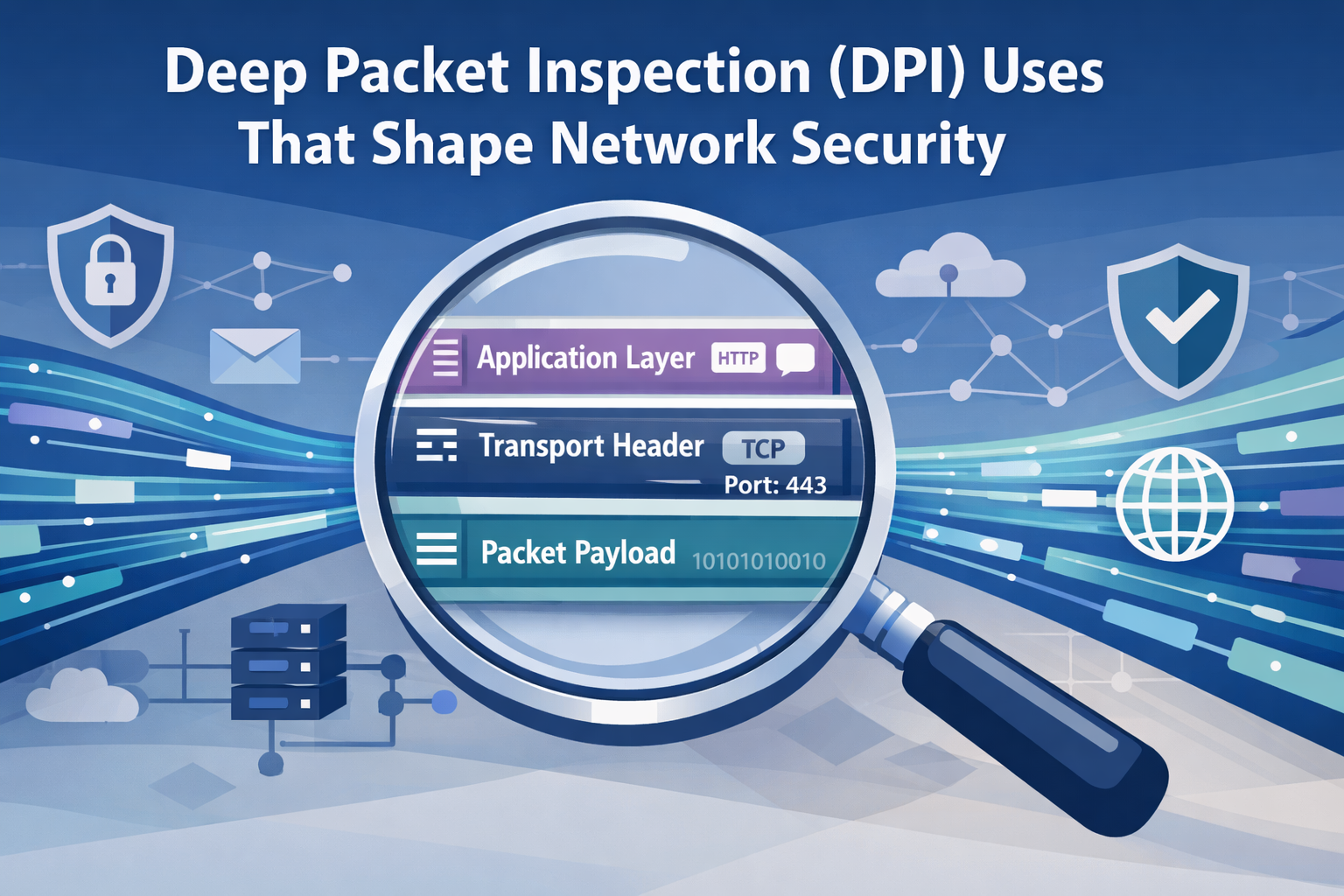
Deep Packet Inspection (DPI) is a method of examining both the headers and the full payload of data packets as they move across a network, so you can see exactly which applications and services are in use.
Instead of stopping at surface details, DPI looks inside the traffic at the application layer, picking up security threats, policy violations, and performance problems that basic filtering would miss.
That’s why it now sits at the core of many next-generation firewalls and monitoring tools. If you want tighter control and clearer insight into your network, keep reading.
Key Takeaway
- DPI enables application-aware security beyond port-based filtering
- Provides granular traffic optimization typically 10-30% in SSL cases” for precision and threat detection
- Faces challenges with encrypted traffic and performance overhead
Deep Packet Inspection Benefits

The advantages of implementing DPI extend across security, performance, and compliance domains.
DPI blocks up to 99% of certain attacks like OWASP Top 10, per studies” or remove/cite vendor source. The technology provides concrete benefits that justify its computational demands.
Network managers gain application-level visibility that was previously impossible. You can distinguish between Zoom video calls and TikTok streams even when they use the same ports.
This level of insight aligns closely with modern network threat detection methods that blend signature, behavioral, and AI detection for comprehensive threat spotting, enhancing overall security posture.
This enables precise policy enforcement based on actual application usage rather than assumptions. Bandwidth management becomes truly effective when you can prioritize business applications over recreational traffic.
Security teams benefit from threat detection capabilities that go beyond surface-level analysis.
DPI identifies malware hidden within legitimate-looking traffic patterns. It detects data exfiltration attempts that would escape notice with basic monitoring. The technology also supports compliance requirements through detailed logging and policy enforcement.
What is Deep Packet Inspection Technology
Credits: Waqas Tech Videos
DPI technology operates at Layer 7 of the OSI model, examining packet payloads rather than just headers.
This deep analysis uses multiple techniques including signature matching, behavioral analysis, and protocol decoding. The system reconstructs data streams from individual packets to understand complete communication sessions.
The technology compares packet contents against databases containing thousands of application signatures.
Modern systems recognize over 5,000 different applications regardless of what ports they use. This port-agnostic approach is essential since many applications now share common ports like 443 for HTTPS traffic.
DPI engines maintain state information across multiple packets, enabling them to detect threats that span several transmissions.
This session-aware analysis provides context that single-packet inspection misses completely.
The technology makes real-time decisions based on configured security policies and traffic management rules.
How DPI Examines Network Traffic

The examination process begins with packet capture and reassembly. DPI systems reconstruct fragmented packets into complete data streams before analysis.
This ensures threats split across multiple packets don’t escape detection. The inspection happens in microseconds through specialized hardware acceleration. Traffic examination follows a structured approach:
- Header analysis for basic filtering decisions
- Payload examination for content identification
- Protocol decoding to understand communication patterns
- Signature matching against known applications and threats
- Behavioral analysis to detect anomalies
This multi-layered approach provides comprehensive visibility into network activities. The system can identify applications, detect threats, and enforce policies based on the complete picture rather than partial information.
| Inspection Stage | What DPI Examines | Security and Control Outcome |
| Packet Capture | Raw packets entering the network | Provides full traffic visibility |
| Session Reassembly | Fragmented packets reconstructed into sessions | Detects multi-packet threats |
| Protocol Decoding | Application protocols and behavior | Identifies protocol misuse |
| Payload Inspection | Application-layer payload content | Enables malware and data leak detection |
| Behavioral Analysis | Traffic patterns over time | Detects anomalies and zero-day threats |
DPI for Application Identification and Control

Application identification represents one of DPI’s most valuable capabilities. The technology recognizes applications by their unique payload signatures rather than port numbers.
This is crucial since modern applications frequently use non-standard or shared ports. The control possibilities are extensive. You can:
- Block specific applications like peer-to-peer file sharing
- Prioritize business software over recreational apps
- Enforce acceptable use policies effectively
- Monitor for unauthorized application installations
This granular control extends to quality of service management. Network administrators can ensure critical applications receive necessary bandwidth while limiting non-essential traffic.
The port-agnostic nature makes these controls effective against application evasion attempts.
Using DPI for Security Enforcement

Security enforcement leverages DPI’s deep visibility to detect sophisticated threats. The technology examines payload content for malicious patterns that header-based inspection misses.
This includes hidden exploits, data exfiltration attempts, and command-and-control communications. DPI enhances security through:
- Intrusion prevention by blocking malicious payloads
- Data loss prevention via content scanning
- Malware detection using multiple analysis methods
- Zero-day threat identification through behavioral analysis
The technology integrates with security systems to provide coordinated defense. When DPI detects threats, it can trigger immediate blocking actions or alert other security components for further investigation.
DPI Performance Considerations and Hardware
Performance optimization is critical for successful DPI implementation. The computational demands of deep analysis require specialized hardware approaches to maintain network performance.
Software-only solutions often struggle with high-traffic environments. Hardware acceleration options include:
- ASICs (Application-Specific Integrated Circuits) for dedicated processing
- FPGAs (Field-Programmable Gate Arrays) for flexible acceleration
- Network processors optimized for packet handling
Proper hardware selection ensures DPI operates at multi-gigabit speeds without introducing unacceptable latency. The performance impact varies based on implementation quality, with optimized systems maintaining throughput while adding minimal delay [1].
Detecting Threats Within Packet Payloads
Threat detection capabilities distinguish DPI from superficial inspection methods. By examining payload content, DPI identifies threats that evade basic security measures [2].
This includes malware hidden within legitimate-looking traffic and sophisticated attack patterns. The technology detects threats through multiple methods:
- Pattern matching against known threat signatures
- Behavioral analysis of communication patterns
- Heuristic detection of suspicious content
- Anomaly identification compared to established baselines
This comprehensive approach provides defense against both known and emerging threats. The deep inspection reveals malicious content that would otherwise pass through undetected.
Limitations of DPI with Encrypted Traffic
Encrypted traffic presents the most significant challenge for DPI technology. When payloads are encrypted using TLS/SSL protocols, DPI cannot examine the content without additional measures.
This limitation grows more pressing as encryption becomes standard practice. Workarounds exist but introduce complications:
- SSL inspection requires decryption/re-encryption processes
- Performance impacts can reach 20-30% throughput reduction
- Privacy concerns arise from breaking end-to-end encryption
- Legal considerations vary by jurisdiction
These limitations mean DPI must be part of a broader security strategy rather than a complete solution. The technology remains effective for unencrypted traffic and situations where SSL inspection is feasible.
Lawful Interception Using DPI
Lawful interception represents a specialized DPI application where authorized entities monitor specific communications. This use case operates under legal frameworks requiring proper authorization and oversight. Interception capabilities include:
- Targeted metadata collection from specific users
- Content extraction from communications sessions
- Real-time monitoring of authorized targets
- Historical analysis of intercepted data
This application operates within strict legal boundaries, typically requiring warrants or court orders. It demonstrates DPI’s capabilities while highlighting important privacy considerations.
DPI in Next-Generation Firewalls (NGFW)
Next-generation firewalls integrate DPI as a core capability, distinguishing them from traditional firewalls.
This integration enables application-aware security policies that adapt to modern network environments. NGFWs use DPI to understand context and make intelligent enforcement decisions. The integration provides:
- Unified security policy management
- Granular control based on multiple factors
- Threat prevention integrated with application control
- Simplified management through consolidated platforms
This convergence makes NGFWs with DPI essential for contemporary network security. The technology enables policies that reflect actual business needs rather than technical limitations.
Bypassing DPI Techniques and Detection
Adversaries continuously develop methods to evade DPI inspection. Understanding these techniques is essential for effective defense. Common evasion methods leverage encryption, obfuscation, and protocol manipulation. Evasion techniques include:
- Encryption hiding malicious payloads
- Protocol tunneling disguising actual content
- Traffic fragmentation overwhelming inspectors
- Port hopping avoiding pattern recognition
Detection challenges require advanced DPI capabilities combined with complementary security technologies. Behavioral analysis and threat intelligence enhance DPI’s effectiveness against sophisticated evasion attempts.
Implementing Effective DPI Strategies
Deep Packet Inspection delivers significant benefits when implemented thoughtfully. The technology provides unprecedented visibility into network activities, enabling precise security enforcement and performance optimization.
However, its effectiveness depends on addressing performance requirements and encryption limitations.
Successful implementation requires balancing inspection depth with network performance. Organizations should combine DPI with other security measures to create defense-in-depth protection.
The technology works best as part of an integrated security strategy rather than a standalone solution.
Consider your specific requirements for application control, threat detection, and performance needs when planning DPI deployment.
Start with a clear understanding of what you want to achieve and how DPI fits into your overall security architecture. The right implementation can significantly enhance your network security while maintaining operational efficiency.
FAQ
How does deep packet inspection support application control beyond ports?
Deep packet inspection uses packet payload analysis and application layer inspection to identify applications regardless of port numbers.
This port-agnostic classification allows accurate application identification even when multiple applications share the same ports.
As a result, teams can enforce application control firewall rules, apply traffic shaping QoS, and perform bandwidth optimization based on actual traffic behavior rather than port assumptions.
Can DPI detect threats that traditional security tools fail to see?
DPI technology detects threats by inspecting payloads using signature matching DPI, protocol decoding, and behavioral anomaly detection.
This approach enables malware identification DPI, exploit detection, and command-and-control C2 blocking.
By analyzing full sessions instead of isolated packets, DPI strengthens intrusion prevention systems and improves zero-day threat detection beyond basic rule-based inspection.
How does DPI handle encrypted traffic without excessive performance loss?
Encrypted traffic challenges limit deep content inspection, especially with TLS 1.3 and end-to-end encryption.
Some environments apply SSL decryption inspection selectively to regain visibility. Hardware acceleration DPI, including ASIC FPGA performance, helps reduce latency and maintain throughput optimization.
Most deployments balance inspection depth with privacy concerns and acceptable DPI performance overhead.
What role does DPI play in compliance and lawful interception?
DPI supports lawful interception by enabling controlled network traffic examination and session reassembly under proper authorization.
It also assists with compliance auditing GDPR by providing detailed traffic records and policy enforcement logs. These capabilities allow organizations to meet regulatory requirements while maintaining visibility for network forensics and security investigations.
How is DPI used in zero trust and threat hunting operations?
In zero trust architecture, DPI provides real-time traffic monitoring that supports SOC threat hunting and network detection response.
Stateful inspection, heuristic analysis, and machine learning DPI help identify lateral movement, insider threat detection, and advanced persistent threats.
This contextual visibility improves detection accuracy and reduces false positives during ongoing security operations.
Turning Deep Packet Inspection into Real Security Advantage
Deep Packet Inspection gives security teams true visibility into what moves across their networks, turning opaque traffic into actionable intelligence.
By enabling application-aware control, advanced threat detection, and precise policy enforcement, DPI strengthens both security and performance.
While encryption and processing overhead require careful planning, DPI delivers the greatest value when deployed alongside complementary controls.
Used strategically, it transforms networks from reactive infrastructures into environments that are monitored, managed, and protected with clarity.
Ready to gain deeper visibility and control across your network? Explore how advanced network threat detection can elevate your security strategy.
References
- https://arxiv.org/abs/2512.07123
- https://www.sciencedirect.com/topics/computer-science/inspection-packet