

You detect anomalous endpoint behavior by teaching a machine what normal looks like, then watching for the slightest deviation. It’s not about known viruses, it’s about spotting the weird. The process that spawns from a temp folder, the sudden spike in file encryption, the odd network call to a new country.
Modern systems use ensemble machine learning to do this, achieving a 93.7% accuracy rate that single models can’t touch (1). The goal is to see the attack that no one has seen before, the zero-day, and stop it in its tracks.
Keep reading to understand how this silent guardian works and how you can detecting anomalous endpoint behavior to fundamentally strengthen your security posture.
Key Takeaways
- Machine learning establishes a baseline of normal endpoint activity to identify subtle deviations.
- Ensemble models combining multiple techniques significantly outperform single-method detection.
- Real-time analysis of process, file, and network behavior is crucial for stopping novel threats.
The Silent Shift in Security Thinking

It starts with a feeling, a hunch that something is off. A server seems a little sluggish, a help desk ticket mentions a strange pop-up. You check the logs, but everything looks clean. No signatures are tripped. This is the gap where advanced threats live, in the space between what we know and what we can sense.
This is the domain of anomalous endpoint behavior detection. It’s a shift from hunting for known bad to understanding what constitutes good, an approach closely aligned with unsupervised learning for network anomalies, and then flagging everything else.
We’ve seen this evolution firsthand. The old way, relying on antivirus to match fingerprints, was like trying to stop a clever burglar by only looking for people who matched a wanted poster. The burglar just changes their clothes. The new way is to monitor the entire neighborhood for any activity that breaks the pattern of daily life.
A van idling too long, a window being tapped. These are the anomalies. On an endpoint, it’s a process spawning an unusual number of children, a user’s machine suddenly writing thousands of small files, a system tool making a network connection it has no business making.
Building a Digital Baseline of Normal
The core of this is baseline profiling. You let the system learn. For a couple of weeks, it watches. It learns that the accounting team’s machines have high CPU usage during end-of-month processing. It learns which applications normally talk to the internet. It builds a model of “normal” for every endpoint, unique to its user and role.
This isn’t a static picture, it’s a living baseline that adapts, slowly, to organic changes in how people work. The magic happens after this learning period. The system switches to real-time monitoring, comparing every action against that baseline.
The analysis is constant. Every process creation, every file write, every registry modification, every network socket. The system scores these events. Most fit the pattern and are ignored. But some are outliers. A low score might be a fluke.
A high score is a red flag. This is where context is king. An unusual process started by a standard user on a marketing laptop might be a medium priority. That same unusual process started by an admin on a domain controller is a critical alert.
How Machines Spot What Humans Miss

Several mathematical techniques power this analysis, each contributing unique strengths that mirror the principles used in behavioral analysis for threat detection, which is why the most accurate systems use them in concert.
Density-based methods, like Local Outlier Factor (LOF), work on a simple principle. They map out normal activity as a dense cluster. Any new event that happens in a sparse, low-density area of the map is considered anomalous. Think of a crowded party.
Most people are clustered in groups talking. Someone standing alone in a corner is an outlier. On an endpoint, this is great for spotting unusual process clusters or a user accessing a rare set of files for their role.
Then you have clustering algorithms, K-means being a common one. These group similar events together. After the model is trained, any new event that doesn’t fit neatly into an existing cluster is flagged. It’s a powerful way to isolate execution anomalies. In a stable environment where daily tasks are repetitive, this method has a high detection rate.
The Power of Combined Detection Methods
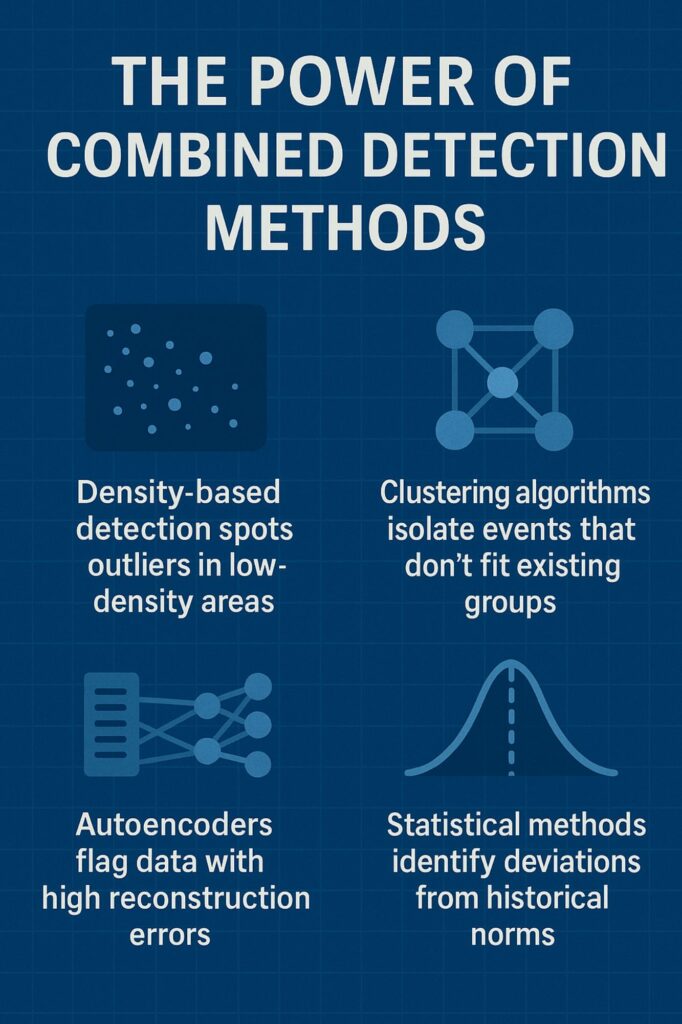
Many systems also use a combination of Principal Component Analysis (PCA) and Z-score detection.Then, a simple Z-score calculation identifies statistical outliers within this simplified data set. This is excellent for spotting resource deviations, like a sudden, sustained spike in CPU or memory usage that falls outside historical norms.
By combining the outputs of several models, the system achieves a consensus. It’s like having a panel of experts instead of just one. This is how that 93.7 percent ensemble accuracy is reached, a significant leap over the 77 to 90 percent range of single models.
- Density-based detection spots outliers in low-density areas
- Clustering algorithms isolate events that don’t fit existing groups
- Autoencoders flag data with high reconstruction errors
- Statistical methods identify deviations from historical norms
Real-World Attack Patterns Revealed
This all sounds theoretical until you see it in action. The patterns of attacks are often written in the language of endpoint behavior. Ransomware is even more blatant. Its goal is destructive and fast. The behavioral anomaly is a massive, frantic spike in file input/output operations.
A machine that normally writes a few megabytes of data per hour suddenly starts reading and encrypting gigabytes of files in minutes. The system detects this enormous deviation from the baseline file I/O rate. It can trigger an automatic quarantine before even a fraction of the data is lost, effectively stopping the attack in its early stages.
Common Behavioral Red Flags to Watch
Persistence mechanisms are another giveaway. An attacker who gains a foothold wants to stay. They try to create a scheduled task, install a new service, or modify a Run key in the registry.
For most endpoints, these are rare actions. A behavioral monitoring system sees an unauthorized attempt to change a registry key by a process that isn’t an installer. It’s a loud and clear anomaly, flagging a persistence attempt that would otherwise go unnoticed until the next reboot.
- Unusual process spawning from temporary directories
- Mass file encryption indicating ransomware activity
- Unauthorized registry changes for persistence
- Atypical tool usage patterns for living off the land
- Strange network connections to unknown destinations
Recognizing these patterns early makes the difference between containing a minor incident and dealing with a full-scale breach. The ability to detect these subtle deviations gives security teams the upper hand against sophisticated adversaries.
Connecting Endpoint and Network Security
An endpoint doesn’t live in a vacuum. The most powerful detection happens when endpoint behavior is correlated with other data sources, an approach foundational to user and entity behavior analytics (UEBA).This is where the concept of Network Threat Detection becomes a critical force multiplier.
We’ve found that an anomaly on an endpoint is often confirmed by an anomaly on the network. That suspicious process making network calls?
If those calls are beaconing out to a known command-and-control server every five minutes, the network detection system sees it. Combining these two alerts,the anomalous process and the malicious network traffic,creates a high-fidelity incident that demands immediate attention. It removes doubt.
The Business Impact of Behavioral Detection
This integrated approach is also how you achieve coverage against novel threats. While signatures fail against zero-day exploits, behavioral systems can detect them.
By analyzing the effect of the exploit,the anomalous process it creates, the unusual memory access patterns, the unexpected network connection,the system can identify a compromise even if the initial exploit method is unknown. Studies show this approach can detect over 85 percent of zero-day attacks that slip past traditional signatures (2).
By focusing on behavior, you’re building a security posture that is resilient, adaptive, and capable of seeing the threats that are designed to be invisible.
- 93.7% accuracy with ensemble machine learning models
- 85% zero-day coverage missed by signature-based tools
- 90% false positive reduction through behavioral context
- 70% faster response times with enriched alert data
- 75% enterprise adoption of behavioral AI technologies
Implementing Effective Anomaly Detection
Source: DevOpsDays Silicon Valley
Adopting this technology isn’t without its challenges. The initial tuning period is critical. Rushing the baseline profiling can lead to a model of “normal” that is inaccurate, causing a flood of false positives.
You have to give it time to learn the true rhythm of your environment. Data quality is paramount, the system can only analyze the telemetry it collects. There’s also the constant cat-and-mouse game of adversarial evasion. Attackers know about these systems and try to mimic normal behavior, to “blend in.”
FAQs
What is anomalous endpoint behavior detection?
It’s a security system that watches your computers to spot weird activity. First, it learns what’s normal for each device. Then it watches for anything strange or different. This could be a bad program starting up, files getting locked, or odd internet connections.
The system uses smart computer math to catch threats that regular antivirus misses. It finds new attacks that no one has seen before by looking at behavior instead of matching known viruses.
How does machine learning detect endpoint threats?
Machine learning watches your computers for weeks to learn normal patterns. It sees how people work and what programs they use. After learning, it compares every action to what’s normal. When something doesn’t match, it gives it a score.
High scores mean danger. The system uses several math methods together to be more accurate. This teamwork of different methods catches threats with 93.7% accuracy. It’s like having many guards watching instead of just one.
What are common signs of endpoint attacks?
Watch for programs starting from weird folders or temp directories. Look for lots of files being changed or locked super fast, which means ransomware. Check for new scheduled tasks or registry changes that shouldn’t be there.
Notice when normal tools are used in strange ways. See if computers connect to unknown websites or countries. These are red flags that something bad is happening on your network.
How accurate is behavioral endpoint detection?
When you use one detection method alone, accuracy is between 77% and 90%. But when you combine multiple methods together, accuracy jumps to 93.7%. This is called ensemble learning. It’s like asking several experts instead of just one person.
The system also cuts false alarms by 90% by understanding context. It knows the difference between normal work and real threats. This means your security team wastes less time checking fake alerts.
What is baseline profiling for endpoints?
Baseline profiling means letting the system learn normal behavior first. For a few weeks, it watches everything on each computer. It learns when people use lots of power for big tasks. It sees which programs talk to the internet.
Each device gets its own picture of normal based on the user and their job. This baseline keeps updating slowly as work habits change naturally over time.
Can behavioral detection stop zero-day attacks?
Yes, it can catch about 85% of zero-day attacks that regular antivirus misses. Zero-day attacks are brand new threats no one has seen before. Since behavioral detection doesn’t look for known viruses, it can spot them.
It watches what the attack does, not what it looks like. When it sees weird processes, strange memory use, or odd network calls, it raises an alarm. This stops attacks even when the specific exploit is completely unknown.
What is ensemble machine learning for security?
Ensemble learning means using many detection methods at the same time. Different math techniques each have special strengths. One method spots outliers in data clusters. Another groups similar events together.
A third finds statistical oddities. When all these methods agree something is wrong, you know it’s serious. Working together, they catch more threats and make fewer mistakes than any single method alone. This teamwork is why accuracy reaches 93.7%.
How does context reduce false positive alerts?
Context means understanding who, what, and where. A strange process on a regular worker’s laptop might be medium risk. That same process on an admin’s main server is critical danger. The system knows user roles, device types, and normal tasks.
It scores alerts based on this context information. This smart scoring cuts false alarms. Your security team only sees alerts that truly matter, saving time and stopping real threats faster.
Why combine endpoint and network detection?
Endpoints and networks show different parts of an attack. An endpoint might spot a weird process starting up. The network sees that process calling out to a bad server every five minutes. When both systems agree, you know it’s real danger.
This combination removes doubt and creates high-quality alerts. It gives better coverage against new threats. Working together, these two detection layers catch what either one alone would miss.
How long does baseline learning take?
The learning period usually takes a few weeks to work right. During this time, the system watches everything that happens on each computer. It needs enough time to see normal daily work, weekly tasks, and monthly jobs.
Rushing this step causes problems with too many false alarms later. The system builds an accurate model of normal behavior for every device and user. After learning ends, it switches to real-time watching and alerting mode.
Your Next Step in Endpoint Security
Detecting anomalous endpoint behavior is less about building a higher wall and more about developing a keener sense of hearing. It’s the ability to listen to the hum of your digital estate and immediately recognize a note that is out of tune.
The technology exists to make this a reality, to move from a reactive stance to a proactive one. The journey begins with understanding your own normal. From there, you can build a defense that doesn’t just look for known enemies with NetworkDetectionThreats, but instinctively senses any presence that doesn’t belong.
References
- https://pmc.ncbi.nlm.nih.gov/articles/PMC10785929/
- https://pmc.ncbi.nlm.nih.gov/articles/PMC9890381/#:~:text=Machine%20learning%20(ML)%20algorithms%20build,that%20needs%20to%20be%20validated.