
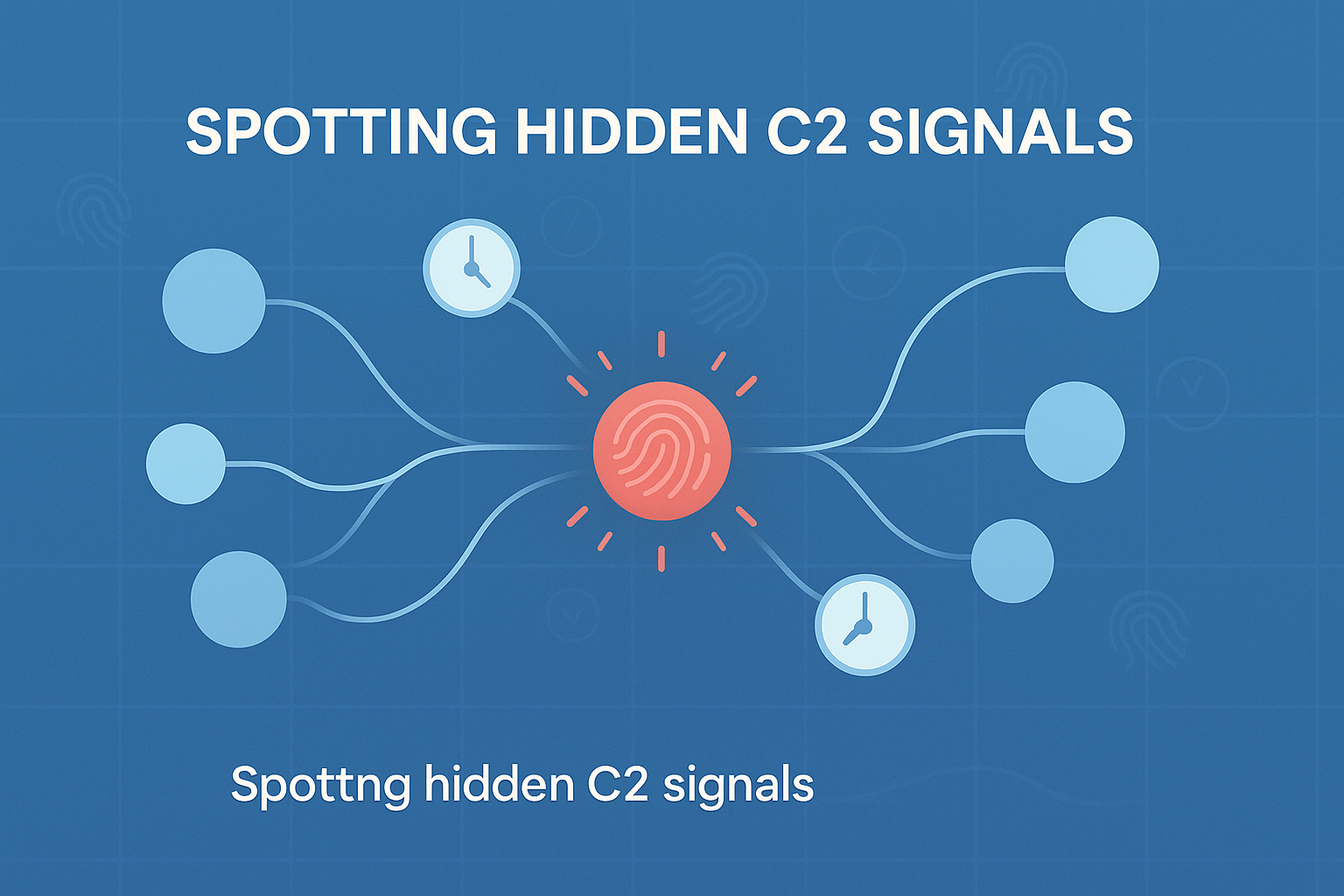
Detecting C2 communication means spotting a quiet, unnatural pattern hiding inside normal network noise.
It’s the steady, almost polite check-in from a compromised host to its controller, buried under real user traffic and routine system calls.
You might not catch the malware binary, but you can see how it bends the network’s behavior just a little out of tune.
This work isn’t about perfect signatures or clever tricks, it’s about training your eye for rhythm, timing, and small mismatches. If you want to tell normal service chatter from a live command channel, keep reading.
Key Takeaways
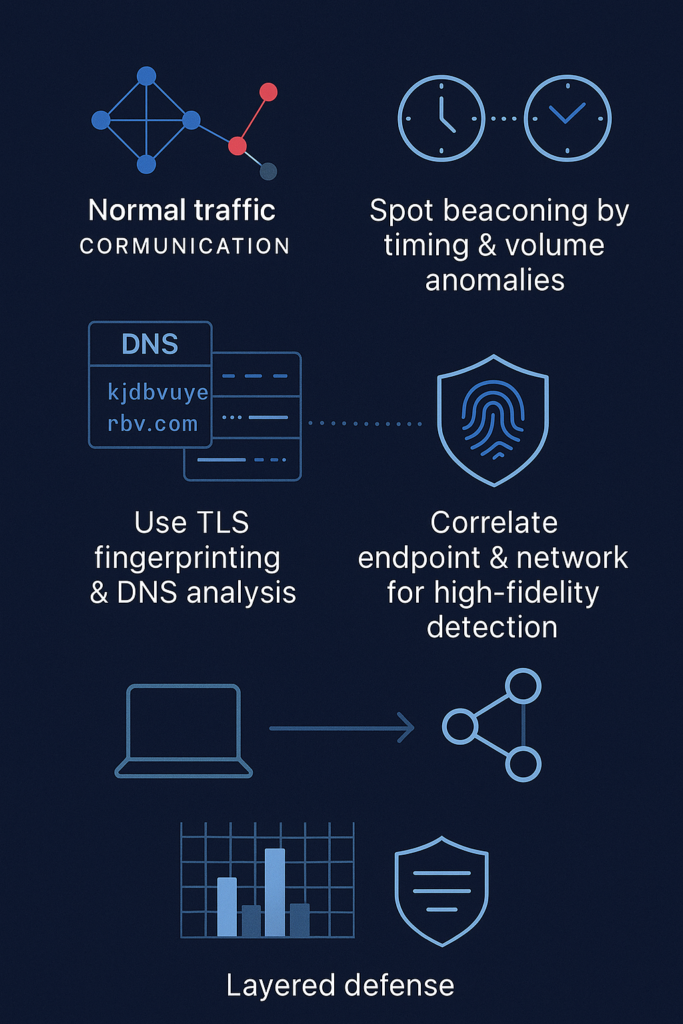
- Spot beaconing by analyzing connection timing and data volume anomalies.
- Use TLS fingerprinting and DNS analysis to uncover encrypted and obfuscated C2.
- Correlate endpoint behavior with network traffic for high-fidelity detection.
The Critical Threat of C2 Communication
It starts with a single, seemingly innocuous connection. A computer on your network, maybe your own, sends a small packet of data to an IP address you’ve never seen before. It’s a heartbeat. A check-in.
This is Command and Control, or C2, the hidden channel that allows an attacker to puppet a compromised system.
The risk isn’t the initial infection, it’s this persistent, managed access. Through this channel, data gets siphoned out, more malware is deployed, and the attacker moves laterally across your environment.
Industry reports indicate most advanced breaches rely on persistent C2 channels. Making its detection not just a technical task, but a fundamental business imperative.
Financial loss, reputational damage, and operational disruption all flow through this covert pipeline.
The challenge is that this communication is designed to be invisible. It mimics legitimate traffic, uses common protocols like HTTP and HTTPS, and often employs encryption.
Attackers use techniques like domain generation algorithms (DGAs) that create thousands of random domain names daily, making blacklisting futile.
They introduce jitter into their beaconing intervals to avoid simple time-based detection. This cat-and-mouse game means that static defenses, like traditional firewalls and signature-based antivirus, are often playing catch-up.
Detecting C2 requires a shift in mindset, from looking for known bad things to identifying subtly abnormal behavior. You’re not just hunting for malware, you’re hunting for a relationship between a machine inside your network and a server controlled by an adversary.
Core Detection Methods: Identifying Malicious Network Traffic
Anomaly-Based Detection: Spotting Deviations from the Norm
Anomaly-based detection works by first understanding what normal looks like. You establish a baseline of network behavior for each host, things like typical data transfer volumes, common destination IP ranges, and standard times of activity.
Once you know the rhythm of your network, the off-beat notes become apparent. A workstation that normally generates a few megabytes of traffic during business hours suddenly sending gigabytes of data at 3 a.m. is a glaring anomaly.
A server that only communicates with a handful of internal systems starts sending packets to a new IP in a foreign country. These deviations are the primary indicators of compromise, often more reliable than signatures for novel attacks.
The power of this method is its generality. It doesn’t need to know the specific malware strain, it just needs to recognize that something is out of place.
Tools like Zeek (formerly Bro) are excellent for this, as they log extensive network metadata, connection durations, protocols, bytes transferred, without requiring deep packet inspection.
The key is to baseline correctly, accounting for predictable changes like end-of-month backups or software updates.
Anomaly detection is your first line of defense, the system that raises its hand to say, “Hey, this doesn’t look right.” It’s the foundation for proactive threat hunting.
- Monitor for unusual traffic volume spikes, especially during off-peak hours.
- Flag connections to new, rare, or geographically suspicious external IP addresses.
- Analyze protocol usage, watching for services communicating over non-standard ports.
- Establish per-host baselines for connection frequency and data size to spot subtle changes.
Signature-Based Detection: Recognizing Known Malicious Payloads
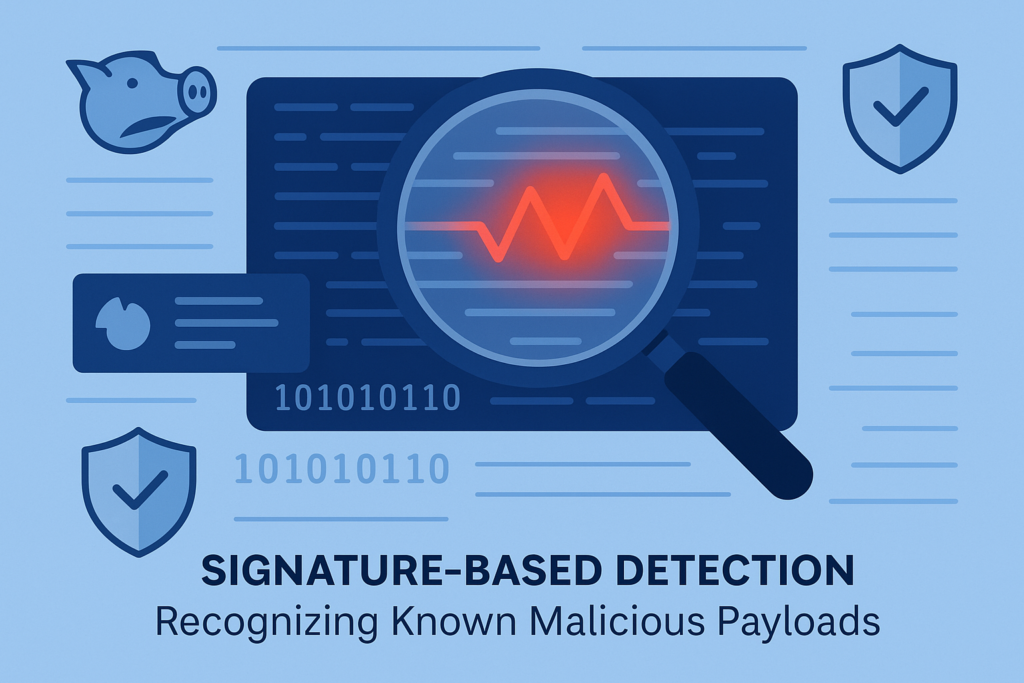
Signature-based detection is the old guard of cybersecurity. It relies on deep packet inspection (DPI) to scan the contents of network traffic for unique sequences of bytes, or “signatures,” that are known to be malicious.
Think of it as a bouncer with a list of known troublemakers. If a packet’s payload contains the exact string of code associated with a particular C2 toolkit, like Metasploit or Cobalt Strike, the traffic is blocked.
While signature-based methods remain effective for known threats, integrating them with signature-based detection systems ensures that defenses stay current with evolving malware signatures.
This method is highly effective for catching widespread, known threats and has the benefit of very low false positives when the signatures are well-tuned. Intrusion Detection Systems (IDS) like Snort or Suricata are built on this principle.
Its major limitation, however, is its inability to catch what it doesn’t know. Zero-day exploits, polymorphic malware that changes its code with each infection, and fully encrypted C2 channels easily bypass signature checks.
Relying solely on signatures is like trying to stop a flu epidemic by only checking for last year’s strain. Yet integration with real-time threat feeds enhances its role. It’s a necessary component, especially for blocking low-hanging fruit, but it’s insufficient on its own.
The value of signature-based detection today is often in its integration with threat intelligence feeds, which constantly update the list of known malicious indicators, keeping the bouncer’s list as current as possible.
Network Traffic Analysis (NTA): Examining Flows for Irregularities
Network Traffic Analysis (NTA) takes a broader view than packet inspection. Instead of looking inside each packet, NTA tools analyze the flow of communication, the who, what, when, and how much of network conversations.
They answer questions like: How long did this connection last? How many packets were sent back and forth? What was the rhythm of the communication? This is where you catch beaconing.
Beaconing is the tell-tale sign of C2, a periodic callback from the infected host to the attacker’s server. It’s a “call me maybe” that happens every few minutes or hours.
Tools like RITA (Real Intelligence Threat Analytics) are built for this. They ingest network flow data (e.g., NetFlow, IPFIX) and automatically look for patterns indicative of beaconing.
They analyze the timing between connections, looking for consistency that suggests automation rather than human interaction.
They also examine the size of the packets; C2 beacons are often small, just a “I’m still here” message, while data exfiltration will show as sustained, large transfers.
NTA gives you the context that raw signatures lack. It sees the forest, not just the trees. By examining the flow, you can identify suspicious relationships between internal hosts and external entities, even if every single packet is encrypted.
Behavioral Indicators: Unmasking C2 Activity
Beaconing: Detecting Periodic Check-Ins
Beaconing is the heartbeat of a modern malware infection. It’s how the compromised machine maintains its link to the attacker, waiting for instructions.
The classic beacon is highly regular, like a clock ticking every 60 seconds. But attackers aren’t stupid, they know this is easy to spot. So they add jitter, randomizing the interval between callbacks, maybe 55 seconds, then 65, then 58.
This makes simple timing filters less effective. The detection, then, moves from looking for perfect periodicity to identifying low-volume, persistent connections to a single destination over a long period. It’s the persistence that gives it away.
A user might visit a hundred different websites in a day, but their computer shouldn’t be checking in with the same unknown server every hour for a week.
You detect this by analyzing network logs over time. Look for external IP addresses that a host communicates with repeatedly. Then, analyze the timestamps of those connections.
Even with jitter, the pattern of communication will have a statistical regularity that differs from human-driven traffic. The volume of data exchanged is also a clue.
Beaconing traffic is usually small, often just a few packets to establish the connection and confirm availability. When you see a host having hundreds of brief, similarly-sized connections to a single external IP, you’re almost certainly looking at a C2 channel.
This kind of pattern recognition is central to behavioral analysis for threat detection, which helps spot subtle deviations from normal network activity, offering a proactive defense against attackers.
It’s a slow, patient drip of communication that, if left unchecked, can eventually flood your entire network.
Domain Generation Algorithms (DGAs): Identifying Pseudorandom Domains
What if your C2 server gets taken down? Attackers solved this problem with Domain Generation Algorithms, or DGAs.
A DGA is a piece of code on the infected host that, every day, generates a long list of potential domain names based on a seed value (like the current date).
The attacker, using the same algorithm, registers only one or two of these domains each day. The malware tries each domain in the list until it finds the one that’s live, re-establishing the C2 connection.
This makes it nearly impossible to block the C2 infrastructure proactively, as the domains are constantly changing.
Detection, therefore, shifts from blocking known-bad domains to identifying the characteristics of DGA-generated domains.
These domains often look like gibberish. They are long, use a random mix of consonants and vowels (e.g., “kjdbvuyewrbv.com”), and have high entropy. Legitimate domains are usually short, memorable, and use real words.
Machine learning models are exceptionally good at this task. They can be trained on millions of legitimate and DGA domains to recognize the statistical fingerprints of algorithmically generated names.
DNS monitoring becomes a critical control point. By flagging DNS queries that look non-human, you can detect the malware’s attempt to phone home before it even establishes a connection. It’s a way to cut the problem off at the pass.
- Analyze DNS logs for queries containing long, random-looking strings of characters.
- Look for clusters of failed DNS queries (NXDOMAIN responses) from a single host as it tests its DGA list.
- Monitor for domains with a very short Time-To-Live (TTL) value, a technique known as fast-flux used to hide C2 servers.
- Employ ML-based security tools that score domain names based on their likelihood of being DGA-generated.
Encrypted Channels: Unveiling Hidden Payloads
Encryption is a double-edged sword. It protects our privacy, but it also provides perfect cover for C2 traffic. When C2 communicates over HTTPS, traditional DPI is blind.
The payload is hidden within the encrypted tunnel. So how do you find it? You look at everything around the encryption. This is where behavioral analysis shines.
For instance, does a host suddenly start making numerous HTTPS connections to a new IP address, when its normal behavior is mostly internal HTTP traffic? That’s suspicious. Another tactic is TLS fingerprinting.
Tools like JA3/JA3S create a hash of the unique aspects of a client’s TLS handshake (the initial negotiation that sets up the encrypted connection).
Different software uses different TLS libraries and settings. The specific ciphers, extensions, and the order they are presented in create a unique fingerprint. C2 toolkits like Cobalt Strike have a known, identifiable TLS fingerprint.
Even if the domain and IP change, that fingerprint can persist, allowing you to spot the tool being used across your network. You can also examine the X.509 certificates presented during the handshake.
Certificates from free or obscure Certificate Authorities, or with odd subject names, can be red flags. The goal isn’t to break the encryption, but to identify the behavior of the encrypted session.
Is it going to a legitimate cloud provider, or to a bulletproof hosting provider known for malicious activity? The context matters as much as the content.
Advanced Techniques: Enhancing C2 Detection
Machine Learning and Deep Learning: Recognizing Subtle Features
Machine learning represents a fundamental shift from rule-based detection to pattern-based recognition. Instead of a human writing a rule like “alert on connections every 60 seconds,” an ML model is trained on millions of examples of both benign and malicious network traffic.
It learns to identify subtle, multi-faceted patterns that are difficult for a human to articulate. It might be noticed that a particular combination of packet size, time of day, destination ASN (Autonomous System Number), and TLS cipher suite is highly correlated with C2 activity.
These models can achieve remarkable accuracy, with advanced DGA classifiers achieving over 99% accuracy in controlled tests.
The real advantage is speed and scale. An ML model can analyze terabytes of network flow data in near real-time, scoring each connection for its malicious probability.
It can detect novel C2 techniques that have no known signature, simply because their behavioral pattern resembles previously seen attacks.
Deep learning, a subset of ML using neural networks, can go even further, analyzing raw packet headers or even the timing between packets to find evasive “low-and-slow” C2 channels.
These systems aren’t perfect, they require large amounts of clean data for training and can generate false positives, but they are a powerful force multiplier. They act as a highly sensitive radar, flagging anomalous traffic for a human analyst to investigate further.
Endpoint Detection and Response (EDR): Correlating Host Behaviors
Credits: IBM Technology
The network view is only one side of the coin. The other is the endpoint. Endpoint Detection and Response (EDR) tools record detailed telemetry from each computer: what processes are running, what files are being accessed, what registry keys are modified.
C2 communication rarely exists in a vacuum. It’s the result of a process on the endpoint executing malicious code. By correlating network activity with endpoint activity, you can move from suspicion to confirmation.
For example, an NTA tool might flag an outgoing HTTPS connection to a suspicious IP as a potential C2 beacon.
The integration of endpoint insights with user entity behavior analytics (UEBA) allows security teams to profile behavior across users and devices, greatly enhancing detection fidelity.
An EDR tool on that same host can then be queried: what process initiated that network connection? If the connection was spawned by a legitimate process like svchost.exe or a web browser, it might be benign (though still worth checking).
But if it was initiated by powershell.exe that was itself launched by an obscure script, or better yet, by a process that performed code injection into a legitimate system binary, you have a high-fidelity alert.
This correlation is the gold standard for detection. It closes the loop. The network evidence provides the “what” (malicious communication), and the endpoint evidence provides the “how” and “why” (the malware and its techniques).
This integrated approach dramatically reduces false positives and allows for a rapid, targeted response.
Building Your C2 Detection Strategy
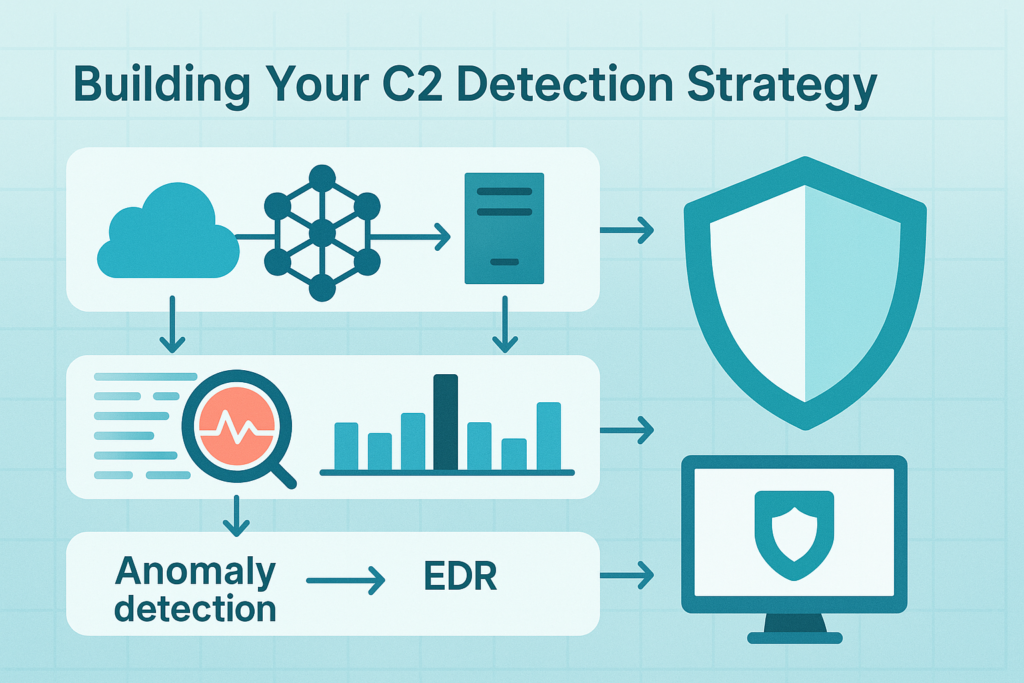
A robust C2 detection strategy uses layered defenses. It starts with visibility. You can’t detect what you can’t see.
Ensure you have logging enabled for network flows (NetFlow/IPFIX), DNS queries, and proxy traffic. Deploy an EDR agent on critical endpoints. The next layer is analysis [1].
Use a Security Information and Event Management (SIEM) system to correlate logs from these different sources.
This is where you write detection rules that look for the behavioral indicators we’ve discussed: beaconing patterns, DGA-like DNS queries, connections to known-bad IPs from threat intel feeds.
The final layer is hunting. Even with the best automated systems, some threats will slip through. Proactive threat hunting involves manually searching through your data for the subtle signs of C2 that machines might miss.
This could be as simple as reviewing all external IPs a particular server has talked to in the last month and investigating any that seem out of place. The strategy is never static. Attackers adapt, and so must you.
Regularly review your detection rules, tune them to reduce noise, and incorporate new threat intelligence. It’s a continuous process of refinement, a commitment to understanding the normal rhythm of your network so you can hear the dissonant notes of an intruder.
The Final Analysis on C2 Detection
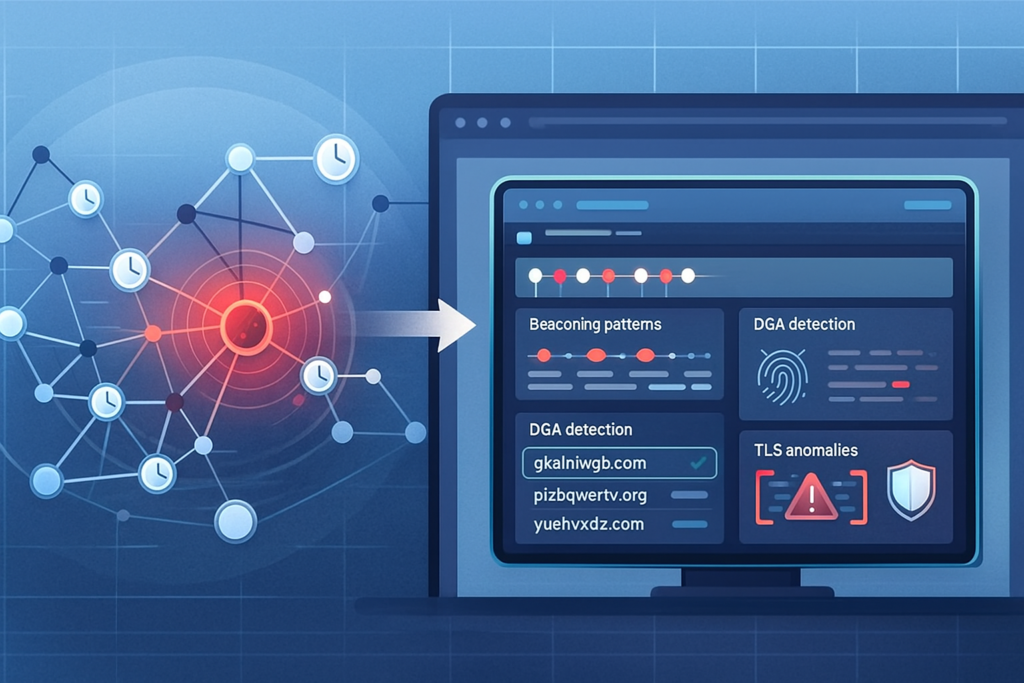
Detecting C2 communication is ultimately an exercise in pattern recognition and context. It’s about moving beyond a checklist of known bad things and developing a feel for the abnormal pulse of your own network [2].
The most effective approach combines the broad visibility of network traffic analysis with the deep forensic context of endpoint monitoring.
By looking for the persistence of beaconing, the gibberish of DGA domains, and the subtle fingerprints left even by encrypted traffic, you can uncover these hidden channels.
There is no single tool that solves this problem. It’s the synergy of data, technology, and human intuition that builds a resilient defense. Start by baselining your normal, then listen carefully for the quiet, consistent signal that shouldn’t be there.
FAQ
What signs should I look for when detecting C2 traffic on my network?
You can look for signs such as anomalous outbound traffic, unexpected IP communication, and rare destination analysis that does not match normal activity.
Some hosts show persistent C2 connections, low-and-slow C2 behavior, or beacon timing deviation that repeats. Detecting c2 traffic also involves checking unusual port usage and covert communication behavior that stands out from everyday patterns.
How can I spot hidden C2 channels when the network traffic looks normal?
You can spot hidden c2 channels by watching for anomalous connection persistence, anomalous data transfer volume, and covert exfiltration detection signals.
C2 traffic fingerprinting, suspicious user-agent detection, and anomalous tls fingerprinting can highlight subtle issues. Many attacks hide inside c2 over https or encrypted c2 channels, so network anomaly scoring helps reveal suspicious patterns that seem normal at first.
Why do attackers use strange DNS activity for command and control detection?
Attackers use DNS because it gives them many ways to hide. You may see unusual dns query patterns, dns request timing anomalies, suspicious domain communication, or dga domain detection signals.
Some threats use fast-flux detection methods or dns tunneling detection to avoid blocking. These clues often appear early, before botnet c2 communication or compromised host callbacks become visible.
How do I detect C2 traffic that uses encryption or protocol tricks to hide?
You can detect encrypted or disguised C2 traffic by using ssl inspection for c2, rare sni detection, suspicious tls certificates, encrypted payload analysis, and tls sni anomaly detection.
These methods expose protocol misuse detection attempts. Many attacks run c2 over http or c2 over https to blend in, but careful monitoring reveals covert channel detection and traffic obfuscation detection.
What helps me find early behavioral signs of C2 before any data leaves the network?
You can find early signs by using c2 beaconing analysis, malware beacon detection, periodic callback detection, and malware heartbeat detection.
Beacon interval detection highlights c2 jitter analysis and c2 callback patterns that repeat in unusual ways. Endpoint c2 indicators, command execution telemetry, and c2 traffic baselining also support threat hunting for c2 before any c2 exfiltration patterns begin.
Mastering the Hidden Patterns of C2 Communication
Detecting C2 communication hinges on understanding the subtle behaviors that separate normal traffic from malicious intent.
No single tool can expose every hidden channel, but combining network analytics, DNS scrutiny, TLS fingerprinting, and endpoint telemetry creates a powerful detection fabric.
By continuously baselining what “normal” looks like, you sharpen your ability to spot the faint, persistent signals of compromise. With layered defenses and proactive hunting, C2 activity becomes far harder for attackers to conceal.
Ready to strengthen your detection strategy? Join the community and explore more insights here
References
- https://www.bitdefender.com/en-us/business/infozone/what-are-command-and-control-c2-servers
- https://unit42.paloaltonetworks.com/c2-traffic/