

Seeing a network threat early starts with knowing what “normal” really looks like. Instead of chasing every packet, you study the usual rhythm of your traffic, so even a small wrong note stands out.
That means building a baseline of everyday activity, then using statistics and machine learning to surface real anomalies, not noise.
This shift lets you move from reacting after a breach to quietly stopping it before it spreads. Keep reading to see how to define a baseline, pick detection methods, and match them to your own environment.
Key Takeaways
- A precise traffic baseline forms the essential foundation, often enhanced by ML for automatic adjustments.
- Machine learning models, particularly unsupervised ones, excel at finding subtle, novel threats that rule-based systems miss.
- Reducing false positives is an ongoing process of tuning and adapting to your network’s natural evolution.
The Core of Detection: Understanding Your Normal
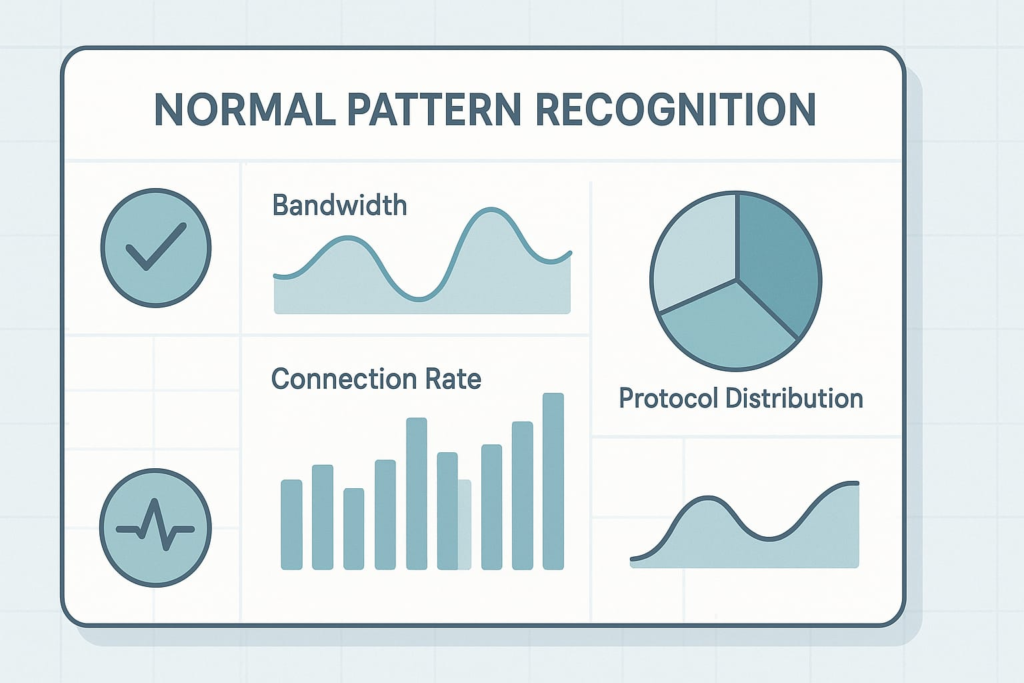
The hum of a healthy network has a certain cadence. It’s the predictable pulse of business hours, the steady stream of database queries, the regular chatter between servers.
Most network administrators develop an intuitive feel for this rhythm. They know when things sound right [1].
Detecting deviations from normal traffic is the practice of giving that intuition a concrete, automated form. It’s about moving from a gut feeling to a data-driven alarm. The goal is simple in theory, complex in execution.
You must first define “normal.” This isn’t a single number. It’s a multi-dimensional profile of your network’s behavior over time.
Think of metrics like bandwidth consumption, connection rates, packet sizes, and even the types of protocols in use.
A baseline might show that your web servers typically handle 5,000 requests per minute during peak hours, with an average packet size of 1.2 KB. Any significant departure from these established patterns is a deviation worth investigating.
Building Your Foundation: The Traffic Baseline
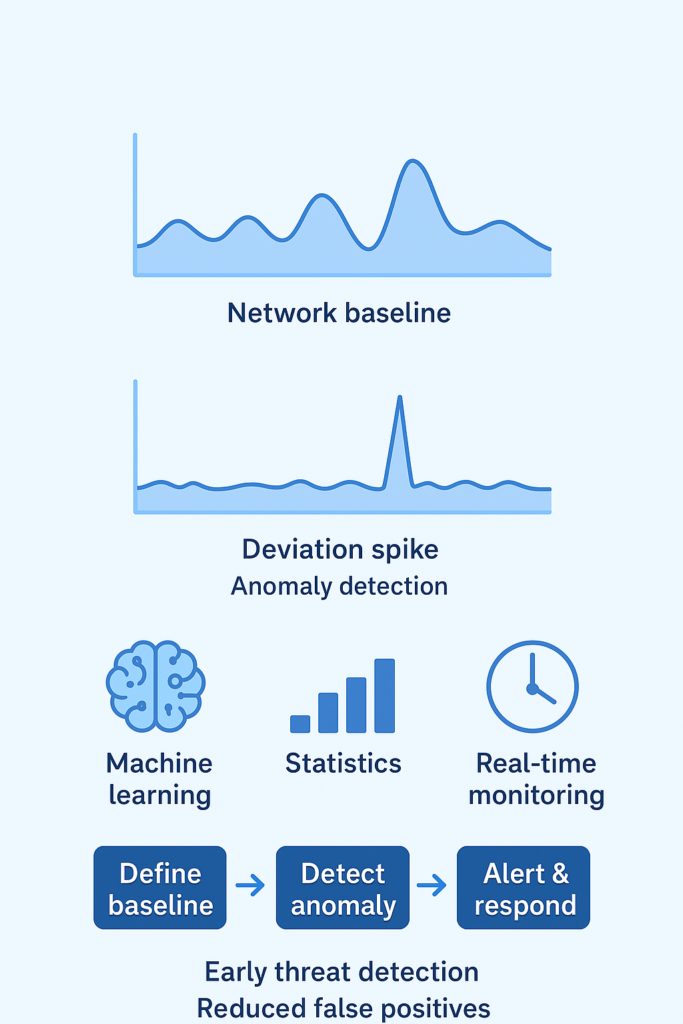
You can’t find what’s strange if you don’t know what’s standard. Establishing a traffic baseline is the critical first step, and it requires careful planning. The quality of your detection hinges entirely on the accuracy of this baseline.
The process begins with data collection. You need a representative sample of your network’s activity.
This usually means monitoring traffic for a significant period, perhaps two weeks or more, depending on cycle complexity (daily/weekly/seasonal), to capture daily and weekly cycles.
You’re looking for patterns. The quiet of night, the surge of the morning logon, the lunchtime lull. This data forms the statistical heart of your baseline.
- Key metrics to profile: Bandwidth usage, number of concurrent connections, packet arrival times, flow durations, and source/destination geolocations.
- This foundational step closely aligns with statistical anomaly detection models, which provide interpretable means to define and measure normal network behavior.
- Static vs. Dynamic: A static baseline is a fixed snapshot, useful for very stable environments. A dynamic baseline evolves, using moving averages to adapt to gradual changes, which is essential for most modern networks.
Some systems use machine learning to create these baselines automatically. They learn the typical patterns without needing explicit rules. This is especially powerful for complex networks where “normal” is a shifting target.
The baseline isn’t a one-time task, either. It should be periodically updated to reflect organic growth, new applications, and changes in user behavior. A baseline that’s six months out of date is worse than useless, it’s misleading.
Choosing Your Detection Method
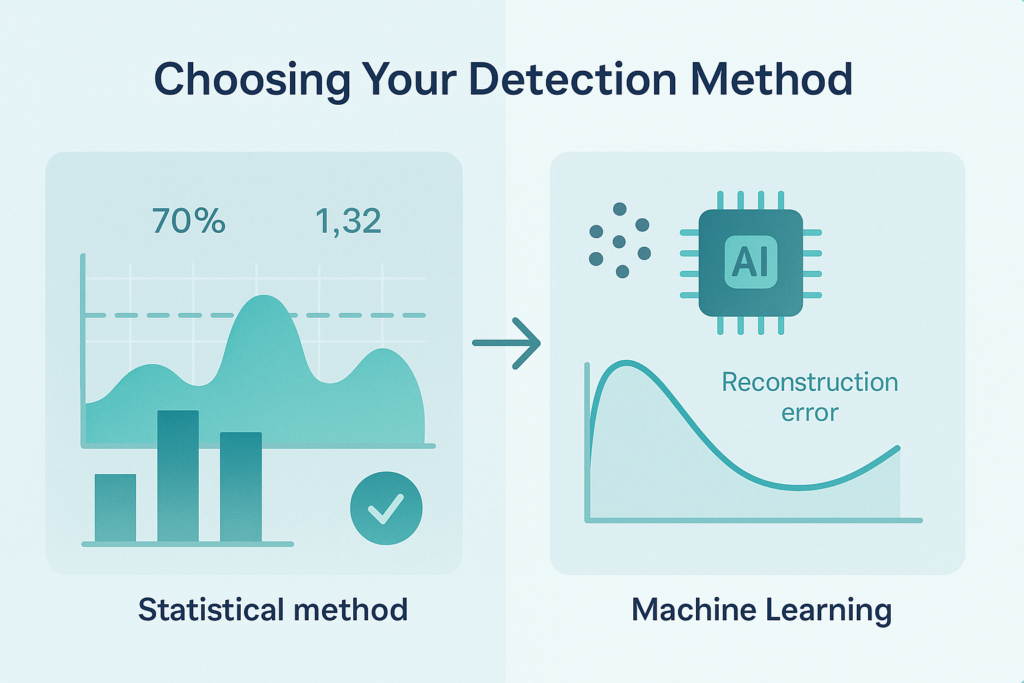
With a solid baseline in place, the next decision is how to compare live traffic against it. The choice of anomaly detection technique often depends on your network’s complexity and your security team’s resources.
There’s a spectrum of options, from simple statistics to advanced artificial intelligence. Statistical methods are straightforward workhorses. They set thresholds based on the baseline’s standard deviation or percentiles.
For example, if average bandwidth at 2 PM is 1 Gbps with a standard deviation of 100 Mbps, any usage sustained above 1.3 Gbps might trigger an alert. This is excellent for detecting obvious spikes and drops, the “smash-and-grab” style anomalies.
It’s computationally cheap and easy to understand. But it struggles with more sophisticated attacks that mimic normal traffic patterns or only cause subtle shifts.
This is where machine learning models shine. Unsupervised learning algorithms, like autoencoders or clustering models, are trained only on your normal baseline data. They learn to compress and reconstruct typical traffic patterns.
When an anomalous pattern flows through, the model has a high “reconstruction error”, it can’t accurately represent the data because it’s never seen anything like it. This error score becomes the anomaly alert.
These techniques are a central part of unsupervised learning anomaly detection, helping to identify threats without predefined signatures and adapting to unknown attack vectors.
Emerging advanced approaches, like contrastive learning, group normal traffic while isolating anomalies. This technique teaches the model to group similar, normal traffic patterns closely together in a mathematical space while pushing anomalies far apart.
It’s highly effective for real-time analysis, even on encrypted traffic where payload inspection isn’t possible. The model analyzes the flow’s metadata, timing, size, direction(—0to spot behavioral oddities.
The trade-off is that ML models require more expertise to implement and tune, and they can be resource-intensive.
Making It Work in the Real World
Implementation is where theory meets practice. Real-time monitoring is the engine of your detection system. It’s the continuous process of scoring incoming traffic against your baseline and models.
The goal is low-latency analysis, flagging potential threats within seconds, not minutes. This requires robust infrastructure, often involving flow data collectors (like NetFlow or sFlow) and a dedicated analysis platform.
The alerts generated by these systems are only as good as the response they trigger. A common pitfall is alert fatigue. If your system cries wolf too often with false positives, your team will start to ignore it.
Tuning the system for optimal sensitivity is a non-stop challenge, making statistical anomaly detection and machine learning tuning essential for balancing alert volume against detection accuracy.
You might start with a wider net, then gradually refine the thresholds to ignore known benign anomalies, like a scheduled backup job that causes a predictable traffic surge.
A well-tuned system correlates alerts. A single failed login attempt is noise. A thousand failed attempts from a new country, coupled with a strange outbound connection, is a signal.
This contextual analysis separates real threats from background chatter. The final step is integrating the detection system with your incident response playbook.
When a high-confidence anomaly is detected, what happens next? Is a ticket created? Is a connection automatically blocked? This closed-loop process turns detection into prevention.
Navigating the Challenges
No system is perfect, and anomaly detection has its share of hurdles. The biggest challenge is often the network itself. Traffic is inherently noisy and variable. A marketing campaign can cause a legitimate traffic spike that looks exactly like a DDoS attack.
New software deployments can change traffic patterns. Your detection system must be adaptable enough to learn these new normals without lowering its guard [2].
Privacy is another significant consideration behavioral anomaly detection often works on metadata alone (e.g., timing, volume, direction), without decrypting payloads.
Especially with increasing encryption. The good news is that behavioral anomaly detection often works on metadata alone.
You don’t need to decrypt HTTPS traffic to see that an internal server is suddenly communicating with a known malicious IP address in a foreign country at an unusual volume.
The “what” is encrypted, but the “who,” “when,” and “how much” are still visible and highly informative.
Finally, there’s the challenge of evolution. Attackers constantly adapt their methods. A detection model that works today may be less effective tomorrow. This necessitates a culture of continuous improvement.
Regularly reviewing detected anomalies, both true and false, is essential for retraining and refining your models. It’s a cycle, not a set-and-forget solution.
Your Path to Proactive Security
Detecting deviations from normal traffic is ultimately a shift in mindset. It moves you from a reactive posture, waiting for a signature-based antivirus to flag a known virus, to a proactive one, where unusual behavior itself is the red flag.
It’s about recognizing that threats don’t always announce themselves with a known name. Sometimes, they just sound a little off.
By investing the time to understand your network’s unique rhythm, you build an early warning system that can sense the dissonance of an attack long before the damage is done. Start by listening to your network.
Define its normal. Then, you’ll be ready to hear the silence, or the scream, that means something is wrong.
FAQ
What signs should I watch for when checking for unusual traffic patterns?
You should look for unusual traffic patterns that break your baseline network patterns. Clear signs include unexpected traffic spikes, abnormal network behavior, or protocol deviation detection that does not match past activity.
Traffic variance measurement and network usage anomalies can also point to network flow anomalies. Many teams use anomaly scoring, drift detection, and network pattern recognition to spot early network intrusion signals.
How can I tell if traffic deviation analysis shows a real threat?
You can compare abnormal network behavior against your normal traffic profiling to see if something is truly off.
Tools that rely on traffic deviation metrics, network visibility, and contextual anomaly detection help you decide whether a spike is routine or dangerous.
Many systems use correlated anomaly detection, threat pattern deviation, and traffic irregularity detection to highlight meaningful network deviation thresholds.
What methods help reduce false alerts in network anomaly detection?
You can reduce false alerts by using adaptive thresholding, anomaly clustering, and network event correlation.
These methods study behavioral baselines so pattern deviation alerts do not trigger on normal traffic changes.
Time-series anomaly detection, temporal anomaly detection, and data deviation analysis help systems understand traffic pattern drift and keep automated anomaly alerts focused on real network threat detection rather than harmless shifts.
How do machine learning anomaly models improve network monitoring?
Machine learning anomaly models improve monitoring by learning your network flow baselines through behavioral analytics and traffic fingerprinting.
They detect network signal deviation and rare event detection that older network monitoring algorithms often miss.
Many systems use unsupervised anomaly detection, ML-based traffic detection, and flow-based anomaly detection to classify unusual packet behavior and identify zero-day anomaly signals before they spread.
What makes a good baseline for detecting deviations from normal traffic?
A good baseline comes from careful network baselining, dynamic baselining, and baseline network patterns that reflect real activity.
This foundation includes network telemetry analysis, traffic flow analysis, and normal traffic profiling gathered over time.
With these in place, deviation-based detection can compare new data accurately. Strong baselines support traffic segmentation analysis, abnormal flow detection, and statistical deviation models used in anomaly detection systems.
Turning Baseline Insight into Real Security Advantage
Detecting deviations from normal traffic isn’t just a technical practice—it’s a strategic advantage. When your network understands its own baseline, every anomaly becomes meaningful.
With precise profiling, adaptive models, and continuous tuning, your defenses evolve alongside modern threats. Proactive anomaly detection helps you catch subtle intrusions early and respond with confidence.
Ready to strengthen your early-warning system? Join here
References
- https://pmc.ncbi.nlm.nih.gov/articles/PMC5908141/
- https://www.sciencedirect.com/science/article/pii/S0167404823004741