

When it comes to catching malware, detecting known malware signatures remains a cornerstone of cybersecurity. At its core, this method compares suspicious files or network data against a vast database of malware fingerprints , unique patterns that identify malicious software.
We’ve seen firsthand how relying on signature-based malware detection helps security teams quickly pinpoint threats with high accuracy.
But it’s not just about matching hashes or code snippets; it’s about integrating those matches into a broader risk analysis framework that adapts as attackers evolve. If you want to understand why this approach is still vital and how to use it effectively, keep reading.
Key Takeaway
- Signature-based malware detection offers fast, accurate identification of known threats.
- Maintaining an updated signature database is crucial for detection accuracy.
- Combining signature detection with behavioral analysis strengthens overall malware defense.
The Basics of Malware Signature Detection

Malware signature detection works by scanning files, applications, or network traffic to find matches with known threat signatures, a process deeply rooted in signature-based detection as a core cybersecurity method.
These signatures often include code patterns, file hashes, or byte sequences unique to a malware strain. Our experience shows that signature-based antivirus signatures remain a frontline defense, especially in environments where rapid detection is critical.
Here’s how it typically plays out:
- A malware scanning engine pulls data from a signature database.
- The engine compares incoming data against the malware signature catalog.
- Matches trigger alerts or automated responses for containment.
This approach is efficient because it relies on static malware analysis , examining the code without executing it , which speeds up scanning times.
Using formats like YARA rules, analysts create flexible, text-based signatures that can cover entire malware families, reducing the need for endless signature updates.
Why Signature-Based Detection Still Matters
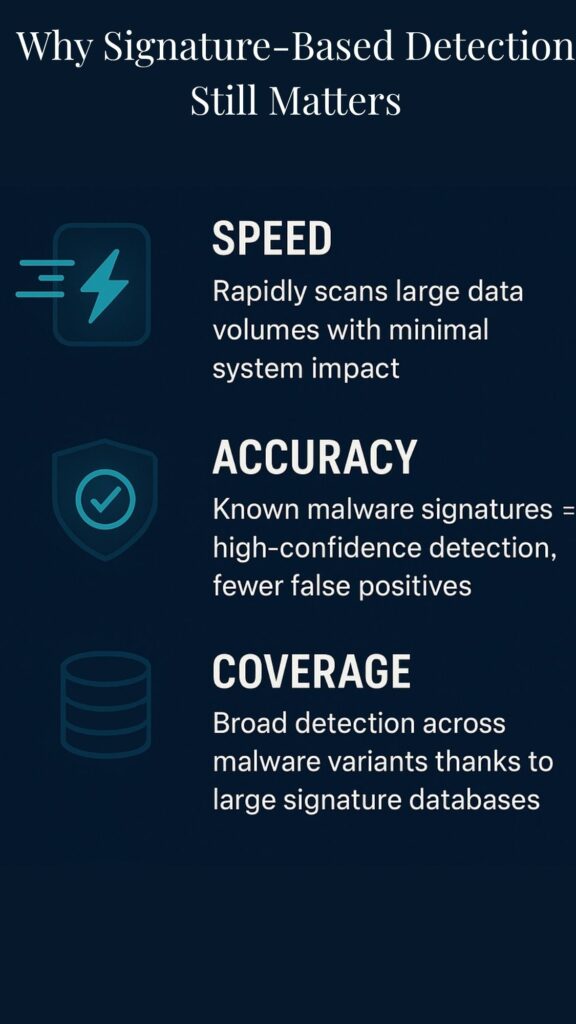
We’ve observed that signature-based malware detection provides:
- Speed: It can rapidly scan large volumes of data with minimal system impact.
- Accuracy: Known malware signatures offer high-confidence detection, reducing false positives.
- Coverage: Comprehensive signature databases allow for broad detection across malware variants.
The sheer scale of signature databases today is staggering, often holding millions of malware signatures. This extensive coverage helps catch a wide range of threats that have been identified and cataloged over the years.
It’s no surprise that signature-based detection is deeply embedded in endpoint security tools and network monitoring systems (1).
Limitations and How We Address Them

Despite its strengths, signature-based detection isn’t flawless. Malware authors use polymorphic and metamorphic techniques to alter their code, evading signature matching. Zero-day malware, which hasn’t been seen before, naturally lacks signatures, leaving gaps in detection.
To fill these gaps, we combine signature-based detection with heuristic detection and behavioral analysis. These methods observe suspicious patterns or anomalies that don’t match existing signatures but may indicate malicious activity.
For instance, dynamic malware analysis , running code in a controlled environment , helps identify new threats by their behavior rather than static code patterns.
Signature-based detection has clear limitations against zero-day threats, since new malware strains don’t yet have known patterns for a scanner to match against.
Enhancing Signature Detection with Network Threat Detection
Network Threat Detection enhances traditional malware signature scanning by integrating real-time threat modeling and automated risk analysis. Our platform supports a signature matching engine that works alongside frameworks like MITRE ATT&CK, enabling deeper insights into attacker techniques and tactics.
We also emphasize signature update automation.
Keeping the malware signature database current is a challenge many teams face, but Network Threat Detection automates this process, ensuring your defenses don’t fall behind emerging threats.
This automation reduces the risk of signature collision , false matches between benign files and malware signatures , improving detection accuracy.
Balancing Signature-Based and Hybrid Detection Approaches
Relying solely on signature-based malware detection is risky. Networks today demand a hybrid malware detection framework that leverages multiple techniques.
Our platform supports this balance by combining signature validation with machine learning malware detection and opcode analysis to extract features from malware binaries.
This layered approach helps reduce false positives and improves malware classification. By profiling malware behavior and comparing it against signature-based alerts, teams get a clearer threat picture.
We’ve found that this synergy accelerates incident response and strengthens overall malware detection performance.
Practical Tips for Maximizing Malware Signature Detection
From our experience, here’s how you can optimize your malware detection pipeline:
- Regularly update your malware signature repository to include the latest threats.
- Use signature-based scanning as an initial filter for quick threat identification.
- Complement signature detection with heuristic and behavioral tools to catch unknown threats.
- Leverage a unified dashboard for managing signature updates and analyzing detection results.
- Automate signature generation and validation to reduce manual effort and errors.
The Role of Signature Databases and Malware Repositories
A reliable signature database is the backbone of any signature-based malware detection system. We’ve maintained that a signature database must be expansive yet well-curated to avoid bloating detection systems with irrelevant or outdated signatures.
A malware signature repository typically contains millions of entries, each representing a specific malware variant or family.
The quality of these databases directly influences malware detection accuracy metrics. Signatures must undergo rigorous signature validation before deployment to minimize false positives and ensure high confidence in threat identification.
Regular signature updates not only add new malware signatures but also optimize existing ones to adapt to malware evasion techniques.
Signature-Based Detection in Real-Time Environments
Real-time malware detection is crucial for stopping threats before they spread. Signature-based detection algorithms scan network traffic or file system activity continuously, matching observed data against known malware patterns.
We also emphasize the importance of keeping signature databases updated, because outdated signatures leave critical detection gaps, especially as new malware variants emerge daily.
The faster these engines operate, the lower the latency in detecting threats, which is critical in environments like enterprise SOCs (Security Operations Centers).
Furthermore, signature-based IDS (Intrusion Detection Systems) rules are often built on these malware signatures, enabling network-layer threat detection.
Integrating signature-based antivirus with signature-based IDS improves the overall security posture by providing multiple layers of detection.
Overcoming Signature-Based Detection Limits with Advanced Techniques
Signature-based detection struggles against evasion tactics such as signature collision and malware signature fuzzing, where attackers deliberately alter malware code to confuse detection engines. To combat this, we use signature optimization techniques and hybrid malware detection frameworks.
Hybrid detection combines signature data with feature extraction from malware binaries, opcode analysis, and machine learning methods. This approach helps detect polymorphic malware variants that change their code but retain behavioral traits.
Malware behavior profiling supplements signature scanning by monitoring suspicious activities that might not trigger signature alerts. This behavioral analysis is vital for reducing false positives and increasing detection accuracy of unknown threats.
How Network Threat Detection Supports Signature Generation and Automation
Generating malware signatures is a complex task that requires detailed malware sample analysis. Our platform offers a signature generation engine that automates much of this process, extracting meaningful patterns from malware binaries and creating signatures that can be deployed quickly.
Signature update automation ensures that new threat signatures reach detection engines promptly, minimizing the window of vulnerability (2).
The malware signature scanning capabilities in Network Threat Detection seamlessly integrate with existing malware signature databases, enhancing and streamlining malware detection pipelines.
The Importance of Malware Threat Intelligence in Signature-Based Detection
Source: SANS Digital Forensics and Incident Response
Malware threat intelligence feeds into signature-based detection by providing context about emerging threats and attacker techniques. We rely on curated intelligence from OSINT and dark web sources to enrich our signature database and risk models.
This intelligence supports malware classification systems that group malware by families and attack signatures, which helps prioritize remediation efforts. It also informs signature-based detection limits, guiding when additional heuristic or behavioral analysis is necessary.
FAQs
What is malware signature detection and how does it work?
Malware signature detection identifies malicious software by matching files or network data against a database of known malware signatures. These signatures are unique code patterns, hashes, or behaviors specific to malware strains.
When a file or packet matches a signature, the system flags it as malicious. This method uses static malware analysis, scanning code without execution, making it fast and efficient for identifying previously seen threats. It remains a key part of many antivirus and network security solutions.
How often should malware signature databases be updated?
Signature databases need frequent updates,often daily or even multiple times per day,to maintain effectiveness. Attackers constantly create new malware variants, so outdated signatures leave gaps in detection.
Automated signature update systems, like those in Network Threat Detection, help ensure the database stays current. Regular updates reduce false negatives and improve detection accuracy by adding new signatures and refining existing ones to adapt to emerging threats and evasion techniques.
What limitations does signature-based malware detection have?
Signature-based detection can only identify threats with known signatures. It struggles against zero-day attacks and polymorphic malware that changes its code to evade detection. This method also risks false positives from signature collisions, where benign files match malware patterns.
To overcome these limits, it’s common to combine signature detection with heuristic and behavioral analysis, which look for suspicious activities or anomalies, improving detection coverage beyond known threats.
How does signature-based detection integrate with behavioral analysis?
Signature-based detection quickly flags known malware, while behavioral analysis monitors system or network activity for unusual patterns. Combining both methods strengthens security by catching threats that lack signatures but exhibit malicious behavior.
For example, if signature scanning misses a new malware variant, behavioral tools might detect its unusual file access or network connections. This hybrid approach reduces false negatives and provides a more comprehensive defense against both known and unknown malware.
What role do YARA rules play in malware signature detection?
YARA rules are flexible, text-based signatures used to identify malware families by matching patterns in code or files. They allow analysts to write complex criteria that capture a wide range of variants without bloating signature databases.
YARA rules enhance signature-based detection’s scope and precision. Our experience shows they’re invaluable for grouping malware samples into families and detecting related threats, making them a key tool for both static malware analysis and ongoing malware signature generation.
Can signature-based detection identify zero-day malware?
No, signature-based detection cannot reliably identify zero-day malware because these threats have no pre-existing signatures. Zero-day malware is new and unknown to signature databases.
Detecting such threats requires complementary techniques like heuristic detection, behavioral monitoring, and anomaly detection, which analyze suspicious activities and patterns beyond known signatures. Combining these methods helps protect networks from emerging threats that signature-based systems alone would miss.
How do malware evasion techniques affect signature detection?
Malware evasion techniques like polymorphism and metamorphism alter malware code to avoid matching existing signatures. This variability challenges signature-based detection, as the malware’s unique patterns change frequently.
Attackers may also use code obfuscation or encryption. To counter this, signature optimization and hybrid detection strategies are employed, incorporating machine learning and dynamic analysis to detect malware beyond static signature matches.
What is the difference between static and dynamic malware analysis?
Static malware analysis inspects code without executing it, focusing on identifying known patterns or signatures within files. It’s fast and useful for initial malware scanning. Dynamic analysis runs the malware in a controlled environment, observing its behavior to detect suspicious activities.
Both methods complement each other: static analysis excels at spotting known threats quickly, while dynamic analysis helps discover new or obfuscated malware that signature-based systems might miss.
How does Network Threat Detection enhance malware scanning?
Network Threat Detection enhances malware scanning by integrating signature-based detection with real-time threat modeling and automated risk analysis. Its platform supports continuous signature update automation, reducing vulnerabilities from outdated signatures.
By tying malware signature matches into frameworks like MITRE ATT&CK and providing attack path visualization, it helps analysts understand threats in context and prioritize remediation.
This unified approach improves detection accuracy and response times across diverse network environments.
What strategies reduce false positives in signature-based detection?
Reducing false positives involves rigorous signature validation and optimization. Signatures must be carefully crafted to avoid matching benign files, which can cause unnecessary alerts and wasted resources. Using hybrid detection , combining signature scanning with behavioral analysis and heuristic methods , further filters out false alarms.
Automated signature comparison and collision detection also help maintain a clean, high-quality signature database. Doing so improves trust in alerts and streamlines incident response efforts.
Final Thoughts on Detecting Known Malware Signatures
Detecting known malware signatures remains a foundational cybersecurity method. It offers fast, reliable threat identification when supported by up-to-date signature databases and complemented by heuristic and behavioral detection.
From our viewpoint, Network Threat Detection provides a first-class platform to enhance signature-based malware detection with real-time threat modeling and risk analysis.
If you want to strengthen your network’s defenses with a solution that keeps your signature database fresh, integrates well with behavioral analysis, and offers detailed attack path visualization, check out Network Threat Detection’s features. It’s designed to help you spot threats before they cause harm and respond faster when they do.
Ready to boost your malware detection capabilities? Explore how Network Threat Detection can help you stay ahead.
References
- https://medium.com/deeptempo/rules-rules-everywhere-why-signature-based-detection-falls-short-against-ai-threats-6bce79f7e974
- https://medium.com/@adnanmasood/a-field-guide-to-llm-failure-modes-5ffaeeb08e80