
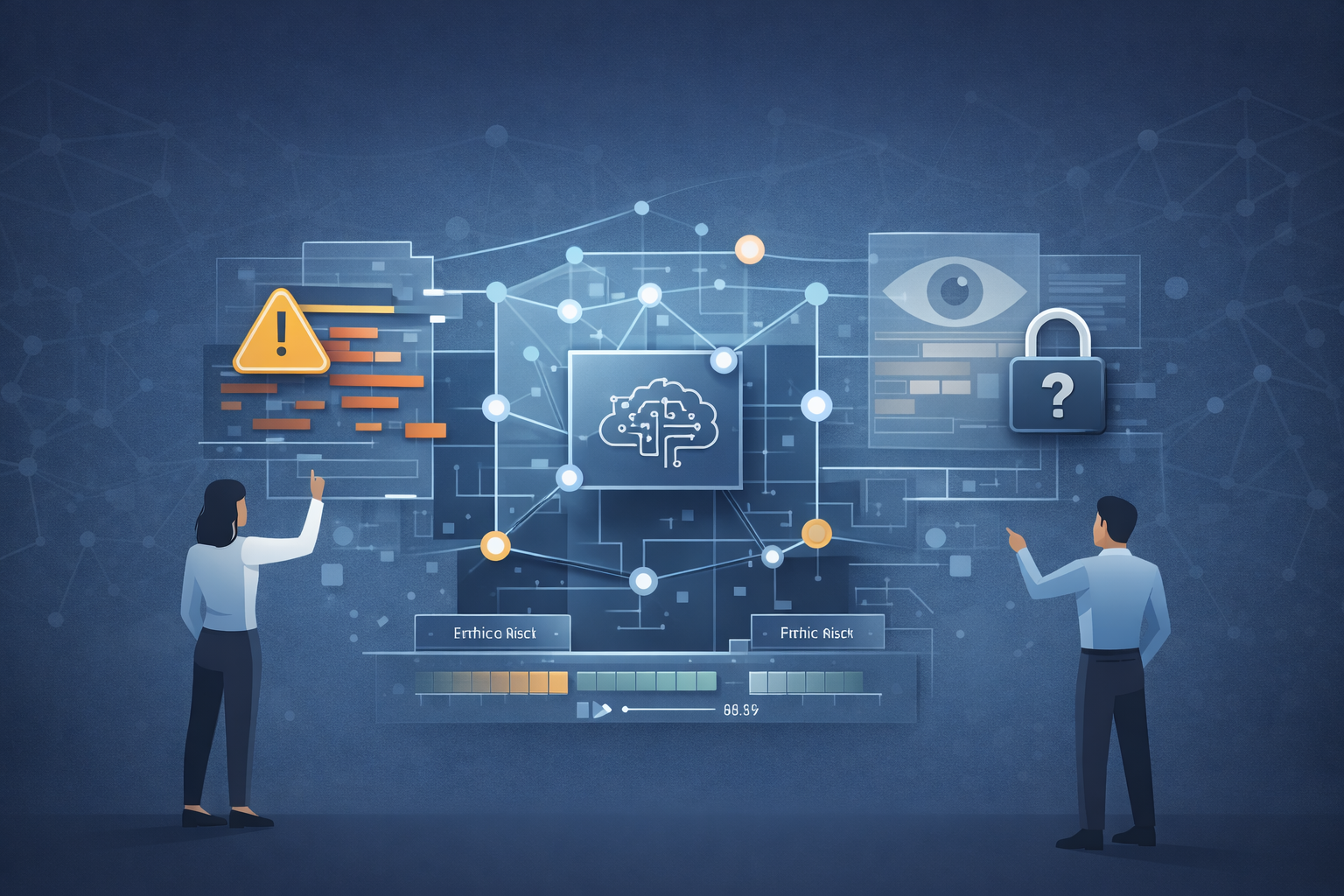
AI is transforming how you defend your network, but it also introduces real ethical risks you can’t ignore.
Models can quietly absorb bias, flagging some users more harshly than others. Automated decisions can become so opaque that no one knows who’s responsible when something goes wrong.
Data collection for “security” can slowly drift into over‑surveillance. And when AI gets it wrong, the impact lands on real people, not just dashboards.
If you care about building protection that’s both strong and fair, keep reading to unpack the core ethical issues in AI cybersecurity and how to handle them responsibly.
Key Takeaways
- AI can perpetuate dangerous biases and invade privacy if not carefully governed.
- A lack of transparency makes it hard to trust or fix automated security decisions.
- Proactive frameworks for fairness and accountability are essential for safe AI use.
The Unseen Risks of Automated Defense
The integration of Artificial Intelligence into cybersecurity isn’t a future possibility, it’s already stitched into how modern defense works.
Security Operations Centers now lean on algorithms to sift through endless alerts, logs, and anomalies, trying to pick out the single trace of a real attack hiding in the noise.
This shift gives defenders incredible reach. Machines can scan faster, correlate more data, and react in ways humans simply can’t match on their own. But that same power also creates a new kind of responsibility, one that’s easy to ignore because it hides behind dashboards and automation rules.
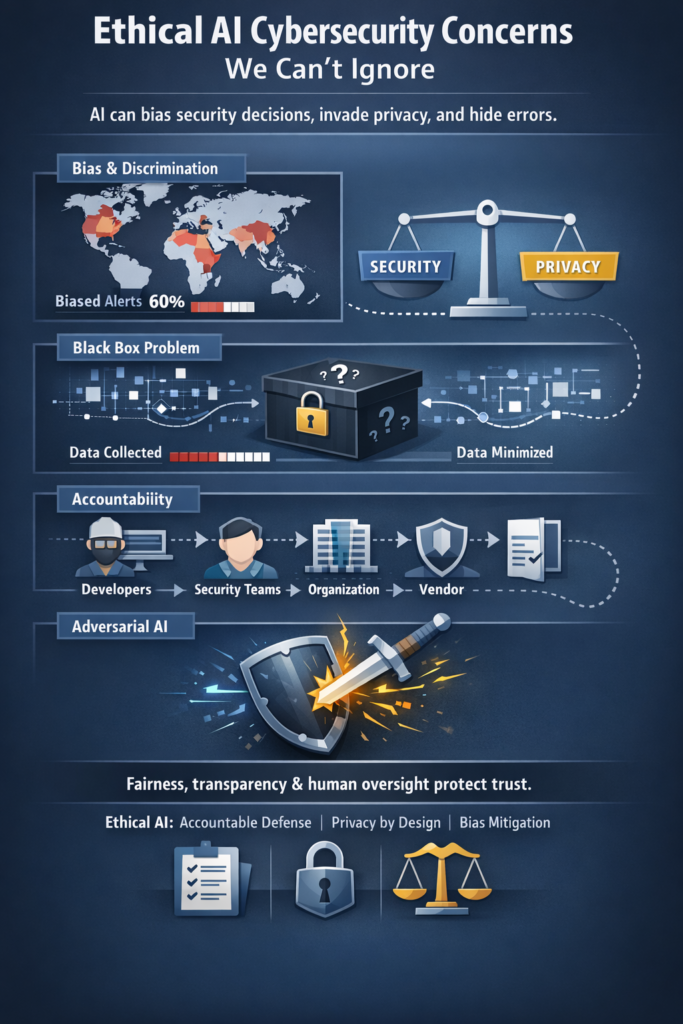
The ethical AI cybersecurity concerns that come with this aren’t just small technical quirks or annoying edge cases:
- They expose bias in how systems are trained and deployed.
- They raise questions about who gets blamed when an automated system fails.
- They shape which threats are taken seriously and which are quietly ignored.
These aren’t minor bugs in the code. These issues highlight foundational challenges in defining ‘secure’ with algorithms.
So we’re no longer just asking, “Can we build automated defense systems that act on their own?”
We’re pressed into a harder question: “Should we trust them to make those calls, and on what terms?”
When Algorithms Get It Wrong: Bias and Discrimination
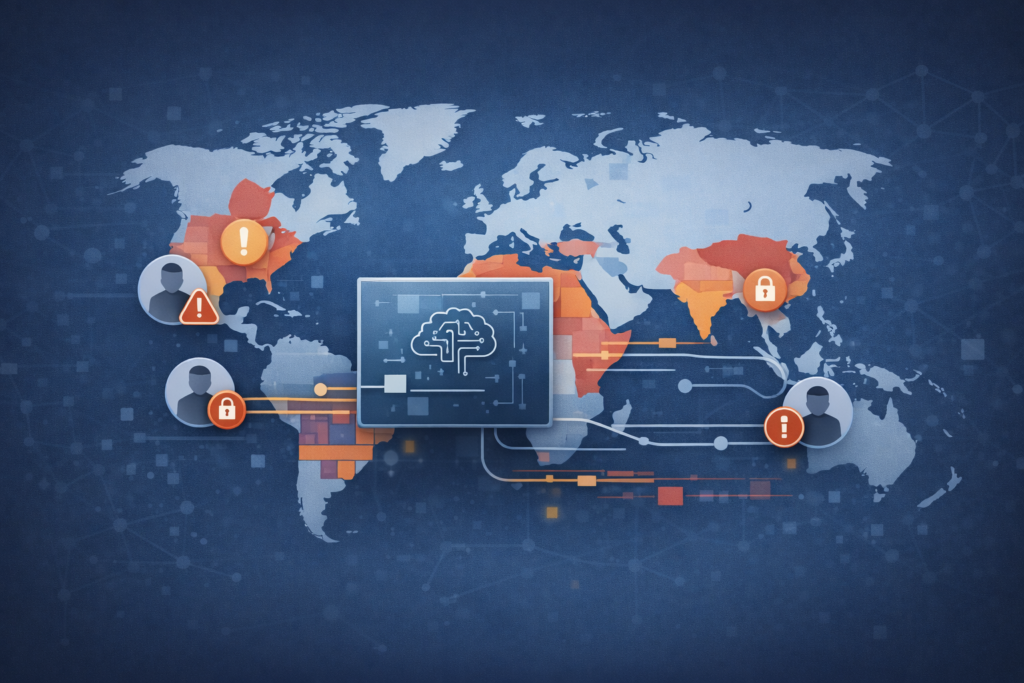
Imagine an AI model trained to detect malicious login attempts. It learns from historical data, data that might show a higher number of flagged logins from a specific geographic region due to past, concentrated attacks.
The AI, in its simplistic logic, begins to associate that entire region with threat activity. Soon, legitimate users from that area face constant CAPTCHAs, access denials, or even account lockouts. This isn’t science fiction, it’s a direct consequence of algorithmic bias.
The problem starts with the data. AI models are only as unbiased as the information they’re fed. If the training data is skewed, the output will be skewed.
This can lead to discriminatory outcomes in threat detection, user behavior analytics, and access control systems. The very tools meant to protect can end up alienating and harming innocent users.
- Skewed Training Data: Historical data often reflects existing prejudices or incomplete pictures.
- Unfair Profiling: Systems may flag activities from specific demographics more frequently.
- Erosion of Trust: Users who are unfairly targeted lose faith in the security system.
Mitigating this requires constant vigilance. It means actively seeking diverse datasets and conducting regular bias audits.
You have to question the data, not just the model. It’s about building fairness into the foundation, not trying to patch it on later. The goal is a system that protects everyone equally, without perpetuating human prejudices.
The Privacy Tightrope: Security vs. Surveillance
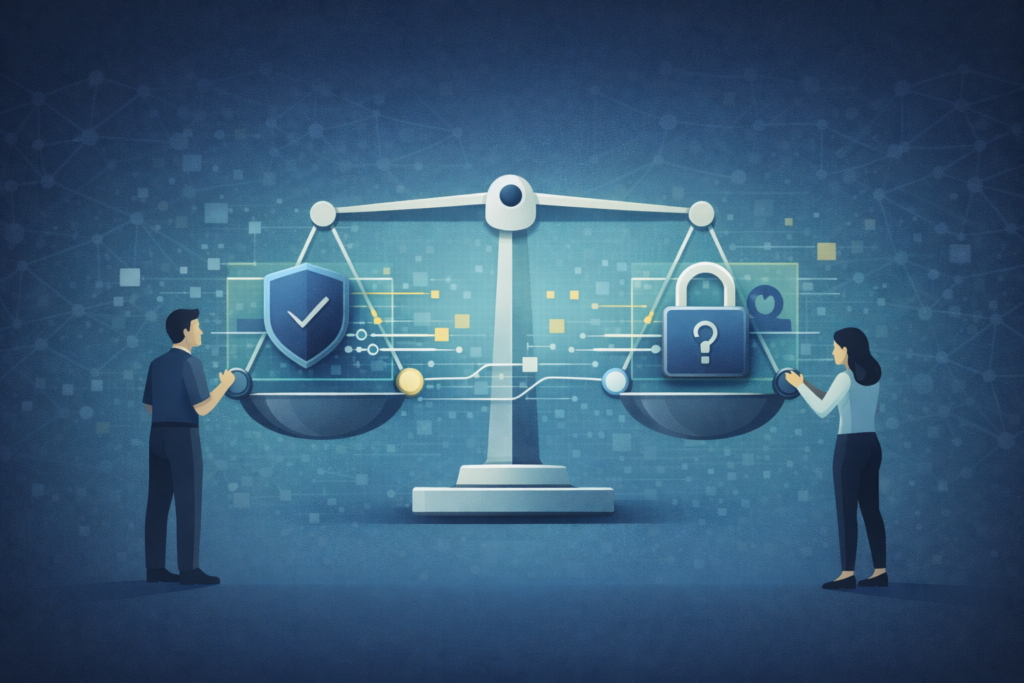
AI-powered security tools run on data, and not just a little bit. To spot what looks “wrong,” they first need a deep sense of what “normal” looks like. That often means pulling in:
- User activity patterns
- Network traffic flows
- System and application logs
- Device behavior over time
Soon, almost every click, request, or login attempt can become part of a training set. The result is a quiet shift, where monitoring that began as protection starts to look and feel like surveillance.
This challenge is similar to the data demands found in machine learning cybersecurity where vast volumes of network data feed models that learn “normal” behavior.
This can create pervasive monitoring resembling a digital panopticon where everyone is observable, all the time.
The ethical problem grows sharper when mission creep enters the picture. Data that was collected to catch insider threats or detect compromised accounts can be tempting to reuse for other goals, especially in workplaces that measure everything they can. That same data set might be pulled into:
- Employee performance tracking
- Productivity scoring or ranking
- Behavioral profiling for HR decisions
And this can happen without clear, informed consent from the people being monitored. The result isn’t just discomfort.
It chips away at civil liberties and nudges organizations toward a culture where trust is replaced by constant suspicion.
On top of that, the more sensitive data you store, the more you attract attackers who know exactly how valuable those records are. Every extra log or dataset becomes one more thing that can be stolen, leaked, or abused.
Regulations like the GDPR in Europe try to draw a firm boundary around this behavior. They lean on ideas such as:
- Data minimization (collect only what you truly need)
- Purpose limitation (use data only for the reason you collected it)
But AI complicates these guardrails. A model might detect an unexpected pattern or “discover” a new use for old data, without a human ever planning that outcome in the first place.
That raises fresh ethical questions: if the system finds a new signal, do you get to use it just because it exists, or do you pause and rethink the consent and purpose behind it?
A more grounded way forward is privacy-by-design. That means treating privacy as a starting rule, not a last-minute patch. For AI-driven defense, that can look like:
- Limiting raw data retention and using aggregation where possible
- Applying strong anonymization or pseudonymization techniques
- Building access controls so only specific teams can see sensitive details
- Documenting exactly why each category of data is collected
Security doesn’t need to come at the expense of dignity. If your defense strategy demands that users surrender all sense of privacy, then the system might be secure on paper, but it’s already failing the people who live inside it.
The Black Box Problem: A Crisis of Transparency and Accountability
Credits: AI and Technology Law
Why did the AI block that IP address? Why did it decide that one user’s late-night login pattern looked malicious, while another slipped through? With many complex models, especially deep learning systems, you often don’t get a straightforward answer.
The system produces an output, but the path it took is buried under dense layers of math and weights that even specialists struggle to unpack.
This “black box” issue is a core concern in deep learning for network security, where understanding model decisions is crucial for trust and effective response.
That’s the black box problem in security, and it’s not just a technical curiosity, it’s a real operational risk. When an opaque model sits at the center of your defenses, several problems start to show up:
- Analysts can’t easily verify whether an alert is valid or just noise.
- Bias or flawed training data can hide inside the model with no obvious warning.
- Incident reviews turn into guesswork instead of careful reconstruction.
Then comes the harder question: when the AI gets it wrong, who owns the mistake? If an automated system locks out a hospital’s critical application during a busy shift, or blocks a key partner’s IP address during a major release, people will want answers, and quickly. You end up staring at a messy chain of potential responsibility:
- The developers who designed and trained the model
- The security team that chose, tuned, and deployed it
- The organization that approved its use in production
- The vendor that supplied the model or platform
Blaming “the AI” doesn’t help anyone recover, and it doesn’t prevent the same failure from repeating as emphasized in governance frameworks requiring audit trails. Without clarity on how decisions are made, it’s difficult to:
- Fix root causes instead of just patching symptoms
- Adjust policies in a targeted way
- Preserve trust with users, customers, and regulators
This is where Explainable AI (XAI) becomes more than a buzzword. It’s a set of methods aimed at making decisions at least somewhat legible to humans. For cybersecurity teams, that might mean:
- Showing which features contributed most to a detection (e.g., unusual port use, login location, time of access)
- Providing human-readable rules or approximations near the model’s decision boundary
- Letting analysts replay and inspect the inputs that led to a specific alert
With those tools, an alert stops feeling like a decree from an untouchable oracle and starts behaving more like a colleague’s recommendation, something you can question and learn from. It also changes how accountability works: logs and explanations give you a trail to audit, argue with, and adjust.
In that sense, building accountability into AI security systems is about drawing a clear line: machines can help us see patterns and move faster, but they don’t get the final word.
A useful system is one that explains enough of itself to support human judgment, not replace it. Otherwise, you’re not partnering with a smart tool, you’re just obeying a silent, unaccountable gatekeeper.
| Black Box Issue | Operational Impact | Ethical Risk | Governance Control |
| Unexplainable alerts | Analyst confusion | Loss of trust | Explainable AI cybersecurity |
| Automated blocking | Service disruption | False positive ethical impact | Human-in-the-loop security AI |
| Hidden model bias | Unequal enforcement | Fairness violations | Bias mitigation in security models |
| No decision logs | Audit failure | No accountability | AI auditability |
| Vendor-controlled models | Responsibility gaps | Blame shifting | Model accountability in cybersecurity |
The Adversarial Advantage: Malicious Exploitation of AI

The same AI tools that defend your network can be turned against you. Adversaries are already using AI to create more sophisticated and convincing phishing emails, to automate password cracking, and to amplify DDoS attacks.
This is the dual-use dilemma of ethical AI cybersecurity concerns. Your shield can be melted down and forged into a sword.
This underscores the importance of applying machine learning cybersecurity with robust safeguards to prevent adversarial manipulation and data poisoning.
More insidiously, attackers can poison the well. They can manipulate the data used to train your AI models, a technique known as data poisoning.
By injecting subtle, malicious data into the training set, an attacker can cause the AI to learn incorrect patterns. The model might then fail to detect a specific type of malware or, worse, classify legitimate activity as an attack.
Deepfakes, powered by AI, present another massive threat, capable of bypassing voice or facial recognition security systems.
Countering these threats requires a governance model that emphasizes security throughout the AI lifecycle.
This includes rigorous testing for adversarial vulnerabilities, secure data pipelines, and monitoring for signs of model drift or poisoning. Ethical guidelines must stress the importance of securing the AI systems themselves, recognizing that they are now a primary attack vector.
Navigating the Uncharted: Regulatory Gaps and Future Frameworks
The legal and regulatory landscape is struggling to keep pace with AI innovation. Existing frameworks like GDPR touch on aspects of data protection, and emerging proposals like the EU’s AI Act attempt to categorize risk, but significant gaps remain [1].
The cross-border nature of both cyber threats and AI development complicates enforcement. There is no universal standard for what constitutes ethical AI in cybersecurity.
This regulatory uncertainty creates a challenging environment for organizations. Without clear rules, they risk either under-investing in ethical safeguards or being blindsided by future legislation [2].
The need is for comprehensive policies that enforce mandatory bias audits, set standards for transparency, and clarify liability in cases of AI failure. The goal is not to stifle innovation but to channel it responsibly.
Proactive organizations aren’t waiting for lawmakers to catch up. They are developing their own internal ethical AI governance frameworks.
These frameworks often include checklists for new AI security projects, covering data provenance, model explainability, and human oversight procedures.
They are building ethics into their procurement processes, choosing vendors who prioritize responsible AI practices. It’s a practical way to manage risk and build more trustworthy systems.
Building a Conscience into Your Code
The ethical AI cybersecurity concerns we face today are not technical problems with easy technical fixes.
They are human problems, rooted in our values, our biases, and our laws. Addressing them requires a shift in mindset. It means moving from a pure focus on efficiency and threat detection to a broader commitment to fairness, transparency, and accountability.
Your approach shouldn’t be about avoiding AI, but about implementing it wisely. Start by demanding clarity from your tools.
Insist on understanding how they work. Prioritize data quality and diversity to combat bias. Weave privacy protections directly into your architecture.
Most importantly, keep a human in the loop, especially for critical decisions. The future of secure and ethical cybersecurity depends on this balance, on building systems that don’t just think, but think right.
FAQ
How does algorithmic bias in cybersecurity affect real users?
Algorithmic bias in cybersecurity can block legitimate users or raise unfair alerts. This problem affects fairness in threat detection and AI fairness in access control.
Bias often comes from limited or unbalanced training data and weak ethical AI model training.
Teams reduce harm through bias mitigation in security models, bias-aware threat models, and ethical risk scoring systems that measure false positive ethical impact on real users.
How can teams protect privacy without turning security into surveillance?
Privacy risks increase with AI-powered surveillance risks and excessive monitoring. Teams should use privacy-preserving security AI and privacy-by-design cybersecurity AI from the start.
Ethical data collection security and clear consent and data usage ethics help limit misuse. Surveillance ethics in cybersecurity and data protection ethics protect AI and civil liberties while supporting ethical anomaly detection and privacy-first security analytics.
Why is transparency important in automated security decisions?
Without AI transparency in security systems, teams cannot understand or challenge automated actions.
AI decision-making transparency and explainable AI cybersecurity show why alerts trigger responses.
AI explainability for analysts supports investigation and review. Transparency in automated response enables proportional response ethics, strengthens trustworthy AI systems, and reduces over-automation security risks in daily security operations.
Who is accountable when AI makes a security mistake?
Clear responsibility requires AI accountability frameworks and model accountability in cybersecurity.
AI auditability records how decisions happen, while AI accountability in breach response supports investigations. Ethical AI governance and cybersecurity ethics frameworks define ownership.
AI security model validation ethics and human oversight in automated defense ensure people remain accountable for outcomes, not the technology alone.
How do organizations manage ethical risks across the AI security lifecycle?
Organizations manage risk through secure AI lifecycle management and secure and ethical AI deployment.
Ethical AI governance and AI governance in cyber operations guide design and use. AI policy enforcement and ethical SOC automation set limits.
Ethical automation in SOCs, AI oversight mechanisms, and ethical AI monitoring reduce AI misuse in cyber defense and adversarial ethics in AI security.
A Responsible Path Forward for Ethical AI Defense
Ethical AI in cybersecurity is ultimately about balance. Powerful automation can strengthen defenses, but without fairness, transparency, and human oversight, it can also create harm at scale.
Responsible defense means questioning data, demanding explainability, protecting privacy by design, and assigning clear accountability.
AI should amplify human judgment, not replace it. Organizations that embed ethics into their security strategy won’t just reduce risk, they’ll build trust that lasts. Ready to strengthen your defenses responsibly? Explore ethical, AI-driven threat detection here.
References
- https://digital-strategy.ec.europa.eu/en/policies/european-approach-artificial-intelligence
- https://gdpr.eu/what-is-gdpr/