
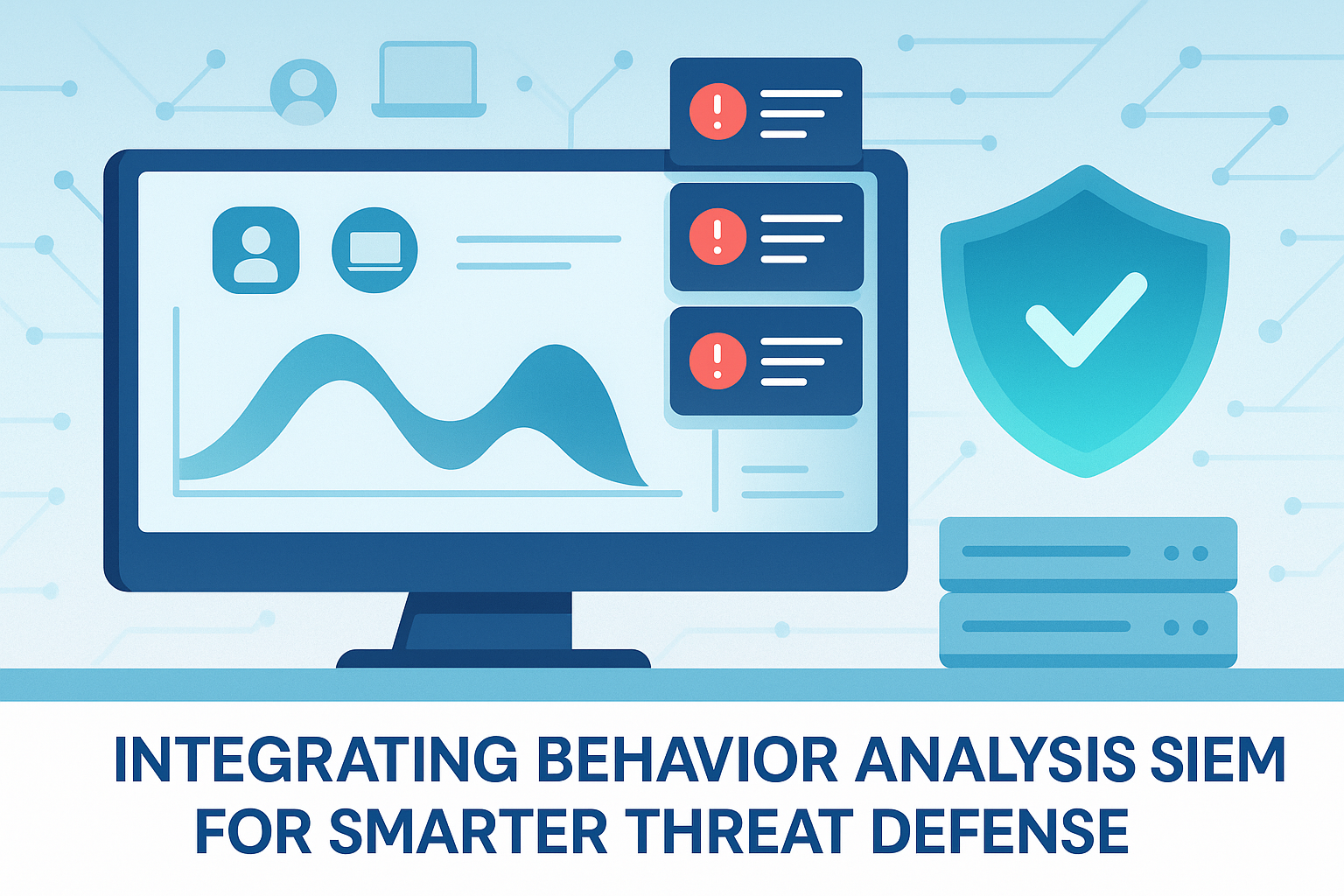
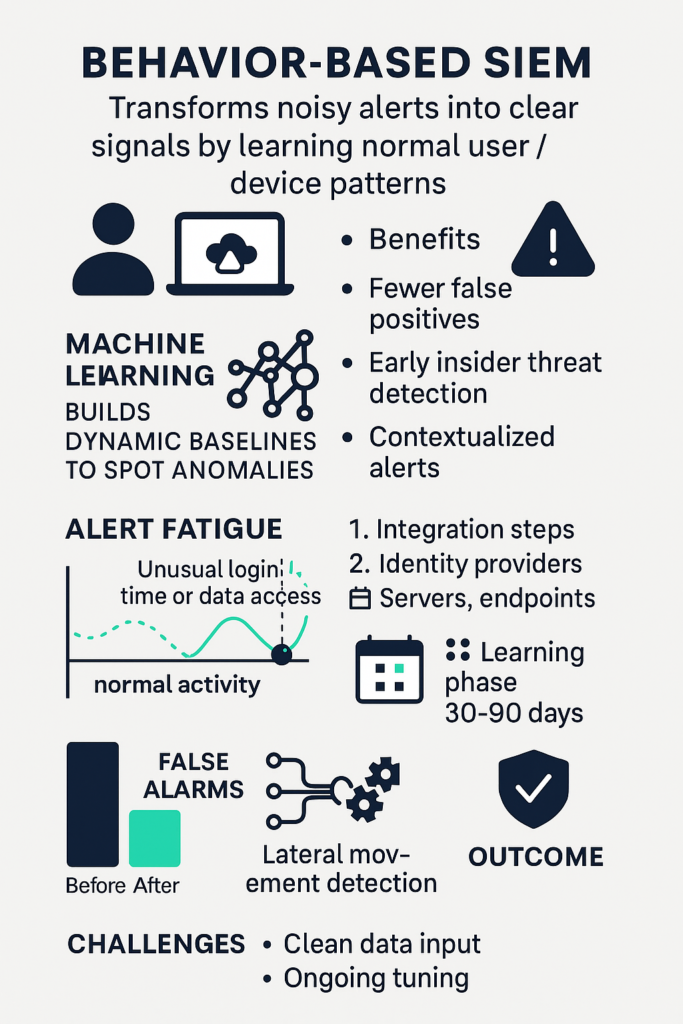
Behavior-based SIEM turns noisy alerts into real signals by teaching your system what “normal” looks like in your environment.
Instead of flooding your team with every rule match, it learns patterns of users, devices, and applications, then highlights what truly looks off.
That means fewer blind spots, better detection of subtle attacks, and a SOC that can focus instead of firefight. You’re not just adding more logs or dashboards, you’re giving your SIEM context and memory.
Keep reading to see how this fusion of rules and behavior creates a security stack that actually understands your organization, much like how user entity behavior analytics builds unique behavioral baselines for every entity.
Key Takeaways
- Context Overrules Code: Behavior analysis provides the “why” behind an alert, turning generic events into targeted investigations.
- Baselines Beat Blind Spots: Machine learning establishes a dynamic picture of normal activity, making anomalies stand out clearly.
- Proactive Defense is Possible: You shift from chasing known threats to identifying novel attacks based on malicious behavior patterns.
Why Your SIEM Feels Like a Noisy Neighbor
It operates on a simple logic of “if this, then that.” A login from a foreign IP at 3 AM triggers an alert. So does a system administrator logging in at 3 PM. The system lacks the intelligence to know one is normal and the other is not. It sees events, not stories.
This signature-based approach is fundamentally reactive. It can only find what it has been explicitly told to look for.
Zero-day exploits, insider threats, and carefully orchestrated attacks often leave a trail of subtle, seemingly benign actions. A rule-based SIEM misses these entirely, because no single action is malicious enough to trigger a rule.
The result is a constant state of alert fatigue. Analysts spend their days sifting through thousands of low-fidelity alarms, most of which are false positives.
This noise creates a dangerous environment where the real signal, the actual breach, can easily be overlooked or deprioritized. The system cries wolf so often that when the wolf actually arrives, nobody listens.
- High volume of false positive alerts
- Inability to detect novel or insider threats
- Lack of contextual understanding for events [1]
Giving Your SIEM a Memory and an Intuition
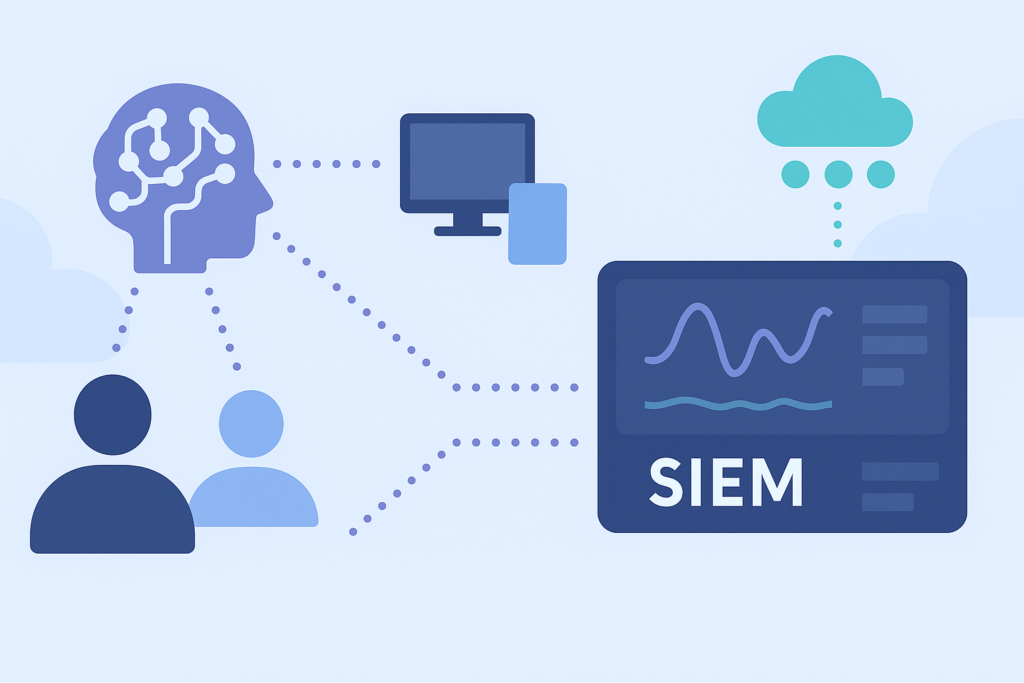
Think of it as giving your SIEM a sense of memory and intuition. Instead of just checking boxes, it learns. It starts by collecting a wide array of data, not just security logs.
It pulls in information from endpoints, network traffic, identity and access management systems, and cloud applications. This creates a rich tapestry of activity to learn from.
Machine learning algorithms then get to work on this data. They aren’t programmed with specific rules. They observe. Over days and weeks, they build a statistical model of what constitutes normal behavior for every user, device, and server in your environment.
They learn that Sarah in accounting always logs in from Chicago between 8 AM and 6 PM, and that the database server typically exchanges 2 GB of data with the app server nightly. This process establishes a behavioral baseline.
It’s a living, breathing profile of your organization’s rhythm, reflecting the importance of understanding normal user behavior patterns to stop threats before they escalate. Once this baseline is set, the system continuously compares real-time activity against it.
Now, when Sarah’s account starts downloading gigabytes of files at 2 AM from a new device, the SIEM doesn’t just see a successful login and a data transfer. It sees a significant deviation from established behavior. That deviation becomes a high-fidelity alert, weighted with context.
The system flags the anomaly. It might assign a risk score of 95 out of 100. This score, along with the enriched context, is fed back into the SIEM console.
The analyst now sees an alert that says, “High probability of compromised credentials: User Sarah exhibiting extreme deviation from normal access patterns.” They have a starting point, not a dead end.
The Quiet and Confident Security Team

The most immediate relief is the quiet. The incessant chirping of low-level alerts diminishes dramatically. Your security team stops being alarm janitors and starts being investigators.
They can focus their energy on the handful of high-risk anomalies that behavior analysis surfaces each day, knowing that each one has a high probability of representing a real threat.
This leads to proactive threat detection. You’re no longer waiting for a malware signature to be published. You can spot an attack based on its operational behavior.
For instance, an attacker moving laterally through your network will typically cause a spike in authentication requests between servers, a pattern that is easily detected as anomalous against the baseline, even if the tools and techniques are brand new.
You gain holistic visibility. A behavior-analytics-enhanced SIEM connects the dots, similar to how behavioral analysis for threat detection cuts through noise to find hidden attack sequences.
It can correlate a suspicious login from an unusual location with subsequent privileged file access on a server and a large outbound data transfer.
It presents this not as three separate alerts, but as a single, contextualized incident timeline. This depth of insight is what makes threat hunting effective and incident response swift.
- Dramatic reduction in false positives and alert fatigue
- Early detection of insider threats and compromised accounts
- Contextualized alerts that speed up investigation and response
Building Your Intelligent Defense Layer
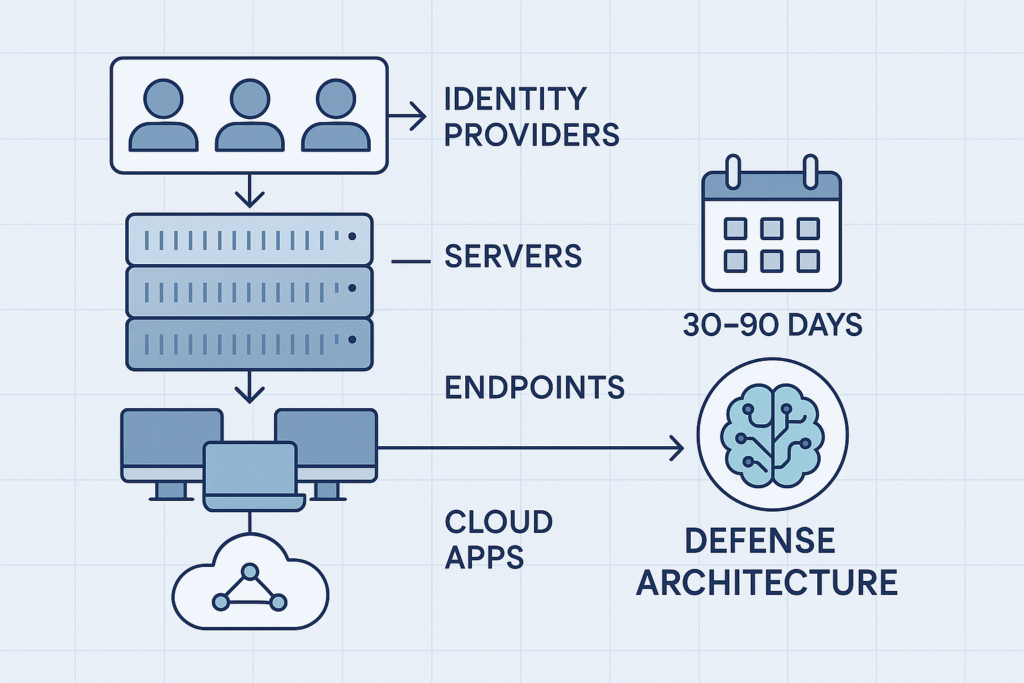
Starting can feel daunting, but it’s best approached in phases. Don’t try to boil the ocean on day one. Begin with your most critical data sources.
Identity providers like Active Directory or Okta are key starting points. Integrating it gives the system a clear view of user logins and access requests. Next, bring in your critical servers and endpoints. The goal is quality data, not just quantity [2].
The machine learning models need time to learn. This initial phase is about baselining. You’ll feed the system historical data, ideally 30 to 90 days worth adjusted based on data volume and activity patterns (e.g., 30 days for small teams, longer for enterprises).
This allows it to understand seasonal patterns, like end-of-month reporting spikes, and establish a reliable normal. During this period, you might not see many alerts, and that’s okay. The system is in school.
Once the baselines are stable, you can start tuning the anomaly thresholds. Every organization has a different risk tolerance.
You might decide that a login from a new country is a medium-risk event, but a login from a new country followed by an attempt to access the HR database is critical. This customization is key to making the system work for your specific environment.
Integration with your Security Orchestration, Automation, and Response platform is the final piece. When the behavior analysis engine flags a high-risk anomaly, it can trigger an automated playbook in your SOAR.
This could automatically isolate a compromised account, block a suspicious IP address, or open an investigation ticket with all the relevant context pre-populated. This closes the loop from detection to response.
The Real-World Challenges and How to Clear Them
Data quality is the foundation. If you feed the system messy, incomplete logs, it will build a flawed understanding of normal.
Spend time upfront ensuring your data sources are configured correctly and that you’re collecting the necessary fields. Garbage in, garbage out applies doubly to machine learning. Prioritize structured logs with fields like user ID, timestamp, and action type
The “unknown unknown” can be a challenge. When the system flags something as anomalous, it’s not always malicious.
It could be a new business process or a user working on a special project. This is why feedback loops are essential.
Your analysts need a way to tell the system, “This is actually normal.” This feedback helps the model adapt and become more accurate over time, reducing future false positives for that activity.
Ongoing maintenance is a commitment, not a one-time setup. User behaviors change, new applications are deployed, and the business evolves.
Your behavioral baselines need to evolve with it. This means periodically reviewing the model’s performance, adjusting thresholds, and incorporating new data sources. It’s a continuous cycle of improvement that keeps your defenses sharp.
From Reactive Watchtower to Proactive Detective
Integrating behavior analysis SIEM is more than a technical upgrade. It’s a philosophical shift from a reactive, rule-bound defense to an adaptive, intelligent one. You stop looking for known badness and start recognizing abnormal behavior.
This is how you catch the threats that don’t play by the rules, the insiders who abuse their access, and the advanced attackers who fly under the radar of traditional tools.
It turns your security operations center from a noisy watchtower into a skilled detective agency. The path requires careful planning, but the destination is a quieter, more confident, and ultimately more secure organization. Start by integrating one critical data source this quarter, and build from there.
FAQ
What does integrating behavior analysis SIEM help me understand?
Integrating behavior analysis SIEM helps you understand how your system normally behaves.
It uses integrated behavioral analytics, siem behavioral analysis, and behavioral baselines to track daily patterns. It watches user session behavior tracking, real-time behavior monitoring, and anomaly detection siem.
By spotting behavioral deviation detection early, it helps you find threats that hide inside routine activity.
How does machine learning improve behavior analysis in my SIEM?
Machine learning siem behavior studies patterns over time and builds a clear behavioral baselining engine.
It supports identity behavior analytics siem, endpoint behavior integration, and network behavior analytics.
It also uses behavioral anomaly scoring and behavioral drift detection to notice small changes. These tools improve behavioral insights for siem alerts and help your system respond with greater accuracy.
Can behavior analysis help me detect insider threats sooner?
Behavior analysis can help you detect insider threats sooner by watching how people normally act.
It uses insider threat behavior monitoring, identity-centric behavior analytics, and privileged user behavior analysis to track changes.
Continuous behavior monitoring siem and abnormal activity detection siem highlight unusual moves. It also uses account compromise behavior analysis and threat behavior signatures siem to spot early danger.
How does cross-domain behavior analysis support stronger threat hunting?
Cross-domain behavior analysis supports stronger threat hunting by linking events across users, devices, and networks.
It uses behavior-based correlation rules, automated behavior correlation, and correlated behavior indicators to connect actions.
It also supports behavior-driven threat hunting, lateral movement behavior detection, and attack path behavior analysis. With adaptive behavior analytics siem and threat actor behavior mapping, it reveals how threats spread.
How does behavior analysis work in cloud or hybrid environments?
Behavior analysis works in cloud and hybrid environments by tracking patterns across all workloads.
Cloud behavior analytics siem, hybrid environment behavior analysis, and workload behavior analytics provide full coverage.
Multi-signal behavior fusion siem and behavioral threat telemetry supply extra detail. A siem unified behavior view supports entity behavior monitoring and helps detect anomalous login behavior detection or account takeover behavior signals.
Why Behavior-Driven SIEM Is the Future of Threat Prevention
Integrating behavior analysis into your SIEM transforms security from reactive noise to intelligent vigilance.
By understanding normal patterns, the system exposes subtle anomalies that rules overlook, giving analysts clearer signals and faster insight.
False positives shrink, investigations sharpen, and emerging threats surface early, even without known signatures. This fusion of context and analytics builds a quieter, more proactive defense.
Start small, integrate key data sources, and let your SIEM evolve into a system that truly sees. Ready to take the next step? Join the movement toward intelligent threat detection
References
- https://thehackernews.com/expert-insights/2025/09/the-high-cost-of-useless-alerts-why.html
- https://www.ibm.com/products/qradar-siem/user-entity-behavior-analytics