
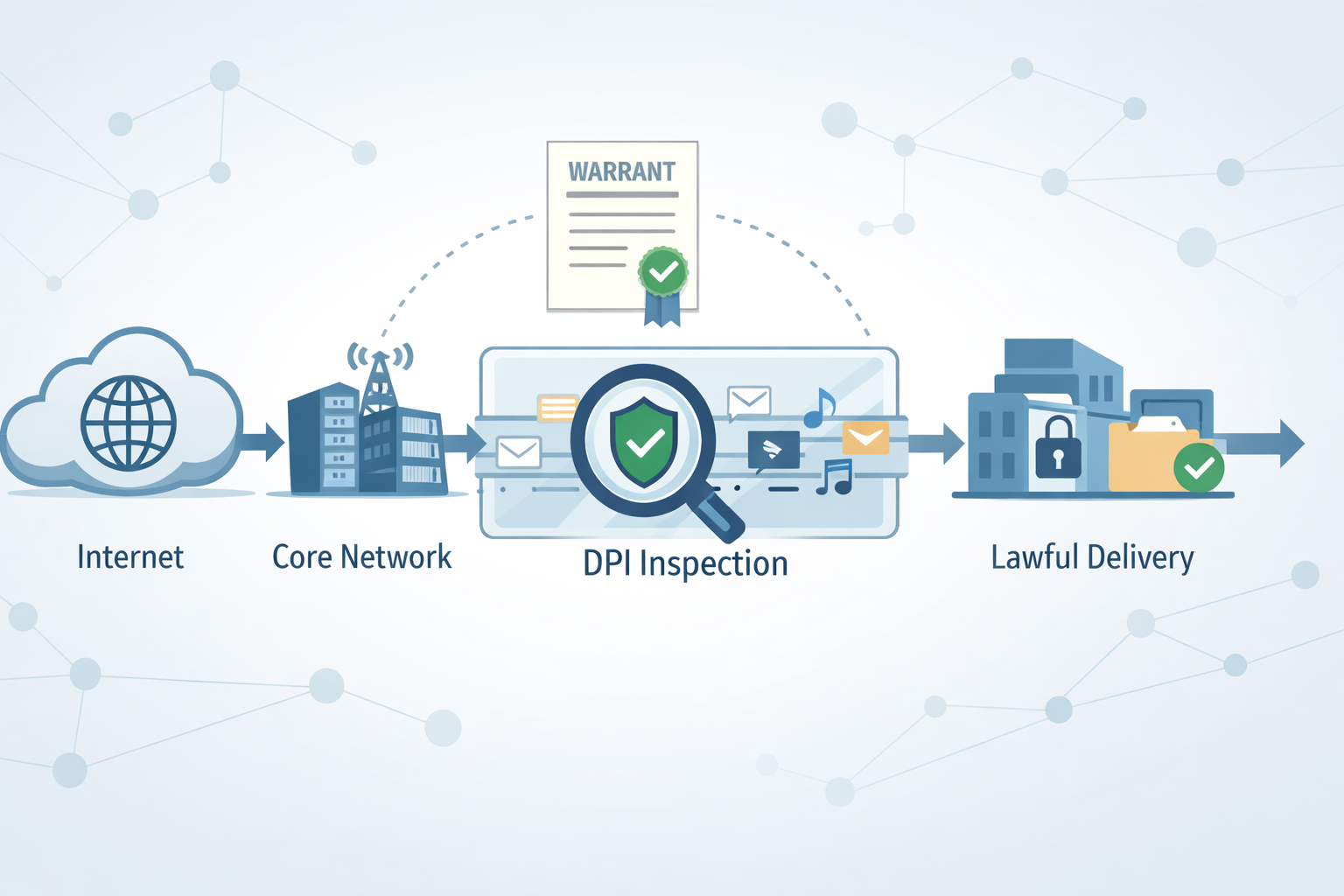
Lawful interception using DPI lets a telecom provider turn a court order into precise, controlled action on live traffic.
When a warrant arrives, it demands one specific conversation from a sea of flows, and DPI can look beyond simple headers to actually identify and filter the targeted data stream.
Instead of tapping half the network, you focus on what’s legally defined, while keeping everyone else’s traffic undisturbed and the core infrastructure steady.
Done right, it’s both compliant and measured. Keep reading to see how DPI-based interception works step by step, from legal trigger to technical implementation.
Key Takeaways
- DPI enables precise interception by analyzing packet content, not just headers.
- Strategic probe placement is critical for effective network-wide monitoring.
- Compliance hinges on strict adherence to warrant scope and data handling protocols like ETSI/3GPP for IRI/CC delivery.
The Operational Reality of Legal Mandates
The legal demand doesn’t arrive as a suggestion. It lands on your desk with weight: a named individual, a clear IP address, a defined timeframe.
No ambiguity, no room to improvise. Your task is to trace this narrow thread of activity inside a raging river of packets moving across your network every second. If you miss it or mishandle it, the risk isn’t just a fine or a stern letter.
It’s damage to trust, public, regulatory, and sometimes even inside your own organization. That constant pressure, quiet but heavy, shapes what it means to run a telecom network now.
Lawful interception isn’t a distant legal idea tucked into a policy binder. It’s a live, operational demand that can arrive at any moment.
Deep Packet Inspection, or DPI, has become the practical response to this kind of precision work. Where basic packet filtering barely scans the envelope, IP, port, a few headers, DPI goes further and opens the message.
It looks into the payload, understands what’s actually being carried, and classifies it. Older methods were blunt tools; they could grab traffic on a port, or a whole protocol, but they couldn’t see what was hiding inside. DPI changes that. Instead of swallowing every flow on a given port, you can:
- Match specific applications, even if they share ports.
- Target particular protocols or protocol behaviors.
- Filter based on patterns and signatures within the data stream, leveraging deep packet inspection uses techniques for refined network traffic control.
That means you’re not vacuuming up unrelated traffic “just in case.” You’re isolating exactly what the warrant describes: one user, one app, one slice of time, as narrowly and cleanly as your rules and technology allow.
The Foundation: Understanding the Warrant
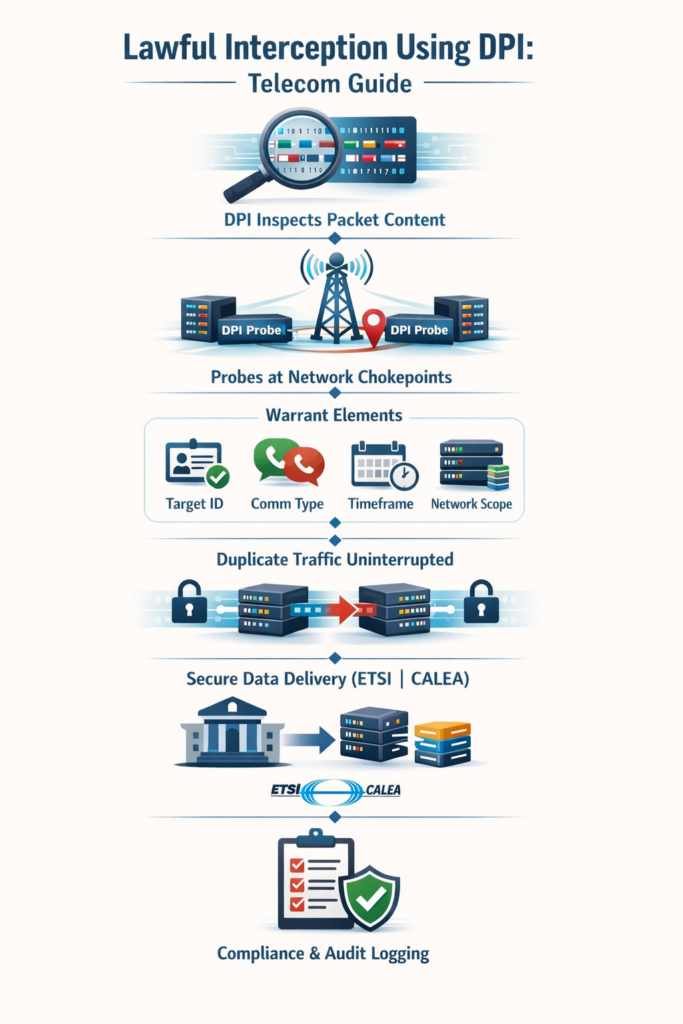
Everything begins with the legal document. The warrant is the blueprint. It defines the who, the what, and the when.
Your technical team must interpret this with absolute clarity. A misunderstanding here can lead to over-collection, a serious privacy violation, or under-collection, which renders the intercept useless. The scope is everything. It’s the fence around your investigation [1].
Once the warrant’s parameters are locked in, the technical work begins. This isn’t about slapping a probe anywhere on the network.
It requires a deep understanding of your own architecture. Where does the target’s traffic flow? Which chokepoints will give you the clearest, most complete view? This planning phase is as important as the interception itself. A poorly placed probe is a blind eye.
- Identify the target: IP address, IMSI number, email account.
- Define the communication types: VoIP calls, SMS, web browsing data.
- Set the duration: The exact timeframe authorized for surveillance.
The goal is to minimize impact on your network’s performance while maximizing the accuracy of the data capture. You’re walking a tightrope between operational efficiency and legal duty. This balance is the core of modern lawful interception. It’s a continuous process of calibration and review.
| Warrant Element | Description | DPI Enforcement Control |
| Target Identifier | IP address, IMSI, MSISDN, or account ID | Subscriber identity tracking and session matching |
| Communication Type | VoIP, SMS, web traffic, signaling | Protocol decoding and application classification |
| Timeframe | Authorized interception period | Time-based filtering and rule activation |
| Network Scope | Access, core, or service layer | Strategic probe placement at traffic chokepoints |
| Data Type | Content of Communication (CC) or IRI | Payload inspection or metadata extraction |
Deploying the Technology: DPI Probes in Action
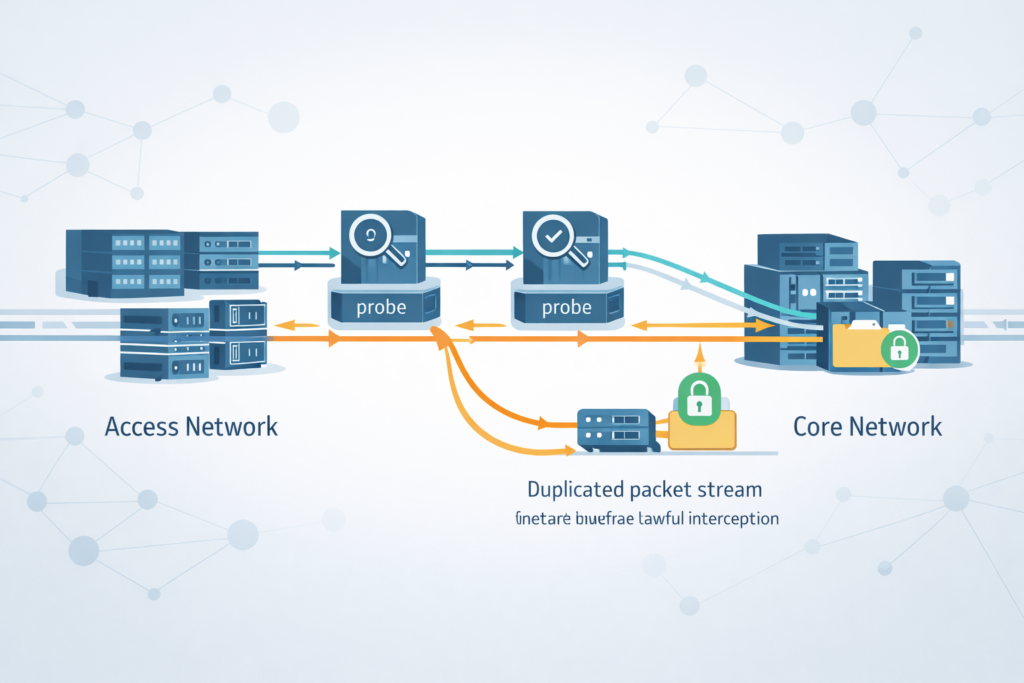
You deploy the DPI probes at the predetermined locations. These aren’t passive listeners. They are active, intelligent filters.
They scan each packet in real-time, comparing its content against the warrant’s criteria. When a match is found, the probe doesn’t stop the original packet.
It creates a perfect copy. The target’s communication continues uninterrupted, completely unaware of the parallel stream now being created.
These probes rely on how DPI examines network traffic in real-time to maintain accurate interception without impacting the original data flow.
This is where DPI’s power truly shines. It handles the modern reality of encryption. Much of the traffic you need to intercept will be wrapped in SSL or TLS.
DPI systems may perform man-in-the-middle decryption where legally authorized and technically feasible (e.g., for provider-managed TLS), extracting content before re-encrypting; however, strong end-to-end encryption limits this for many apps.
The intercept copy contains the readable content. This process is delicate, requiring significant processing power and strict security controls to prevent leaks.
The filtered and duplicated data is then routed to a secure delivery function. This isn’t a simple file dump. It’s a structured, real-time stream of information.
It includes the Content of Communication (CC), like the actual audio of a call, and the Intercept Related Information (IRI), which is the metadata, who called whom, when, for how long.
This data is packaged according to standards like those from ETSI, ensuring it’s usable by law enforcement agencies.
- Real-time filtering: Instantaneous matching against warrant parameters.
- Secure duplication: Creating a copy without disrupting the original data flow.
- Standardized delivery: Formatting data for law enforcement compatibility.
The entire system operates under a principle of minimal intrusion. It collects only what is authorized. Nothing more.
This is a technical and ethical requirement. The DPI system’s rules must be configured with an exacting focus on the warrant’s scope.
Any deviation risks the legality of the entire operation and the reputation of your organization. The technology enables precision, but human oversight ensures its proper application.
Navigating the Legal and Ethical Landscape
The technical capability of DPI is impressive, but it exists within a tight legal framework. In the United States, CALEA (Communications Assistance for Law Enforcement Act) sets the benchmark.
In Europe, the European Electronic Communications Code (EECC) and ePrivacy Directive set frameworks, emphasizing proportionality. These regulations all emphasize proportionality and necessity.
The interception must be justified, and its execution must be contained. Your role as a provider is one of implementation, not interpretation. You follow the letter of the law as defined by the judiciary.
This requires DPI for application identification control to ensure only targeted communications are intercepted, avoiding broad, indiscriminate data collection.
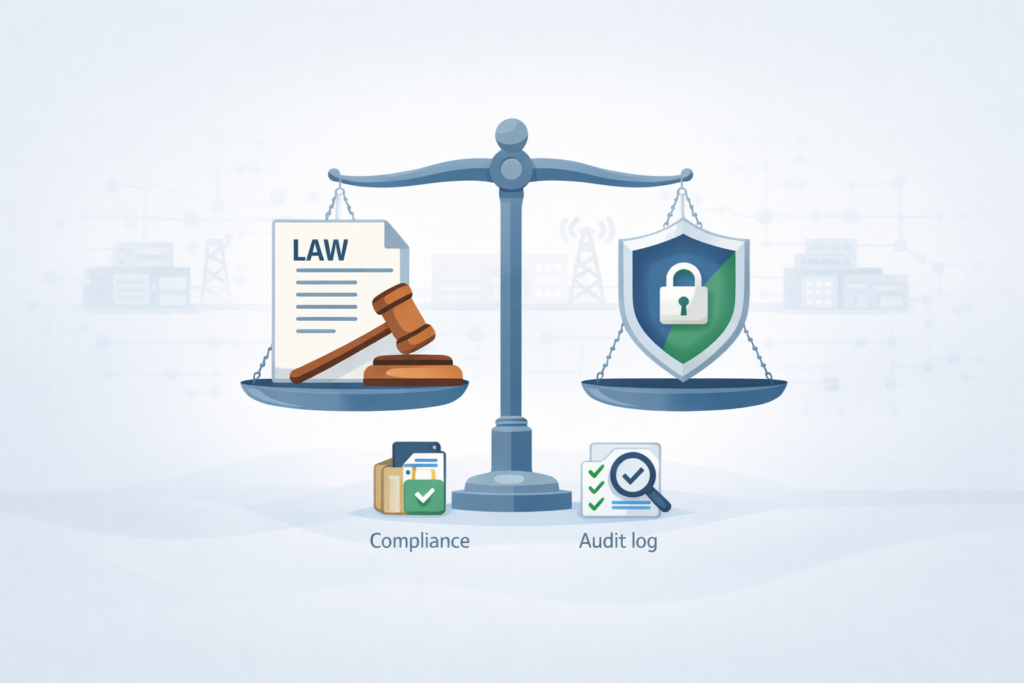
This creates a significant operational burden. Every intercept must be logged. Who activated it? When? For what reason? These audit trails are essential for accountability.
They protect you in the event of a challenge. They prove that your actions were based on valid authority and executed within strict boundaries.
A robust lawful interception platform includes comprehensive logging and reporting features, turning compliance from a headache into a manageable process.
Perhaps the biggest challenge is the public perception of surveillance. The same DPI technology that enables lawful interception can, in different hands, be used for mass surveillance or invasive advertising.
This places a heavy responsibility on providers. You must demonstrate unwavering commitment to using these tools solely for their intended, legal purpose. Transparency about your compliance processes, without revealing operational secrets, builds trust with regulators and the public alike.
Final Analysis: Balancing Duty and Privacy
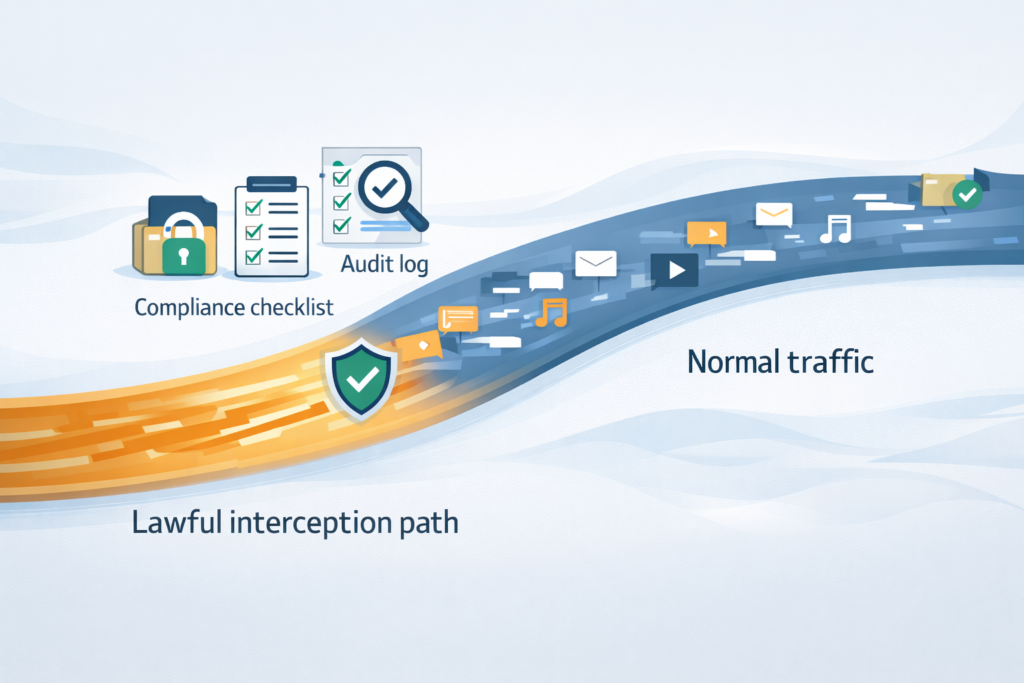
Lawful interception using DPI is a permanent feature of the telecommunications landscape. It is a complex dance between legal mandate, technical capability, and ethical responsibility. For network operators, it’s not about choosing sides.
It’s about perfectly executing a court order with surgical precision. The technology provides the scalpel. Your policies and people guide its hand [2].
The goal is always the same: to fulfill a critical public safety duty while staunchly protecting the privacy of every other user on your network. The integrity of your system depends on getting this balance right, every single time.
FAQ
How does lawful interception using DPI differ from traditional network tapping methods?
Lawful interception using DPI differs from traditional network tapping because it selectively intercepts traffic instead of copying entire data streams.
Deep packet inspection enables targeted network traffic interception based on warrant-defined identifiers.
This allows protocol decoding, traffic flow analysis, and content of communication interception while limiting packet capture technology to only authorized communications, supporting lawful surveillance compliance.
Can lawful interception using DPI operate when traffic is encrypted?
Lawful interception using DPI can operate with encrypted traffic by focusing on encrypted traffic analysis and metadata extraction.
DPI monitoring analyzes signaling metadata collection, session timing, IP traffic monitoring, and call detail records without decrypting payloads. This approach supports lawful access frameworks and telecom regulatory requirements while preserving encryption for non-targeted users.
What role do lawful intercept probes play in telecom networks?
Lawful intercept probes are carrier-grade DPI components placed at controlled network locations. They support real-time traffic monitoring, signaling interception, and VoIP interception.
These probes forward authorized data to an interception mediation device, enabling accurate lawful interception reporting while maintaining network performance and preventing unauthorized traffic collection.
How is intercepted data securely delivered to law enforcement agencies?
Intercepted data is delivered through a mediation and delivery function or lawful monitoring gateway. This process formats content and metadata according to ETSI LI standards or CALEA compliance requirements.
Secure evidence delivery relies on interception audit logging, interception handover interface controls, and lawful data retention to maintain data integrity and accountability.
How does lawful interception using DPI avoid mass surveillance?
Lawful interception using DPI operates within a defined lawful access architecture and requires active interception provisioning systems.
Subscriber identity tracking, traffic correlation analysis, and real-time lawful intercept rules restrict collection to warrant-approved targets. Lawful monitoring analytics ensure that only authorized communications are intercepted, preventing bulk surveillance and privacy overreach
Operationalizing Lawful Interception Through DPI
Lawful interception using DPI ultimately succeeds or fails on discipline. When warrants are translated into precise technical rules, interception becomes targeted, auditable, and defensible. DPI gives operators the visibility to act narrowly, not broadly.
But technology alone is insufficient. Clear governance, trained teams, strict logging, and constant scope verification are what preserve trust.
Done correctly, DPI-based interception fulfills legal duty while leaving the wider network untouched and user privacy intact across modern telecom environments worldwide. Learn how disciplined, DPI-based network monitoring can be implemented in practice.
References
- https://www.steptoe.com/publications/228g.pdf
- https://www.sciencedirect.com/topics/computer-science/lawful-interception