
Packet capture is legal when you own the network, have user consent, and follow regulations like the GDPR. Without this, you’re breaking the law. But for threat detection, it shifts from a liability to your core defense.
Read on to learn how to build a compliant monitoring system that actually protects your organization and legal considerations packet capture
Legal Guardrails Every Packet Capture Program Must Follow
- Consent is non-negotiable. You must have a documented policy or banner notice informing users of monitoring.
- Scope and retention are legally defined. Capture only what you need and delete it as soon as your compliance window closes.
- The chain of custody is everything. For evidence to hold up, you must prove the data wasn’t altered from capture to courtroom.
Where Cybersecurity Ends and the Law Begins
That first packet capture after an alert is unforgettable. My screen flooded with raw hex code, a secret conversation. My heart pounded, but not just from the threat. A colder question hit me: “Am I allowed to look at this?” Were we breaking the law to protect it? That’s the tightrope we walk. This tool is our network microscope. Use it wrong, and you break trust.
“The legality of packet sniffing depends on the context and jurisdiction. In general, packet sniffing is legal when done on networks you own or have explicit permission to monitor. … However, intercepting data on networks you don’t own or have permission to access can violate laws like the U.S. Wiretap Act or similar regulations in other countries.” – Portnox
The line between security and privacy is solid law, not a suggestion. In the U.S., the Electronic Communications Privacy Act (ECPA) makes intercepting communications illegal. We rely on exceptions.
The main one is the “provider exception”: if you operate the network, you can monitor it. But you have to tell people. That standard login banner about “consent to monitoring” isn’t just text. It’s your legal permission to do your job.
The Compliance Clock is Always Ticking
Credits: SentryWire
Once you can capture data, the next fight is over how long you can keep it. We might want packets for months to investigate. The law usually disagrees. Rules set strict, short time limits to prevent endless internal surveillance.
For example, U.S. federal memo M-21-31 says some agencies must keep full packet captures for exactly 72 hours. Not roughly three days, 72 hours. In healthcare, if your capture has patient data, HIPAA says encrypt it.
For credit card data, PCI-DSS requires logging every access attempt. That odd 2 a.m. connection in your logs becomes your legal proof you were watching.
The rules vary:
- U.S. Federal: Keep full packet data for 72 hours.
- Financial: Log all access to payment data.
- Healthcare: Encrypt any patient data you capture.
- GDPR: Keep data only as long as absolutely necessary.
| Regulation Area | Retention Expectation | Key Legal Focus |
| Government Systems | Short fixed forensic windows | Prevent long-term surveillance |
| Financial Environments | Continuous access logging | Prove monitoring of sensitive transactions |
| Healthcare Networks | Encrypted captured data | Protect patient privacy |
| General Data Protection Laws | Minimal necessary retention | Balance security with personal privacy |
| Internal Security Policies | Defined deletion timelines | Reduce legal exposure and breach risk |
Your evidence in court needs a perfect chain of custody. A .pcap file is just a file. You must prove no one changed it after the capture. That requires a clear log tracking everyone who handled it, from the network to the courtroom. Without that log, your evidence won’t hold up.
Building Your Legally-Sound Capture System
Most teams start by capturing everything and worrying about legality later. We learned quickly that approach creates more risk than protection. A full stream off a busy link doesn’t just fill disks, it pulls in private emails, credentials, and sensitive conversations no security team should be touching.
“However, the sheer volume of traffic, as well as common legal hurdles to collecting this data, can hinder or altogether preclude its strategic or proactive collection. … In either mode of collection, packet capture can quickly get to massive volumes and may incur legal considerations that require careful non-technical consideration in addition to the technical ones.” – Red Canary
The smarter move is targeted capture. In our own threat models, packet collection only triggers when risk signals appear, turning detection into the legal and technical starting point instead of blind monitoring.
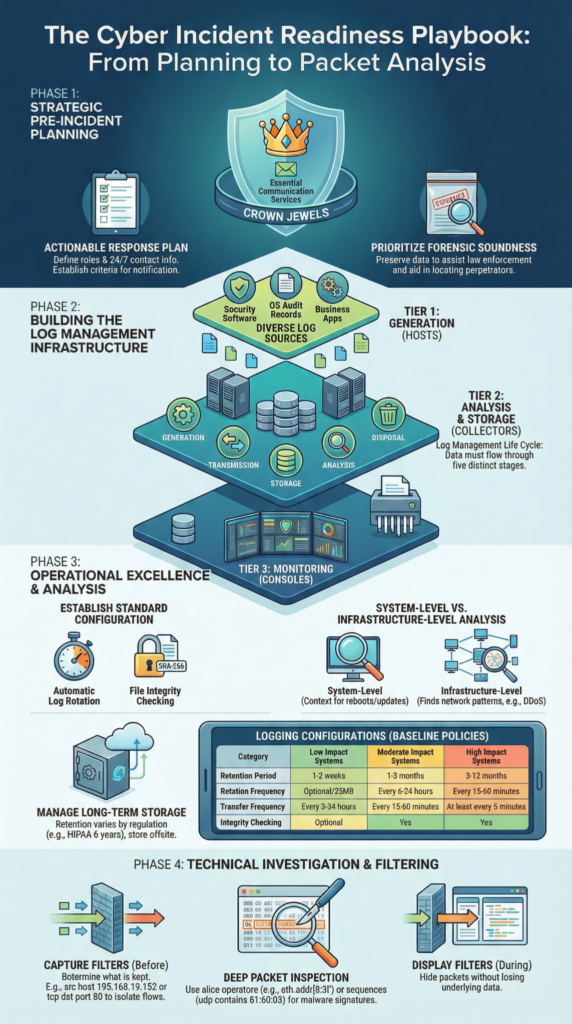
Filtering at the source makes the biggest difference. BPF rules can exclude HR networks, finance systems, and encrypted traffic that isn’t relevant to an investigation. Each filter reduces privacy exposure while keeping attackers visible.
Strong governance matters just as much as tooling. Our playbooks now require least-privilege access to PCAP data, encrypted centralized storage, automated retention limits, and routine legal reviews of scope.
We rebuilt everything after a ransomware case pulled in employee data by accident. Since then, scoped capture driven by risk analysis has kept us compliant and far more effective.
The Steep Price of Getting It Wrong
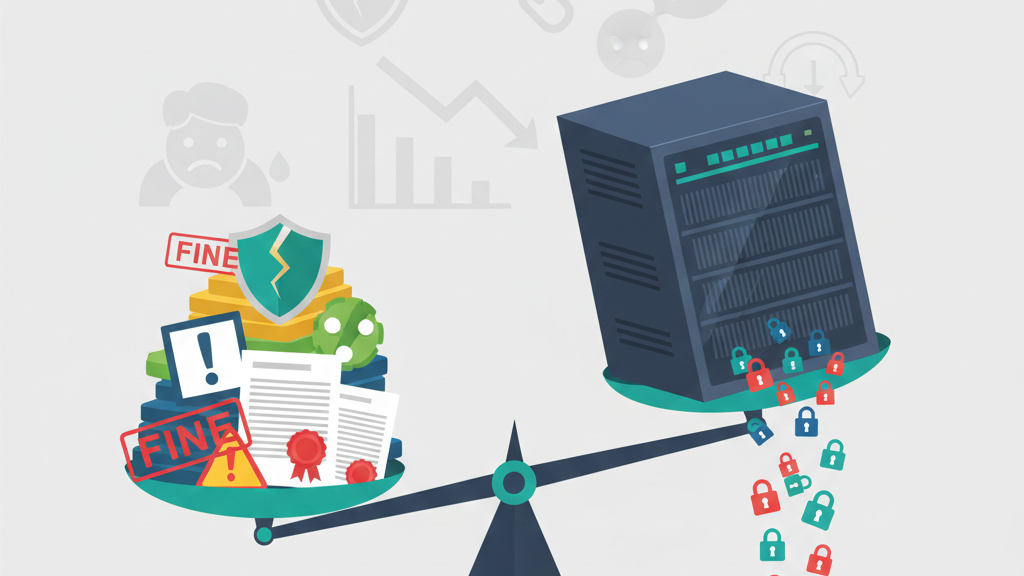
When packet capture crosses legal boundaries, the consequences tend to compound quickly. From a criminal standpoint, intercepting traffic on networks you don’t own, such as public Wi-Fi, is a felony under the ECPA, which is why law enforcement requires warrants to do the same thing. Civil risk follows closely behind.
Employees or users can bring privacy lawsuits if personal communications, financial sessions, or private messages are captured without clear notice and documented consent.
Reputational damage is often the hardest to recover from. A breached packet capture repository doesn’t expose a single system, it reveals entire communication flows, internal behavior, and security weaknesses at once.
IBM’s 2023 data shows the average breach cost reached $4.45 million, and PCAP storage concentrates that risk dramatically. As security experts frequently note, full packet capture is a powerful defensive asset, but without legal oversight, it can become an organization’s most dangerous liability.
FAQ
Is capturing network traffic legal when personal data passes through company systems?
Packet capture becomes sensitive when network traffic includes private information like Personally Identifiable Information or login activity. Even if the site owner controls the network equipment, data protection laws still apply.
Legal departments usually require notice, consent, and filtering criteria to avoid collecting payload content such as Social Security Numbers or personal messages. Lawful monitoring focuses on security systems and threat detection, not user behavior surveillance.
How can packet capture support forensic analysis without violating user privacy?
Forensic analysis works best when Packet Capture focuses on packet headers, network protocols, and suspicious IP address activity rather than full content. Network Traffic
Analysis can detect malware communication, data exfiltration, and intrusions and attacks while limiting private information exposure. Using Berkeley Packet Filters and scoped capture logs helps teams gather useful evidence while staying within privacy considerations.
What packet sniffing practices raise the highest legal risks for organizations?
Full packet capture in promiscuous mode or monitor mode can collect HTTP traffic, requested URLs, and sensitive payload content unintentionally.
Packet Sniffing Attacks aside, poor filtering on port mirroring or network taps often causes overcollection. Legal trouble usually starts when organizations store personal or organizational information without lawful purpose, retention limits, or documented regulatory standards.
How does deep packet inspection impact compliance during incident response?
Deep Packet Inspection gives strong threat detection during network intrusion events, malware communication, or Distributed Denial of Service activity. However, DPI also exposes payload content inside data packets.
During incident response, teams must balance digital forensics needs with user privacy. Most compliance programs restrict DPI to confirmed threats using narrow filtering criteria approved by legal departments.
Turning Legal Duty into Defensive Strength
The law around packet capture isn’t a restriction, it’s a framework that makes your security work sharper. It pushes us from collecting everything to capturing evidence with clear, justified purpose.
This is where a strong detection platform becomes essential. It provides the documented trigger that makes your forensic actions not just effective, but legally sound. The goal is to use this tool with confidence and power.
Ready to build that justified, defensible detection capability? See how our platform aligns legal compliance with operational strength.
References
- https://www.portnox.com/cybersecurity-101/cyber-threats/what-is-packet-sniffing/
- https://redcanary.com/blog/threat-detection/better-know-a-data-source/better-know-a-data-source-network-telemetry/