
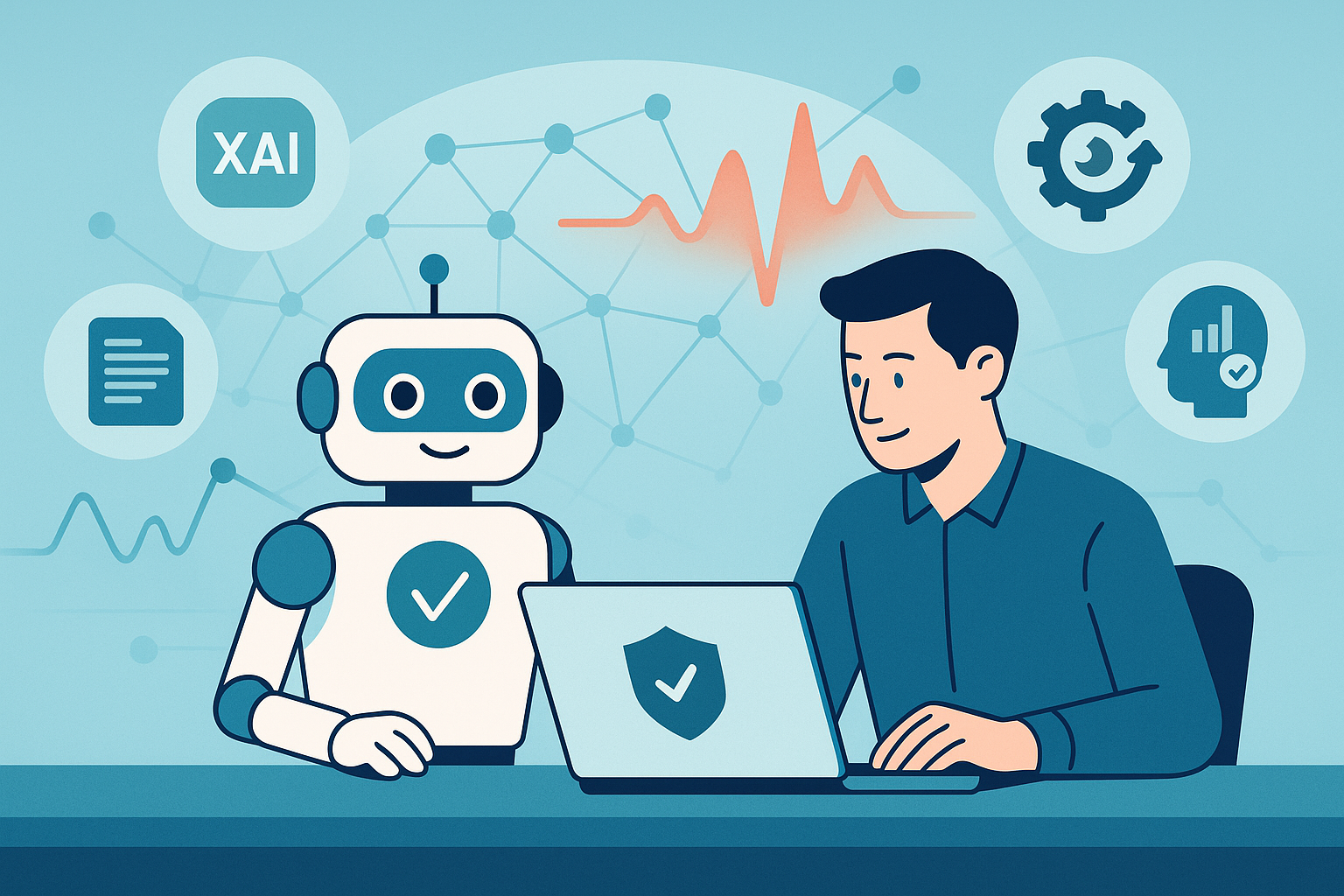
Machine learning and AI in cybersecurity give you back control by learning what “normal” looks like across your network, then flagging what actually deserves your attention.
Instead of chasing every blinking alert, you start seeing which signals are quiet but serious, which patterns don’t fit the usual rhythm of your traffic, and which events truly matter.
These tools don’t replace your judgment, they sharpen it, helping you respond faster and with more confidence while cutting through noise and fatigue. If you want to see how AI can work like a tireless analyst at your side, keep reading.
Key Takeaways
- AI learns your network’s unique “normal” to spot real threats.
- It drastically cuts down false alarms, saving analyst time.
- Explainable AI (XAI) makes the machine’s decisions understandable.
Deep Learning for Network Security

Think of your network traffic as a constant, chaotic conversation. Millions of packets talking at once. A human can’t listen to it all.
A deep learning model, however, is built for this. It uses complex structures like Convolutional Neural Networks (CNNs) to automatically find patterns in the data flow.
It learns what a typical Tuesday afternoon sounds like on your network. Then, it hears the whisper of something wrong.
A model like an autoencoder can be trained to reconstruct normal traffic. When it encounters an anomaly, its reconstruction error spikes. That spike is a quiet, precise alarm.
These systems have shown detection rates of 92-99% in controlled and lab environments. They see the threats that rule-based systems miss because they aren’t just matching known signatures. They’re sensing irregularities.
Applying Machine Learning Cybersecurity
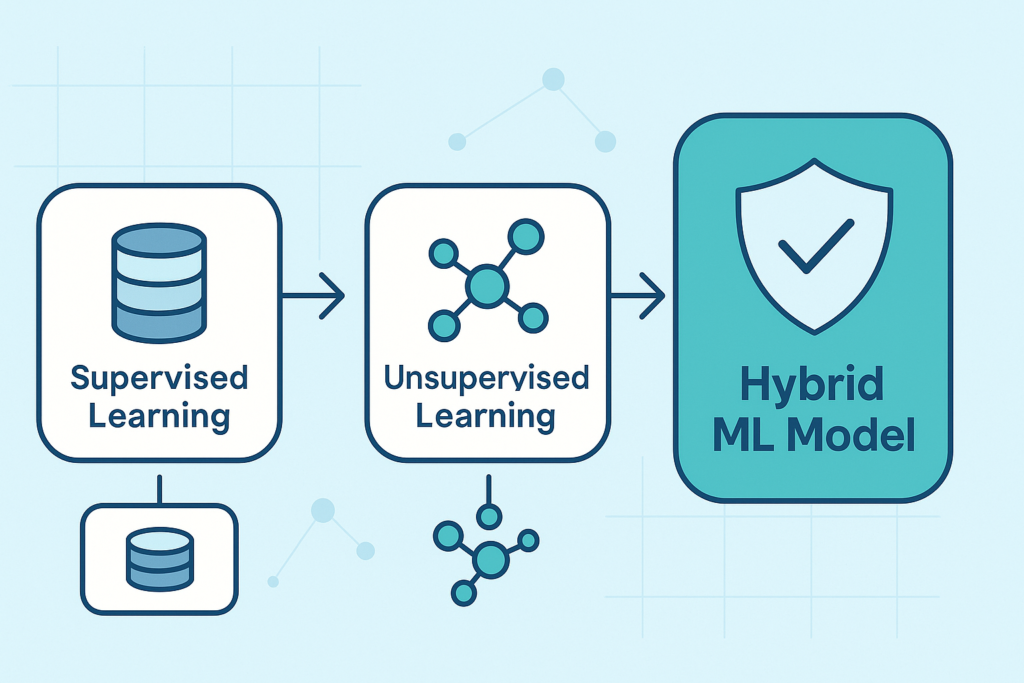
Machine learning in security isn’t one single tool. It’s a toolkit for different jobs. You have supervised learning, which is great for classification tasks. It needs labeled data, this is a virus, this is safe.
It learns from the past to identify the future. Then there’s unsupervised learning. This is for when you don’t know what you’re looking for. It clusters data points, finding groups of similar activity. It can uncover novel attack methods or insider threats that no one has defined yet.
The real power comes from combining them. A hybrid model might use unsupervised learning to flag unusual behavior.
Then, a supervised model classifies that behavior as malicious or just a user working late. This layered approach is how you build a resilient system. It’s not magic, it’s applied mathematics.
| Learning Type | What It Does | Data Needed | Strengths | Limitations |
| Supervised Learning | Classifies known threats based on labeled examples | Large labeled datasets | High accuracy for known attacks | Weak against new or unseen threats |
| Unsupervised Learning | Finds unusual or unknown behaviors | Unlabeled datasets | Detects novel threats and insider risks | Can produce more false positives |
| Hybrid Model | Combines both methods for layered detection | Mix of labeled + unlabeled data | Balanced accuracy + discovery | More complex to maintain |
Supervised Learning Threat Detection
Credits: Forta Network
Supervised learning is the workhorse. You feed it historical data where the outcomes are already known. The model learns the correlations.
For phishing detection, it might analyze thousands of emails. It learns that emails with certain keywords, suspicious links, and strange sender addresses are often bad. It builds a probability score.
This is how many next-gen email security gateways operate. They get better over time as they process more data.
By combining this with signature-based detection methods similar to those used in network threat detection technologies, the system improves accuracy and reduces false positives.
The challenge is the quality of the training data. Garbage in, garbage out, as they say. If your labeled data is biased or incomplete, the model’s judgments will be too. It requires careful curation. It can achieve accuracies of 95-99% for known threats like malware and ransomware.
AI Powered Threat Intelligence Analysis
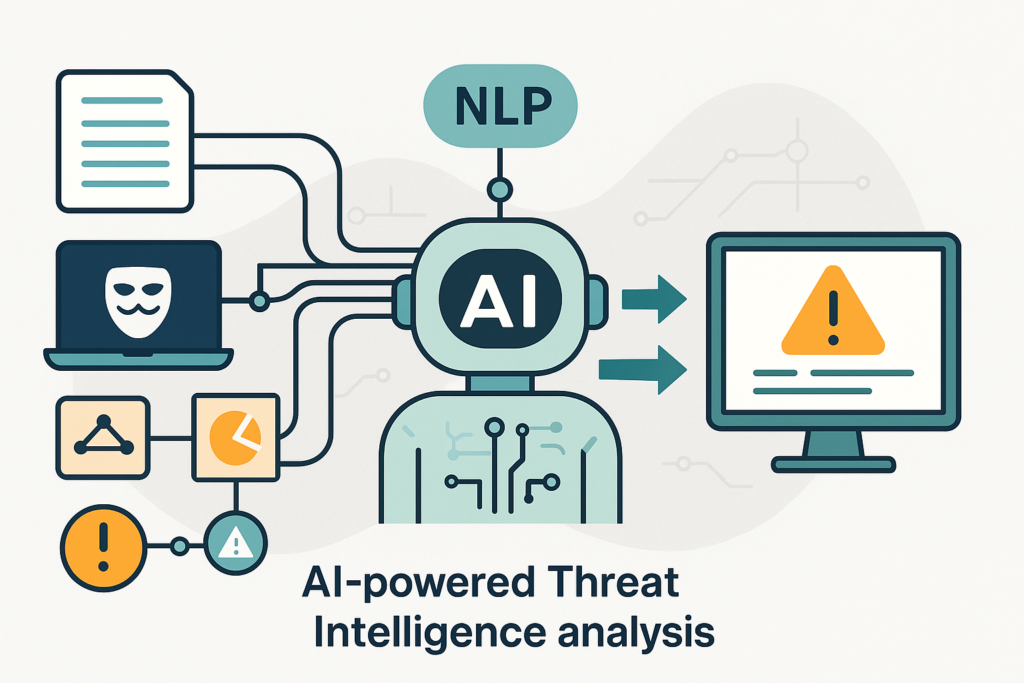
Threat intelligence feeds are a firehose of data. New indicators of compromise (IOCs), hacker forum chatter, vulnerability disclosures. AI can drink from that firehose.
Natural Language Processing (NLP) models, like BERT, can scan thousands of unstructured text sources, blogs, reports, dark web forums, to extract actionable intelligence. They can connect the dots between a new vulnerability and exploit code being sold online.
This shifts threat intelligence from a manual, slow process to a real-time one. The AI doesn’t get tired. It continuously correlates external threat data with internal events in your SIEM.
It might notice that an IP address flagged in an intelligence report just attempted a login on your system. That alert now has context. It’s no longer just a failed login; it’s a potential targeted attack.
Challenges Training ML Security Models
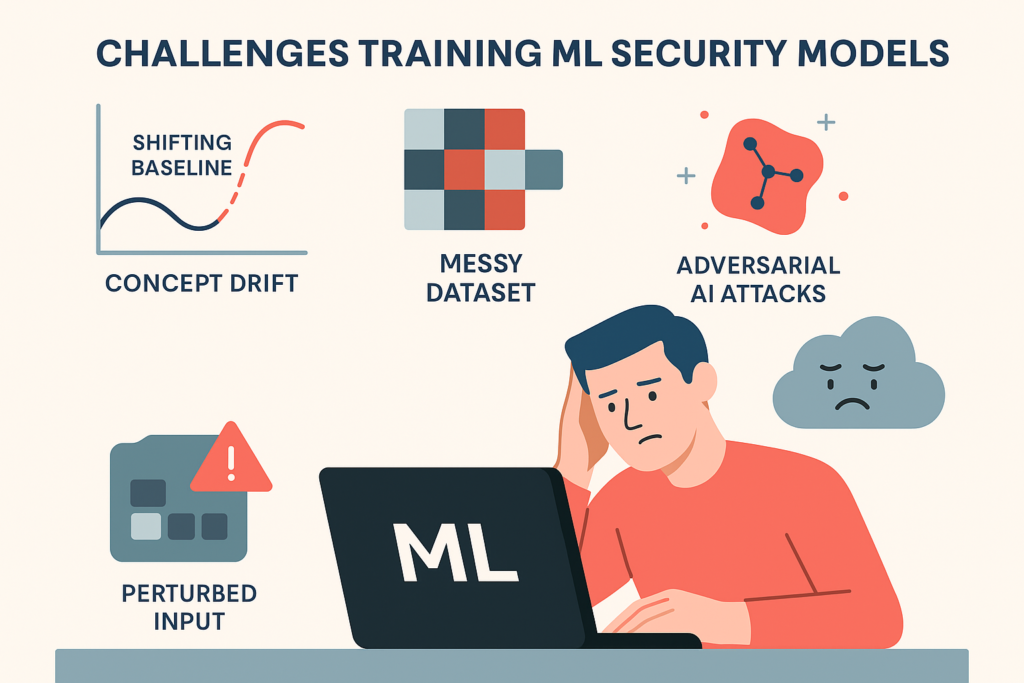
Getting these models right is hard. The data problem is huge. You need massive, clean, and representative datasets to train on. Many organizations simply don’t have that data, or it’s siloed.
There’s also the problem of concept drift. The “normal” for a network changes. New applications are installed, employees come and go. The model must be continuously retrained or it becomes obsolete.
Then there are adversarial attacks. Attackers know you’re using AI. They can craft malicious software or network traffic specifically designed to fool your model.
They make small, calculated changes that are invisible to a human but cause the AI to misclassify the threat. This is a constant cat-and-mouse game.
Explaining AI Detection Decisions (XAI)
A security analyst gets an alert: “AI Model 7B has flagged this user’s activity as 99.7% malicious.” Why? The old “black box” problem is a deal-breaker in security. You can’t act on a decision you don’t understand.
This is where Explainable AI (XAI) comes in. Techniques like LIME or SHAP can show the analyst which features most influenced the decision.
- Unusual login time: 3:00 AM.
- Massive data download: 50 GB in 10 minutes.
- Access to sensitive server: First-time access [1].
Now the analyst sees the reasoning. It’s not a mysterious red flag. It’s a logical sequence of events. XAI builds trust. It turns the AI from an oracle into a colleague that shows its work. This transparency is critical for adoption in high-stakes environments.
Reducing False Positives with AI
The biggest drain on a Security Operations Center (SOC) isn’t the real attacks. It’s the false alarms. Analysts spend hours investigating events that turn out to be nothing.
AI, particularly behavioral analytics, cuts this down. By establishing a deep baseline of normal behavior for every user and device, the AI ignores the harmless noise [2].
It knows that Sarah in accounting always logs in from Chicago and accesses the financial database. That’s normal. If Sarah’s account suddenly logs in from Latvia and starts trying to access source code, that’s a high-fidelity alert.
This focus means analysts spend their time on real threats, not busywork. Studies report reductions in false positives from 20% up to 90%.
Automating Threat Detection Tasks
Automation is the next step. Once a threat is confirmed with high confidence, AI can trigger a response.
This is the core of SOAR (Security Orchestration, Automation, and Response) platforms integrated with AI. The system can automatically isolate an infected endpoint, block a malicious IP address at the firewall, or disable a compromised user account.
This shrinks critical metrics like Mean Time to Detection (MTD) and Mean Time to Response (MTR). Instead of taking hours or days, containment can happen in minutes.
The machine handles the repetitive, time-consuming tasks. It gives human analysts the bandwidth to focus on complex tasks like threat hunting and strategic planning.
Future Trends AI Cybersecurity
The future is about augmentation, not replacement. AI will increasingly act as a force multiplier for human analysts.
We’ll see more AI that can write its own detection rules based on what it finds. There’s also a growing focus on resilience against adversarial AI, making models harder to fool.
Privacy-preserving techniques like federated learning will allow organizations to collaborate on improving models without sharing sensitive data.
Ethical considerations will move to the forefront. How do we prevent bias in AI security tools? How do we ensure they respect privacy? The technology is powerful, and with that power comes responsibility.
The goal is a collaborative future where AI handles the scale and speed, and humans provide the context, intuition, and ethical oversight.
Explainable AI Security Benefits
The benefits of XAI go beyond just building trust. It directly improves security outcomes. When an analyst understands why something was flagged, they can refine the detection logic.
They might realize the model is being too sensitive to a particular, but legitimate, business process. This feedback loop makes the AI smarter and more accurate over time.
XAI is also crucial for compliance and auditing. Regulators need to understand how decisions affecting data privacy and security are made.
An unexplainable black box is a non-starter. With XAI, you can provide clear documentation on the decision-making process, satisfying audit requirements and demonstrating due care.
Adversarial AI Attack Examples
So what do these attacks look like? It’s not science fiction. A common example is data poisoning. An attacker with some access might subtly alter the training data.
They could slowly label malicious files as “benign” over time. The model learns the wrong lesson, becoming blind to that specific threat.
Another method is evasion attacks. For an image-based malware detector, an attacker might add a few scattered pixels to a malicious file. To a human, it looks the same.
To the AI model, the mathematical signature is now just different enough to be classified as safe. These attacks highlight the need for robust, continuously monitored models.
Predictive Threat Analytics AI
This is where AI moves from detection to prediction. By analyzing patterns across vast datasets, internal logs, global threat feeds, vulnerability databases, predictive models can assign risk scores to assets.
They might flag that a particular server is highly vulnerable to a newly discovered exploit based on its configuration and the software it runs.
This allows security teams to shift from a reactive posture to a proactive one. Instead of waiting for an attack, they can patch the server, adjust firewall rules, or increase monitoring on that asset before it’s targeted. It’s about anticipating the adversary’s next move.
AI Cybersecurity Tools Comparison
The market is crowded with vendors, each claiming superiority. Tools like Darktrace and Vectra AI specialize in unsupervised behavioral analytics, learning normal patterns to find anomalies.
CrowdStrike and Sentinel One leverage AI on the endpoint for real-time malware prevention. Palo Alto Networks Cortex XDR uses AI to correlate data across networks, clouds, and endpoints. Comparing them means looking beyond marketing claims. You need to evaluate:
- Detection Accuracy: What are their true positive and false positive rates?
- Explanation Capabilities: How well do they explain their alerts?
- Integration: How easily do they fit into your existing security stack?
Implementing AI Security Solutions
Jumping in headfirst is a recipe for failure. A successful implementation starts small. Identify a high-volume, repetitive problem. Phishing email detection is a great candidate.
Pilot a tool focused on that specific use case. Measure its performance against your current solution. Did it reduce the workload for your team? Did it catch things you missed?
Gradually expand from there. Ensure you have the right data infrastructure to feed the AI models. And most importantly, train your team. They need to understand how to work with the AI, not against it. It’s a cultural shift as much as a technological one.
Ethical AI Cybersecurity Concerns
The power of AI brings serious ethical questions. Bias is a major one. If an AI model is trained on data from a company with a predominantly male engineering team, it might learn to view female user behavior as more “anomalous.” This could lead to false flags and discrimination.
Privacy is another concern. AI models for user behavior analytics require deep visibility into what employees are doing.
Where is the line between security monitoring and surveillance? These questions require clear policies and human oversight to ensure the technology is used responsibly.
Evaluating AI Security Vendors
When talking to vendors, move beyond the sales pitch. Ask for proof. Request a detailed pilot where you can test the tool with your own data.
Ask pointed questions about adversarial robustness. “How do you protect your model from poisoning attacks?” Inquire about their model maintenance. “How often is the model retrained, and with what data?”
The best vendors are transparent about their technology’s limitations. They see you as a partner in building a more secure environment. The worst vendors treat their AI as a magic black box they can’t, or won’t, explain.
AI Augmenting Security Analysts
The goal is not a fully automated SOC with no people. The goal is to augment the analysts you have.
AI can triage thousands of low-level events, presenting the human with only the handful that truly matter.
It can automatically gather contextual data for an incident, saving the analyst hours of manual search. This augmentation boosts SOC efficiency significantly, by some estimates 40-50%.
It reduces burnout and allows your best people to focus on what they do best: complex analysis, threat hunting, and strategic thinking. The machine handles the scale, the human provides the wisdom.
AI Impact Security Operations
The overall impact on security operations is profound. AI compresses the timeline of an attack. Detection happens faster.
Response is almost instantaneous for known playbooks. This fundamentally changes the cost calculus for attackers. The window of opportunity for them to operate unnoticed shrinks to minutes instead of days.
It also changes the skills needed on a security team. There’s less demand for analysts who can manually sift through logs.
There’s more demand for people who can manage AI systems, interpret their findings, and handle the complex incidents that the AI escalates. It’s an evolution of the profession.
The New Rhythm of AI Security
Machine learning and AI are quietly reshaping the frontline of cybersecurity. They are not silent replacements but loud partners, designed to handle the overwhelming noise so human experts can focus on the signal.
The future of security operations is a symphony of machine speed and human intuition. The technology exists not to make security less human, but to make it more effective.
The first step is to listen to the chaos in your own network and ask what a tireless, intelligent listener could find. Start that conversation with a pilot project today.
FAQ
How do anomaly detection networks help find new risks in Machine Learning & AI in NTD systems?
Anomaly detection networks find unusual behavior that does not match normal patterns. They work with autoencoders anomaly detection and neural networks IDS to detect early warning signs. These methods support false positives reduction ai by showing only real issues. They help teams respond faster and keep Machine Learning & AI in NTD systems safer and more stable.
What makes explainable AI XAI useful for people working with Machine Learning & AI in NTD?
Explainable AI XAI helps people understand why a model makes a decision. Tools like lime shap xai security show the important features the model used. These explainable ai benefits build trust and help ai security analysts check alerts quickly. Clear explanations make Machine Learning & AI in NTD easier to manage and safer for daily use.
How can supervised learning threat detection improve safety in Machine Learning & AI in NTD work?
Supervised learning threat detection studies labeled data to find known risks. It supports phishing detection ml, malware classification ai, and ransomware prediction by learning clear patterns. Models such as decision trees security and random forest ids provide reliable alerts. These tools help Machine Learning & AI in NTD systems detect threats early and protect users from harm.
How does automating threat detection support security teams using Machine Learning & AI in NTD?
Automating threat detection removes slow manual steps and speeds up responses. It works with security information event management siem ai and security orchestration automation response soar to group alerts and guide actions. These tools reduce mean time detection mtd reduction and improve mean time response mtr ai. This helps Machine Learning & AI in NTD systems stay secure and efficient.
How do predictive threat analytics help teams plan ahead in Machine Learning & AI in NTD?
Predictive threat analytics uses machine learning cybersecurity methods to highlight future risks. It examines network traffic analysis ai, behavioral analytics security, and intrusion detection system ids data to find patterns. It also tracks advanced persistent threats apt ai signals. These insights help teams protect Machine Learning & AI in NTD systems early and create stronger long-term security plans.
A More Human Rhythm of Cyber Defense
Machine learning and AI are not silver bullets, but they redefine how security teams survive at scale.
By learning normal behavior, reducing false positives, explaining decisions, and automating response, AI gives analysts back their most valuable asset: time. When implemented thoughtfully and ethically, it becomes a trusted partner, not a black box.
Start small, demand transparency, and let humans and machines defend together, faster, calmer, and far more resilient. Ready to take the next step? Join the movement today.
References
- https://journals.plos.org/plosone/article?id=10.1371%2Fjournal.pone.0318542
- https://www.sciencedirect.com/science/article/pii/S016740482300439X