

The NDR incident response workflow is a step-by-step process that organizations use to spot network threats quickly, stop them from spreading, and fix the damage.
Network Threat Detection sits at the heart of this system, acting as the first line of defense by constantly monitoring and analyzing traffic for unusual activity.
Many of us have seen firsthand how having a structured response plan cuts down the chaos when alerts flood in.
This workflow isn’t just about tools; it’s about putting people and technology together to act fast and smart. Keep reading to understand how these stages connect and why they matter.
Key Takeaway
- Preparation and training make responding faster and more effective.
- Continuous detection and analysis uncover real threats amid noise.
- Containment and recovery limit damage and speed up return to normal.
Starting Strong: Preparation in NDR Incident Response
Preparation is where the groundwork gets laid. We set policies, run drills, and make sure everyone knows their role before trouble hits.
Network Detection and Response (NDR) solutions sit at the heart of this system, acting as the first line of defense by constantly monitoring and analyzing traffic for unusual activity
Deploying NDR tools across network segments ensures coverage where it counts. Communication lines get tested and clear escalation paths defined.
With a solid plan, teams can act without hesitation. These essentials include:
- Regular incident response training
- Clearly documented escalation protocols
- Well-configured detection tools ready to spot anomalies
This stage is like setting up a fire alarm system; the better it is maintained, the quicker you react when smoke appears.
Preparing an incident response team also means understanding your network’s normal behavior. We invest time in baseline profiling, so when something deviates, it stands out sharply. Without this baseline, alerts can be overwhelming or misleading.
Our experience tells us that even the best detection tools fail if the people handling alerts aren’t ready or if communication breaks down. So, preparation is both technical and human.
Watching Closely: Detection and Analysis

Spotting an attack early depends on how well you watch network traffic. Our Network Threat Detection approach dives into the metadata and payloads, using behavioral analytics and machine learning to find anything that seems off.
This could be a sudden spike in outbound traffic or a rare protocol being used (1).
Alerts come in fast, but not all are real threats. Sorting these requires deep analysis to confirm incidents, understand their scope, and prioritize them. Without this, teams waste time chasing false leads.
The workflow here flows like this:
- Continuous traffic monitoring by NDR tools
- Anomaly detection using behavioral patterns
- Alert validation and incident prioritization
- Correlating security events for a clearer picture
Behavioral analytics help spot patterns that don’t match usual user or network activity. That might mean detecting a compromised user account acting differently or a device communicating with an unusual external server. Machine learning models improve over time by learning what’s normal and flagging deviations.
We’ve noticed that early detection alone isn’t enough. The depth of analysis matters. For example, incident analysts need detailed contextual data , who, what, when, where, and how ,to understand if an alert is a false positive or a real threat.
This is where integrating threat intelligence feeds into the NDR platform plays a key role, enriching alerts with known attacker signatures or tactics.
Automated alerting and triaging reduce analyst fatigue by filtering out low-priority events. This lets the team focus on high-risk incidents, speeding up response times.
Taking Control: Containment Measures
Once a threat is confirmed, slowing it down is critical. We’ve found that immediate actions like isolating affected hosts or blocking malicious IPs keep the damage from spreading.
Network segmentation helps too, creating boundaries that stop intrusions from crossing into other parts (2).
Sometimes traffic is rerouted to honeypots,decoy systems designed to distract attackers and collect intel. Containment is a crucial pause, buying time for a full investigation.
Key containment strategies include:
- Quarantining compromised systems
- Blocking malicious addresses or domains
- Isolating network segments
- Redirecting traffic for threat distraction
Containment isn’t about permanently fixing the problem. It’s a tactical move that creates breathing room for more thorough eradication efforts.
The speed and decisiveness of this step often decide how much damage the attack can cause. For example, an attacker spreading ransomware through a network can be stopped cold if affected machines get cut off fast enough.
We’ve seen containment strategies evolve with automation. Some organizations now use response orchestration platforms that trigger immediate containment actions based on defined playbooks, reducing manual steps and human error.
This automation can include blocking suspicious IPs at firewalls or disabling compromised user accounts instantly.
Still, human judgment remains key. Determining what exactly to isolate or block without disrupting business operations requires experience and good communication between security teams and IT.
Clearing the Threat: Eradication and Recovery

After containment, the dirty work begins. Removing malware, closing backdoors, and disabling unauthorized accounts are top priorities. This stage also means patching vulnerabilities that attackers exploited.
We’ve seen incidents where incomplete eradication led to repeated breaches. That’s why verifying system integrity and restoring services carefully are essential. Recovery isn’t just flipping switches back on; it’s making sure the network is safe to use again.
Typical steps cover:
- Malware removal and account cleanup
- Vulnerability patching and system restoration
- Verification of system health
- Monitoring for signs of residual threats
Eradication often requires network forensics to track the attacker’s movements and understand the full extent of the breach. Forensic data collection helps reconstruct incident timelines and supports legal or compliance reporting.
Recovery planning is another critical aspect. It involves restoring systems from clean backups, re-imaging compromised machines, and gradually bringing services back online while monitoring closely for any signs of relapse.
Our experience shows that recovery can be a slow, painstaking process. Rushing it can leave hidden threats in place, risking future incidents. So teams walk a fine line between restoring normal operations quickly and ensuring security.
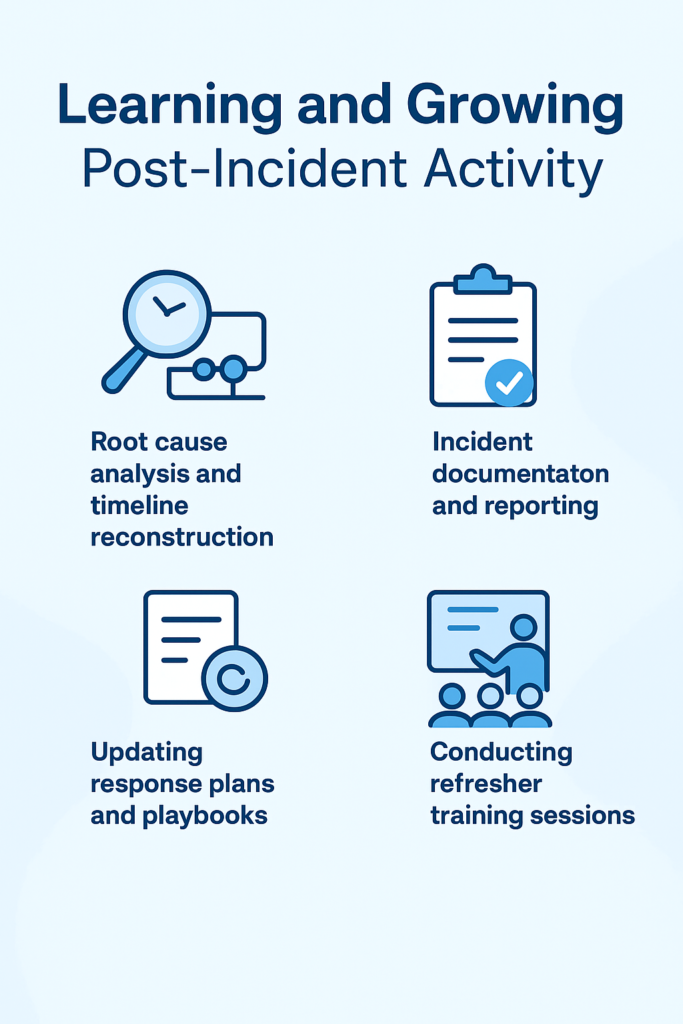
Learning and Growing: Post-Incident Activity
The final stage is reflection. After things calm down, teams gather to analyze what happened, why it happened, and how the response went. Documenting this helps improve the incident response playbook and prepares everyone better for next time.
We’ve found that sharing lessons learned and updating training based on real incidents builds stronger defenses. This also includes refining detection rules and improving communication protocols.
Post-incident activities often feature:
- Root cause analysis and timeline reconstruction
- Incident documentation and reporting
- Updating response plans and playbooks
- Conducting refresher training sessions
Good incident documentation is crucial. It creates institutional memory and helps new team members get up to speed. It also supports compliance with regulations that require detailed breach reports.
Sometimes post-incident reviews reveal gaps in controls or new threat vectors. Organizations then adapt by introducing new security tools, improving network segmentation, or enhancing user awareness training. This continuous loop helps security operations center workflows stay relevant as attackers evolve.
Real-World Impact of NDR Workflows
Source: Enhanced Information Solutions
Organizations that embrace this NDR incident response workflow see clear benefits. Detection times drop by up to 60%, meaning threats get caught before they do serious harm. Response times halve, speeding containment and recovery.
These measurable results highlight the benefits of using NDR tools in improving visibility, reducing false positives, and streamlining response across hybrid environments.
Automated alerts and event correlation reduce false positives by over 40%, easing the burden on security analysts. This means teams can focus on real threats rather than chasing shadows. The dwell time,how long attackers stay hidden,shrinks from months to mere hours or days.
Such improvements come from blending technology like behavioral analytics and automation with human expertise and clear processes.
We’ve worked with teams that reported a dramatic drop in incident response time after adopting automated threat mitigation steps integrated with their NDR platform.
This not only reduces risk exposure but also improves SOC workload optimization, letting analysts focus on threat hunting and deeper investigations.
Incident Response Best Practices to Consider
Understanding the NDR workflow is one thing, putting it into practice well is another. Based on our experience, here are a few tips to enhance your incident response lifecycle:
- Keep your incident response playbook updated and realistic.
- Train your team regularly with simulated attacks tailored to your network.
- Integrate threat intelligence feeds to enrich detection and prioritization.
- Use automated tools judiciously but keep human oversight.
- Document every incident thoroughly for review and compliance.
- Foster collaboration between SOC analysts, IT, and business units.
- Monitor incident response metrics to spot bottlenecks or weaknesses.
- Review and test escalation protocols frequently.
These practices help reduce incident response time, improve incident prioritization, and ensure all stakeholders are aware and prepared.
And when selecting or upgrading your detection platform, make sure you’re evaluating NDR vendor solutions that align with your infrastructure, scalability goals, and integration needs.
Addressing Common Challenges in NDR Incident Response
No workflow is perfect. Some recurring challenges include:
- Alert fatigue from too many false positives.
- Difficulty in correlating events across different security tools.
- Lack of communication between teams during incidents.
- Insufficient training leading to slow or incorrect responses.
- Complexity of modern networks adding to investigation difficulty.
We think dealing with these requires a mix of technology and culture change. Automated alert triaging helps reduce noise, while integrated security orchestration platforms can bridge tool gaps. Clear incident communication channels prevent confusion and speed escalation.
Regular incident response training builds confidence and sharpens skills. Also, involving cross-functional teams early can ensure all angles,from technical to business impact,are considered.
Bringing It All Together: The Network-Centric Edge
What sets NDR incident response workflows apart is their focus on network traffic and behavior.
While endpoint detection and response (EDR) and SIEM tools play their parts, Network Threat Detection offers a broad, real-time view of what’s happening across the entire network.
This network-centric approach means threats that bypass endpoint defenses or hide in encrypted traffic get spotted sooner. It also supports rapid incident investigation and root cause analysis by providing rich contextual data.
Our experience suggests that integrating NDR with existing security operations center workflows creates a more resilient defense posture.
It supports threat hunting, insider threat response, and even phishing response by linking network events to user actions.
Final Thoughts on NDR Incident Response Workflow
Getting a handle on incident response means more than just reacting to alerts. An NDR incident response workflow brings a clear, repeatable process that speeds detection, containment, and eradication.
It blends technology like behavioral analytics and automation with the human element of analysis and communication.
We encourage organizations to look closely at their current incident handling procedures and see how a network detection response framework could tighten their defenses
FAQs
What is an NDR incident response workflow?
An NDR incident response workflow is a structured process designed to detect, analyze, contain, and remediate threats specifically through network detection and response tools. It focuses on real-time monitoring of network traffic to identify anomalies or malicious behavior before they cause serious damage.
This workflow involves preparation, continuous detection, containment, eradication, recovery, and post-incident review, helping organizations reduce response times and improve overall cybersecurity posture by leveraging behavioral analytics and automated alerts.
How does Network Threat Detection improve incident response?
Network Threat Detection enhances incident response by continuously monitoring network traffic and applying behavioral analytics to spot unusual activity. It acts as an early warning system, catching threats that might bypass endpoint protections.
This leads to faster detection, fewer false positives, and more accurate prioritization of incidents. By providing rich context about network events, it enables security teams to investigate and contain threats more efficiently, reducing dwell time and limiting damage.
What role does behavioral analytics play in NDR workflows?
Behavioral analytics in NDR workflows examines normal network and user behavior patterns to identify deviations that may indicate malicious activity. By analyzing metadata and payloads, it detects subtle changes such as unusual login times, atypical data transfers, or communication with suspicious IPs.
This approach helps reduce false positives and uncovers threats that signature-based detection might miss, making incident detection more precise and effective.
How important is incident containment in the NDR workflow?
Incident containment is critical because it stops an attack from spreading and causing more damage. Once a threat is confirmed, quick actions like isolating infected hosts, blocking malicious IPs, or segmenting the network prevent lateral movement.
Containment provides a valuable window to conduct deeper investigation and eradication without the attacker advancing further. Effective containment minimizes operational disruption and limits data loss or system compromise.
What is the difference between eradication and recovery in incident response?
Eradication involves removing the root cause of an incident, such as malware, unauthorized accounts, or backdoors. Recovery focuses on restoring systems to normal operation, which includes patching vulnerabilities, verifying system integrity, and bringing services back online safely.
Both steps are necessary to ensure the threat is fully eliminated and the network returns to a secure, functional state without residual risks.
How does automation benefit the NDR incident response process?
Automation speeds up incident response by instantly triggering containment actions like blocking IPs or quarantining hosts based on predefined rules. It reduces manual workload and human error, enabling analysts to focus on complex investigations.
Automated alert triaging helps filter out false positives, improving response accuracy. In NDR workflows, automation enhances threat mitigation and incident escalation, making the response lifecycle more efficient and scalable.
Why is post-incident review essential after a network breach?
Post-incident review allows teams to analyze what happened, identify root causes, and assess response effectiveness. Documenting findings helps improve future incident response playbooks and security controls.
It also supports compliance requirements and trains staff using real-world examples. Continuous learning from incidents strengthens defenses and reduces the likelihood or impact of similar attacks in the future.
How does NDR integrate with other security tools like SIEM or EDR?
NDR complements SIEM and EDR by focusing on network-level visibility. While EDR monitors endpoints and SIEM aggregates logs, NDR analyzes network traffic patterns to detect threats that might evade endpoint detection.
Integrating these tools provides a holistic security view, improves event correlation, and enhances threat hunting capabilities. This layered approach delivers faster detection and more informed incident response decisions.
What challenges do organizations face when implementing NDR workflows?
Common challenges include managing alert fatigue due to too many false positives, correlating events across multiple security tools, and ensuring effective communication between teams during incidents.
Training gaps and complex network environments can slow response times. Overcoming these requires proper tuning of detection tools, automation for triaging alerts, regular incident response training, and fostering collaboration across SOC, IT, and business units.
How can organizations improve their incident response time using NDR?
Organizations can improve response time by preparing thoroughly with documented playbooks and regular training. Deploying NDR tools for continuous network monitoring and using behavioral analytics help detect threats early.
Automating alert triaging and containment actions speeds decision-making. Prioritizing incidents based on impact and integrating threat intelligence further refines focus. Together, these actions reduce detection and resolution times, limiting damage and speeding recovery.
Conclusion
Strong preparation, continuous monitoring, swift containment, thorough recovery, and honest post-incident reviews form a cycle that keeps improving.
If you want to talk through your network security challenges or figure out how to shape a better incident response plan, we’re here to help. The key lies in seeing network threat detection not just as a tool, but as a partner in a holistic security effort.
With NetworkThreatDetection.com, cybersecurity teams can turn that partnership into action, leveraging real-time threat modeling, automated risk analysis, and continuous intelligence to strengthen every layer of defense.
References
- https://medium.com/@BlessingDuru/network-segmentation-a-necessary-standard-b44341f8eeb4
- https://medium.com/@zemim/7-network-segmentation-security-best-practices-38f8456265de