

When it comes to threat hunting, Network Detection and Response (NDR) stands as a crucial ally. NDR gives us unmatched visibility into network traffic, helping uncover hidden threats that traditional methods often miss.
Its strength lies in monitoring everything from encrypted packets to IoT device communications, while using behavioral analytics and machine learning to spot unusual activity.
This lets us catch threats early, reducing the time an attacker can lurk unnoticed. If you’re curious about how NDR role in threat hunting with real-time network, keep reading.
Key Takeaway
- NDR provides deep, real-time visibility across diverse network environments.
- Behavioral analytics and machine learning enable early detection of stealthy threats.
- Automated investigation tools speed up incident response and reduce alert fatigue.
Comprehensive Network Visibility Powers Effective Threat Hunting
Network threat hunting relies heavily on seeing the entire traffic flow. We’ve observed firsthand how NDR tools monitor all network data , including encrypted channels and less obvious endpoints like IoT devices. This wide lens helps spot anomalies that typically slip past endpoint detection.
We’ve observed firsthand how Network Detection and Response (NDR) solutions monitor all network data , including encrypted channels and less obvious endpoints like IoT devices. This wide lens helps spot anomalies that typically slip past endpoint detection.
Every packet counts. NDR collects data continuously, so threat hunters gain a real-time pulse of network activity. This constant monitoring is crucial for detecting lateral movement, which is a common sign of advanced persistent threats.
Moreover, NDR’s ability to cover operational technology (OT) networks adds a layer often overlooked but vital for industrial environments. Without this coverage, blind spots emerge, giving attackers a playground.
Benefits of NDR’s network visibility include:
- All-encompassing coverage of network traffic types
- Continuous data collection for real-time insights
- Detection of subtle, hidden threat indicators
Having this kind of visibility lets us build a clearer threat picture, guiding where to dig deeper during investigations.
Machine Learning and Behavioral Analytics Detect the Undetectable
NDR’s secret weapon is its use of behavioral analytics powered by machine learning. It learns what “normal” looks like on your network, then raises flags when something deviates (1).
This approach catches zero-day attacks and stealthy intrusions that signature-based systems miss.
One example I recall involved catching lateral movement by spotting a rare connection pattern between devices. The NDR system alerted us well before the attacker could escalate privileges.
These machine-learned models adapt over time, improving accuracy and reducing false positives.
This method goes beyond just spotting anomalies. It scores network behaviors, helping prioritize alerts that matter most. As a result, threat hunters spend less time chasing noise and more on genuine threats.
The key advantages here are:
- Early detection of unknown threats
- Continuous learning that refines detection models
- Prioritization of alerts to reduce false positives
Behavioral-based NDR tools are indispensable in today’s threat landscape where attackers increasingly use subtle, low-and-slow tactics.
Data Enrichment and Contextualization Improve Investigation Efficiency

Raw alerts can overwhelm analysts, but NDR platforms integrate cyber threat intelligence feeds and contextual data to enrich findings. This makes threat hunting workflows more efficient by giving hunters the background they need to quickly assess severity.
We’ve seen how this contextualization aids incident response teams. Instead of starting from scratch, they get timelines, session reconstructions, and related indicators of compromise (IOCs) right away. That accelerates triage and helps piece together an attacker’s path.
Additionally, automation features like playbooks help handle repetitive tasks, freeing analysts to focus on complex investigations. This integration between manual and automated processes boosts operational efficiency in security operations centers (SOC).
Features that enhance threat hunting through data enrichment include:
- Integration with external cyber threat intelligence
- Session reconstruction and event timeline creation
- Automated playbooks for incident response
Such capabilities transform NDR from a passive monitoring tool into an active partner in the hunt, amplifying human expertise.
Early Detection Cuts Dwell Time and Limits Damage
The average attacker remains undetected inside networks for months. We’ve observed that NDR’s early warnings about reconnaissance activities or command-and-control traffic dramatically reduce this dwell time.
By catching threats before they escalate, NDR limits potential damage and lowers response costs. This proactive stance is critical in defending against advanced persistent threats and zero-day exploits.
Statistics back this up: organizations using NDR report detection speeds up to 60% faster and response times cut nearly in half. These improvements mean less time spent cleaning up breaches and more time reinforcing defenses.
Key outcomes of early detection with NDR:
- Shorter attacker dwell time inside networks
- Faster containment and remediation
- Reduced operational impact and costs
We know that reducing dwell time is one of the best ways to protect sensitive data and maintain business continuity.
Strategies of NDR Role In Threat Hunting

A well-rounded threat hunting strategy uses NDR’s unique capabilities to monitor attack surfaces continuously. We recommend combining network traffic baselining with anomaly correlation to spot deviations quickly.
Threat hunting workflows benefit from NDR’s attack surface monitoring, which tracks unusual command and control communications and lateral movement patterns. These signals often indicate an ongoing breach.
Effective strategies include:
- Leveraging deep packet inspection for detailed traffic analysis
- Employing machine learning models for behavioral anomaly detection
- Utilizing threat hunting dashboards for real-time visualization
By integrating these tactics, security teams get a clearer, more immediate view of network health and threats.
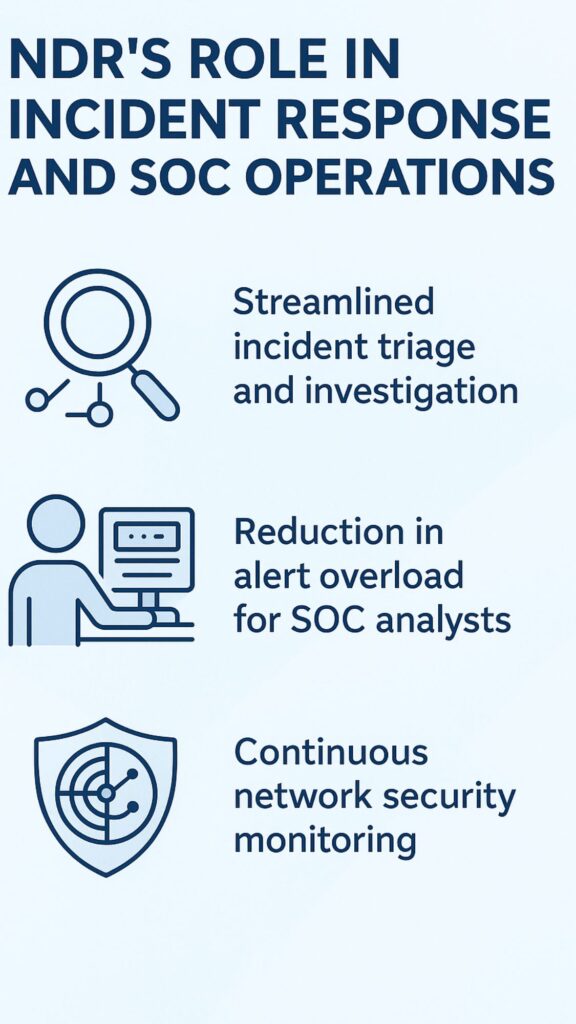
NDR’s Role in Incident Response and SOC Operations
NDR doesn’t just help find threats; it also integrates seamlessly with incident response processes. We’ve found that when incident responders receive enriched forensic data from NDR, they can reconstruct attacks and execute mitigation faster.
This integration with the NDR incident response workflow helps teams streamline investigations and coordinate faster containment actions.
SOC teams benefit from reduced alert fatigue thanks to NDR’s false positive reduction. This lets analysts focus on actionable threats without drowning in noise.
Furthermore, many NDR platforms support continuous monitoring, allowing teams to maintain vigilance without gaps , essential for hybrid environments with complex network architectures.
This integration promotes:
- Streamlined incident triage and investigation
- Reduction in alert overload for SOC analysts
- Continuous network security monitoring
It’s almost like having an extra set of eyes that never tire, constantly watching and learning.
Practical Advice for Leveraging NDR in Threat Hunting
If you’re considering expanding your threat hunting capabilities, start with enhancing network threat detection coverage through NDR.
And when evaluating NDR vendor solutions look for platforms that offer behavioral analytics, real-time traffic visibility, and automated investigation workflows.
Don’t overlook the value of data enrichment and automation. They turn mountains of data into manageable, actionable intelligence.
Also, tailor your threat hunting playbooks to incorporate NDR insights, and continuously refine your machine learning models as your network evolves.
Remember these tips:
- Maintain continuous network traffic monitoring, including encrypted data.
- Use anomaly scoring to prioritize alerts effectively.
- Integrate NDR findings into your existing incident response workflows.
By doing this, you’ll boost your team’s ability to detect and respond to threats before they spiral out of control.
Strengthening Network Threat Detection with NDR
Source: TedxTalks
It’s clear that NDR plays a pivotal role in modern threat hunting. By providing broad network visibility, applying advanced analytics, and supporting efficient investigations, it enhances network threat detection in ways traditional tools can’t match (2).
We’ve seen how incorporating NDR leads to faster detection, fewer false positives, and a more proactive defense posture. It’s no surprise that security teams relying on NDR report markedly improved outcomes.
FAQs
What is the primary function of NDR in threat hunting?
NDR’s primary function in threat hunting is to provide deep and continuous visibility into network traffic. It monitors all kinds of data flows, including encrypted and IoT device communications, allowing security teams to detect unusual behaviors and hidden threats.
By applying behavioral analytics and machine learning, NDR identifies anomalies that traditional tools often miss, helping to catch attacks early before they cause damage.
How does NDR differ from traditional endpoint detection?
Unlike endpoint detection that focuses on individual devices, NDR monitors network-wide traffic. It captures the entire communication flow between devices, spotting lateral movement and command-and-control activities that endpoints might miss.
This network-centric view gives broader coverage, especially important for detecting threats moving stealthily across systems or targeting unmanaged devices like IoT and operational technology.
Can NDR detect encrypted traffic threats?
Yes, NDR can analyze encrypted traffic by examining metadata and communication patterns without decrypting content.
Using behavioral analytics and anomaly detection, it spots suspicious activity in encrypted channels, which are often exploited by attackers to hide malicious actions.
This capability is vital because a growing amount of network traffic is encrypted, making traditional inspection methods less effective.
What role does machine learning play in NDR threat hunting?
Machine learning in NDR helps establish baseline normal network behavior and detect deviations automatically. It continuously learns from network activity patterns to refine its detection models, improving accuracy over time.
This helps identify zero-day attacks and stealthy threats that don’t match known signatures, enabling earlier and more reliable threat detection with fewer false positives.
How does NDR support incident response teams?
NDR supports incident response by providing enriched forensic data, including session reconstructions and event timelines. This detailed context speeds up investigation and helps responders understand attacker methods and impact.
Additionally, NDR’s automation features, like playbooks and alert correlation, streamline workflows, enabling faster containment and remediation while reducing analyst workload.
What types of network threats can NDR detect?
NDR can detect a wide range of network threats, including lateral movement, command-and-control traffic, advanced persistent threats, zero-day attacks, and malware propagation.
It spots anomalies in network behavior, unusual connection patterns, and malicious payloads hidden in normal-looking traffic.
Its coverage extends to IoT and OT devices, which are common targets for attackers seeking to exploit vulnerabilities.
How does NDR reduce false positives in threat hunting?
NDR reduces false positives by combining machine learning with behavioral analytics to distinguish between benign anomalies and real threats. It scores alerts based on their severity and context, helping analysts focus on actionable findings.
Continuous learning from network patterns also means detection models improve over time, lowering noise and improving overall efficiency in threat hunting operations.
What are the benefits of integrating NDR with threat intelligence feeds?
Integrating NDR with threat intelligence feeds enriches alerts with relevant data about known indicators of compromise, attacker tactics, and emerging threats.
This contextualization helps prioritize alerts, making investigations faster and more focused. It also enables correlation across multiple data sources, improving detection accuracy and providing a clearer picture of ongoing attacks or campaigns.
How does NDR help with network anomaly scoring?
NDR assigns anomaly scores to network activities based on deviation from established baselines and threat indicators. This scoring helps prioritize investigation efforts by highlighting the most suspicious behaviors.
Analysts can focus on high-score anomalies that indicate potential compromise, while lower-score events may be harmless deviations, thus optimizing resource allocation and speeding up threat hunting.
Can NDR be used in hybrid network environments?
Absolutely. NDR platforms are designed to operate across hybrid environments, monitoring traffic in on-premises, cloud, and edge networks.
This comprehensive coverage ensures no blind spots, which is crucial as organizations adopt complex infrastructures. NDR’s ability to analyze traffic from diverse sources helps maintain consistent threat detection and response capabilities regardless of where network assets reside.
Conclusion
If you want to sharpen your threat hunting and reduce risk, investing in NDR’s capabilities is a logical step. It’s about staying one step ahead of attackers, understanding your network’s subtle signals, and responding decisively.
For those who live in the trenches of cybersecurity, NDR is a tool that turns the tide, making the invisible visible and the complex manageable.
Explore how NetworkThreatDetection.com brings that power to life through real-time threat modeling, automated risk analysis, and continuously updated intelligence—helping teams uncover blind spots before attackers do.
References
- https://medium.com/@gaurikale0901/what-is-network-detection-and-response-ndr-a-complete-guide-9a3566ed322e
- https://medium.com/@abbask/agentic-ai-a-paradigm-shift-in-cybersecurity-operations-soc-1078d186cbf2