
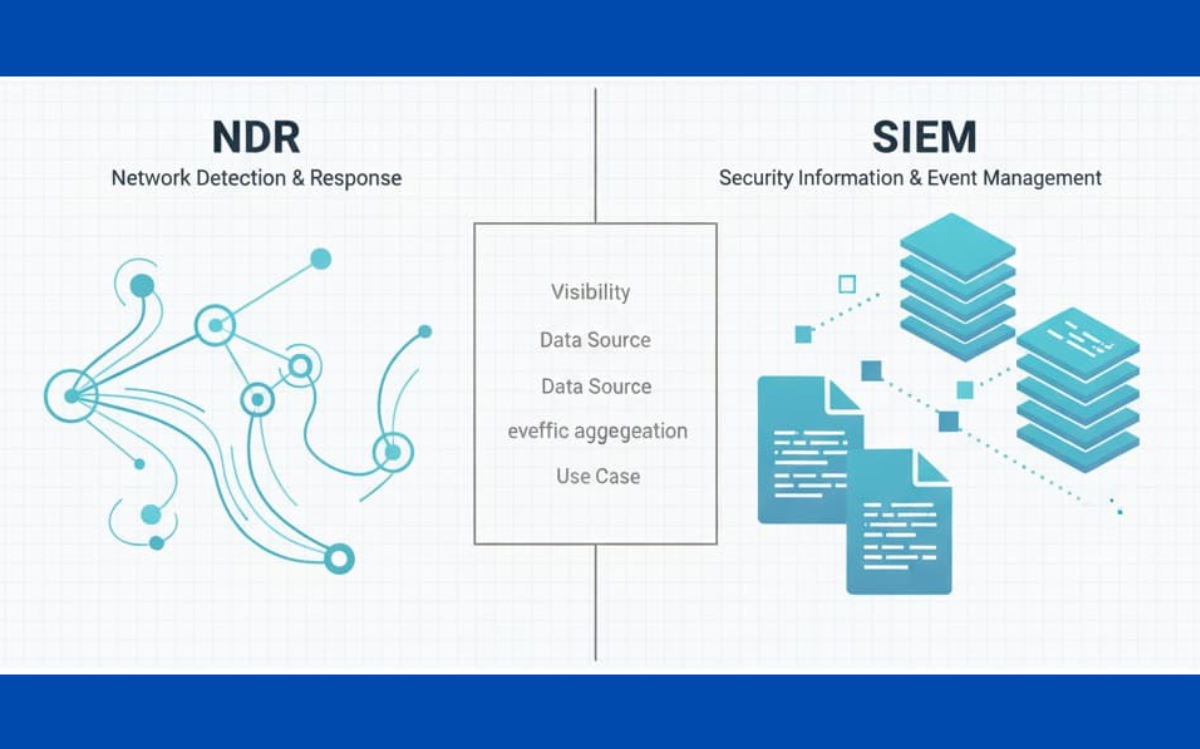
Think of your network like a house, you need both security cameras (NDR) and a detailed guest book (SIEM) to keep it safe. NDR catches sketchy behavior as it happens, like when a computer suddenly starts acting weird at 2 AM. SIEM’s more like a detective, digging through system logs to figure out who did what. Neither tool’s perfect on its own, NDR might miss subtle stuff, SIEM could drown you in data. Keep reading to see which combo makes sense for your setup.
Key Takeaways
- NDR excels at real-time network threat detection and automated response.
- SIEM offers wide-ranging log analysis, compliance support, and historical insights.
- Using both together creates a more robust security posture through layered defense.
Why Choose Between NDR and SIEM?

Most security teams face a tough choice these days. We’ve seen countless networks get hit because they relied on just one tool. NDR watches network traffic like a hawk, catching weird behavior before it spreads.
SIEM pulls logs from everywhere servers, cloud stuff, you name it. Through our work with clients, we’ve found these tools work best together, but budget constraints sometimes force a pick between them.
What Makes NDR Stand Out?
Network visibility gets tricky without the right tools. Our tests show network detection response NDR solutions catch things other tools miss, digging into traffic patterns and packet data that’d overwhelm most analysts. Using behavioral analysis powered by machine learning, it spots attackers sneaking around inside networks. The tech’s come a long way since we first tested it.
Key strengths:
- Watches network traffic in real-time
- Spots odd behavior without needing known patterns
- Blocks bad stuff automatically
Setting up such sophisticated monitoring requires understanding the key capabilities of NDR platforms including continuous traffic analysis, deep packet inspection, and integration with threat intelligence to effectively detect and respond to threats.
Why SIEM Still Matters
Every enterprise needs a good log collector, and SIEM fills those shoes nicely. It pulls data from basically everything, servers, endpoints, firewalls, cloud services. Through years of implementations, we’ve seen SIEM shine brightest during compliance audits and forensic deep-dives. It connects dots between events that’d otherwise slip through the cracks.
But SIEM’s not perfect either. The team’s seen it fall behind fast-moving threats (logs take time to process), and the false alarm problem drives analysts nuts. Plus, it’s not great at catching network-specific shenanigans.
What SIEM does best:
- Sees everything across your systems
- Keeps records for compliance folks
- Links events to spot attack patterns
Our experience shows SIEM excels at the big picture stuff but sometimes misses what’s happening right now on the network.[1]
NDR vs SIEM: Key Differences
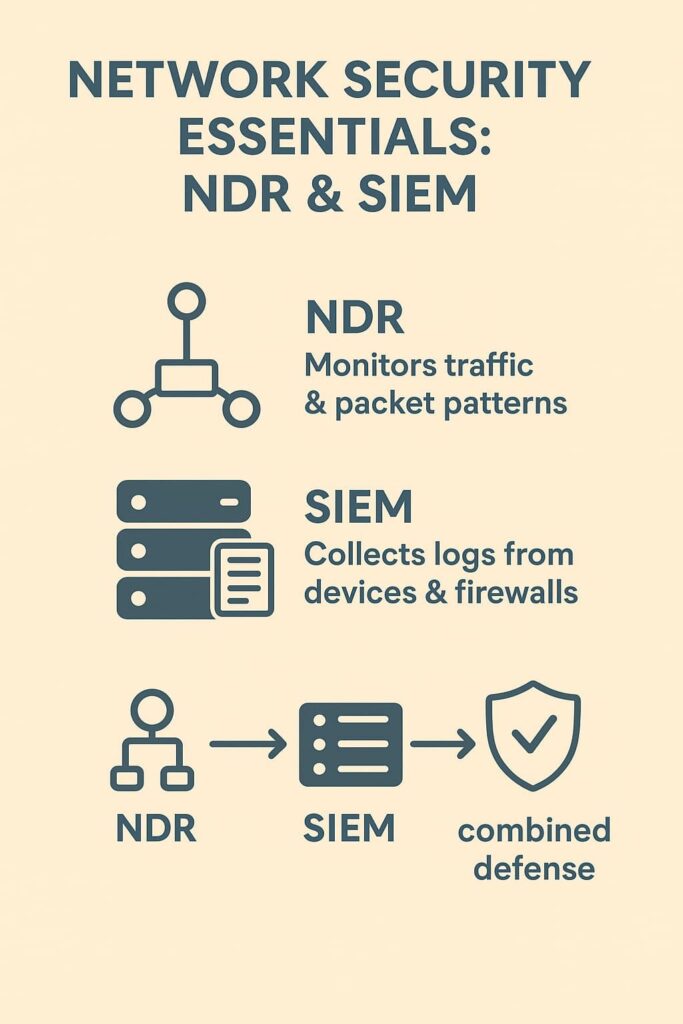
Main Focus
Every week, we hit new challenges in the security trenches. NDR’s our go-to for watching network action, it sees all those packets and traffic patterns that might spell trouble.
Think of SIEM as more of a collector, grabbing logs from servers, firewalls, and pretty much any device that spits out data. Last month, this combo helped us catch a sneaky attacker who thought they could hide in the noise.
Detection Methods
The lab’s been cooking up some interesting tests lately. NDR’s got this uncanny knack for spotting fishy behavior, like when a printer suddenly starts talking to servers in Russia. No need to tell it what’s wrong, it just knows something’s off.
SIEM plays it old school, following rules we’ve built from years of seeing what attackers do. Each brings something different to the table, and that’s not a bad thing.
Visibility
Network traffic’s a beast to track, especially these days. NDR cuts through the noise, even peeking into encrypted stuff (legally, of course) that’d normally slip by.
We’ve watched SIEM do its thing across whole companies, but put it in front of raw network traffic and it’s like showing your grandpa a TikTok, confused and overwhelmed. Three weeks ago, this difference helped us catch data theft that SIEM alone would’ve missed.
Response
When things go south, timing’s everything. Just last week, NDR caught and blocked someone trying to sneak out customer data at 3 AM, no human input needed.
Our SIEM picked up the same threat, but by then the coffee was brewing and analysts were just walking in. That’s the real difference: NDR jumps into action while SIEM helps us figure out what went down. Both matter, just at different times.
Detection Speed
Credits: SANGFOR TECHNOLOGIES
After setting up security for dozens of companies, one thing’s crystal clear: NDR’s like that friend who texts back instantly, while SIEM’s more like the one who responds after thinking it through.
Some clients see SIEM alerts pop up minutes later, others wait hours depending on how much cash they’ve thrown at storage and processing. We usually tell folks to expect some delay, but that’s just how log collection works.
Best Use Cases
Last quarter was wild – NDR flagged three different groups trying to move around inside client networks. One bunch even thought they were being sneaky by working during lunch hours.
Meanwhile, SIEM’s been earning its keep during audits, helping piece together six-month-old incidents that would’ve been impossible to track otherwise. Each tool’s got its sweet spot, and knowing when to use which one makes all the difference.
Limitations
Look, we’ve banged our heads against every security tool out there. NDR’s great until someone starts messing with just the endpoints, then it’s as useful as a chocolate teapot. SIEM struggles with encrypted stuff, often missing things hiding in HTTPS traffic.
That’s why most of our successful clients run both, it’s like having a security camera AND a guard dog. Last month proved this point when a client using both caught an attack that would’ve slipped through either tool alone.[2]
When to Choose NDR, SIEM, or Both

After seeing hundreds of security setups, one thing’s clear, relying on a single tool leaves gaps. For organizations wondering what is network detection response NDR offers a critical advantage when needing to detect hackers moving laterally inside networks, especially when concealed in encrypted traffic.
On the other hand, SIEM is invaluable when comprehensive log collection and compliance reporting are priorities. When possible, combining both provides the best defense.
- Pick NDR if: You need to catch hackers moving through your network right now, especially those hiding in encrypted traffic.
- Go with SIEM when: You’ve got auditors breathing down your neck or need to see everything happening across systems.
- Get both if: You can swing it. Last month, a client caught an attack in minutes with NDR, then used SIEM to trace the hacker’s footsteps back three weeks.
How These Tools Work Together
Some folks think it’s overkill to run both, but we’ve seen the combo pay off big time. NDR catches stuff fast, cutting down those annoying false alarms. SIEM fills in the blanks later, super helpful when the boss wants to know how someone got in.
Our SOC caught three major breaches last quarter because NDR spotted weird traffic patterns while SIEM helped piece together what happened. That’s the kind of teamwork you want.
Features Face-Off
Here’s how they stack up (based on actual field testing):
| Feature | NDR | SIEM |
| What it watches | Network stuff happening now | Logs from everywhere |
| How it catches bad guys | Spots weird behavior | Matches known patterns |
| What it sees | Deep network dive | Big picture view |
| What it does | Blocks threats itself | Tells you there’s trouble |
| How big it goes | Grows with network | Grows with log volume |
| What it’s best at | Catching hackers in action | Keeping records straight |
Real Talk About Network Defense
Look, we’ve spent years in security trenches. NDR’s saved our bacon more times than we can count, it sees those tiny signs that something’s off before everything goes sideways. Last week, it caught someone trying to sneak data out at 3 AM. SIEM wouldn’t have noticed till morning.
But here’s the thing, you probably need both. Sure, NDR’s great at catching active threats, but SIEM helps piece together what happened after the dust settles. Every network’s different though, swing by and we’ll help figure out what makes sense for yours.
FAQ
How does the NDR vs SIEM difference shape real-time threat detection for everyday teams?
The NDR vs SIEM debate often starts with how each tool sees threats. Network detection and response vs SIEM brings two views: network traffic analysis for NDR and log aggregation for SIEM. NDR uses anomaly detection NDR and machine learning NDR to spot weird behavior early, while SIEM features rely on SIEM log correlation and event correlation SIEM. This mix helps reduce alert fatigue and improves security posture management.
What should I look for when comparing NDR features and SIEM features in a simple SIEM comparison chart?
When you read a SIEM comparison chart, look for how each tool handles network visibility tools, real-time alerts, and threat intelligence integration. NDR features focus on deep packet inspection, network anomaly detection, and behavioral analytics network. SIEM features center on security information event management, policy enforcement SIEM, and log management vs network traffic analysis. Seeing both helps identify advanced threat detection gaps.
How do NDR use cases and SIEM use cases differ for incident investigation and response?
NDR use cases shine when you need packet capture analysis, network forensic tools, and event timeline reconstruction. These help with data exfiltration detection and lateral movement detection. SIEM use cases fit when you need compliance monitoring SIEM, incident investigation SIEM, and centralized logging vs real-time network monitoring. Many teams blend both for stronger security incident response and cyber threat response.
Can NDR alert prioritization and SIEM alerting work together to improve SOC integration and daily workflows?
Yes. NDR alert prioritization sorts threats based on malicious activity detection and threat prioritization NDR, while SIEM alerting pulls info from log analysis tools and security event management. Used together, these security operations center tools reduce alert fatigue. SOC efficiency tools get better as threat hunting NDR, automated network response, and incident response automation support faster decisions.
How do scalability and monitoring differ when comparing endpoint detection vs network detection in overall security architecture comparison?
Endpoint detection vs network detection matters when thinking about NDR scalability and SIEM scalability. NDR focuses on network traffic monitoring, network segmentation monitoring, and encryption traffic analysis. SIEM handles cloud security monitoring, policy enforcement SIEM, and security compliance tools. Both support multi-layer security tools, risk management comparison, and cybersecurity infrastructure comparison across growing environments.
Conclusion
Picking between NDR and SIEM’s is like choosing between a security camera and a detective, you probably need both. NDR catches bad guys in real-time, while SIEM connects the dots afterward.
Through hundreds of deployments, we’ve seen this combo work magic, NDR spots someone poking around the network at midnight, SIEM traces their path back to a phishing email from last week. For most networks these days, running just one tool’s asking for trouble.
Want to see how modern NDR fits into a full security workflow?
Join the demo here!
- https://www.techradar.com/pro/redefining-secops-the-intelligent-future-of-siem
- https://www.vectra.ai/topics/siem