

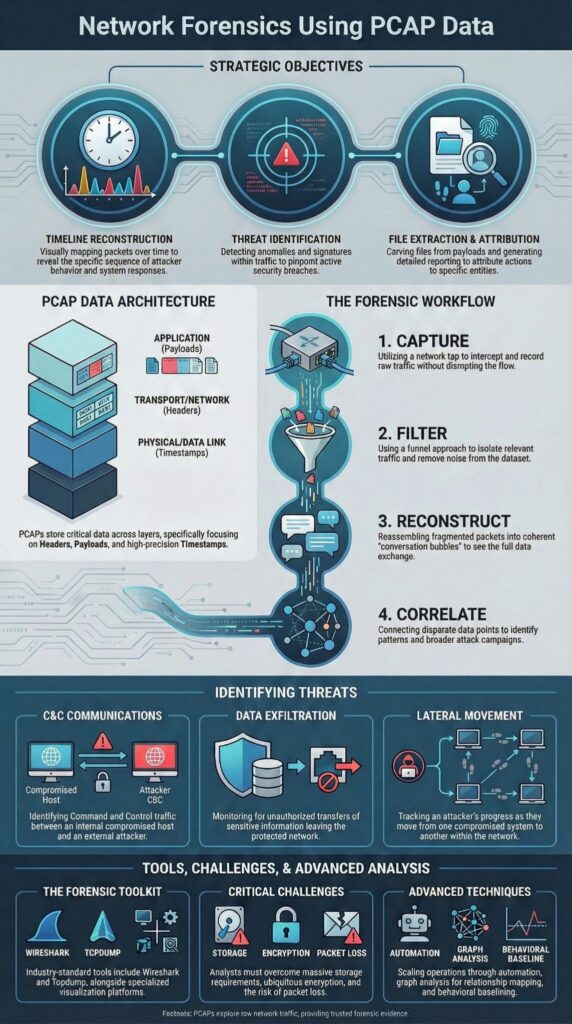
Network forensics using PCAP data analyzes raw packet captures to reconstruct activity, identify threats, and build reliable evidence. PCAP files record every packet exactly as it traveled the network, including timestamps, headers, and payloads, making them a trusted artifact in cybersecurity.
In our own investigations, PCAPs have often been the only source that explained how an intrusion unfolded when logs were incomplete or altered. This piece explains how PCAP forensics works, why it’s critical, and how analysts turn packets into defensible conclusions you can act on. Keep reading for the method.
Quick Wins – PCAP Analysis for Deeper Network Insight
- PCAP analysis provides a packet-level timeline that reveals attacker behavior logs often miss.
- Network forensics using PCAP data supports intrusion detection, malware analysis, and evidence admissibility.
- When combined with Network Threat Detection, packet analysis scales from investigation to proactive defense.
What Is Network Forensics Using PCAP Data?
Network forensics using PCAP data analyzes packet-level traffic to reconstruct incidents, identify threats, and trace attacker behavior. PCAP files preserve headers, payloads, and timestamps, letting analysts replay events with high fidelity months later.
PCAP stands for packet capture, a format that records network traffic exactly as seen on an interface. Each packet includes link-layer data, IPs, ports, protocols, and sometimes full payloads. This means investigators see not just that a connection happened, but exactly how it behaved.
This depth is reflected in academic guidance. As noted in the Washington State University Network Forensics Introduction PDF:
“Pros: Full capture of everything. Can include files, non-standard protocols, and a lot more. … PCAP files provide detailed records of network traffic for forensic examination.” – Washington State University
The core goals of PCAP forensics are:
- Reconstructing timelines of communication between hosts.
- Identifying malicious protocols, payloads, or behaviors.
- Extracting files or credentials transmitted over the network.
- Supporting attribution and reporting with solid evidence.
A PCAP file contains data across multiple OSI layers, giving visibility from physical transmission up to application behavior. At minimum, it includes source/destination IPs, ports, protocols, flags, and precise timestamps.
Why Are PCAP Files Critical for Incident Investigation?

PCAP files are critical for investigations because they preserve a packet-by-packet timeline that logs often miss. They enable the detection of malware, command-and-control traffic, and data exfiltration paths. In our own cases, PCAPs have repeatedly revealed activity that attackers tried to hide from logs.
Analysts can spot malware beaconing, DNS tunneling, and anomalies in encrypted traffic metadata even when the payloads are hidden. Government training materials emphasize this investigative focus. As outlined in the CISA/NICCS Introduction to Network Forensics & Investigation (NFI 1):
“Identify and extract network artifacts for further forensic analysis … Compare observed network traffic to expected topology; Research and analyze unknown (non-standard) packets.” – CISA
PCAP analysis reveals threats by focusing on behavior, not just alerts. Commonly observed threats include:
- C&C communication through periodic callbacks to abnormal destinations.
- Data exfiltration via sustained outbound transfers or covert channels.
- Lateral movement traces using protocols like SMB or RDP, and unusual internal scans.
These patterns become clearer when packet data is correlated with flow visualization and timeline reconstruction tools.
How does the PCAP analysis workflow work?

The PCAP analysis workflow takes raw network packets and turns them into clear answers about what happened on the network, especially when teams focus on leveraging network traffic PCAP to move from raw packets to structured investigative insight. It moves step by step, reducing noise and adding context until the traffic makes sense.
Step 1: Capturing network traffic
Traffic is collected directly from the network or the host. Analysts decide early how much detail they need.
- Data is captured through taps, SPAN ports, or host-based sensors
- Tools such as tcpdump are commonly used
- Full payloads allow deep inspection, while headers only reduce storage
- Ring buffers and file rotation help balance retention and performance
Step 2: Filtering and inspecting packets
Once traffic is captured, analysts narrow it down to what matters.
- Filters focus on IP addresses, ports, protocols, or indicators
- Wireshark and tshark support fast inspection and protocol analysis
Step 3: Reconstructing sessions and files
Packets are rebuilt into readable activity.
- TCP streams restore full conversations
- Files, emails, or credentials can be extracted when protocols allow
Step 4: Correlating with other data sources
PCAP data becomes stronger when matched with logs, SIEM alerts, and endpoint data. This step ties packet-level details to user activity and system events, helping investigators confirm actions and timelines with higher confidence.
Which tools are used for network forensics with PCAP?
Network forensics uses several tools to handle PCAP data, from close inspection to large-scale analysis, often aligning packet review with broader data sources collection strategies to improve investigative depth and context.
In real work, analysts rarely depend on just one tool. We switch tools based on traffic size, investigation speed, and how much detail we need at a given moment.
The table below shows common tools and how they are typically used.
| Tool type | Primary use | Forensic strength |
| Wireshark | Deep packet inspection | Protocol decoding and stream reconstruction |
| A-Packets Viewer | Web-based analysis | Timelines and connection mapping |
| PcapXray visualization | Graph analysis | Visual detection of abnormal flows |
| Tcpdump / tshark | Capture and scripting | Speed, automation, and scale |
Visualization tools help early in an investigation.
- Flow graphs expose unusual communication paths
- Timelines reveal bursts of suspicious activity
- Network maps help isolate compromised hosts
Guides from A-Packets note that visualization speeds up host identification by showing patterns instead of raw packets. That matches our experience, especially when tracking patient zero.
At scale, PCAP works best with context. Analysts correlate it with Zeek logs, Suricata alerts, and NetFlow data. We feed these signals into our threat models and risk analysis tools, keeping packet evidence while improving investigation speed and clarity.
What Challenges Arise When Analyzing PCAP Data?
PCAP analysis comes with real limits around scale, encryption, and data quality, particularly when investigations require extracting files from network captures under encrypted or fragmented conditions. These issues show up in both live investigations and long-term monitoring, and if they are ignored, visibility drops fast.
We often have to decide early what is worth keeping. Storage optimization becomes part of daily operations, not a cleanup task. Deduplication helps remove repeated traffic, while tools like editcap and mergecap are used to trim or combine files so analysts can work with manageable datasets.
With most traffic protected by TLS, payload inspection is rarely an option. Analysts shift attention to what remains visible, such as SNI values, certificate details, packet timing, and size patterns. In our own investigations, this has pushed us toward behavior-based analysis and stronger correlation across data sources.
Common technical constraints tend to repeat:
- Packet loss during high-speed capture
- Limited visibility into VPN tunnels and IPsec ESP traffic
- Higher analyst skill requirements to avoid misreading patterns
With clear questions, disciplined workflows, and threat models supported by risk analysis tools, PCAP still plays a critical role in understanding network threats.
What advanced techniques improve PCAP-based forensics?
Credits : Pranava Rao
Advanced PCAP forensics goes beyond manual packet review. Teams combine automation, enrichment, and graph analysis to handle larger datasets and spot threats earlier. The goal is not just to explain what happened, but to surface patterns that would otherwise stay hidden.
We use automation heavily during threat hunting to keep results consistent across datasets. Over time, this cuts down repetitive work and lets analysts focus on decisions instead of parsing packets.
Another shift happens with graph-based analysis. Rather than looking at single sessions, investigators map relationships between hosts, services, and time. In several cases, we have used communication graphs to trace lateral movement and privilege escalation paths that looked normal at the packet level but suspicious when viewed as a whole.
Common optimization techniques include:
- Protocol-specific carving for VoIP, email, and IoT traffic
- Behavioral baselining to spot deviations from normal traffic
- Use of public forensic datasets for training and validation
When these methods are paired with Network Threat Detection, PCAP analysis becomes continuous. Packet-level insight feeds our threat models and risk analysis tools, improving detection without burying analysts in raw data.
FAQ
How does PCAP analysis uncover hidden attacks during network traffic investigation?
PCAP analysis allows investigators to review raw packet data to understand exactly what occurred on the network. Packet capture forensics examines packet headers, payloads, and timing to identify protocol anomaly detection issues.
This method supports network intrusion forensics by exposing malware traffic analysis patterns, command-and-control communication tracing, and early indicators of data exfiltration detection that logs often miss.
What techniques identify data exfiltration and malware behavior in packet capture forensics?
Investigators identify data exfiltration by analyzing abnormal traffic patterns, repetitive beaconing, and suspicious payload structures.
Deep packet inspection and TCP stream reconstruction reveal base64 encoded traffic, obfuscated payloads, and unauthorized file transfers. Behavioral anomaly spotting combined with signature-based detection improves malware traffic analysis and helps confirm compromised host identification with higher confidence.
How can encrypted traffic metadata support network intrusion forensics?
Encrypted traffic still provides useful metadata such as session duration, packet size, frequency, and destination patterns.
Analysts examine IP port protocol breakdowns and TLS SNI inspection to identify DNS tunneling identification and covert communication channels. Encrypted traffic metadata supports network traffic investigation by enabling IOC extraction PCAP analysis and accurate timeline reconstruction packets.
What role does timeline reconstruction play in incident response PCAP investigations?
Timeline reconstruction packets help responders establish a clear sequence of attacker actions during an incident.
By correlating timestamps, flow direction, and OSI layer analysis, analysts track lateral movement traces and privilege escalation network activity. This structured view strengthens threat hunting packets, supports forensic evidence admissibility, and explains attacker behavior in a clear and defensible manner.
How do analysts ensure PCAP findings meet forensic evidence admissibility standards?
Analysts maintain admissibility by preserving original PCAP files, documenting collection methods, and recording every handling step.
Consistent packet filtering display techniques and accurate network mapping connections improve transparency. Detailed IP port protocol breakdowns and repeatable analysis workflows ensure network forensics using PCAP data remains verifiable and defensible during audits or legal review.
Network forensics using PCAP data in practice
Network forensics using PCAP data turns raw packets into a clear account of what happened and why it matters. PCAP remains one of the most reliable evidence sources because it records real network behavior, not assumptions.
When combined with Network Threat Detection, packet analysis supports faster response today and sharper detection over time by feeding real traffic into threat models and risk analysis.
References
- https://wpcdn.web.wsu.edu/wp-vcea/uploads/sites/3267/2022/05/Part6-NetworksForensicsIntro.pdf
- https://niccs.cisa.gov/training/catalog/cdw/introduction-network-forensics-investigation-nfi-1