
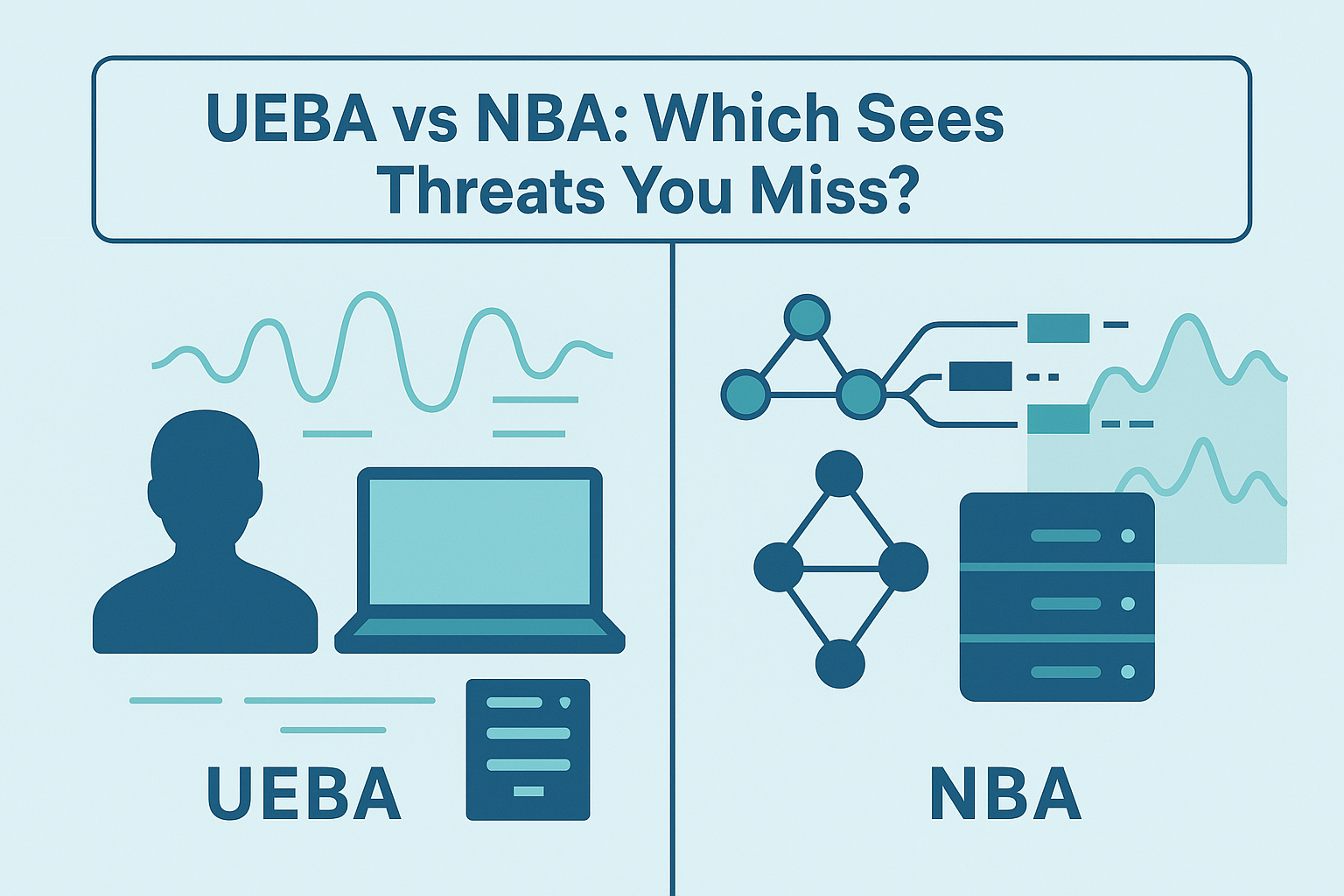
UEBA and NBA solve two different problems: UEBA helps you understand risky users and devices, while NBA helps you understand risky network traffic.
When an alert pops up, UEBA asks, “Who is doing this, and is it normal for them?” NBA asks, “How is this traffic behaving, and does it break the usual pattern?” One frames intent and identity, the other reveals movement and exposure.
When you line them up side by side, you stop chasing every spike and start tracking real threats with context. Keep reading to see when to use each, and how to make them work together.
Key Takeaways
- Scope Defines Purpose: UEBA analyzes the behavior of users and entities like servers, while NBA primarily monitors network traffic patterns.
- Data Sources Dictate Insights: UEBA thrives on logs and endpoint data for contextual understanding, whereas NBA relies on packets and flow data for real-time network visibility.
- Integration is the Goal: Using UEBA and NBA together provides a layered defense, with NBA flagging suspicious pathways and UEBA revealing the actors behind them.
The Two Lenses of Security Analytics
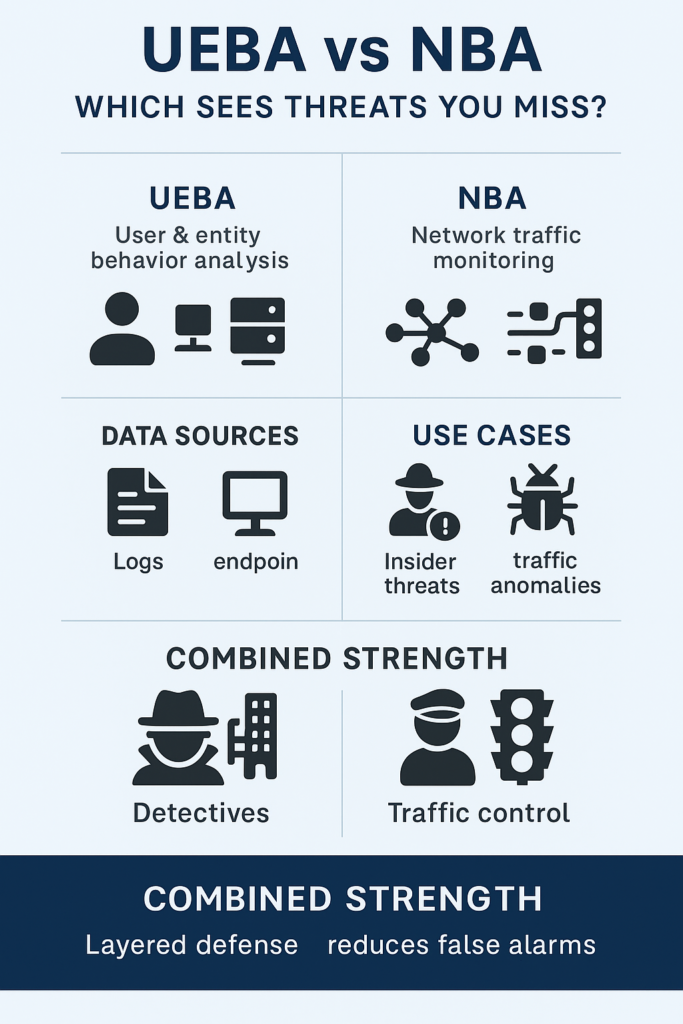
Think of your IT environment as a city. UEBA is like having detectives who follow individuals, where they go, what they do, who they meet.
It builds a profile of normal behavior for every user, server, and application. A financial analyst who only ever logs in from New York suddenly accesses the payroll system from a foreign IP address at 3 AM. That’s the case for UEBA.
It connects the dots across different systems, using data from endpoints, authentication logs, and cloud applications to understand intent. This behavior-driven approach resembles detecting anomalous endpoint behavior by monitoring subtle deviations from normal endpoint activity.
The NBA, on the other hand, is the traffic control center. It watches the highways and side streets, monitoring the flow of data packets between devices. It doesn’t care about the driver’s identity as much as it cares about the vehicle’s movement.
Is there a server suddenly sending huge amounts of data to an unknown external IP? Is there lateral movement between workstations that shouldn’t be talking to each other? NBA spots these patterns by analyzing network flows, protocols, and traffic volume in real time.
It’s your first line of defense against threats that manifest primarily on the wire.
- UEBA’s Focus: Users, servers, applications, and their actions.
- NBA’s Focus: Data packets, communication channels, and network flows.
- The Overlap: Both use analytics to establish a baseline of “normal” to detect deviations.
One tool looks at identity and action, the other at communication and connection. They see different parts of the same picture.
A Side-by-Side Comparison
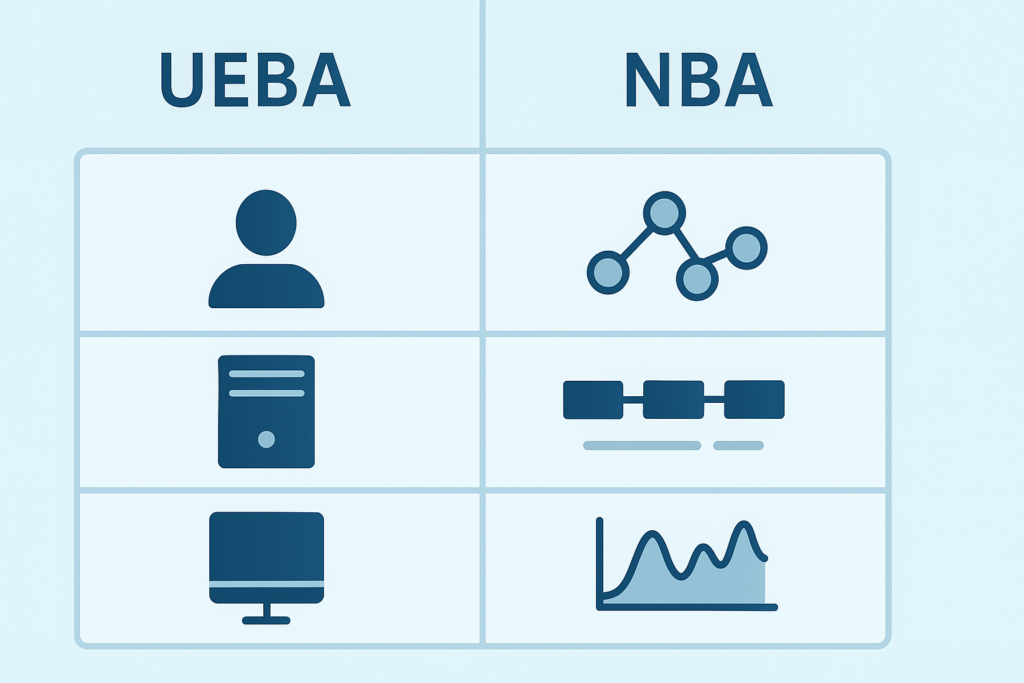
When you break it down, the distinction becomes even clearer. The core difference is the fundamental layer of IT they monitor.
UEBA operates at the identity and entity layer. It’s concerned with the actors within your digital space. This gives it a powerful advantage against insider threats, whether malicious or accidental.
It can detect a privileged user slowly exfiltrating sensitive files or a compromised account being used to access unauthorized resources. Its strength is context, weaving together disparate data points to tell a story about an entity’s behavior over time.
The NBA is rooted in the network layer. Its world is defined by IP addresses, ports, and protocols. This makes it exceptionally good at catching threats that are loud on the network.
Command-and-control (C2) callbacks from infected machines, data exfiltration attempts, and denial-of-service attacks are all within its purview.
It can see the early signs of a ransomware attack as it spreads laterally across the network, something that might be invisible to a tool focused only on individual endpoint behavior.
Its weakness is its blind spot to actions that don’t generate significant network traffic. Consider their data sources. UEBA consumes:
- Authentication logs (Active Directory, SSO)
- Endpoint activity logs
- Cloud application audit trails
- Data access records
NBA, conversely, analyzes:
- NetFlow, IPFIX, and sFlow data
- Full or sampled packet captures (PCAP)
- DNS query logs
- Firewall and proxy logs
This fundamental difference in data intake directly shapes the threats each tool is best suited to find. You wouldn’t use a metal detector to find a wood splinter, and you wouldn’t use a magnifying glass to search for a buried pipe. Choosing the right tool starts with knowing what you’re looking for [1].
When Your Priority is UEBA

So, when does the “who” matter more than the “how”? UEBA should be your go-to when your primary security concerns revolve around identity and insider risk.
If you’re in a regulated industry like finance or healthcare, where monitoring user access to sensitive data is paramount, UEBA is non-negotiable.
It’s the tool that answers questions like, “Why is this system administrator accessing customer records they have no business needing to see?” It shines in detecting slow, subtle attacks that don’t trigger traditional signature-based alarms.
This is a perfect example of user entity behavior analytics UEBA in action, where understanding user and device behavior can uncover threats others miss.
Another strong use case for UEBA is in environments with a heavy cloud presence. As identity becomes the new perimeter in cloud and zero-trust architectures, understanding user and workload behavior is critical.
UEBA can baseline the normal activity of a cloud application or a serverless function, flagging deviations that might indicate a configuration drift or a compromise. It’s about understanding the behavioral fabric of your entire digital estate, not just the network wires.
If your threat model includes disgruntled employees, compromised credentials, or privileged user abuse, your investment should lean heavily towards a robust UEBA solution.
When Your Priority is NBA
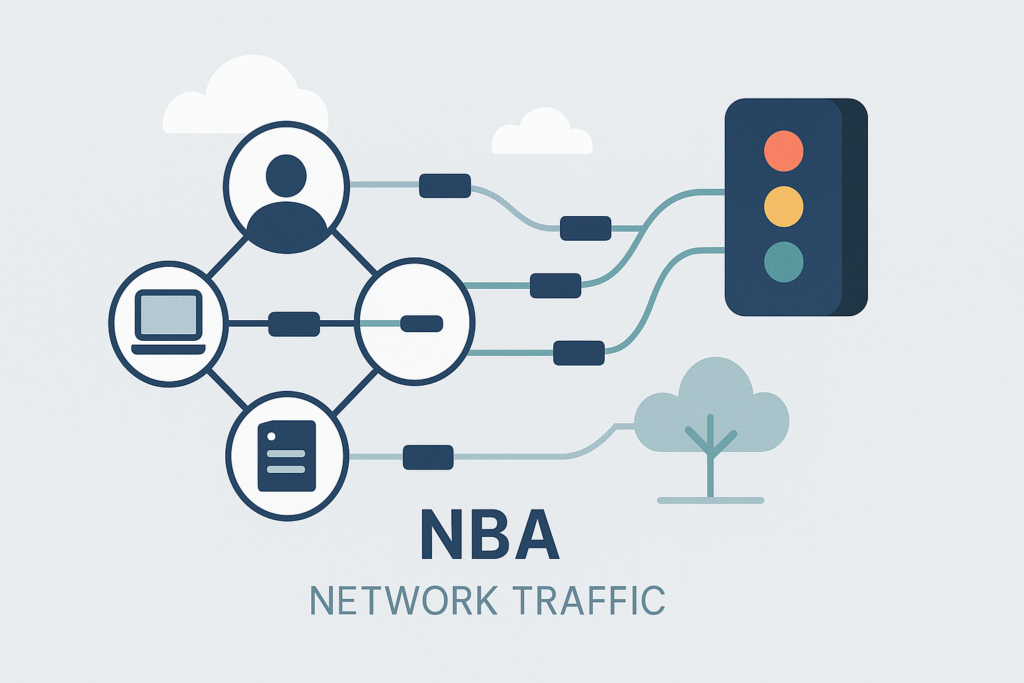
Shift your focus to the NBA when your biggest fears are external threats that play out across your network. Organizations with a traditional, well-defined network perimeter often find immense value in the NBA.
It’s the vigilant sentry watching the gates. If you’re concerned about malware infections establishing C2 channels, bots participating in DDoS attacks, or attackers moving laterally after an initial breach, NBA provides the visibility you need [2].
It operates at wire speed, offering real-time or near-real-time detection of malicious traffic patterns. NBA is also essential for protecting critical network segments.
Industrial control systems (ICS), operational technology (OT) networks, and research and development environments often have unique traffic patterns.
NBA can learn these baselines and alert on any anomalous communication, which could be the first sign of a targeted attack. It’s less about the user’s intent and more about the purity of the data flow.
When your mission is to ensure the integrity and confidentiality of data as it moves from point A to point B, NBA is your foundational technology.
The Combined Advantage
The most powerful security posture doesn’t choose between UEBA and NBA, it leverages both. They are complementary forces, not competitors.
Imagine this scenario: Your NBA system alerts on suspicious lateral movement between a marketing workstation and a database server. This is a potentially serious finding, but it could be a false positive caused by an authorized scan or a misconfigured application. This is where UEBA enters the picture.
Your UEBA system can immediately analyze the behavior of the user logged into that marketing workstation.
Is it a database administrator performing routine maintenance? Or is it a junior graphic designer who has never accessed that server before? By correlating the network alert (NBA) with the user context (UEBA), you transform a low-fidelity noise into a high-fidelity threat.
This layered defense is the essence of behavioral analysis for threat detection, connecting insights from user activity and network patterns to catch threats earlier and more accurately.
The integration reduces false positives dramatically, allowing your security team to focus on genuine incidents. The NBA pinpoints the anomalous pathway, and the UEBA reveals the actor walking it.
This layered approach is the future of security operations. It creates a system where the whole is greater than the sum of its parts.
NBA provides the initial signal, and UEBA provides the narrative. Together, they don’t just tell you something is wrong, they tell you who is doing it, what they’re after, and how they’re moving. This contextual intelligence is what turns a reactive security team into a proactive one.
Your Decision Framework
How do you decide where to start? It’s not about which technology is better, it’s about which problem you need to solve first.
Ask yourself a few key questions. What keeps you up at night? Is it the fear of an insider leaking data, or an external attacker moving through your network unseen? Look at your existing data sources. Do you have rich logs from endpoints and applications, or are your strengths in network flow data?
Consider your team’s expertise. Investigating UEBA alerts often requires understanding identity and access management.
Investigating NBA alerts requires strong network analysis skills. Your choice might be influenced by the skills you have readily available.
For most organizations, the ideal path is a phased approach. Start with the tool that addresses your most pressing pain point, with a clear plan to integrate the other later. The goal is a unified security analytics platform that brings UEBA and NBA insights together onto a single pane of glass.
Making the Right Call
The UEBA vs NBA debate isn’t about picking a winner. It’s about understanding two critical pieces of the modern security puzzle.
UEBA gives you the deep, contextual story of your users and systems. NBA gives you the real-time map of your digital traffic.
Ignoring one leaves a blind spot that attackers will inevitably exploit. The most resilient security strategies recognize that threats are multi-faceted, and so must be the defenses.
By thoughtfully integrating both analytics approaches, you build a security operation that sees the whole field, not just one corner of it. Start by addressing your biggest gap today, but keep the combined power of UEBA and NBA as your ultimate destination.
FAQ
What are the biggest UEBA vs NBA differences that matter when choosing a tool?
Many teams want to understand the main UEBA vs NBA differences before selecting a solution.
UEBA studies users and devices, while NBA studies network traffic. A UEBA vs NBA comparison guide helps you see which approach fits your security goals, based on the type of behavior you need to track and the visibility you already have.
How can UEBA vs NBA similarities help teams build a stronger security plan?
UEBA vs NBA similarities can make a security plan stronger because both tools look for patterns that do not match normal behavior.
They use UEBA vs NBA behavioral analytics, UEBA vs NBA anomaly detection, and UEBA vs NBA threat detection to find risks early. When used together, they give clearer signals and reduce false positives.
What should I review when doing a UEBA vs NBA evaluation for real-world work?
A thorough UEBA vs NBA evaluation should include a review of UEBA vs NBA capabilities, UEBA vs NBA limitations, and UEBA vs NBA performance.
It is also important to check how well each tool handles UEBA vs NBA data sources and UEBA vs NBA accuracy. These checks help you understand how each tool will behave during real security events.
When do UEBA vs NBA use cases show the most useful benefits for daily security tasks?
UEBA vs NBA use cases show the most value when you connect them to daily needs. UEBA supports UEBA vs NBA identity analytics and insider threat questions.
NBA supports UEBA vs NBA network threat detection and network traffic analytics. Many teams rely on UEBA vs NBA integration because it brings identity context and network movement into one view.
How do I reduce noise and improve signal quality when doing a UEBA vs NBA analysis?
A strong UEBA vs NBA analysis uses UEBA vs NBA baselining and UEBA vs NBA event correlation to reduce noisy alerts.
These steps support better UEBA vs NBA threat prioritization. You can also review UEBA vs NBA noise reduction and precision improvement efforts. Over time, better baselines and cleaner data make your alerts more reliable and easier to act on.
Unifying UEBA and NBA for Complete Threat Visibility
In a world of escalating threats, UEBA and NBA work best as a unified defense, not competing approaches.
UEBA uncovers intent by analyzing user and entity behavior, while NBA exposes hidden risks moving through your network. Each fills the other’s blind spots, transforming scattered alerts into clear, contextual intelligence.
Start with the capability that solves your most urgent challenge, then integrate both to build a security posture that sees more, understands more, and stops threats faster. Ready to strengthen your defenses? Join the movement toward smarter threat detection.
References
- https://www.esecurityplanet.com/products/best-user-and-entity-behavior-analytics-ueba-tools/
- https://www.paloaltonetworks.com/cyberpedia/what-is-user-entity-behavior-analytics-ueba