
Unsupervised learning network anomaly detection watches your traffic by first learning what “normal” really looks like. Think of your network as a pattern of habits, where data moves with a familiar tempo between users, apps, and servers.
Over time, the system learns this baseline and treats it like a reference track. When something strays from that learned pattern, even slightly, it raises a quiet alert. No threat signatures, no pre-labeled attacks, just behavior.
That’s why it can catch strange, early-stage intrusions and zero-day exploits that signature tools might overlook, so keep reading to see how this actually protects you.
Key Takeaways
- Learns normal behavior from raw, unlabeled network traffic data.
- Flags deviations as potential threats, ideal for novel attacks.
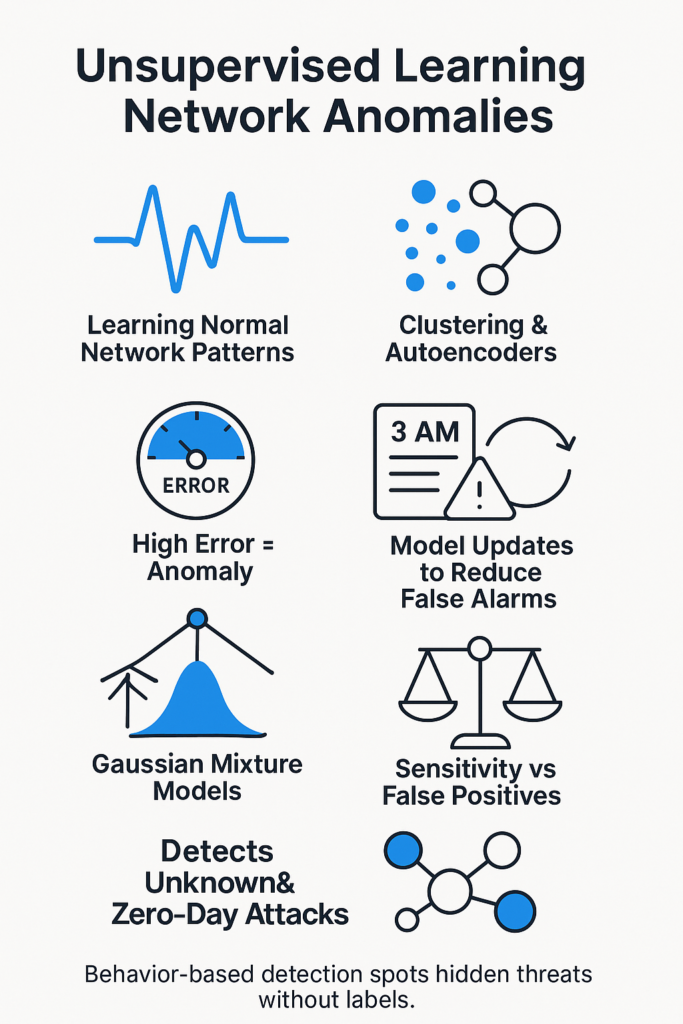
- Uses algorithms like clustering and autoencoders to model complexity.
Listening to the Network’s Heartbeat
Picture a security guard who doesn’t have a book of wanted posters. Instead, they just watch the crowd, learning the normal patterns of movement. They know the regular commuters, the typical flow.
When someone moves against the grain, or lingers too long in a strange place, it stands out. That’s unsupervised learning. It’s a form of machine learning that finds patterns and outliers in data without being told what to look for.
In the context of your network, the data is the constant stream of packets, connections, and protocols.
This is fundamentally different from supervised methods. Supervised learning needs a teacher. You have to feed it examples of both “good” traffic and “bad” attacks.
It learns to distinguish between the two. The problem is, you can only teach it attacks you already know about, unlike network anomaly detection methods that use behavioral analysis to adapt and flag unusual activity automatically.
Unsupervised learning operates in the wild. It’s given the massive, unlabeled log of your network’s daily life and tasked with figuring out what ‘normal’ even is. An anomaly, then, is simply anything that doesn’t fit the learned pattern of normalcy.
Why does this matter? Because the threat landscape is a shapeshifter. Attackers constantly develop new methods, new malware, new ways to slip through defenses.
A supervised system is blind to these novel threats. An unsupervised system, however, might spot the subtle, unusual spike in outbound traffic from a single server at 3 AM.
It might notice a user’s connection patterns have slightly changed, mimicking a compromised account. It’s looking for strangeness, not a specific signature.
- It autonomously discovers inherent structures in network traffic.
- Anomalies appear as statistical outliers or reconstruction failures.
- It excels where labeled data for attacks is scarce or nonexistent.
The core value is in its adaptability. As your network evolves, as new applications are deployed and user behavior changes, the model of ‘normal’ can be updated.
This continuous learning loop allows the system to stay relevant, reducing false alarms over time while remaining sensitive to genuine, emerging threats.
The Toolkit: How It Spots the Strange

Several powerful algorithms form the backbone of unsupervised anomaly detection. Each has a different way of understanding the data and identifying what doesn’t belong.
K-means may miss subtle blends assuming spherical clusters, while DBSCAN excels with density variations
Isolation Forests take a clever approach. Instead of profiling what is normal, they focus on isolating anomalies.
They randomly select a feature and a split value, partitioning the data. The idea is that anomalies are few and different, so they are easier to isolate.
A normal data point, deeply embedded within the pack, will require many more random partitions to be isolated. An anomaly might be isolated with just a few splits.
It’s computationally efficient and handles high-dimensional data well, a technique often highlighted in statistical anomaly detection models for their explainability and speed.
Then there are reconstruction-based methods, like Autoencoders. Think of an autoencoder as a smart compression algorithm.
It’s a neural network trained to take network traffic data, squeeze it down into a simplified representation (the latent space), and then reconstruct the original data from that simplified version as accurately as possible.
The network gets really good at reconstructing normal traffic it has seen before. But when you feed it an anomaly, the reconstruction will be poor. The high “reconstruction error” is the anomaly score. It’s a powerful way to detect complex, multi-faceted deviations.
Gaussian Mixture Models (GMMs) approach the problem probabilistically. They assume the normal network data is generated from a mixture of several Gaussian distributions.
The model learns the parameters of these distributions. Once trained, it can calculate the probability that a new data point belongs to this learned model of normalcy.
A very low probability indicates a likely anomaly. This method is great for capturing complex, overlapping patterns in traffic.
Variational Autoencoders (VAEs) are a more advanced cousin of the standard autoencoder. They introduce a probabilistic twist, learning a distribution of the latent features.
This makes them more robust and better at generalizing, which can lead to fewer false positives. They are particularly adept at modeling the complex, high-dimensional data typical of modern network telemetry.
Navigating the Real-World Hurdles

This approach isn’t a magic bullet. It comes with significant challenges that require careful consideration. The biggest one is the false positive.
Because the system is looking for anything unusual, a legitimate but rare event, like a large data backup or a new application’s traffic, can trigger an alert.
Tuning the sensitivity, or the anomaly score threshold, becomes a critical balancing act between catching real threats and alert fatigue.
The data itself can be messy. Network traffic is noisy. It’s filled with transient errors, retransmissions, and background chatter that isn’t malicious but isn’t perfectly ‘normal’ either.
This noise can distort the model’s understanding of true normal behavior. Robust data preprocessing, cleaning, and feature engineering, core to anomaly detection techniques in NTD, are non-negotiable steps to make the signal clearer than the noise.
Another challenge is the ‘black box’ problem, especially with deep learning models like autoencoders. You might get an alert that a connection has a high anomaly score, but understanding why can be difficult.
This lack of interpretability can frustrate security analysts who need to investigate and respond. Techniques that provide more explainable scores, or pairing unsupervised detection with other tools, can help mitigate this.
The model’s assumptions may not always fit reality. K-means assumes spherical clusters; GMM assumes Gaussian distributions, which may not match irregular traffic
A GMM assumes data follows a Gaussian distribution. Real network traffic is often more complex and irregular. Choosing the right algorithm for your specific network environment is crucial. Furthermore, models can become stale.
If they aren’t periodically retrained on new data, their concept of ‘normal’ will drift away from the actual network state, reducing their effectiveness.
- Balancing detection sensitivity with false alarm rates is a constant effort.
- Noisy network data requires extensive cleaning and feature selection.
- Model interpretability and periodic retraining are essential for long-term success.
Despite these challenges, the payoff is substantial. The ability to detect a threat you’ve never seen before is a game-changing advantage in cybersecurity. It shifts the defense from a reactive posture to a more proactive one.
Putting It Into Practice

So, how do you start? The first step is always data. You need a rich source of network telemetry. This could be NetFlow data, packet captures, or logs from firewalls and endpoints.
The more contextual information you have, the better the model can learn. Feature extraction is next. You transform raw logs into meaningful numerical features, things like bytes per second, number of unique connections per host, or the entropy of packet sizes [1].
Then comes model selection. There’s no single best algorithm for every situation. You might experiment with a simpler, faster model like an Isolation Forest first. If your traffic is highly complex, an autoencoder might be necessary.
The choice often depends on your computational resources and the specific characteristics of your network. Use grid search or Bayesian optimization, validating via cross-validation on normal data subsets.
Use unsupervised metrics like silhouette score or visual inspection; leverage historical incidents for pseudo-labeling if available. Often, though, initial evaluation is more qualitative.
Security analysts review the top anomalies flagged by the system to see if they are true threats or just unusual business activity. This human-in-the-loop feedback is invaluable for refining the system.
Implementation isn’t a one-time event. It’s a cycle. The model must be monitored continuously. Its anomaly scores should be tracked, and its alerts reviewed.
As the network changes, the model will need to be retrained on fresh data to ensure its baseline of normalcy remains accurate. This ongoing process is what turns a promising algorithm into a reliable part of your security infrastructure.
The Final Analysis
Unsupervised learning for network anomalies represents a fundamental shift toward intelligent, adaptive security. It acknowledges that you can’t possibly know every future attack vector [2].
Instead of building taller walls, it trains a perceptive watchman who understands the lay of the land. This technology empowers you to detect threats based on their behavior, not their fingerprints.
While it demands careful setup and management, the ability to uncover hidden threats lurking within your own traffic patterns is an undeniable strategic advantage.
Start by analyzing your own network data, find its rhythm, and listen for the silence that screams something is wrong.
FAQ
What makes unsupervised anomaly detection helpful when I cannot label my data?
Unsupervised anomaly detection is helpful when you have large amounts of unlabeled data detection and no clear way to sort it.
It learns normal traffic through traffic baseline learning and finds abnormal traffic patterns on its own. It uses network behavior modeling, network flow analysis, and outlier detection models to identify rare event detection and hidden threat discovery early.
How can I tell if strange network changes matter or if they are only noise?
You can study traffic pattern modeling, traffic entropy analysis, and network telemetry analysis to decide if a change matters.
These methods use anomaly scoring and anomaly trend analysis to highlight unusual connection patterns or subtle intrusion detection. They also track temporal behavior shifts and behavior drift detection, so you can separate real risks from harmless spikes in activity.
What happens when my network grows or changes a lot over time?
When your network grows, adaptive anomaly detection, high-dimensional anomaly detection, and statistical anomaly detection help the system adjust.
These methods monitor network drift detection, network log anomalies, and network pattern deviation as the environment changes.
Flow-based anomaly signals and multi-metric anomaly detection also support stable network anomaly detection, even when new devices or services appear in your network.
How do these models find threats that try to look normal on purpose?
These models use behavior-based detection and ML security analytics to study packet behavior anomalies and network deviation analysis.
Autoencoder network anomalies measure anomaly reconstruction error, and probabilistic anomaly detection and PCA anomaly detection highlight small shifts.
Isolation forest network models and density-based clustering methods such as DBSCAN anomalies help detect threats that hide inside normal-looking traffic.
Can these methods help me spot attacks before they spread across my network?
These methods can help you spot attacks early. Time-series anomaly detection, real-time anomaly inference, and network intrusion detection catch traffic spikes detection and anomalous outbound traffic quickly.
Anomaly-based IDS systems use ML-based threat detection, unsupervised SOC analytics, and unsupervised threat hunting to support zero-day threat detection, giving you time to stop novel attack detection before it grows.
Why Behavior-Based Detection Matters Now
Unsupervised learning gives your network a quiet but sharp set of instincts. By learning normal patterns and flagging subtle shifts, it exposes threats that signatures and rules often miss.
It adapts as your environment changes, helping you stay ahead of novel attacks without constant manual tuning.
While it requires careful data prep and ongoing refinement, the payoff is clear: stronger visibility, faster detection, and security that evolves with your infrastructure, your silent guard, always watching. Start strengthening your detection here.
References
- https://www.comparitech.com/net-admin/machine-learning-threat-detection/
- https://www.sciencedirect.com/science/article/pii/S2468227624003284