

Your network is always talking. It tells you who connected to what, when, and for how long. This is utilizing network metadata & session records, the log of connections, not the content. Analyzing this traffic gives you a clear, structured view of behavior across your whole system.
It’s like moving from a phone call transcript to a simple call log. For security teams swamped with alerts, that log is a lifeline. It shows you the what and when so you can decide where to look next. This cuts through the noise to focus on the connections that matter. Read on to see how this works in a real investigation.
What You’ll Learn
- How session data is generated from raw traffic, creating a manageable flow record.
- The critical balance between metadata’s efficiency and full packet capture’s depth.
- Practical ways to use connection patterns and enriched context for proactive threat hunting.
From Raw Traffic to Actionable Sessions
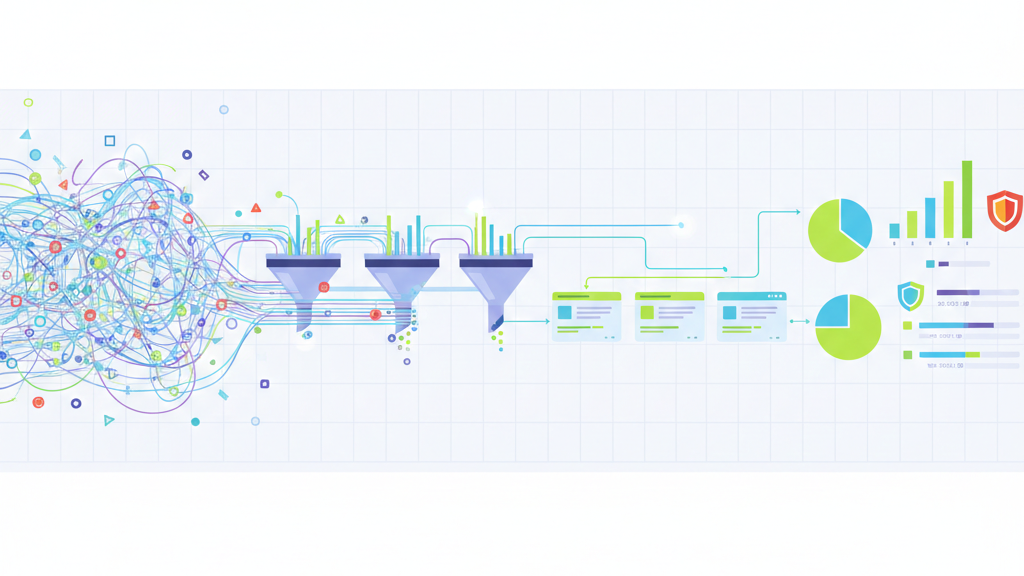
To understand what’s happening on your network, you need to see the sessions. Our work starts by taking the river of raw traffic and turning it into a clear ledger of conversations. Think of it like generating a detailed phone bill.
For every connection, we log the caller, the recipient, the line they used, the call type, the start and end time, and how much data was exchanged. This record, the five-tuple, is our fundamental unit.
We build this by inspecting the initial packets in a network flow. The result is a compact, searchable timeline that tells us who talked to whom and for how long. It turns network chaos into structured, queryable data.
In our models and tools, we focus on specific attributes from these sessions:
- The five-tuple: source and destination IPs, ports, and protocol.
- Timestamps and total connection duration.
- Volume metrics like bytes and packets sent.
- Protocol state flags that show how a connection was opened and closed.
This session data is the foundation. It lets us move from just seeing traffic to understanding behavior.
Metadata vs. Full Capture: Choosing Your Lens
Credits: Session
This brings us to the core debate: metadata vs full packet capture. It’s not about which is better, but which is right for the job at hand. Full packet capture (PCAP) is the ultimate forensic tool. It records everything, allowing you to reconstruct files and see exact content.
“By utilizing metadata for analysis, network communications can be observed at any collection point and be enriched by information providing insights about encrypted communication… for every session passing through the network, the source/destination IP address, session length, protocol used (TCP, UDP), and the type of services used are recorded.” – Exeon Analytics Blog
But it’s like recording every single word of every phone call in a city, the storage and processing cost is immense. Metadata, like our phone bill, is a summary. It tells you about the call’s existence, duration, and participants, but not the words spoken.
| Aspect | Network Metadata | Full Packet Capture (PCAP) |
| Primary Use | Real-time monitoring, behavioral baselining, threat hunting. | Deep forensic investigation, malware analysis, content verification. |
| Storage Need | Low; stores summaries and attributes. | Very High; stores every bit of every packet. |
| Analysis Speed | Fast; optimized for real-time querying and aggregation. | Slower; requires parsing and extraction for insights. |
| Privacy Risk | Lower; no direct access to payload content (email bodies, file data). | Higher; contains all application data and user content. |
For ongoing Network Threat Detection, we find metadata is the starting point. It lets us monitor the entire enterprise at once, spotting anomalies in behavior, like a server suddenly talking to a new country, that would be lost in a PCAP haystack. PCAP is then pulled for the specific, suspicious conversations metadata flags.
Uncovering Patterns in the Ledger
With session data in hand, the real work begins: analyzing connection logs insights and identifying communication patterns metadata. A single connection log entry is a data point. Thousands of them over time reveal a story.
You can see normal baselines: which servers talk internally, standard work hours for user traffic, common destination ports. Deviations from these patterns are your signals.
A workstation establishing hundreds of short-lived connections on random high ports might indicate scanning. A server sending large, sustained data volumes to an external IP at 3 AM could be exfiltration. This is how using metadata for threat hunting operates. It’s a hunt for statistical and behavioral outliers within the communication graph of your network.
Building a Richer Story with Context
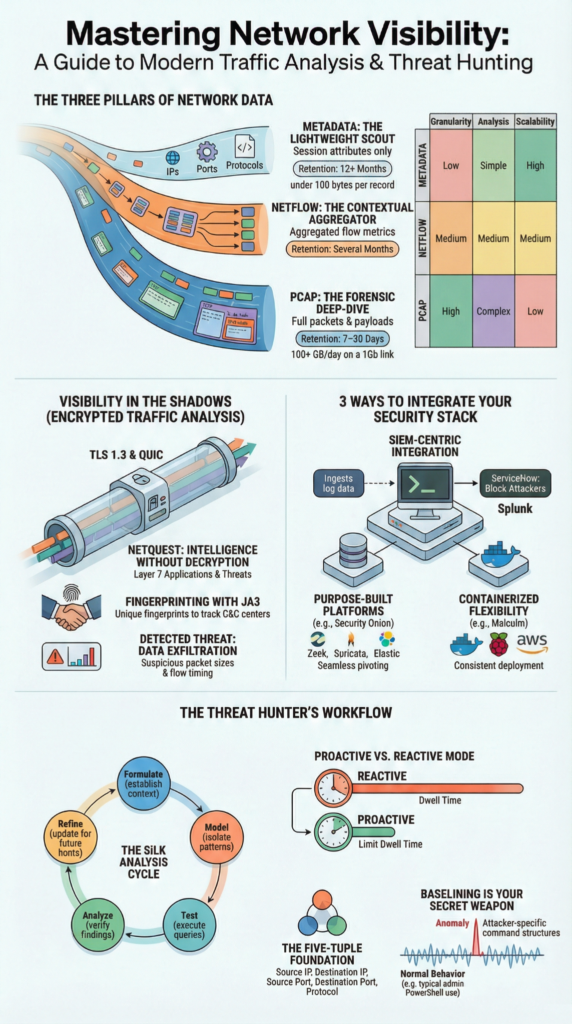
Raw metadata tells you what happened. Enriching metadata with context tells you why it might be important. This is the force multiplier. By correlating an internal IP address with an asset owner from Active Directory, you know if a suspicious flow originated from a CEO’s laptop or a test server.
Adding GeoIP and ASN data reveals if a connection is going to a cloud provider in Virginia or a suspicious hosting service in a high-risk region. Mapping a JA3 fingerprint from a TLS handshake can identify specific malware families or outdated software.
This enrichment transforms an anonymous log entry into a risk-assessed event, allowing for faster, more accurate decision-making during investigations.
Making the Data Work for You
To be effective, you need a plan for storing processing network metadata. The volume, while less than PCAP, is still substantial. The goal is to keep it searchable for both real-time alerting and historical hunting. Modern approaches use scalable, structured data pipelines.
- Collection: Tools generate flows (NetFlow, IPFIX) or session logs (Zeek conn.log).
- Enrichment: Streams are augmented with threat intel, asset DBs, and GeoIP lookups.
- Storage: Data is written to optimized, searchable systems like time-series or columnar databases.
- Analysis: Security teams query via SIEMs or custom dashboards to hunt and investigate.
This architecture ensures metadata is not just collected, but is immediately actionable, feeding detection rules and hunting queries without drowning teams in data management overhead.
The Responsibility of Visibility
Collecting this data isn’t without its dilemmas. We must consider the privacy implications metadata collection. Even without reading emails or file contents, a detailed communication log is powerfully revealing. It can show when employees are active, who they communicate with, and what services they use.
“Network metadata is crucial for visibility into network activities, aiding in identifying anomalies and potential threats. Network metadata helps in detecting threats by analyzing traffic patterns, anomalies, and connections that indicate suspicious behavior… aiding in compliance by providing visibility into network activities and ensuring adherence to security policies.” – Vectra AI Blog
In certain jurisdictions, this intersects strongly with regulations like GDPR. The principle is to collect what you need for security and operational purposes, and no more. Techniques like data minimization, sensible retention periods, and internal access controls are critical.
It’s about finding the balance between necessary visibility for protection and respect for personal privacy, ensuring the tool meant to secure the organization doesn’t erode trust within it.
Selecting Your Toolkit
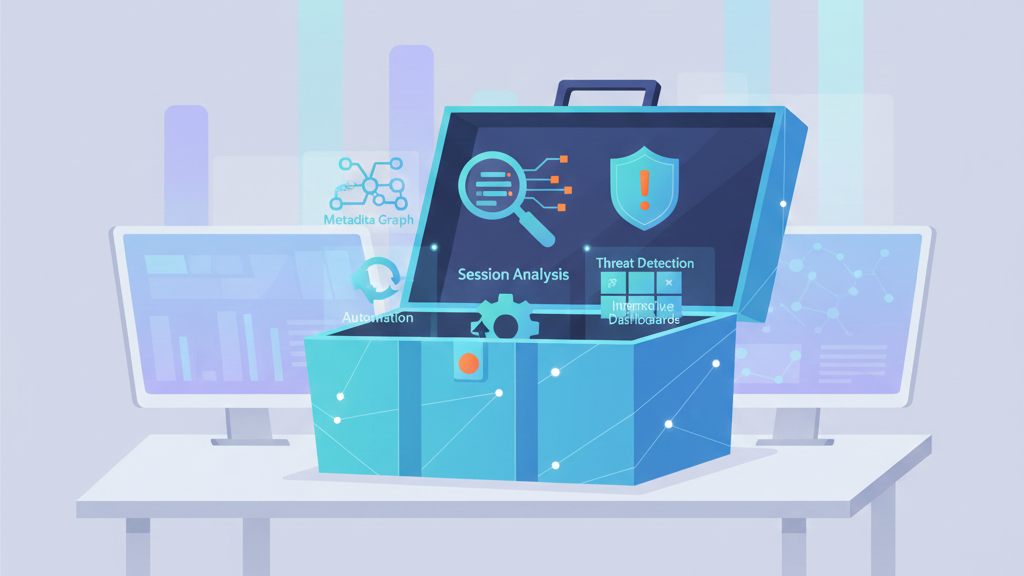
Finally, let’s look at metadata analysis tools comparison. The landscape ranges from powerful open-source frameworks to integrated commercial platforms. Your choice depends on scale, in-house expertise, and specific use cases.
Open-source tools like Zeek offer incredible depth and flexibility for generating and analyzing custom logs, but require significant setup and tuning. Commercial NDR (Network Detection and Response) platforms often build upon these open-source engines, adding automated enrichment, correlation, and user-friendly interfaces out of the box.
The best tool is the one that fits your team’s workflow, turning raw session data into clear, prioritized insights without adding complexity.
FAQ
How do network flow records support threat hunting?
Network flow records like NetFlow data capture the IP five-tuple, source destination ports, protocol identifiers, packet byte counts, and timestamp intervals. This session summarization helps analysts review connection duration and bidirectional traffic without full payloads.
By querying flow exports and DNS query logs, teams can spot C2 communication patterns, lateral movement tracking, and anomaly detection flows faster during threat hunting queries.
Can encrypted traffic analysis work without deep packet inspection?
Yes. Encrypted traffic analysis relies on packet header fields, TLS handshakes, JA3 fingerprints, user agent strings, and certificate transparency instead of payload content. These deep packet inspection alternatives provide payload agnostic insights.
By reviewing beaconing intervals, data volume spikes, and TTL anomalies, analysts can identify encrypted C2 communication patterns or exfiltration detection risks while preserving privacy preserving flows.
What tools help analyze session records at scale?
Teams often combine Zeek conn logs, Argus auditing, Suricata eve json, and Wireshark tshark flows for visibility. Flow exports such as NetFlow v9, IPFIX templates, and sFlow sampling feed into flow collector appliances.
Data is indexed using Elasticsearch indexing, Splunk sessionization, Kibana visualizations, Logstash pipelines, ClickHouse queries, or Apache Kafka streaming for scalable telemetry and storage optimization.
How can metadata improve incident timeline building?
Session records enable forensic reconstruction by correlating connection duration, timestamp intervals, SMB sessions, Kerberos tickets, and RDP connections. Adding GeoIP mapping, ASN lookup, and Active Directory correlation strengthens SIEM enrichment.
Analysts can track insider threat patterns, ransomware propagation, exploit kit traffic, or phishing domain resolutions to support incident timeline building and compliance logging requirements.
The Strategic Advantage
So, what’s the strategic advantage? Network metadata analysis gives you a scalable, efficient way to understand your entire digital environment. It moves you from reacting to single incidents to seeing your network’s overall health and habits.
For our team, this is the essential first layer of intelligence. It tells us exactly where to aim our deeper, more resource-intensive tools. By mastering flow records and connection patterns, you build a foundation that makes every other security control work better.
This foundational visibility is what lets you build confidently. If you’re looking to streamline your security operations and ensure your tools actually align with your goals, our team can help. We offer expert consulting to reduce tool sprawl and boost service quality.
References
- https://exeon.com/blog/deep-packet-inspection/
- https://www.vectra.ai/blog/what-is-network-metadata-and-why-do-i-need-it