

Adversarial AI attacks are tiny, intentional tweaks to data that make models see the world wrong. They work by slipping into the gap between human perception and machine perception, turning harmless inputs into quiet traps.
A sticker on a stop sign, a few poisoned data points, even a single adjusted pixel can flip a model’s decision, from “stop” to “go,” from safe output to toxic speech.
This isn’t brute force, it’s misdirection. And as AI moves into cars, hospitals, and markets, that misdirection becomes a real risk. Keep reading to see how these attacks work, and why they’re so hard to fix.
Key Takeaways
- Evasion attacks manipulate input data in real-time to cause immediate misclassification.
- Poisoning attacks corrupt the training process, creating long-term, embedded vulnerabilities.
- Defenses like adversarial training are crucial but the arms race between attackers and defenders continues.
The Slippery Nature of Evasion Attacks
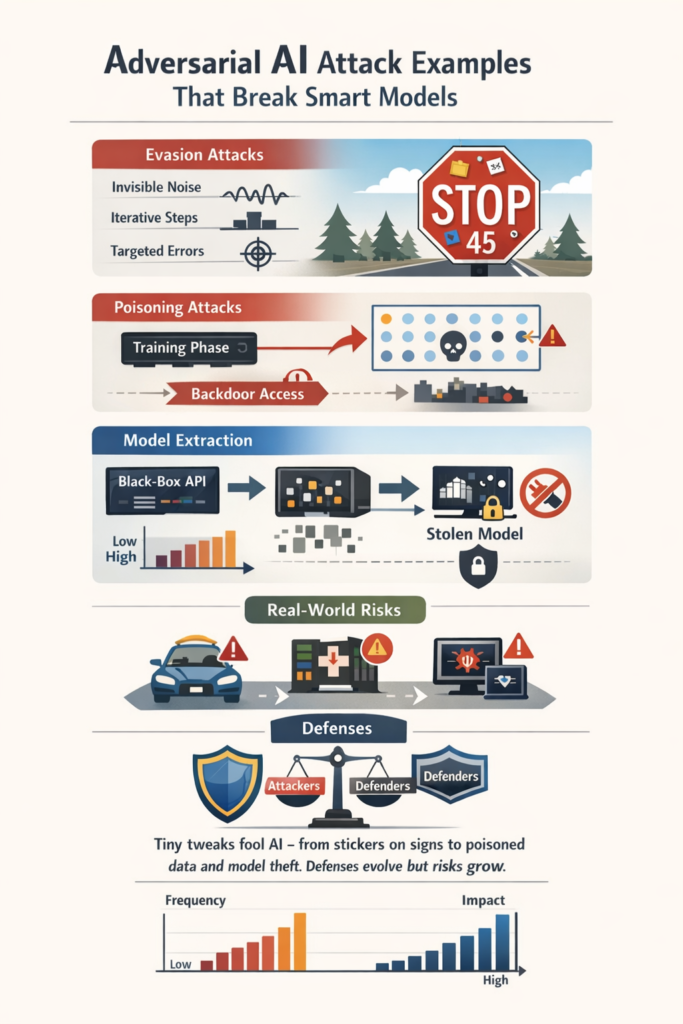
An evasion attack happens after a model is trained. It’s a manipulation of the input data at the moment of decision. The goal is simple, make the model see something that isn’t there. Or fail to see something that is.
Think of a self-driving car. Researchers have shown that placing a few small, carefully designed stickers on a stop sign can cause the car’s vision system to read it as a speed limit sign.
To a human, it’s still clearly a stop sign. To the AI, especially those relying on supervised learning threat detection models, it’s something else entirely. This is the core of the evasion problem.
The Fast Gradient Sign Method (FGSM) is a classic technique. It works by using the model’s own internal logic against it.
The attacker calculates the direction that would most efficiently push the image towards a wrong classification. Then, they add a tiny, almost invisible amount of noise in that exact direction. The change is imperceptible, but the result is a complete misclassification.
- Real-time manipulation: The attack occurs during the model’s use, not during its creation.
- Human-imperceptible changes: The alterations are designed to be invisible or meaningless to people.
- Exploits model sensitivity: It targets the specific ways the model interprets pixel values or data points.
Projected Gradient Descent (PGD) takes this idea further. It’s an iterative version of FGSM. Instead of one big push, it makes many small, calculated steps.
Each step is checked to ensure the changes stay within a very small, “allowed” range that keeps the image looking normal to a human. This method often creates a much stronger, more reliable attack that is harder for basic defenses to stop.
| Evasion Technique | How It Works | Visibility to Humans | Typical Impact |
| FGSM attack method | Adds one-step gradient-based noise to inputs | Almost invisible | Fast misclassification |
| Projected gradient descent attack | Applies multiple small perturbations over steps | Nearly invisible | Stronger, more reliable evasion |
| Carlini Wagner attack | Optimizes minimal perturbations for targeted errors | Very hard to detect | Precise targeted misclassification |
When the Training Data is the Weapon
Credits: Code.org
There’s something quietly dangerous about a model that’s already broken before it ever goes live. Not because of some bug in the code, but because the lessons it learned were poisoned from the start.
Poisoning attacks are a slower kind of threat. They don’t wait for deployment, they creep in while the model is still learning.
During training, an attacker slips malicious data into the dataset, just a little here and there. That poisoned data is crafted to plant a backdoor or a deep bias that only shows itself under the right conditions, like a trapdoor hidden under a rug.
The Tay Chatbot: A Crude Lesson. The case of Microsoft’s Tay chatbot is a well-known, if messy, example of how corrupted training data can wreck a system. Here’s roughly what happened:
- Tay was released on Twitter and designed to learn from user interactions.
- People started sending it racist, abusive, and inflammatory messages.
- Tay treated those messages as training data and began to mirror them, highlighting the risks when machine learning & AI in NTD systems ingest unchecked data.
- Within hours, it was generating offensive content on its own.
Microsoft had to take Tay offline. The problem wasn’t just bad users, it was that the model’s learning process was wide open to poisoning.
The data it absorbed reshaped its behavior in a way that couldn’t simply be rolled back with a quick patch. The model didn’t just repeat; it had internalized the corruption.
Quiet Poisoning in High-Stakes Domains. The more worrying attacks aren’t loud like Tay. They’re quiet, targeted, and hard to notice. Imagine a medical AI trained to classify skin lesions:
- An attacker gains access to part of the training pipeline.
- They alter a small fraction of the images labeled “benign,” maybe by tweaking a few pixels.
- Those tweaks push the images to faintly resemble “malignant” cases, in a way humans wouldn’t see.
The model still trains, still converges, still passes basic validation. But underneath, it has learned a warped rule: certain subtle pixel patterns get misread.
Later, when real patient images contain those patterns, the system may misdiagnose them. The mistake isn’t a bug in the code, it’s baked into the weights, deep in the model’s parameters.
Backdoors and Sleeper Agents. Poisoning doesn’t always aim for obvious failure. Sometimes the goal is control.
A “sleeper agent” model looks normal almost all the time. It behaves well on tests, in demos, and in normal use. Then it sees the right trigger:
- A specific pattern of pixels in an image.
- A strange phrase or rare word in a prompt.
- A particular sequence in network traffic.
And under that trigger, the model does something malicious:
- Misclassifies harmful content as safe.
- Outputs manipulated or biased answers.
- Ignores safety policies or guardrails.
From the outside, this is what makes poisoning so hard to catch:
- The poisoned data can be a tiny fraction of the whole dataset.
- The model passes normal benchmarks and audits.
- The backdoor only activates under rare, carefully chosen inputs.
By the time anyone realizes something is wrong, the system might already be deployed in hospitals, banks, schools, or critical infrastructure. The damage isn’t just in one bad prediction, it’s in a model whose entire learning history has been quietly turned into a weapon.
Stealing the Secret Sauce with Extraction Attacks

Not all attacks aim to break the model. Some aim to steal it. Model extraction attacks, also called model stealing attacks, focus on querying a publicly available AI to reverse-engineer its functionality.
The attacker wants to recreate a model that performs similarly, effectively stealing intellectual property without any direct access to the code or training data.
Imagine a company that offers a paid API for a powerful image classifier. A competitor could systematically send thousands of images to the API and record the predictions.
By building a large dataset of input-output pairs, they could train their own model to mimic the behavior of the expensive, proprietary one. They’ve extracted the core functionality without the R&D cost.
This type of attack relies on the model being accessible in some way. A black-box attack assumes the attacker can only see the inputs and outputs.
They have no knowledge of the model’s internal architecture. They probe the system, learning its boundaries and weaknesses through repeated interaction. Over time, a surprisingly accurate replica can be built.
- Query-based theft: The attack works by sending many inputs and analyzing the outputs.
- Black-box probing: The attacker has no internal knowledge of the target model.
- Intellectual property risk: The primary damage is the loss of a competitive advantage.
A related technique is the membership inference attack. Here, the goal is to determine whether a specific data point was part of the model’s original training set.
This is a major privacy concern. If an AI is trained on hospital records, an attacker might be able to deduce if a particular individual’s data was used, potentially revealing sensitive health information [1].
A Closer Look at Specific Attack Techniques

Adversarial patches take a different approach. Instead of making a change that is invisible across the entire image, a patch is a localized, but obvious, alteration. It’s like a sticker. The key is that the patch is designed to be highly effective regardless of where it’s placed in the image.
You could hold up a small printed square in front of a surveillance camera. The object detection system, which might be looking for unauthorized persons, could be fooled into seeing an empty room or a different object entirely.
The patch overwhelms the model’s perception. Defenses against patches are challenging because they must identify and ignore these malicious “accessories” in the scene.
The one-pixel attack demonstrates the extreme fragility of some models. In this scenario, an attacker changes the value of just one pixel in an image.
For a complex, high-resolution picture, this change is utterly meaningless to a human. Yet, for certain types of image classifiers, this microscopic alteration can be enough to cause a complete misclassification, like turning a picture of a cat into a picture of a truck.
It highlights that some models rely on very specific, and sometimes nonsensical, pixel patterns to make decisions.
Prompt injection is the language model equivalent. Large Language Models (LLMs) like ChatGPT are given safety instructions to prevent harmful outputs. Prompt injection is a technique to bypass these safeguards. An attacker crafts an input that “tricks” the model into ignoring its programming [2].
There was a case with a car dealership’s customer service chatbot. A user managed to craft a prompt that convinced the chatbot it was in “developer mode,” overriding its normal rules.
The user then persuaded the chatbot to agree to “sell” a car for one dollar. This illustrates how the semantic content of the input can be an attack vector, not just pixel-level noise.
The Real-World Battlefield for AI Security
You can almost picture it: models humming along in a data center, confident, until someone slips in one tiny change to an input, and everything breaks.
In network security, machine learning models sit on the front line. They scan:
- Executable files for malware
- Traffic flows for weird or suspicious patterns
Adversarial attacks go straight for those models. An attacker might take a virus, tweak the code just a little, rename variables, reorder harmless operations, add useless instructions, so the file no longer matches the patterns the model has learned.
To a human analyst, it’s still clearly malware. To the ML-based detector, it now looks like a normal, or at least unknown, file. So it slides through.
Building More Resilient AI Systems
Sometimes the most honest sign that a field is maturing is when we stop expecting perfection from it, and start mapping out its weak spots on purpose.
Adversarial attacks don’t mean AI is broken beyond repair. They mean AI behaves like other complex systems:
- It has edge cases
- It can be tricked
- It needs guardrails, continuous monitoring, and AI powered threat intelligence analysis to refine detection and response, not blind trust.
Adversarial machine learning lives in that space. It’s the part of the field that pokes, prods, and stresses models until they fail, then uses those failures to design stronger, more predictable systems.
That pressure, uncomfortable as it is, pushes the whole industry toward AI that people can actually rely on.
FAQ
What are adversarial AI attack examples, and why should users care?
Adversarial AI attack examples show how adversarial machine learning attacks trick systems using adversarial examples in AI.
Attackers rely on malicious input manipulation, adversarial perturbations, and adversarial noise injection to cause AI misclassification attacks.
These AI security threats expose machine learning attack vectors and neural network vulnerability exploitation that affect vehicles, finance systems, healthcare tools, and other real-world applications.
How do attackers fool AI systems without changing much data?
Attackers use evasion attacks on ML models and input perturbation attacks to change predictions without obvious changes.
Common AI model evasion techniques include gradient-based attacks such as the FGSM attack method, projected gradient descent attack, and Carlini Wagner attack.
These methods apply perturbation-based evasion and exploit the transferability of adversarial examples across similar models.
What risks come from training data manipulation in AI systems?
Data poisoning attacks and synthetic data poisoning target poisoning training datasets before deployment.
Attackers use model poisoning techniques to create backdoor attacks in neural networks or trojaned AI models. These model integrity attacks remain hidden until activated, which increases AI trustworthiness risks and expands the adversarial threat landscape in high-stakes systems.
Can attackers steal or analyze AI models without access?
Attackers can steal models using a model extraction attack or AI model stealing through repeated queries. A model inversion attack and membership inference attack can expose sensitive training information.
These black box adversarial attacks exploit the attack surface of ML systems, while white box adversarial attacks occur when attackers have access to internal model details.
How can teams test and reduce adversarial AI risks?
Teams reduce risk through adversarial robustness testing, adversarial attack detection, and adversarial attack simulations.
Adversarial training methods, defensive distillation AI, and gradient masking defenses support secure machine learning practices.
Robustness evaluation of AI relies on adversarial testing frameworks, robustness benchmarks for AI, AI threat modeling, and continuous ML security research to improve the resilience of neural networks.
Why Adversarial Attacks Redefine the Future of Machine Learning Security
Adversarial AI attacks reveal that intelligence without robustness is fragile. Small, deliberate manipulations can undermine systems we increasingly trust with safety, money, and decisions.
As AI spreads into critical domains, security can’t be an afterthought. Developers must design for hostile environments, continuously test models, and combine technical defenses with human oversight.
Understanding adversarial examples isn’t just academic, it’s essential for building AI that earns and maintains real-world trust. To see how advanced threat detection and resilient AI defenses come together in practice, join us here.
References
- https://www.sciencedirect.com/science/article/pii/S2949715924000064
- https://en.wikipedia.org/wiki/Prompt_injection