
AI security works only when the environment around it is calm, organized, and intentional. The smartest tool on the market won’t help much if it’s dropped into chaos, because you can’t automate confusion or wish away weak foundations.
What actually drives real protection is the quiet work underneath: trained people, clear processes, clean data, and a shared understanding of risk and responsibility.
When those pieces line up, the “intelligence” in AI finally has something solid to stand on. If you want your AI security investment to protect rather than disappoint, keep reading.
Key Takeaway
- Define your threats and success metrics before selecting any technology.
- Your data quality dictates your AI’s effectiveness.
- Integration than the AI model alone, as hybrid human-AI loops enhance efficacy with existing workflows is more critical than the AI model itself.
The Quiet Crisis in Modern Security
The server room hums like it always has, but the pressure feels different now. Screens flood with logs at volumes exceeding human real-time processing capacity.
This is the modern security operations center, where attention is the rarest resource in the room. The older methods, manual triage, handcrafted rules, endless alert queues, feel more and more like trying to empty a sinking ship with a teacup.
The alerts don’t stop, the patterns shift, and the attackers don’t care how tired your team is. The scale has outgrown what a human-only approach can handle.
This is the space where AI-driven security tools actually earn their keep. Not as a quiet threat to someone’s job, but as a real force multiplier, the kind that lets a small team stand their ground against a massive stream of events. It’s the difference between staring at the river and:
- Having a system that notices when something moves upstream
- Catching the odd, quiet signals buried in routine noise
- Highlighting behavior that doesn’t belong, even if it matches no known rule
You still need people to make the judgment calls. But now they’re not drowning in data first. They’re watching the strange, dark currents that actually matter [1].
Start With the Problem, Not the Product
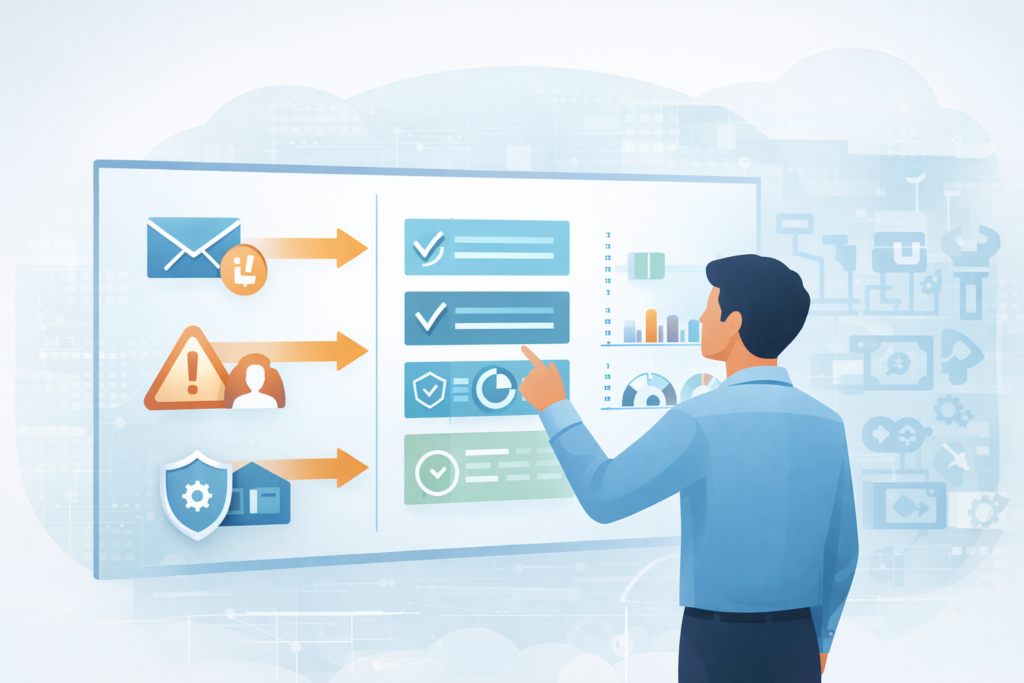
You wouldn’t call a contractor and say, “I need a hammer.” You’d describe the leaky roof. The same logic applies to implementing AI security.
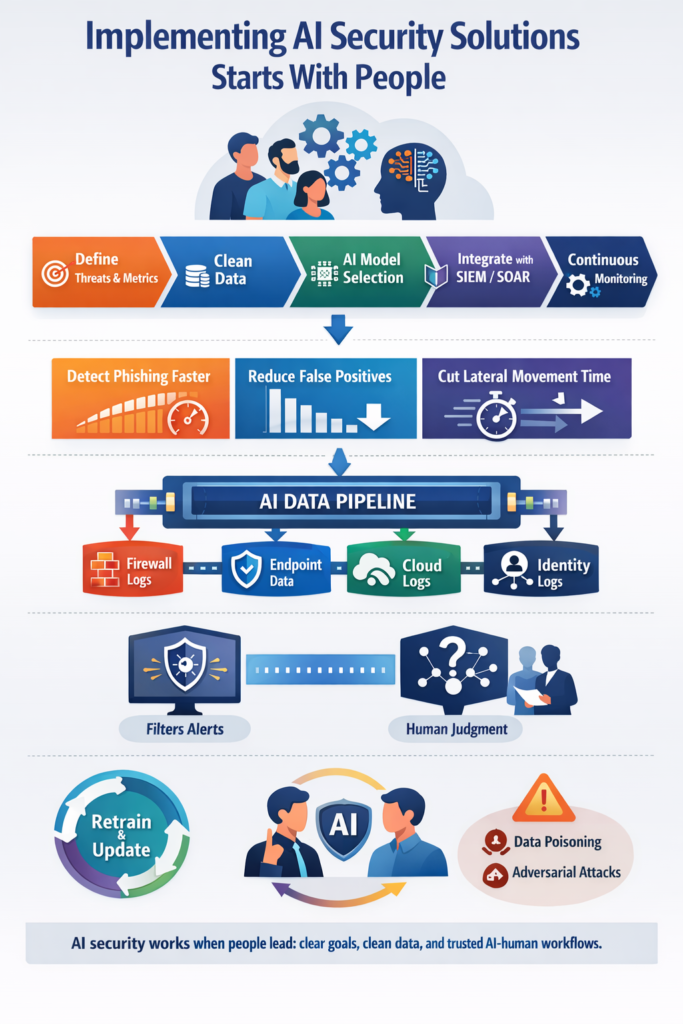
The first, and most often skipped, step is to define precisely what you’re trying to fix. Is it slow response to phishing campaigns, unidentified insider threats, or advanced malware slipping past traditional signatures?
Be specific. Vague goals like “improve security” lead to wasted investment. Instead, set measurable objectives.
For example, “Reduce the time to detect a lateral movement attempt from 48 hours to 4 hours,” or “Cut false positives from our endpoint detection system by 60%.”
These metrics become your north star, guiding every decision that follows, from data collection to model selection.
They force you to think about the outcome, not just the technology. In many modern environments, machine learning & AI in NTD play a pivotal role in refining these detection goals by enabling more precise identification of threats.
- Identify the most critical threats to your specific environment.
- Set quantifiable goals for detection speed and accuracy.
- Align these security objectives with overarching business priorities.
This initial scoping phase is fundamentally a human exercise. It requires your security team to articulate their pain points and your leadership to define what protection is worth. Without this clarity, you’re just adding a very smart engine to a car with no destination.
| Security Problem | Clear Metric | Why It Matters |
| Slow phishing detection | Time to detect reduced from hours to minutes | Limits credential abuse and account takeover |
| Excessive false positives | Alert volume reduced by percentage | Prevents analyst fatigue and missed real threats |
| Lateral movement risk | Time to detect internal movement | Reduces breach impact and spread |
| Insider access abuse | Unusual access patterns flagged | Protects sensitive systems and data |
Your Data is the Foundation. Is it Solid?
Credits: IBM Technology
AI models aren’t fortune tellers, they’re pattern finders. They only learn from what you give them. If the input is messy, incomplete, or skewed, the output will be confused in the same way. That old line “garbage in, garbage out” fits painfully well here.
When your logs are missing, your network traffic is noisy, or your event history has big gaps, the model doesn’t magically fix that. It just absorbs the chaos. The result is an AI that’s jumpy, inconsistent, and hard to trust.
To avoid that, the work starts with building a full, unified view of your environment. That usually means pulling in:
- Firewall logs
- Endpoint and EDR data
- Cloud platform logs (IaaS, SaaS, PaaS)
- Identity and access logs (SSO, IAM, VPN, directory services)
- This data foundation is essential for deep learning for network security systems to accurately model normal behavior and detect subtle anomalies.
Once the data is flowing, the next phase is the least glamorous, but the most important: data preparation. This is the janitorial side of AI, where you:
- Clean corrupted or duplicate records
- Handle missing values in a consistent way
- Normalize formats (timestamps, IP formats, usernames, resource IDs)
- Align time zones and clocks across systems
It’s not flashy work, but this step usually has the biggest impact on how well your model performs later. If this part is sloppy, the model is building patterns on top of sand.
After that comes feature engineering, where human expertise really matters. This is where raw fields turn into useful signals. Instead of just feeding the model “login time” and “IP address,” your team defines what might indicate risk in your specific environment. For example:
- What does a suspicious login look like for your company?
- Is it a login from a new country at 3 a.m. for that user?
- Is it followed by access to a sensitive HR or finance system?
- Is there a sudden spike in data downloads or file transfers right after?
Those combinations become features: behavioral signatures that tell the model, “This pattern is worth a closer look.” Good features can include:
- Number of failed logins before success
- Distance between last known location and current login
- Access to high-value systems after privilege changes
- Unusual protocol or port usage for a given device
The sharper and more honest these features are, the more precise the model becomes. If the features are vague or poorly thought out, the AI will be, too.
So the real question isn’t just, “Do we have AI?” It’s, “Is our data clean, complete, and structured in a way that reflects how attacks actually play out in our environment?” Because in the end, the model’s vision is only as clear as the data lens you give it.
Choosing and Deploying the Right Mind
With a clear problem and clean data, you can now intelligently select an AI approach. The choice often boils down to the nature of the threat.
For known threats, like specific malware families, supervised learning models are effective. You train them on labeled datasets of “good” and “bad” files, and they learn to classify new ones.
For detecting novel attacks or subtle insider threats, unsupervised learning models are more appropriate. These models don’t need labels, instead, they learn what “normal” network behavior looks like for your organization.
They then flag significant deviations from that baseline. This is powerful for finding the proverbial needle in a haystack, the attack that doesn’t match any known signature.
However, challenges training ML security models remain, such as data scarcity, bias, and adversarial manipulations, all of which require ongoing attention during deployment.
The real test begins after model selection. Rigorous training and testing are non-negotiable. You must validate the model’s performance against data it hasn’t seen before.
This is where you uncover biases and vulnerabilities. A model that is 99.9% accurate might still be useless if it fails to detect the one attack that matters most to you.
Deployment is where theory meets reality. The goal is seamless integration. AI shouldn’t exist in a silo. It needs to feed its findings into your Security Information and Event Management (SIEM) or Security Orchestration, Automation, and Response (SOAR) platforms.
This integration is what creates the automated response loop, the AI detects an anomaly, the SOAR platform executes a pre-defined playbook to contain the threat, all within seconds. This is the automation that actually reduces the burden on your SOC team.
- Supervised learning for known, labeled threats.
- Unsupervised learning for novel anomalies and insider risk.
- Integration with SIEM/SOAR for automated response.
Think of deployment not as a finish line, but a new starting gate. The digital threat landscape is a living ecosystem, constantly shifting.
Your AI models will suffer from concept drift, their performance decaying as attacker tactics evolve. A model trained on last year’s threats is already growing obsolete.
The Unseen Architecture of Maintenance
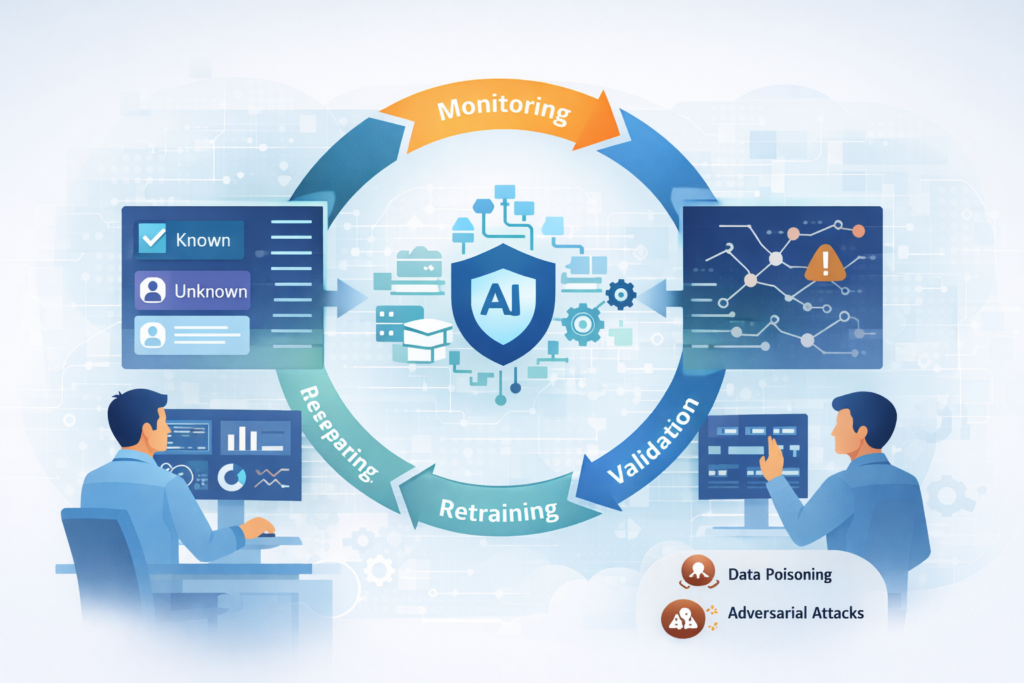
This demands a commitment to continuous maintenance. You need to monitor the model’s performance over time, watching for a rise in false positives or a drop in detection rates. These are the signs that it’s time to retrain the model with new data.
This cycle of monitoring, retraining, and redeployment is the ongoing cost of having an intelligent defense. It’s not a set-and-forget technology, it’s a living system that requires care and feeding.
This maintenance extends beyond the model to the entire security framework. Adopting a zero-trust mindset is no longer optional. Assume breach.
Verify every user, device, and request, regardless of its origin. Strict access controls and multi-factor authentication become the walls that contain any threat the AI identifies.
Data encryption, both at rest and in transit, ensures that even if data is exfiltrated, it remains useless to the attacker.
You must also plan for the AI system itself to be attacked. Adversaries can attempt to poison your training data or manipulate the model’s inputs to cause misclassification. Building adversarial robustness through regular red teaming exercises is essential.
Your team needs to think like an attacker trying to fool your AI, and then harden the system against those techniques.
Making it Work in the Real World
Once you start putting AI into a live security program, a few predictable problems show up. Data scarcity hits first, especially in smaller organizations that don’t have years of clean, labeled logs.
Then there are skill gaps in SOC teams, where analysts may not trust or fully understand what the models are doing.
That combination can lead to misuse, or the opposite problem: the tools just sit there, underused. A practical way through this is a phased rollout rather than a big-bang deployment:
- Start with a pilot on a narrow, well-defined use case
- Choose a problem where impact is clear and measurable (for example: phishing detection or lateral movement detection)
- Involve the analysts early, so they can test, question, and challenge the outputs
- Use feedback from the pilot to adjust rules, playbooks, and training [2]
The pilot isn’t just about testing the tool, it’s about building habits. This is where the team gets used to reading AI-driven alerts, interpreting scores or confidence levels, and feeding outcomes back into the system. Slowly, the technology shifts from “black box” to “trusted assistant.”
Real-world deployments offer good models for how this can look when it works. Darktrace’s Antigena, for example, creates a moving baseline of normal behavior for each device and user. It watches patterns over time: logins, data transfers, protocols, locations.
When something breaks that pattern in a serious way, say, the sudden, encrypted spread of ransomware across the network, it doesn’t wait for a signature update. It can autonomously step in:
- Throttle or block suspicious connections
- Isolate a device from the wider network
- Limit a user account’s access while the event is investigated
The key is that it flags behavior as malicious based on deviation, not on whether the malware is known by name.
Cylance takes a related but different path. Instead of waiting for files to run, it uses AI to examine them before execution. The model evaluates billions of characteristics (file structure, code patterns, metadata) to predict whether a file is likely to be malicious. That means:
- Blocking threats before they execute
- Reducing reliance on daily signature updates
- Shifting effort from reactive cleanup to proactive prevention
When tools like these are tightly woven into the security workflow, you get a clear outcome: response times shrink dramatically. Events that used to take hours or days to even detect can be flagged and acted on in seconds.
That speed only matters, though, when the process around it, people, playbooks, and trust, is built carefully, one real-world step at a time.
The Final Integration
Implementing AI security isn’t just a technical rollout, it’s an organizational shift. The tools are strong, but they’re not a cure-all.
They only work when the groundwork is there: a clear plan, reliable data, and a place for AI inside your existing defense-in-depth.
Even the most advanced model will stumble if it’s dropped into a broken or unclear process. The real target is a steady, working partnership between your human analysts and the AI systems. You want:
- AI to handle the volume, filtering the constant stream of alerts and noise
- Humans to bring context, judgment, and real-world understanding
- Clear workflows that connect AI outputs to human decisions
- Feedback loops so analysts can correct and improve AI over time
In that setup, the AI does what machines do best: scale. It scans logs, correlates events, and flags patterns that no individual could sort through in time. The analysts do what people do best: they weigh risk, read intent, and tie technical events back to business impact.
From there, choices become sharper. Humans review the alerts that matter, trace them to systems and data that actually affect the organization, and decide on responses that fit both security and operations.
The AI supports the work, it doesn’t run the show. If you’re building toward this kind of partnership, start with the basics:
- Define your security mission and priorities
- Clean and structure your data so the models have something trustworthy to learn from
- Select tools that fit your team’s skills and workflows, instead of trying to replace them
- Align AI outputs with existing incident response and escalation paths
Your security posture will rise or fall based on how well your people and your AI work together. The technology amplifies what’s already there, good or bad. So you build the foundation now, on purpose, before the models go anywhere near production.
FAQ
What should teams prepare before AI security implementation begins?
Before AI security implementation begins, teams must define goals, assign clear roles, and document risks. A strong enterprise AI security strategy guides deploying AI in cybersecurity in a controlled way.
Teams should design AI security architecture, establish AI security governance, and plan AI risk management early. This preparation supports secure AI deployment and long-term AI security transformation.
How does AI security integration affect daily security operations?
AI security integration directly changes daily security work. An AI security operations center uses AI security monitoring, AI SOC automation, and AI security orchestration to reduce alert overload.
With AI SOAR integration and AI security workflow automation, analysts spend less time triaging alerts and more time handling real incidents, improving AI incident response speed and consistency.
What data types matter most for AI-powered threat detection?
AI-powered threat detection depends on accurate and complete data. Machine learning security systems use network, endpoint, and identity logs for AI-based intrusion detection.
Behavioral analytics AI security and AI anomaly detection systems rely on historical activity patterns. Strong AI security data pipelines improve predictive security analytics, real-time AI security analysis, and AI threat intelligence accuracy.
How does AI support risk and compliance without replacing humans?
AI supports teams by strengthening AI security risk assessment and AI security posture management. AI security compliance tools track controls and audits more reliably.
AI model security controls and AI security policy enforcement reduce human error. However, people still make decisions in AI zero trust security and AI identity and access management processes.
How do organizations measure value from AI security investments?
Organizations measure AI security ROI using clear performance metrics. These include faster AI threat hunting, improved AI-driven vulnerability management, and reduced AI attack surface management.
Gains in AI security scalability, AI-powered endpoint protection, AI network security analytics, and AI cloud security solutions show progress toward higher AI cybersecurity maturity.
Human Strategy Is the Real Security Multiplier
AI can transform security operations, but only when it’s grounded in human-led strategy. Clear goals, clean data, and well-defined workflows determine whether AI becomes an advantage or a liability.
The strongest programs treat AI as a partner, not a replacement, letting machines handle scale while people provide judgment and context.
Build the foundation first, integrate thoughtfully, and maintain continuously. When humans and AI reinforce each other, security becomes faster, smarter, and resilient by design. Ready to strengthen your security with the right strategy and tools? Join us now to get started.
References
- https://assets.kpmg.com/content/dam/kpmgsites/xx/pdf/2025/05/trust-attitudes-and-use-of-ai-global-report.pdf
- https://pmc.ncbi.nlm.nih.gov/articles/PMC11983460/