

Cloud security shouldn’t just be a compliance checklist. While standard tools log events and hope for the best, those logs only show what happened, not why. At Network Threat Detection, we’ve seen cloud-native tools consistently miss slow-burn attacks, like a compromised account slowly exfiltrating data.
That’s why implementing ueba for cloud security monitoring is an absolute game-changer. It analyzes asset intent, transforming your static posture into a dynamic, active defense. Keep reading to see where it fits.
The Core Intel: What’s Inside
Before diving into the technical mechanics, here is a quick snapshot of how behavioral analytics fundamentally shifts the data security paradigm:
- UEBA analyzes the intent behind cloud actions, catching threats that rule-based alerts miss entirely.
- It creates unified behavioral profiles across IaaS, SaaS, and your corporate network, closing visibility gaps.
- Effective cloud UEBA requires specific data sources like CloudTrail, CASB, and crucially, network flow data.
How Does Cloud Security Create Blind Spots That UEBA Fixes?
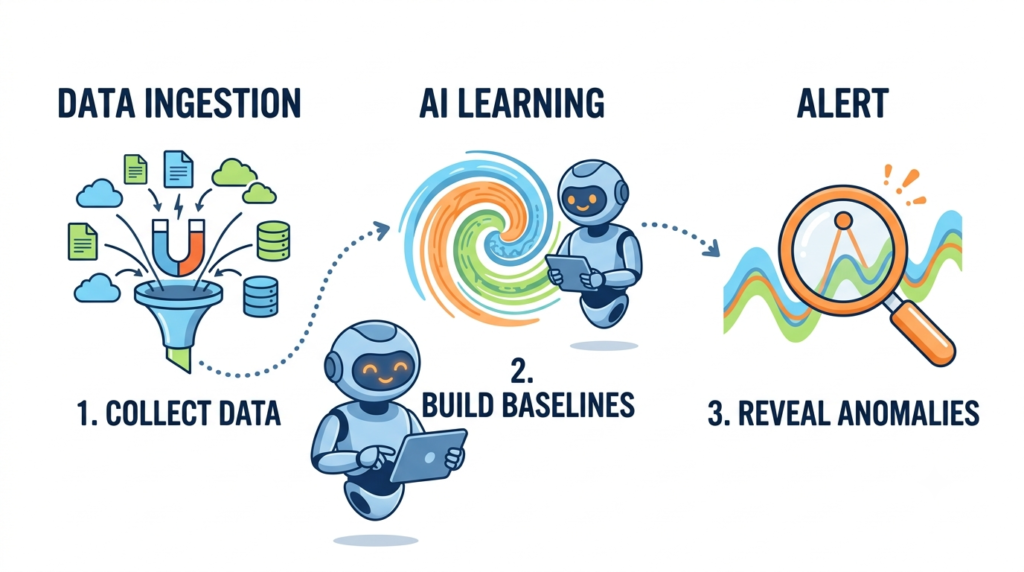
The cloud’s greatest strength, its distributed, API-driven nature, is also a security blind spot. Traditional tools look at events in isolation. A login from a new country. A large file download. A new IAM role created.
Standard cloud security posture management (CSPM) and SIEM rules struggle with this correlation. We ran into this repeatedly. Deploying advanced user and entity behavior analytics (UEBA) bridges this context gap. Without it, an alert would fire for “unusual time of login” to a SaaS app, leaving analysts without a clear narrative.
We ran into this repeatedly. An alert would fire for “unusual time of login” to a SaaS app. By the time an analyst checked it, the session was over.
Was it a threat or just an employee working late? Without context, it was just noise. UEBA fixes this by building a baseline. It learns that Sarah in marketing always logs in from New York and Lisbon, and typically accesses the marketing drive.
What Specific Cloud Data Sources Should UEBA Analyze?
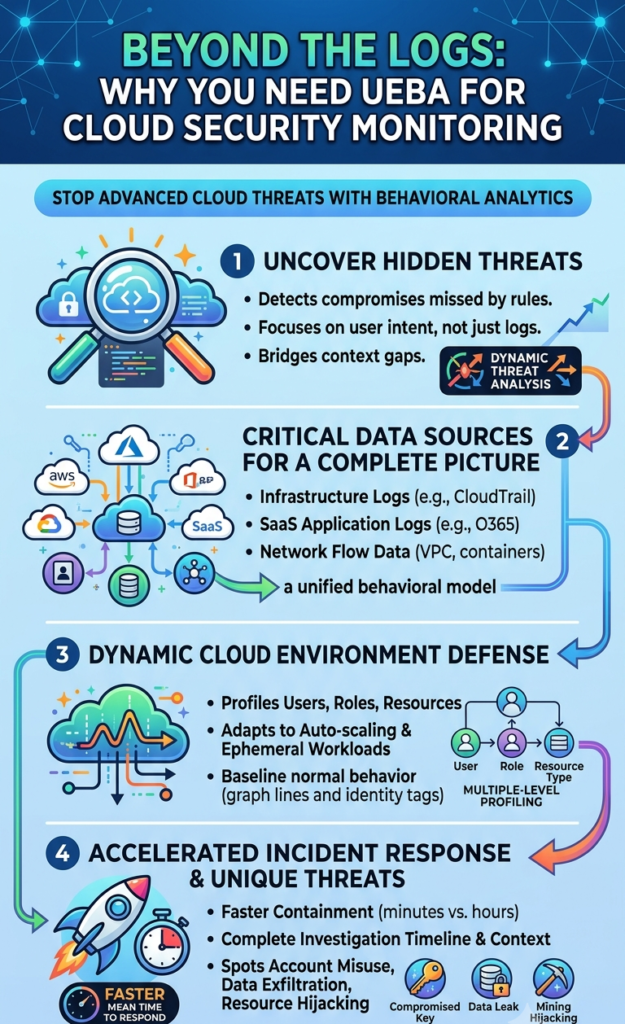
You can’t analyze what you can’t see. For UEBA to work in the cloud, it needs the right telemetry. The core sources are non-negotiable. First, infrastructure logs from AWS CloudTrail, Azure Activity Logs, or GCP Audit Logs.
These provide the “who did what” in your IaaS environment. Second, SaaS application logs, often fed via a CASB (Cloud Access Security Broker). This covers your O365, Google Workspace, Salesforce, and other critical apps.
“User and Entity Behavior Analytics (UEBA) identifies compromised cloud identities based on historical behavioral patterns, which are only made visible through data recorded about your environment. Your system, user activity, and network traffic logs, along with other telemetry data like application metrics, establish a baseline for what happens in your environment. UEBA uses that data to determine if a particular identity’s behavior is unusual compared to its long-term patterns.” – Datadog
But there’s a third, often overlooked source that we consider foundational: network traffic data. In the cloud, this means VPC Flow Logs, container network metadata, and virtual network logs.
Why is this so critical? Because an attacker moving laterally between cloud instances, or exfiltrating data to an external server, will leave a network trail even if they clean their audit logs. Network Threat Detection at this layer gives you a persistent, resilient signal.
Can UEBA Actually Keep Pace With Dynamic Cloud Environments?
The cloud isn’t static. Instances spin up and down. Containers live for minutes. Serverless functions execute in seconds. A behavior model built for a fixed corporate network will fail here. The UEBA system must understand cloud transience.
It can’t treat a new EC2 instance as a brand-new, unknown entity every time. It needs to understand concepts like auto-scaling groups, container orchestrators, and ephemeral workloads.
From our testing, the successful approach involves profiling at multiple levels. You profile the user (the IAM principal). You profile the role (the permissions set). And you profile the resource type (e.g., an S3 bucket holding sensitive data).
When a new lambda function is instantiated, its behavior is compared to the baseline for its execution role and the resources it accesses. This allows the system to say, “This function, using the ‘data-reader’ role, is querying databases it has never accessed before,” which is far more valuable than just logging its execution.
How Does UEBA Improve Incident Response in the Cloud?
In the cloud, speed is everything. A compromised account can spin up cryptocurrency miners, launch attacks, or exfiltrate terabytes of data in minutes. Traditional investigation, manually querying logs across five different consoles, is too slow. UEBA accelerates this by providing built-in context and a unified timeline.
When an alert fires, the analyst isn’t starting from scratch. The UEBA console should show them the complete story: the user’s risk score over time, the specific anomalous actions (e.g., “created new security group, modified bucket policy, initiated large S3 download”), and the correlated network traffic showing the data transfer to an external IP.
This turns a 45-minute log hunt into a 5-minute confirmation. The table below shows the response time difference.
| Investigation Phase | Traditional Cloud SIEM | UEBA-Enhanced Investigation |
| Alert Triage | Log in to multiple cloud consoles. | Review unified risk timeline in one pane. |
| Context Gathering | Manually correlate user, API, and network logs. | Pre-correlated narrative of events is provided. |
| Scope Determination | Guesswork based on available logs. | Clear map of affected entities and actions. |
| Mean Time to Respond | High (often 60+ minutes). | Dramatically reduced (often under 15 minutes). |
This efficiency lets small security teams contain cloud breaches before they become catastrophic.
What Are the Unique Threats UEBA Spots in Cloud Environments?
Credits: Matt Soseman
Cloud attacks follow different patterns. UEBA is uniquely tuned to find them. The first is account compromise and misuse. This isn’t just a stolen password. It’s an attacker using a valid IAM key or OAuth token to behave like a legitimate user.
The second is data exfiltration from cloud storage. Attackers don’t always download everything at once. They might slowly siphon data over weeks. UEBA detects the behavioral change in access patterns, unusual times, unusual volumes, unusual destinations for data egress, especially when paired with network flow analysis.
“These are the data sources from which the UEBA engine collects and analyzes data to train its ML models and set behavioral baselines for users, devices, and other entities. UEBA then looks at data from these sources to find anomalies and glean insights.” – Wikipedia
The third, and most insidious, is resource hijacking. This is where an attacker uses your cloud compute power for cryptomining or as a launchpad for attacks.
UEBA notices the anomalous resource consumption: a normally idle VM suddenly at 95% CPU, or a new, unauthorized instance type being spun up in a dormant account. It connects the technical anomaly to the user or service account behind it.
How Do You Start Implementing UEBA for Cloud Security?
Starting doesn’t mean boiling the ocean. A phased approach is best. When evaluating UEBA vendor solutions and features, prioritize platforms that allow modular deployment. Begin with your crown jewels, the data and systems that would cause the most damage if compromised.
- Phase 1: Identity & Access. Integrate UEBA with your cloud identity provider (like Azure AD) and IAM logs. Focus on detecting anomalous logins, privilege escalation, and unusual role assumptions. While navigating the legal and privacy implications of UEBA monitoring for your staff, this phase gives you immediate, compliant protection against account takeover.
- Phase 2: Critical Data Stores. Connect UEBA to your major data repositories, S3 buckets, Azure Blob Storage, SQL databases. Profile normal access patterns for these sensitive resources. This catches data staging and exfiltration.
- Phase 3: Network & Compute. Finally, bring in the network flow logs (VPC, vNet) and compute instance metrics. This adds the layer of Network Threat Detection to see the movement and communication patterns that other logs can’t capture, completing your visibility.
Prioritize use cases, not data sources. Start with “detect data exfiltration” and bring in the logs needed to solve that.
FAQ
Is UEBA redundant if we already have a Cloud SIEM?
No, they are complementary. A Cloud SIEM aggregates and alerts on log events based on pre-defined rules. UEBA adds behavioral intelligence, finding threats that have no existing rule by spotting deviations from normal patterns. The SIEM is your library of events; the UEBA is the detective finding the hidden story within them.
How does UEBA handle serverless functions (like AWS Lambda)?
It profiles the execution context. Instead of profiling a server, it profiles the IAM role or service account the function uses, the resources it typically accesses, and its normal invocation patterns. Anomalies occur when that role starts accessing new databases or the function is invoked from an unexpected geographic source.
Can UEBA work in a multi-cloud environment?
Yes, this is where it becomes especially powerful. A good UEBA solution normalizes data from AWS, Azure, and GCP into a single behavioral model. This can catch threats that span clouds, like an account compromised in Azure AD being used to access resources in AWS, a pattern invisible to single-cloud tools.
What’s the biggest mistake in deploying cloud UEBA?
Treating it like an on-prem tool. The biggest mistake is not adjusting the baselining and models for cloud elasticity and transience. If you don’t configure it to understand ephemeral resources and identity-centric attacks, it will generate endless false positives or, worse, miss real threats.
Integrating UEBA Into Your Cloud Defense
Cloud security requires a new kind of visibility. It’s not enough to know what rules were broken; you need to understand the intent behind every API call, data access, and network flow. UEBA provides that missing analytical depth, transforming your cloud from a collection of isolated events into an ecosystem of understood behaviors.
By grounding identity and data context with network-level detection, you build a truly dynamic defense. Ready to eliminate your cloud security blind spots? Request a Tailored Demo with Network Threat Detection to visually simulate attack paths, confidently prioritize risks, and strengthen your posture today.
References
- https://www.datadoghq.com/blog/ai-powered-threat-analysis/
- https://en.wikipedia.org/wiki/User_behavior_analytics