
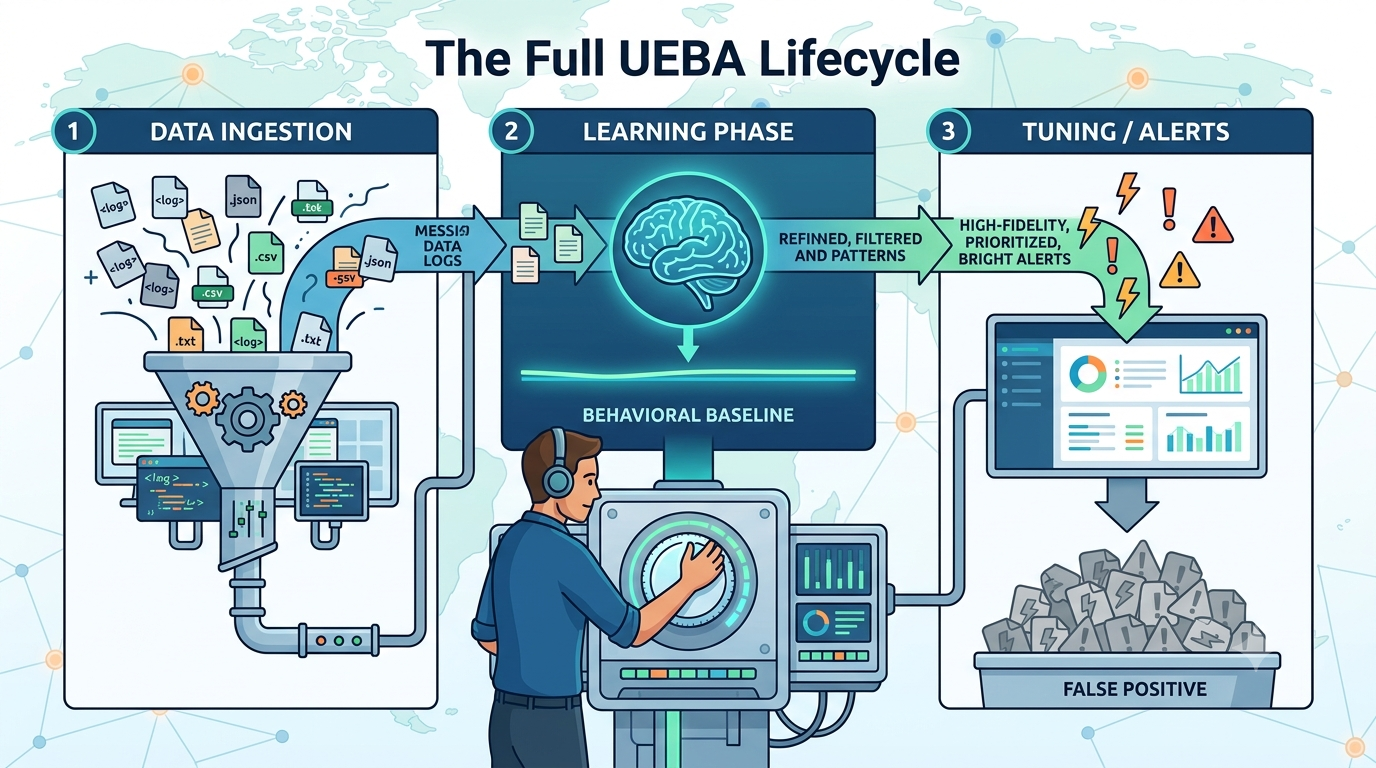
Deploying ueba deployment considerations tuning challenges feels like a promise of security clarity. But the gap between that promise and reality is filled with data pipelines, tuning headaches, and the risk of creating more noise, not less.
A successful UEBA deployment isn’t about installing software; it’s about engineering a behavioral monitoring system that learns your unique environment. Incorporating a robust Network Threat Detection strategy ensures you capture the right data early on. Keep reading.
What Lies Ahead: Core Pillars for Success
Before diving into the architecture, keep these foundational realities in mind to ensure your behavioral monitoring system delivers true security value without burning out your team:
- Success hinges on data quality and coverage, not just the algorithm. Garbage in, garbage out.
- The initial learning phase is critical; rushing it creates a broken baseline that flags everything as anomalous.
- Continuous tuning is not a failure, it’s the system working. It requires a dedicated feedback loop from analysts.
What’s the First, Most Critical Deployment Decision?
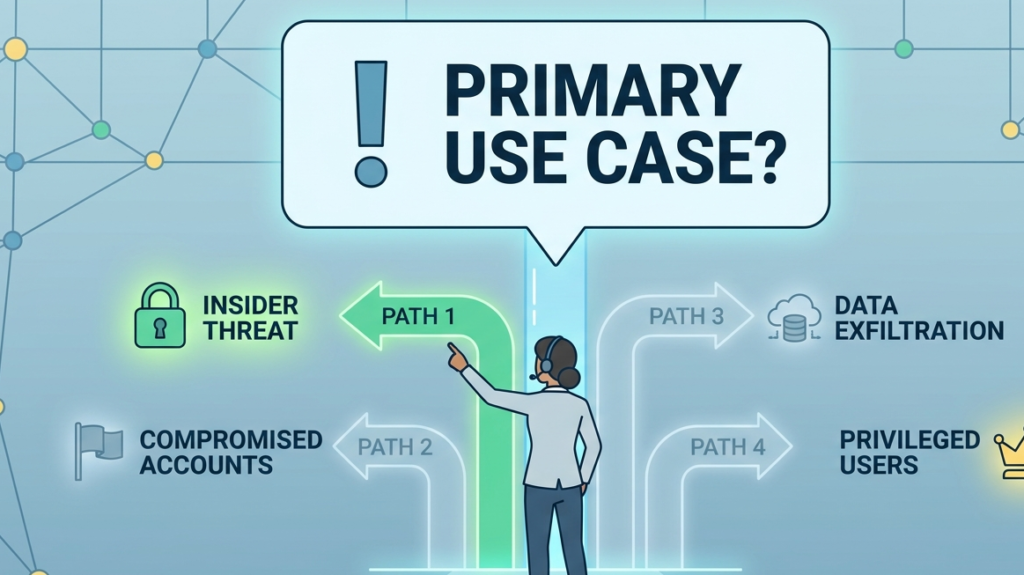
It’s not which vendor to choose. It’s deciding what you want the system to actually do. A UEBA can chase insider threat, detect compromised accounts, find data exfiltration, or monitor privileged users. Trying to do all of them at once, on day one, is a recipe for failure.
You must pick a primary use case. This focus dictates your data sources, your tuning priorities, and how you measure success. Mapping out your business goals against common ueba use cases keeps the roadmap realistic.
“UEBA is only as good as its data inputs. If critical systems, cloud applications, or endpoint agents are not feeding telemetry into the platform, blind spots persist. Organizations frequently underestimate integration scope before deployment.” – Cyberhaven
If it’s data loss, you need data access logs and network flow information. We’ve seen deployments stall because teams tried to boil the ocean. Start with one well-defined problem, solve it completely, and then expand. This focused approach makes the inevitable tuning manageable.
How Do You Avoid Garbage Data Crushing Your Models?
The most advanced machine learning model is worthless if you feed it incomplete or messy logs. UEBA builds a baseline of “normal.” If your data is spotty, its view of normal is distorted.
Consider time zones. If logs aren’t normalized to UTC, the system might think a user logging in at 9 AM EST and 9 AM PST are two different people, creating false anomalies. Missing fields are another killer. If 30% of your DHCP logs lack a hostname, the UEBA struggles to link IP addresses to specific machines over time.
The deployment phase must include a data audit and normalization project. You need consistent, parsed logs from your chosen priority data sources before the learning period even begins. This isn’t glamorous work, but it’s the foundation.
Why Is the “Learning Phase” So Misunderstood?
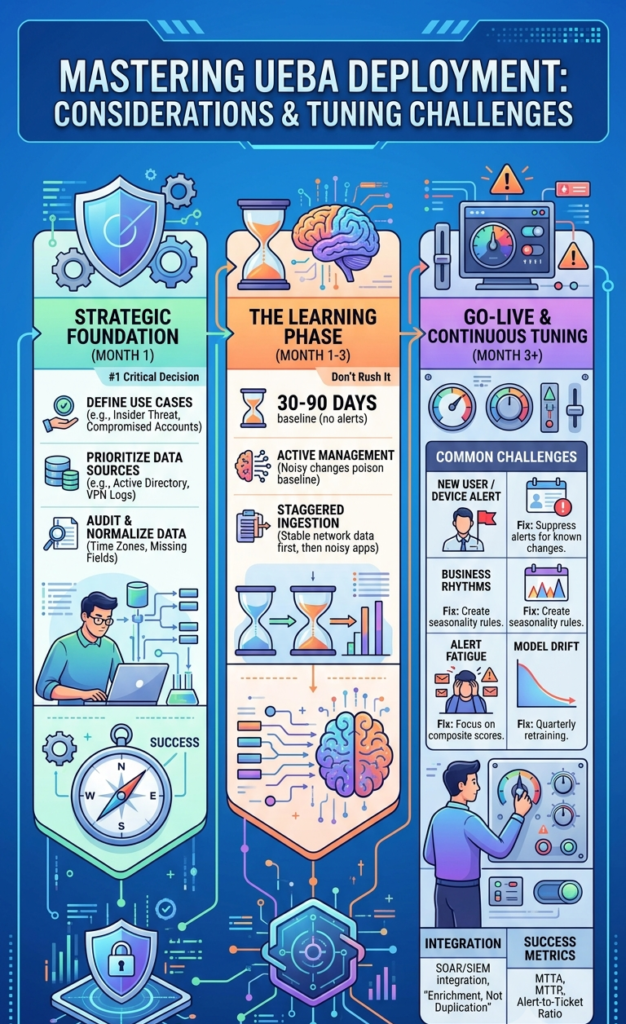
This is the period, typically 30 to 90 days, where the UEBA observes traffic without generating alerts to establish its behavioral baseline. The biggest mistake is to assume this is a passive, fire-and-forget process.
You must actively manage this phase. Is the data flowing consistently? Are major business changes happening, like a merger or a new application rollout, that would poison the baseline with “temporary” noise that becomes permanent? We often recommend a staggered approach.
Start the learning phase for your most stable data source first, frequently, this is Network Threat Detection data. Network behavior of servers and devices tends to be more consistent than human user behavior, providing a solid, initial baseline.
Then, layer in noisier data like user application logs. Phasing your deployment strategy helps build a more predictable baseline for your user and entity behavior analytics matrix, preventing the system from forming a chaotic, unusable model from day one.
What Are the Most Common Tuning Challenges After Go-Live?
The system goes live, and the alerts flood in. This is the make-or-break moment. The challenge isn’t the volume, it’s the type of alert.
The “Everything is New” Problem: After the learning phase, any new user, device, or application appears as an anomaly. You must tune the system to understand that “new” does not always equal “bad.” This often means creating rules to suppress alerts for known, planned changes like new hire onboarding cohorts.
The “Business Rhythm” Problem: Your finance team works crazy hours during quarter-close. Your retail website has predictable traffic spikes on weekends. The UEBA doesn’t know this unless you teach it. Tuning involves creating “seasonality” rules or feeding it business context calendars to adjust its expectations.
| Tuning Challenge | What It Looks Like | How to Address It |
| False Positives from Change | Alerts for every new server or employee. | Implement change management integration or scheduled whitelisting. |
| Ignoring Real Threats | Missing slow, low-and-slow attacks that blend in. | Adjust sensitivity scores for privileged users and critical assets. |
| Alert Fatigue | Hundreds of low-risk anomalies daily. | Raise the risk score threshold for alert generation and focus on composite scores. |
| Model Drift | Alerts decay in accuracy over months as business changes. | Establish a quarterly review and model retraining cycle. |
How Do You Integrate UEBA Without Breaking Analyst Workflow?
A UEBA that lives in its own console is a dead UEBA. The alerts must feed into the analysts’ primary workspace, usually the SIEM or SOAR platform. The tuning challenge here relies on seamlessly integrating ueba data for enrichment, not duplication.
“Lack of automation: many UEBA solutions lean heavily on security teams for implementation and tuning. Teams must manually update the frequency at which their detectors run or adjust the mean and standard deviation to improve accuracy, relying heavily on humans to keep them both accurate and efficient.” – Hunters Security
You shouldn’t create a separate “UEBA alert.” Instead, the UEBA should attach a behavioral risk score to existing log events in the SIEM. This turns a generic “User X accessed File Y” log into a “High-Risk Data Access by User X” alert.
The tuning involves setting the right thresholds: what risk score triggers a SIEM alert? What score just adds a notable tag? This requires close collaboration between the UEBA admin and the SOC analysts. They need to define together what constitutes “actionable.” It’s an iterative process of adjusting thresholds and reviewing alert quality weekly.
Can You Set and Forget a UEBA? The Model Drift Problem.
Credits: Databricks
A UEBA model is a snapshot of your business at the time of training. But businesses evolve. People change roles. New software is deployed. Work-from-home policies shift. If the model isn’t updated, its “normal” baseline becomes outdated, a problem called model drift.
The system will either alert on new, legitimate behaviors (false positives) or, worse, fail to alert on new attack patterns because they don’t deviate enough from the stale baseline. You cannot set and forget. Successful deployment includes a plan for continuous tuning and periodic retraining.
This can be monthly or quarterly. It involves feeding confirmed false positives and true positives back into the model as learning examples. It’s about having a dedicated resource, even if part-time, to shepherd the system’s evolution alongside the business.
What Does Success Actually Look Like? (Beyond the Dashboard)
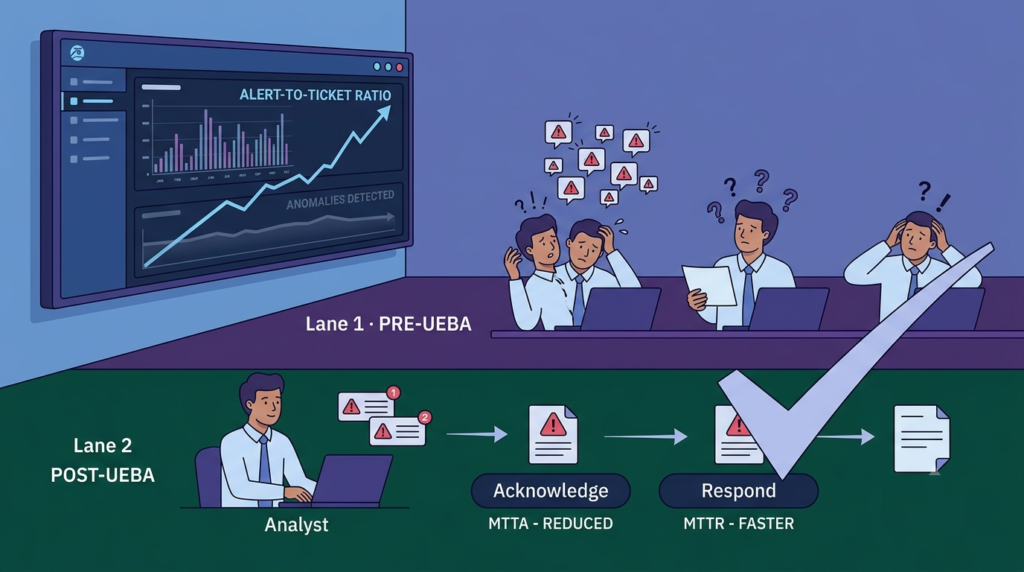
Vendor dashboards show pretty graphs of “anomalies detected.” Ignore those. Real success is measured in operational metrics for your security team.
- Mean Time to Acknowledge (MTTA): Does the enriched alert from the UEBA give enough context for an analyst to immediately understand the risk, reducing initial triage time?
- Mean Time to Respond (MTTR): Does the behavioral context, combined with other data, allow for faster, more accurate containment actions?
- Alert-to-Ticket Ratio: What percentage of UEBA-influenced alerts become formal incident tickets? This measures precision. The goal is a high ratio, proving the alerts are quality.
If your deployment doesn’t move these metrics within 3-6 months, your tuning isn’t done. The system should make your team faster and more precise, not give them more work.
FAQ
How long does a typical deployment and tuning process take?
Plan for 3-4 months for a focused use case. Month 1: Data preparation and initial learning. Month 2: Initial go-live and aggressive threshold tuning. Months 3-4: Refining integrations and establishing the feedback loop. It’s an ongoing process, not a one-time project.
Do we need a data scientist on staff to manage this?
Not necessarily. Modern UEBA platforms are designed for security analysts. The key need is not a PhD in ML, but a deep understanding of your own environment, your logs, and your business processes to provide the context for tuning.
What’s the biggest resource drain?
Ongoing analyst time for tuning and feedback. The system requires human judgment to label alerts as true/false positives. Budgeting 5-10 hours a week for a lead analyst to review and adjust is a common requirement for the first 6 months.
Can we outsource the tuning and management?
Yes, many Managed Detection and Response (MDR) services offer UEBA management. The trade-off is they may lack deep context about your specific business rhythms. A hybrid model, where internal staff handle business-context tuning and the MDR handles model health, can be effective.
The Long Game of Behavioral Monitoring
Deploying UEBA is not a project with an end date; it is the establishment of a continuous behavioral monitoring and tuning discipline. These challenges are simply features of a system that must adapt as fast as your business does. Success comes from treating it like a living system that needs quality data, focused use cases, and an unwavering feedback loop.
To proactively defend your network and eliminate blind spots, explore Network Threat Detection for real-time threat modeling, automated risk analysis, and visual attack path simulations.
References
- https://www.cyberhaven.com/infosec-essentials/what-is-ueba?utm_source=cyberhaven.com&utm_medium=direct#how-does-a-ueba-work
- https://www.hunters.security/en/blog/mulit-context-ueba-time-series