
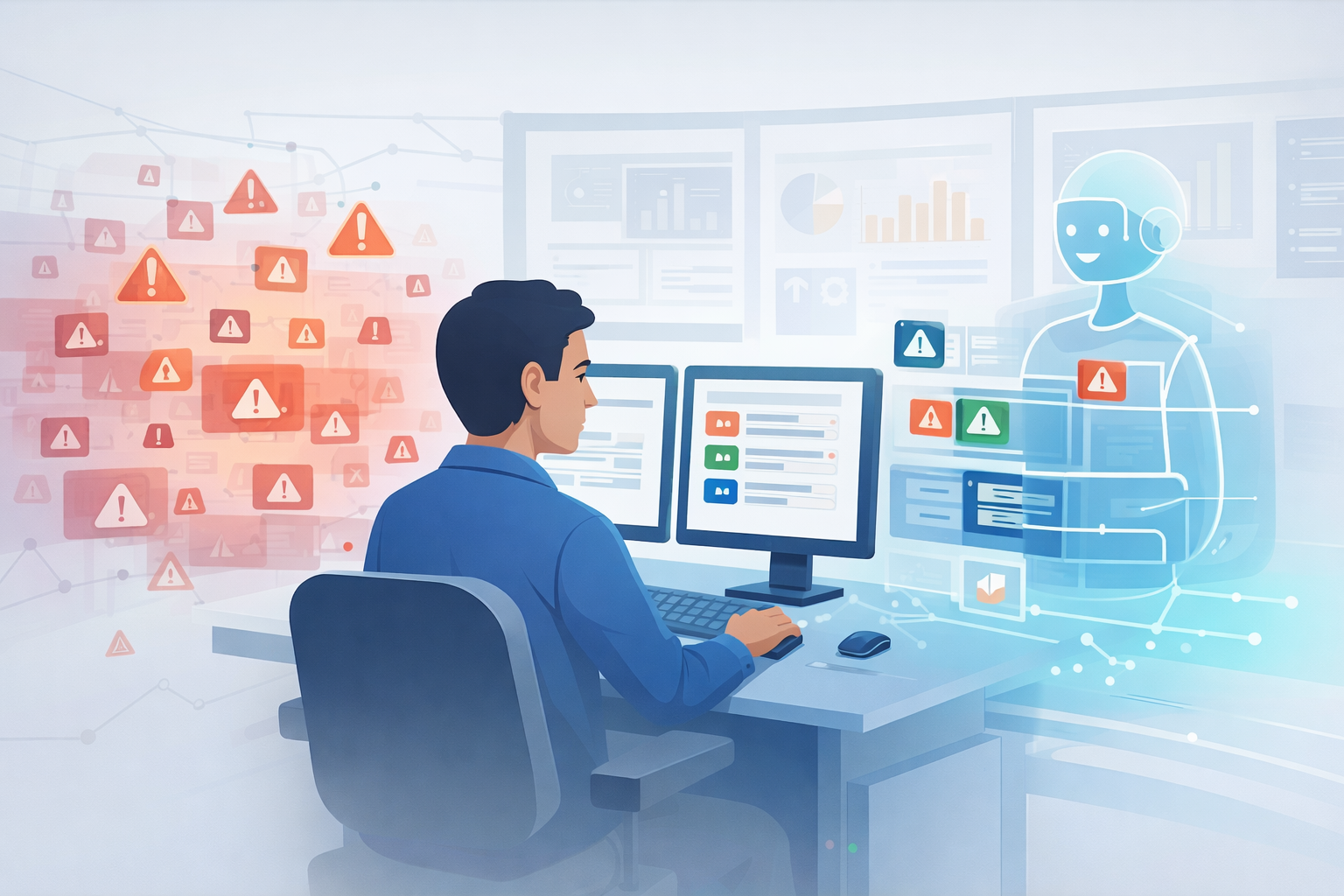
AI in the SOC isn’t science fiction, it’s a practical way to cut through chaos and focus on real threats. In a modern Security Operations Center, analysts face floods of alerts, tight deadlines, and constant pressure to be right.
AI doesn’t step in to replace them, it works alongside them, filtering noise, surfacing high-risk activity, and adding useful context to every decision.
Investigations finish faster, mistakes drop, and specialists get more time for deeper, strategic work. This is what cyber defense looks like when humans and machines share the load, keep reading to see how that shift actually works in practice.
Key Takeaways
- AI automates alert triage, dramatically reducing analyst fatigue.
- It enriches data with context, speeding up and improving investigations.
- The human-AI team combines machine speed with human intuition for better outcomes.
The Overwhelming Tide of Alerts

Imagine a firehose of information, constantly spraying. That’s the modern SOC. Thousands of alerts flow in every day from firewalls, endpoints, and cloud services.
The sheer volume is paralyzing. Analysts suffer from alert fatigue, a state where constant exposure to mostly meaningless notifications leads to missed critical threats.
It’s like trying to find a single whispered conversation in a roaring stadium. Manual investigation of each alert is simply impossible. The system is set up to fail before the first real threat even appears.
This isn’t just an inconvenience, it’s a strategic vulnerability. Studies consistently show that without assistance, manual investigations are slow and prone to human error, especially under pressure e.g., averaging 105 min vs. 58 min with AI [1].
The average time to detect a breach stretches on, giving attackers more time to cause damage. The security team is stuck in a reactive loop, always cleaning up messes instead of preventing them. They’re fighting the last war, not the next one. Something has to change.
- Volume: SOCs process thousands to 10,000+ alerts daily.
- Fatigue: Constant noise leads to critical oversights.
- Speed: Manual processes are too slow for modern threats.
How AI Cuts Through the Static
Credits: Parasoft
This is where real augmentation begins. AI-powered alert triage behaves less like a simple filter and more like a colleague that actually understands the network.
It doesn’t just tally alerts, it interprets them. Using machine learning cybersecurity techniques, these systems learn what “normal” looks like for your specific environment.
Over time, they recognize routine behavior: a standard software patch, a scheduled backup, an employee accessing a well-known internal tool.
Those lower-risk events can be pushed aside. What remains is sorted and ranked. The AI scores alerts by severity, possible business impact, and how closely they match known threat patterns or suspicious behaviors.
That means the first question, “What deserves my attention right now?”, already has a working answer before an analyst even logs in.
The analyst’s day no longer begins with a wall of raw noise. Instead, they see a curated, prioritized queue. The system has already:
- Suppressed or lowered the rank of obvious false positives
- Grouped related alerts into a single, richer incident
- Highlighted the alerts with clear indicators of compromise
- Flagged unusual behavior tied to high-value assets
This change sounds simple, but it shifts the whole posture of the team. Instead of burning hours chasing dead ends, analysts can focus on the alerts with real teeth.
That’s how people move from feeling like reactive firefighters to acting more like hunters. The AI takes the first pass, doing the kind of repetitive screening that humans are both too valuable and too exhausted to maintain at scale.
Behind that prioritization, the algorithms are weighing several data points at once. They examine where the alert came from, which systems are involved, and how it compares to historical activity across the network. Context becomes the core of the decision:
- An alert from a critical database server with regulated data gets higher priority than one from a lab workstation
- Repeated unusual access attempts against a key application stand out more than a one-off anomaly on a low-risk device
- Activity that lines up with past incident patterns or threat intelligence feeds gets flagged faster
This layered context is what makes AI augmentation feel different from a basic rules engine. It’s not only faster, it’s more selective.
The result is that analysts aren’t staring at a blur of indistinguishable events. They open their console with a head start: a structured view, a preliminary risk assessment, and clearer guidance on what to tackle first instead of a flat, confusing feed of alerts.
| Aspect | Traditional SOC Workflow | AI-Augmented SOC Workflow |
| Alert Volume Handling | Analysts manually review large alert queues | Automated alert triage reduces noise early |
| Prioritization Method | Static rules and manual judgment | AI threat prioritization with risk scoring |
| False Positives | High volume, time-consuming to dismiss | Suppressed or deprioritized automatically |
| Analyst Focus | Reactive alert chasing | Focused on high-risk, high-impact alerts |
| Decision Speed | Slow, dependent on human availability | Faster, consistent prioritization |
Giving Data a Voice and a Story

A security alert on its own is usually just a blip. It flashes once, then disappears into the scroll. An AI augmented system changes that by turning the blip into a story you can actually follow. That process is called deep learning for network security data enrichment.
When a potential threat pops up, the AI doesn’t simply open a ticket and walk away. It starts pulling in related data from across your stack, your SIEM, your endpoint detection tools, identity systems, and external threat intel feeds. While the analyst is still reading the alert title, the system is already:
- Running IOC lookups against known bad IPs, domains, and file hashes
- Checking for behavioral anomalies tied to that user, host, or service
- Building a timeline that shows what happened before, during, and after the alert
- Tagging assets with business context (critical system, test box, executive laptop, etc.)
The result is that an alert stops being an isolated event. It becomes part of a narrative: who did what, where it happened, when it started, and how it connects to other activity.
That narrative is where the meaning lives. A single login from a foreign country might look like a minor curiosity on its own.
But when the AI instantly correlates it with that same user pulling down large volumes of data a few minutes earlier, the risk level changes. The system doesn’t just say, “Here’s an alert.” It quietly answers, “Here’s why this matters more than the others.”
This kind of enrichment has a very practical effect on the workday. Investigation time drops sharply, because the analyst isn’t forced to:
- Pivot across four or five tools just to confirm basic facts
- Manually assemble timestamps into a coherent sequence
- Re-run the same types of lookups for every new alert
Instead, they open a case and see a consolidated, structured view of the incident. Studies and field reports show that investigations built on this model can finish 45 to 61 percent faster, which is a polite way of saying people get hours of their day back.
The same machinery that enriches alerts also supports proactive threat hunting. By scanning large volumes of historical data, the AI can highlight anomalies that don’t fit cleanly into known rule sets, the kind of slow-burn activity that hides under “normal” noise. It can:
- Surface rare but recurring behaviors tied to specific accounts or hosts
- Link a small, odd event from weeks ago to a fresh indicator from threat intel
- Suggest related log sources or entities that deserve a closer look
The human analyst still leads the hunt, asking the questions and deciding what matters. But the AI works like a tireless research assistant, sorting through terabytes of logs, pointing out odd connections, and keeping track of patterns across time.
When that partnership clicks, the security team moves from just blocking obvious attacks to practicing a more watchful, informed kind of defense.
The Unwavering Digital Partner

Human performance rises and falls. Fatigue, incident fatigue, meetings, or even a late-night shift can drag down attention.
AI systems don’t feel any of that. One of their real strengths is how steady they are. An AI engine will triage and enrich alerts at 3 AM with the same pace and care it has at 3 PM. This is a core benefit of applying machine learning cybersecurity to SOC operations.
That consistency keeps investigation quality from dipping just because the day has been long or the queue is overflowing. For analysts, that stable baseline becomes a kind of anchor. They can trust that:
- The same rules and models are applied every time
- Low-quality alerts are filtered with a consistent standard
- Obvious red flags won’t be missed just because everyone’s tired
That reliability makes the AI’s first pass feel less like a black box and more like a dependable teammate. The analyst walks in already knowing the initial sort will be thorough and free from stress, boredom, or bias.
As people work with these systems, their opinion shifts. In surveys, more than 94 percent of analysts say they view AI more positively after using it in real workflows.
A big part of that change comes from explainable AI. The stronger platforms don’t just say, “High risk.” They also walk you through the reasoning, in plain language. For example:
- “This alert is high risk because the source IP is tied to a known botnet.”
- “The accessed file is tagged as critical intellectual property.”
- “The access pattern matches a known data exfiltration technique.”
When the system shows its logic, the analyst can quickly judge whether it aligns with the environment they know. That transparency turns the AI’s output into something you can question, confirm, or correct, instead of something you’re expected to accept blindly.
That corrective step matters. Every time an analyst overrides or adjusts an AI recommendation, they’re teaching the model how their organization actually works. Over time, the system learns:
- Which alerts this team always treats as high priority
- Which hosts or apps are noisy but low risk
- Which behaviors are normal for a specific user, team, or business unit
This back-and-forth creates a feedback loop. Human judgment sharpens the machine’s understanding, and the machine’s pattern recognition supports human judgment.
The result isn’t a static tool that behaves the same on day one and day one hundred. It’s a digital partner that steadily adapts to the quirks and realities of the environment, growing more aligned with the security team each time they interact.
A Glimpse at the Next Generation SOC

The future of this collaboration is even more integrated. Emerging conversational AI agents are integrating into SOCs.
Imagine an analyst asking a natural language question: “Show me all login attempts for this user account in the last 48 hours and correlate them with file access logs.
“The AI agent understands the request, executes the complex query across multiple data sources, and presents the results in a clear, summarized format. This interaction feels less like using software and more like consulting an expert colleague [2].
These agents will also play a key role in training and preparedness. They can simulate sophisticated attacks, creating realistic training scenarios for analysts to practice their response.
This is hands-on learning in a safe environment. The AI can mimic the tactics of specific threat actors, allowing the team to hone their skills against the very threats they are most likely to face. It turns the SOC into a continuous learning lab, constantly raising the team’s level of readiness.
The ultimate goal is a seamless human-AI synergy. The machine handles the scale, speed, and data-crunching. The human provides the strategic oversight, the business context, and the final judgment call on complex, edge-case scenarios.
AI augments security analysts by being the force multiplier that every overworked team needs. It doesn’t aim to replace the expert, but to make them a super-expert, capable of defending against threats with unprecedented speed and insight.
The Augmented Analyst’s New Reality
The shift is already happening. The role of the security analyst is evolving from a fatigued alert-chaser to a strategic threat hunter. AI augmentation is the catalyst.
It takes the overwhelming parts of the job, the triage, the data gathering, the initial correlation, and automates them with relentless efficiency. This frees the analyst to do what humans do best: think critically, understand business risk, and make nuanced decisions.
The partnership creates a defense that is both faster and more intelligent. The machine handles the volume, the human provides the wisdom.
For any security team drowning in alerts, the path forward isn’t about working harder. It’s about working smarter, with a capable AI partner by your side. Start exploring how these tools can integrate into your workflow today.
FAQ
How does AI augmentation change daily decision-making for security analysts?
AI security analyst augmentation improves daily decisions by supporting analysts with clear data and ranked alerts.
In human-in-the-loop cybersecurity, analysts stay in control while using analyst decision support systems. These systems apply AI threat prioritization, AI-driven risk scoring, and intelligent alert prioritization.
Explainable AI for analysts and trusted AI security systems help analysts understand why alerts matter and act with confidence.
What skills do analysts need to work with AI in a modern SOC?
AI-assisted SOC operations require analysts to understand machine learning security analytics and behavioral analytics AI security.
In an augmented security operations center, analysts use machine learning SOC tools, analyst-centric AI tools, and cognitive cybersecurity systems.
These skills help teams interpret AI-powered anomaly detection results and collaborate effectively in a human-AI defense model.
How do teams measure success when using AI to support analysts?
Teams measure success by tracking SOC efficiency optimization and security analyst productivity AI. Key indicators include faster AI-driven incident response, fewer false positives from automated alert triage, and improved AI-enhanced investigation speed.
AI-powered security dashboards, AI-enhanced security visibility, and AI-driven situational awareness show whether SOC automation with AI improves daily operations.
What limits should organizations set when deploying AI for security analysis?
Organizations must define clear limits for analyst workflow automation. Analysts should review outputs from AI-powered security decisioning, AI security orchestration support, and AI-assisted remediation guidance.
Human oversight prevents blind reliance on AI correlation engines, automated threat correlation, and adaptive security analytics, ensuring analysts validate actions before execution.
How does AI support deeper investigations without replacing human judgment?
AI-powered threat analysis supports investigations through AI-assisted malware analysis, AI-supported forensics, and AI-assisted root cause analysis.
AI for security context enrichment and contextual threat intelligence AI provide background and timelines. Proactive threat detection AI and AI-enhanced threat hunting run within a security operations AI platform to assist analysts, not replace their judgment.
From Alert Fatigue to Augmented Insight
AI-driven augmentation marks a turning point for modern security teams. By absorbing alert overload, enriching context, and maintaining consistent analysis, AI allows analysts to reclaim focus and judgment.
The result is not automation for its own sake, but clarity at scale. When machines handle volume and humans guide decisions, security shifts from constant reaction to informed anticipation.
This partnership defines the future of resilient, effective cyber defense, ready to elevate your team’s capabilities? Join the movement and learn more here.
References
- https://blog.purestorage.com/perspectives/why-socs-must-embrace-ai/
- https://swimlane.com/blog/ai-soc/