
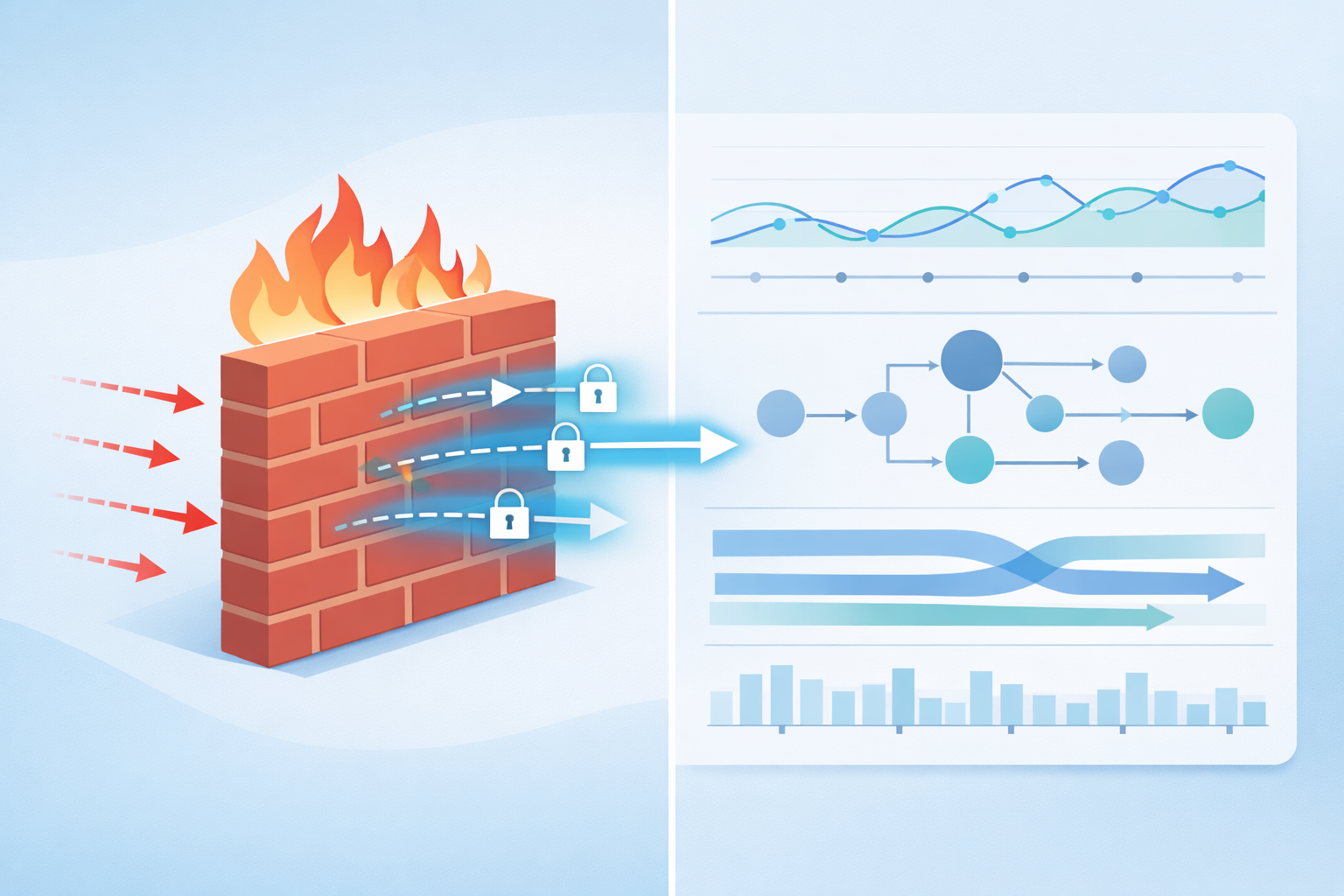
Flow data analysis strengthens network security by turning traffic patterns into clear, usable intelligence, instead of just relying on taller walls and stricter gates.
When you read those patterns well, you start to see your network as a living system: who’s talking to whom, from where, and how often.
It’s less about cracking open every packet, and more about watching the rhythm and spotting the off-beat. That’s how you catch the “wrong-way driver” on a busy, encrypted highway. If you want to turn that raw metadata into real defensive power, keep reading.
Key Takeaways
- Flow data provides critical visibility into encrypted traffic and scales to monitor high-speed networks where other tools fail.
- The real power lies in establishing a behavioral baseline; you can’t spot an anomaly if you don’t know what normal looks like.
- Automated analysis, especially with machine learning, transforms raw flow records into prioritized alerts, cutting through the noise of modern network traffic.
The Silent Language of Your Network
You stand in front of a router and watch the small green lights flicker in rhythm. It looks calm, almost reassuring.
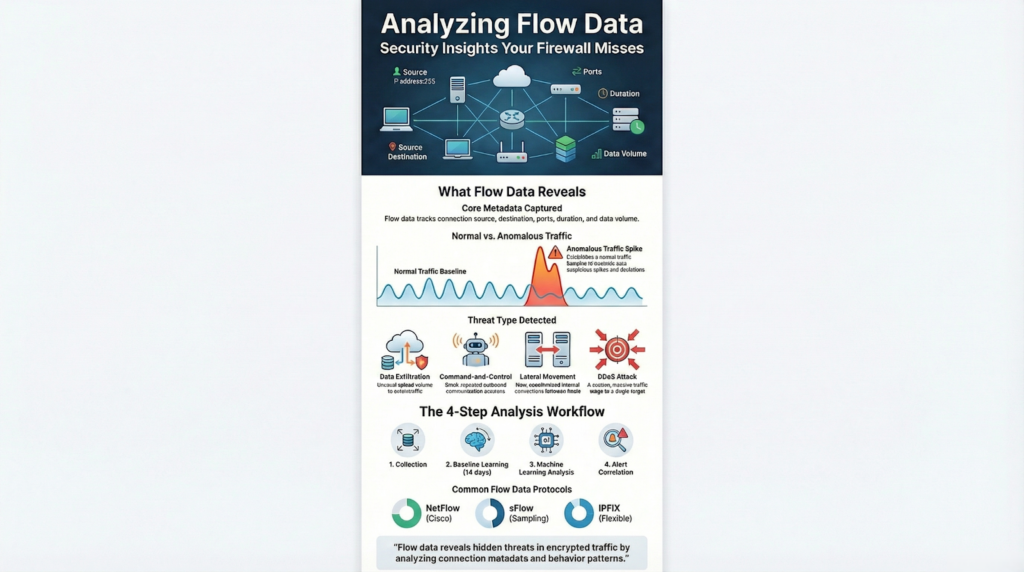
Data is moving, the network is alive, but the lights don’t tell you what’s actually happening. Flow data fills that gap. It turns hidden conversations into something readable without capturing message content. Instead, it records metadata such as:
- Source and destination
- Ports
- Duration
- Data volume [1]
Many teams overlook this because deep packet inspection feels “louder,” but it’s heavier to scale. Flow data keeps the signal and trims the noise.
Think of viewing a city intersection from above. You don’t hear conversations, but you see rhythms, commutes, spikes, slowdowns, and the outliers that stand out.
Flow-based security works the same way. It watches who talks to whom, when, and how much. Over time, you learn the normal routes. Then unusual flows, like large data transfers to an unknown IP or new services talking at odd hours, become visible fast. That’s the silent language of your network becoming clear through motion, rhythm, and routes.
Why Your Security Stack Needs Flow Analysis
Deep packet inspection has its place. It’s the detective that opens the envelope and reads the letter. But on a modern network, there are simply too many envelopes, and most of them are sealed with encryption anyway.
The detective spends all day staring at wax seals. Flow analysis is different. It’s the postal clerk who notes the sender, the recipient, the weight, and the frequency of mail.
This is why comprehensive network monitoring using protocols like NetFlow, sFlow, or IPFIX is essential to gain actionable insights without overwhelming your systems. Sometimes, that tells you everything you need to know.
A server that normally sends 50 MB of data daily to a backup system suddenly pushes 2 TB to an unfamiliar IP in a foreign country.
The content of those packets might be encrypted, unreadable. But the metadata screams. That’s a security insight you can act on immediately.
This approach is inherently scalable. It’s why large cloud providers and enterprises rely on it. They can’t possibly inspect every packet at line rate, but they can certainly analyze every flow record.
- It sees what DPI misses in encrypted traffic tunnels.
- It operates at the speed of your core network without crippling hardware.
- It provides a historical record for forensic analysis after an incident.
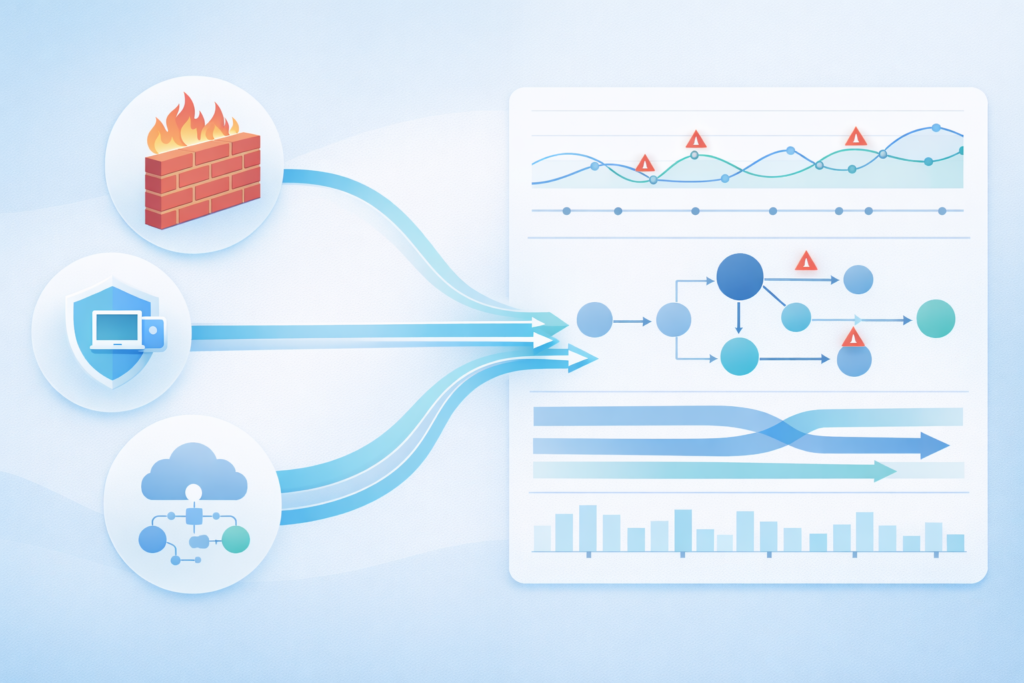
The goal isn’t to replace your other tools. It’s to give them context. A SIEM alert is just a line in a log. A SIEM alert correlated with a flow record showing a massive data transfer from the alerted device, that’s a story. That’s a ticket for the security team with a priority already attached.
NetFlow, sFlow, IPFIX: Choosing Your Protocol
Credits: Internet Infrastructure Explained
The world of flow data runs on a few key protocols. It can feel like alphabet soup. NetFlow, sFlow, IPFIX. They all accomplish a similar goal, exporting metadata from network devices to a collector.
But their approaches differ, shaped by the problems they were originally designed to solve. Picking the right one isn’t about finding the “best,” but the best fit for your specific environment.
NetFlow is the old guard, a Cisco creation that became a de facto standard. It’s rich, providing a detailed account of each conversation. If you’re in a predominantly Cisco shop, it’s often the path of least resistance. sFlow takes a statistical sampling approach.
It doesn’t try to catch every single flow. Instead, it samples packets at a defined rate, giving you a representative picture with minimal performance impact on high-speed switches.
IPFIX is the IETF-standardized evolution of NetFlow v9, offering vendor-neutral extensibility with custom fields like TCP flags. Here’s a quick breakdown:
- NetFlow: Best for Cisco-heavy networks where depth of data is critical.
- sFlow: Ideal for high-speed environments where low CPU overhead is a priority.
- IPFIX: The flexible choice for multi-vendor setups needing custom telemetry.
You configure your routers, switches, and firewalls to export these records to a central collector. This collector becomes the brain, the repository of all these conversations.
It’s where the raw data becomes something you can query, visualize, and alert on. The setup is often simpler than people think, a few command lines on a network device pointing to an IP address. The magic happens after the data arrives.
The Hidden Threats in Plain Traffic
So what are you looking for. The threats aren’t labeled. They hide in the noise. Data exfiltration, for instance, rarely looks like a dramatic heist. It looks like a slightly elevated trickle over time, or data disguised as normal outbound web traffic.
By establishing a baseline of what a user or server typically sends, a flow analysis system can flag the deviation. However, understanding the limitations of network flow data is key to setting realistic expectations about what flow analysis can and cannot reveal in complex network environments.
Was that 15 GB upload to a cloud storage provider part of a scheduled backup, or is it the finance department’s files heading out the door. The flow record shows the volume, destination, and timing. The security analyst connects the dots.
Command-and-control traffic is even stealthier. It’s the patient signal. A compromised host checking in with its controller might generate a tiny, brief flow every few minutes.
Individually, each flow is insignificant. But over time, the pattern of persistent, low-volume communication with an unknown external IP stands out against the backdrop of normal, varied web browsing.
DDoS attacks are the opposite, a flood that tries to overwhelm. Here, flow data shows the sheer scale, the millions of synchronized requests from disparate sources converging on a single target IP or port. The packet rate graph doesn’t just go up, it goes vertical.
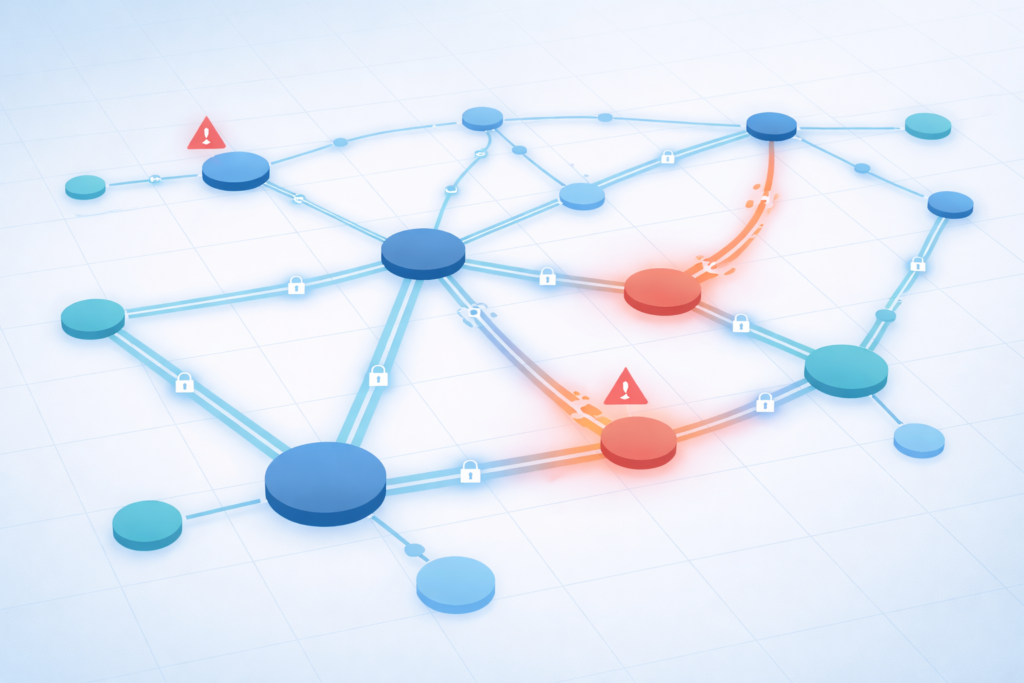
Lateral movement inside a breached network has its own signature. After an attacker gets a foothold on one machine, they probe others.
This creates a surge in east-west traffic, internal flows between devices that don’t normally talk, or talk on ports that are usually quiet. A web server suddenly initiating hundreds of connections to other servers on port 445 (SMB) is a massive red flag.
Flow data maps this internal movement, revealing the attacker’s path across your network in a way perimeter logs never could.
| Threat Type | Flow Data Indicator | Security Value |
| Data Exfiltration | Unusual upload volume to external IPs | Helps detect stolen data movement |
| Command-and-Control Traffic | Small, repeated outbound sessions | Reveals persistent attacker beacons |
| DDoS Activity | Sudden traffic surge to single target | Identifies coordinated attack traffic |
| Lateral Movement | New internal connections between hosts | Shows attackers moving inside the network |
| Suspicious Remote Access | Unexpected VPN or admin traffic | Flags unauthorized access attempts |
A Practical Workflow: From Data to Action
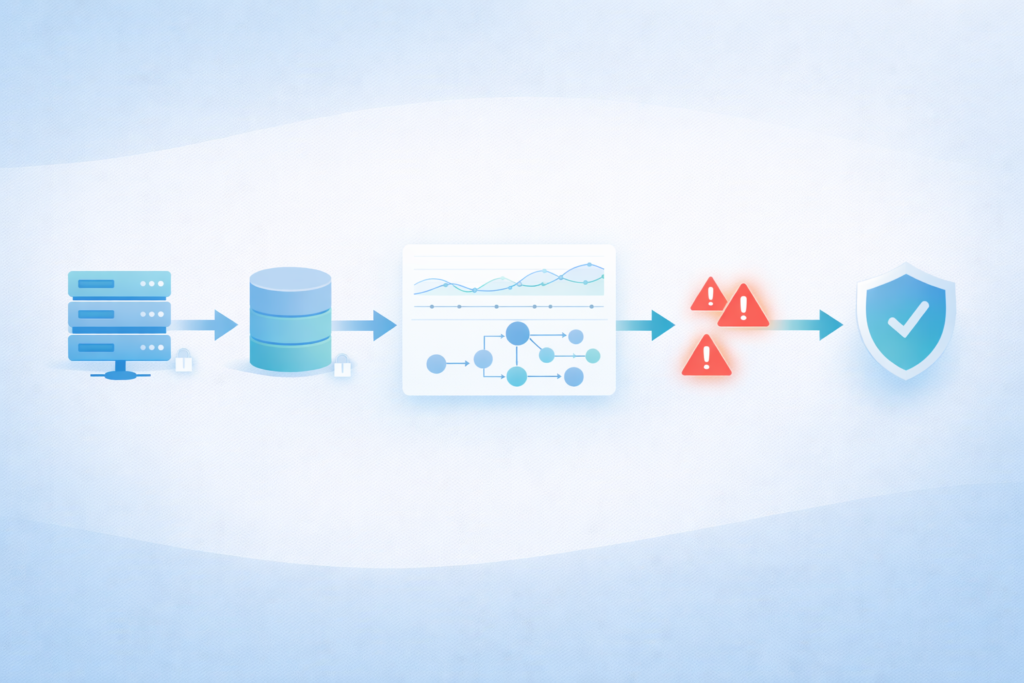
Theory is one thing. Practice is another. How do you actually do this without drowning in data. A structured workflow turns the firehose into a guided stream. It starts, obviously, with collection. You’ve configured your exporters.
The data is flowing to your collector, a piece of software running on a server. Maybe it’s a commercial product, maybe it’s an open-source stack like Elasticsearch, Logstash, and Kibana (ELK).
This process perfectly illustrates the power of network flow analysis, where NetFlow and related protocols export critical metadata that fuels deeper security and operational insights.. The platform matters less than the process you build around it.
The next step is the most critical, and the most often rushed. You have to establish a baseline. You watch. For at least two weeks, you simply collect.
You learn the rhythm of Monday morning, the lunchtime lull, the batch jobs that run at 2 AM. This period defines “normal.” Any good system will let you set dynamic thresholds based on this learning.
Alerts shouldn’t fire for a 10% increase in traffic at 9 AM on a weekday. They should fire for a 500% increase to a new geographic region at 3 AM.
- Let the system learn for a minimum of 14 days.
- Define “normal” per device, per subnet, even per application.
- Use rolling baselines that adapt to organic business growth.
Then comes the analysis layer. This is where machine learning models, even simple ones, earn their keep. They can score anomalies, not just flag them.
A slight deviation in a low-risk server’s traffic might score a 2 out of 10. A massive data transfer from your domain controller to an IP in a known bad neighborhood scores a 95.
This triage is everything for a Security Operations Center. It fights alert fatigue. The final step is correlation. A flow anomaly is powerful.
That same anomaly, linked to a suspicious login from the SIEM and a malware alert from an endpoint tool, is a confirmed incident. Flow data becomes the connective tissue.
Beyond Detection: Compliance and Clarity
The impact of this kind of analysis doesn’t stop at the security team’s door. It sharpens how the whole organization sees its own network, almost like finally turning the lights on in a room you’ve been walking through for years.
For compliance teams, it can feel like a relief. Regulations such as GDPR and PCI DSS expect you to know exactly where sensitive data lives and how it travels [2].
A flow data map gives you that view in concrete terms, not guesses. With those maps in place, you can:
- Show that credit card data moves only from the payment servers to the secured archive.
- Confirm that it doesn’t pass through unapproved systems or locations.
- Produce records that prove this when an auditor asks.
You’re not just saying “we think this is what happens.” You have evidence. Logs. Paths. Regular reviews go far beyond ticking a compliance box. They tighten real security. When you walk through the flows on a schedule, patterns appear. You might:
- Spot “shadow IT.”
- Notice unexpected service connections.
- Catch legacy data paths still running.
The map becomes your reality check. Over time, the network shifts from a maze into a place you truly understand.
Learning to Listen
The network is always talking. It tells you about performance issues, misconfigurations, and user behavior.
But for security, it whispers about intrusions, exfiltration, and latent threats. Analyzing flow data is the practice of listening to those whispers.
You start by collecting the simple records of connection and volume. You learn the unique language of your own environment. Then you automate the listening for anything that breaks the established rhythm. It’s not about having a perfect, impregnable fortress.
That’s a fantasy. It’s about having such a clear understanding of your own terrain that the moment an adversary steps into it, they stand out. They create a ripple in the flow. And you’ll be watching. Start by enabling flow export on one critical network segment this week. See what it tells you.
FAQ
How does analyzing flow data security insights improve network visibility?
Analyzing flow data security insights improves network visibility by showing how devices communicate in real time. Using network flow analysis, network telemetry, and application traffic visibility, you can understand traffic pattern analysis instead of guessing.
This supports intrusion detection, behavioral analytics, and incident response analytics, so you can detect unusual activity early and respond before security issues cause real operational or business impact.
What security risks can flow data monitoring detect before major damage occurs?
Flow data monitoring detects real threats early by highlighting suspicious deviations from normal behavior.
With anomaly detection, network threat hunting, and suspicious flow detection, you can identify botnet detection signals, data exfiltration detection attempts, and unusual remote access monitoring.
It also enables lateral movement analysis and east west traffic visibility, helping you detect attackers moving internally before they reach sensitive systems or valuable business data.
Why is encrypted traffic analysis valuable when packet contents remain unreadable?
Encrypted traffic analysis remains valuable because packet flow analytics and metadata analysis reveal communication behavior without exposing content. You can review who connects, when traffic occurs, and how much data moves.
Traffic baselining, anomaly scoring, and adaptive threat detection highlight unusual behavior. This supports cybersecurity analytics, automated threat detection, and security operations analytics while maintaining privacy and avoiding risks associated with decrypting user traffic.
How does machine learning improve flow based security and anomaly detection accuracy?
Machine learning improves flow based security by learning normal traffic behavior over time. It supports network anomaly modeling, predictive security analytics, and automated threat detection through continuous analysis of flow record aggregation.
These systems produce high fidelity alerts instead of false positives. They also improve security event correlation and breach detection signals, helping teams strengthen security posture assessment and respond faster with accurate threat intelligence.
Can flow data support compliance, investigations, and long-term cybersecurity analytics?
Flow data strongly supports compliance and long-term cybersecurity analytics. Continuous security monitoring insights and real time monitoring create a reliable network audit trail.
With SIEM correlation, protocol usage analysis, network log analytics, and network compliance reporting, organizations maintain clear proof of security controls.
Flow based security also improves threat surface analysis and endpoint traffic correlation, supporting data driven security and informed risk management decisions over time.
From Traffic to Insight: Turning Flow Data Into Real Security Advantage
Flow data turns your network from a blur of traffic into a readable storyline. By mapping normal behavior and highlighting anomalies, it exposes risks that firewalls and DPI alone can’t see, especially in encrypted environments.
This isn’t about replacing tools, but empowering them with context. When you understand the rhythm of your network, threats no longer hide in plain sight. You gain clarity, faster detection, and the confidence that your defenses are finally listening. Ready to take the next step? Join here.
References
- https://www.ibm.com/docs/en/qradar-on-cloud?topic=monitoring-network-flow-data
- https://www.fortra.com/blog/top-benefits-network-monitoring