
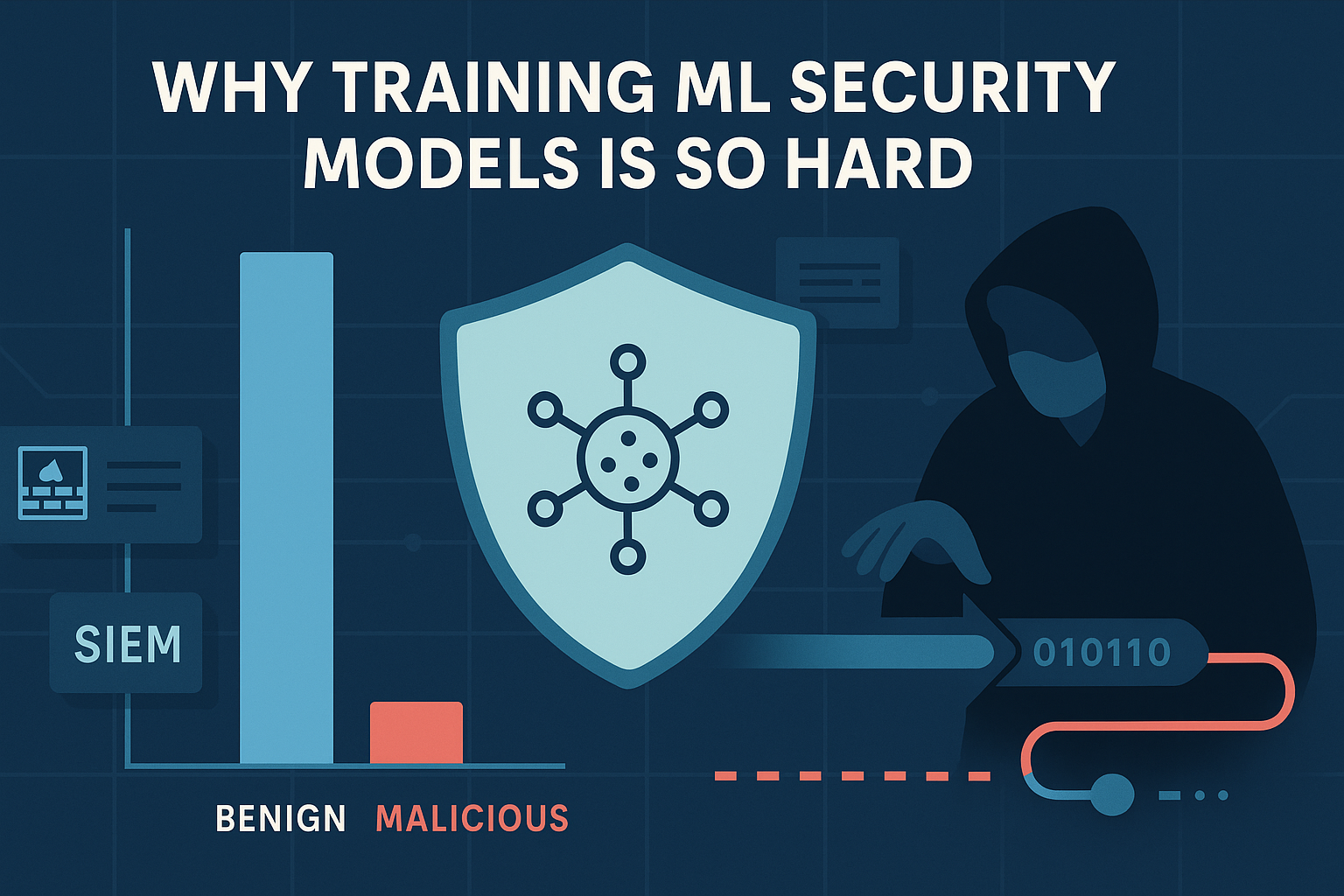
Machine learning in cybersecurity is hard because the “bad” data you actually care about is rare, messy, and constantly changing.
Models must detect rare attacks amid vast benign logs, while attackers work every day to confuse or poison those same models.
On top of that, security datasets are imbalanced, labels are noisy, and many models act like black boxes, which makes trust and explainability a real problem.
When you zoom out, building an AI defender isn’t just clever math, it’s a fight against a moving target, so keep reading to see what it really takes.
Key Takeaways
- Quality security data is incredibly scarce, imbalanced, and often noisy.
- Adversaries actively poison data and craft attacks to evade detection.
- Deploying models requires constant updates to combat concept drift.
The Data Desert: Finding Enough Good Threats
Imagine trying to learn a language by only hearing a few words a year. That’s what training an ML security model is like.
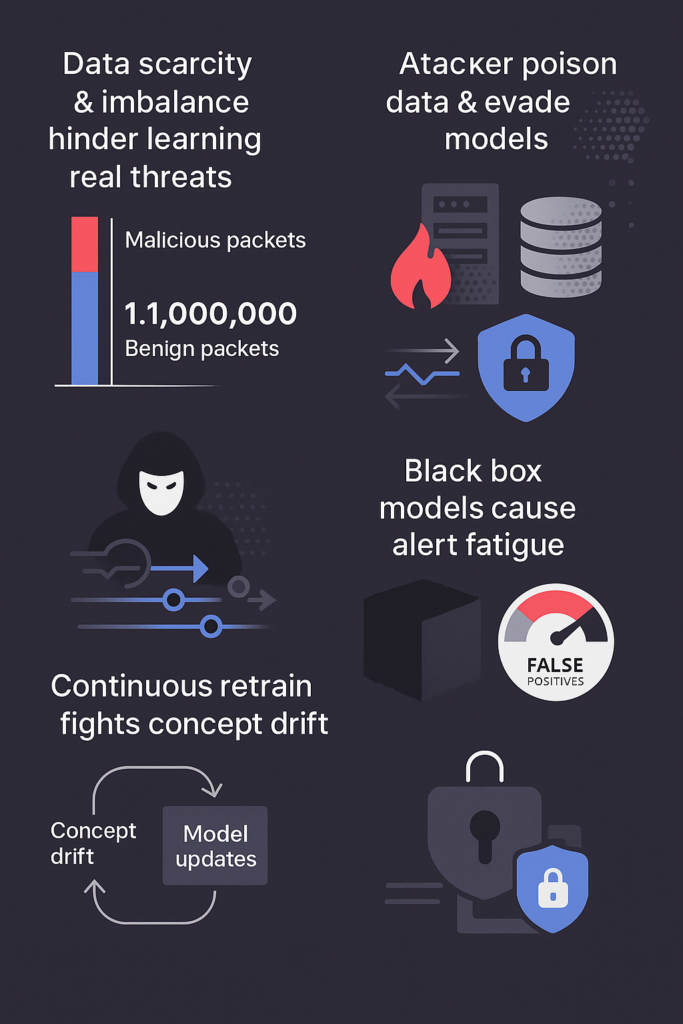
Real-world attack data is precious and hard to come by. Companies are hesitant to share logs full of sensitive information, and novel attacks, like zero-days, have no historical examples to learn from.
What data does exist is wildly imbalanced. For every one malicious packet, there might be a million legitimate ones up to 1:1M in network traffic datasets.
This imbalance teaches the model to be lazy, to always guess “normal” because it’s almost always right. The model becomes an expert in recognizing good traffic but blind to the bad.
- Scarcity of Real Attacks: There simply aren’t enough labeled examples of sophisticated breaches.
- Class Imbalance: Models learn to prioritize the majority class (benign activity).
- Noisy Logs: Security data from firewalls and SIEMs is often incomplete or inconsistent.
This data problem is compounded by privacy laws like GDPR, which restrict how data can be used. Even when you have data, its quality is a constant battle.
Logs come from different systems in different formats, some sensors miss packets, and encryption hides the very payloads you need to inspect.
The foundation you build your model on is inherently shaky. You’re forced to rely on techniques like machine learning and AI in NTD, creating synthetic attack data, which may not fully capture the cunning of a real human adversary.
| Data Challenge | Description | Impact on ML Models |
| Scarcity of real-world attack data | Few labeled attacks, including zero-days, reduce learning signals | Weak ability to detect real threats |
| Extreme class imbalance | Malicious traffic can be as rare as 1:1,000,000 | Models predict “normal” too often and miss attacks |
| Noisy or inconsistent logs | Logs differ across systems and sensors miss packets | Produces unreliable features and low accuracy |
| Privacy and compliance limits | GDPR and internal policies restrict data use | Prevents diverse datasets and harms generalization |
| Encrypted traffic | Payloads hidden inside TLS or VPN flows | Reduces model visibility into threat indicators |
An Opponent That Fights Back

In most machine learning applications, the world is static. A cat picture doesn’t try to disguise itself as a dog. Cybersecurity is the opposite.
Your opponent is intelligent, adaptive, and motivated. They engage in deep learning for network security, specifically designing attacks to deceive your models. A common tactic is the evasion attack, where an attacker subtly alters malicious code just enough to slip past detection while remaining functional.
It’s like changing a fingerprint ever so slightly to bypass a scanner. Another serious threat is data poisoning. An attacker with access to your training pipeline can inject corrupted samples.
They might subtly label malicious code as benign, teaching your model that the threat is harmless. Over time, this creates a backdoor, a hidden vulnerability the attacker can exploit at will.
Defending against this requires constant vigilance. You have to assume your training data could be tainted and your models will be probed for weaknesses.
This adversarial relationship makes robustness the primary goal, often at the expense of raw accuracy.
The Black Box Problem and Alert Fatigue
Credits: The Arthi AI Collective
When a traditional security rule flags an event, an analyst can trace the logic. “This alert fired because the connection came from a known bad IP address.” With a complex ML model, especially a deep neural network, that explanation vanishes.
It becomes a black box. The model says “malicious” with 99% confidence, but cannot say why. This lack of interpretability erodes trust. Security teams, already overwhelmed by thousands of daily alerts, suffer from alert fatigue [1].
If they can’t understand why an alert was generated, they are more likely to ignore it, especially if the model has a high false positive rate.
High FPs lead to analyst desensitization, reducing efficacy. Conversely, a false negative, a missed real attack, can lead to a catastrophic breach.
Tuning these models is a delicate balancing act between precision (minimizing false alarms) and recall (catching all real threats). It’s a trade-off with massive operational consequences.
The Never-Ending Race Against Concept Drift
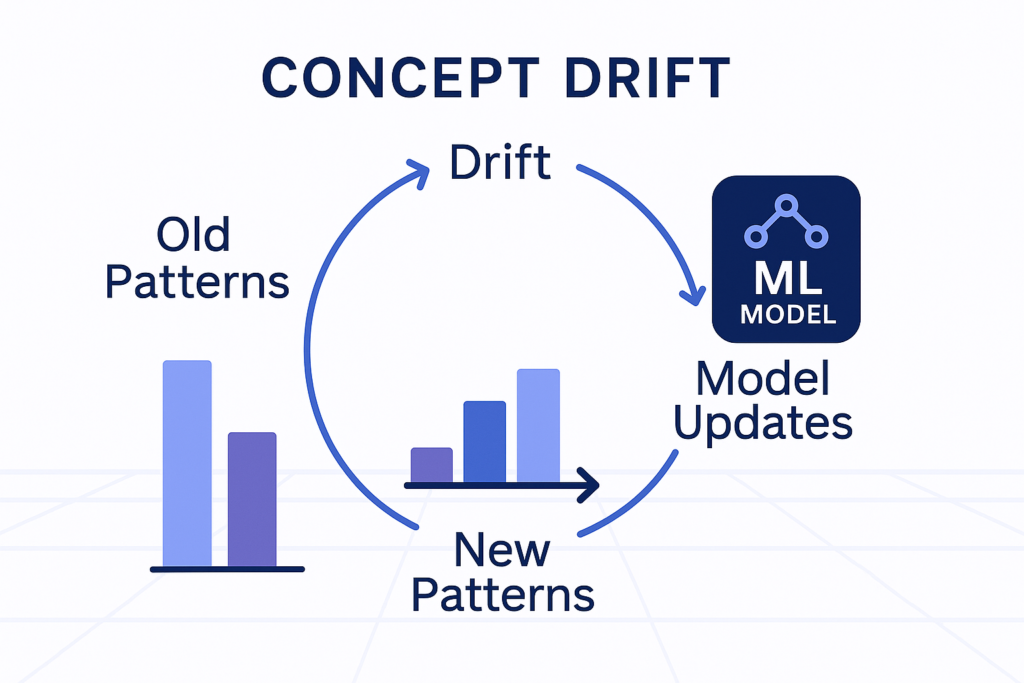
A model trained on last year’s threats is already obsolete. The digital landscape isn’t static; it suffers from concept drift. Attackers change their tools and techniques. User behavior evolves. Network configurations get updated.
What was considered normal activity six months ago might be anomalous today. This means a security ML model isn’t a product you build and deploy. It’s a service that requires continuous feeding and care.
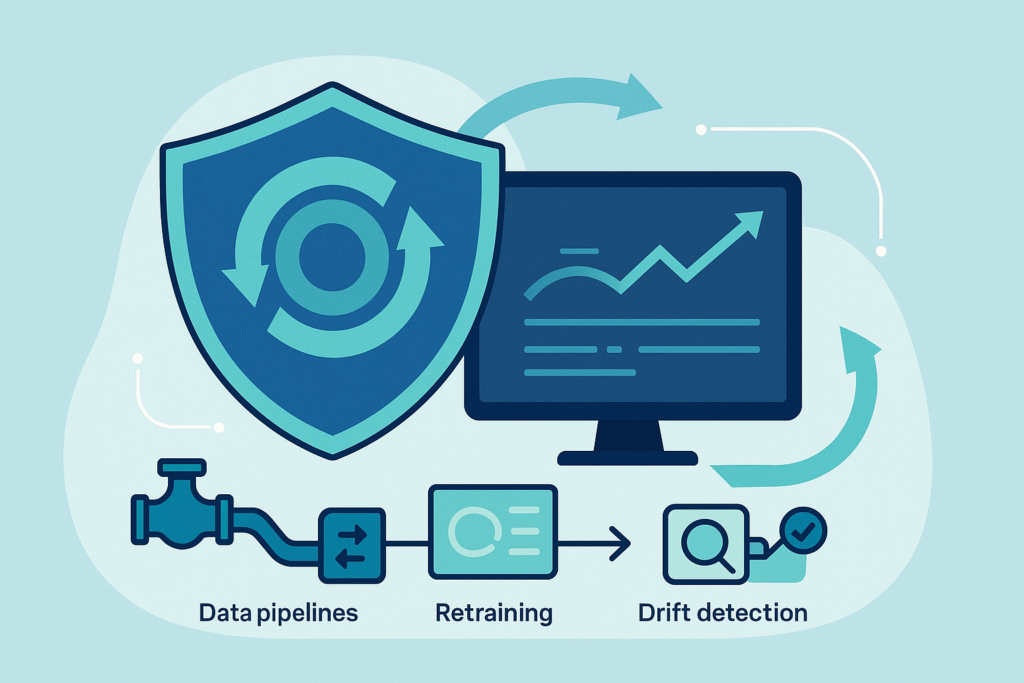
You need a pipeline for continuous retraining, feeding fresh data into the model to keep it current. This demands significant computational resources and creates deployment complexity.
Integrating these ever-evolving models into existing Security Information and Event Management (SIEM) or SOAR platforms is a major hurdle. The model that worked perfectly in the lab might slow down a real-time production system to a crawl, creating its own security gap. This is why applying machine learning cybersecurity requires seamless integration and constant optimization.
A Path Forward in a Shifting Landscape
Training machine learning models for security is fundamentally different from other domains. You are not analyzing a passive universe, you are engaging in a battle of wits. The challenges of data scarcity, adversarial attacks, and operational drift are immense [2].
Success hinges on accepting this reality. It requires a shift from thinking about a single model to building an entire adaptive system, one that prioritizes robust data pipelines, continuous monitoring for model degradation, and a healthy skepticism of its own outputs.
The goal isn’t perfection, it’s resilience. The most secure systems are those that expect to be tested and have a plan to learn and evolve from each encounter. The work is never finished, but neither is the protection.
FAQ
Why is data scarcity in cybersecurity such a big problem when training ML security models?
Data scarcity in cybersecurity makes it difficult for models to learn real threats. Many teams face scarcity of real-world attack data, limited labeled malware samples, and incomplete packet captures. Noisy security logs and inconsistent log formats create gaps in understanding. These issues cause overfitting to historical threats, underfitting in sparse environments, and broader model generalization challenges.
How do imbalanced security datasets affect accuracy in ML threat detection?
Imbalanced security datasets create major accuracy issues because class imbalance in intrusion datasets skews learning. Models often receive insufficient negative samples and insufficient positive attack samples. These gaps raise high false positive rates and high false negative rates. Noise in SIEM data, inconsistent sensor coverage, and heterogeneous data sources make detection less reliable and reduce overall model stability.
What makes adversarial machine learning risks so hard for teams to handle?
Adversarial machine learning risks are challenging because attackers use data poisoning attacks, evasion attacks on ML models, mimicry attacks, and polymorphic malware variation. These threats evolve quickly as attacker tools change. Limited visibility of encrypted traffic and missing contextual metadata reduce detection accuracy. These combined issues make it difficult for teams to trust and validate model outputs.
Why do ML security models fail over time even after strong training?
ML security models often fail over time due to concept drift in cyber threats, drift in user behavior baselines, and dataset aging issues. Dynamic network environments and feature drift in security telemetry shift patterns the model once understood. Real-time model degradation grows when continuous retraining demands are not met, leading to scalability issues and weaker long-term detection performance.
What makes building and running ML security pipelines so complex for security teams?
Building and running ML security pipelines is complex because teams face deployment complexity in SOCs, model update complexity, and strict operationalizing requirements. Limited compute resources for training and real-time inference latency slow performance. Integration challenges with SIEM/SOAR add more work. Privacy constraints in log sharing and compliance-restricted data access limit data availability, increasing the continuous monitoring burden.
The Hard Road to Reliable Security ML
Training ML security models is hard because the threat landscape never sits still. Data is scarce, adversaries adapt, and models drift the moment they’re deployed.
Yet progress comes from embracing this instability, treating security ML as a living system that learns, updates, and questions itself.
Resilient defenses emerge not from perfect models, but from continuous refinement, diverse data, and robust guardrails. In cybersecurity, evolution isn’t optional, it’s the only path to staying ahead. Ready to build smarter defenses? Join the movement.
References
- https://www.sciencedirect.com/science/article/abs/pii/S0957417425003422
- https://aisel.aisnet.org/cais/vol51/iss1/28/