
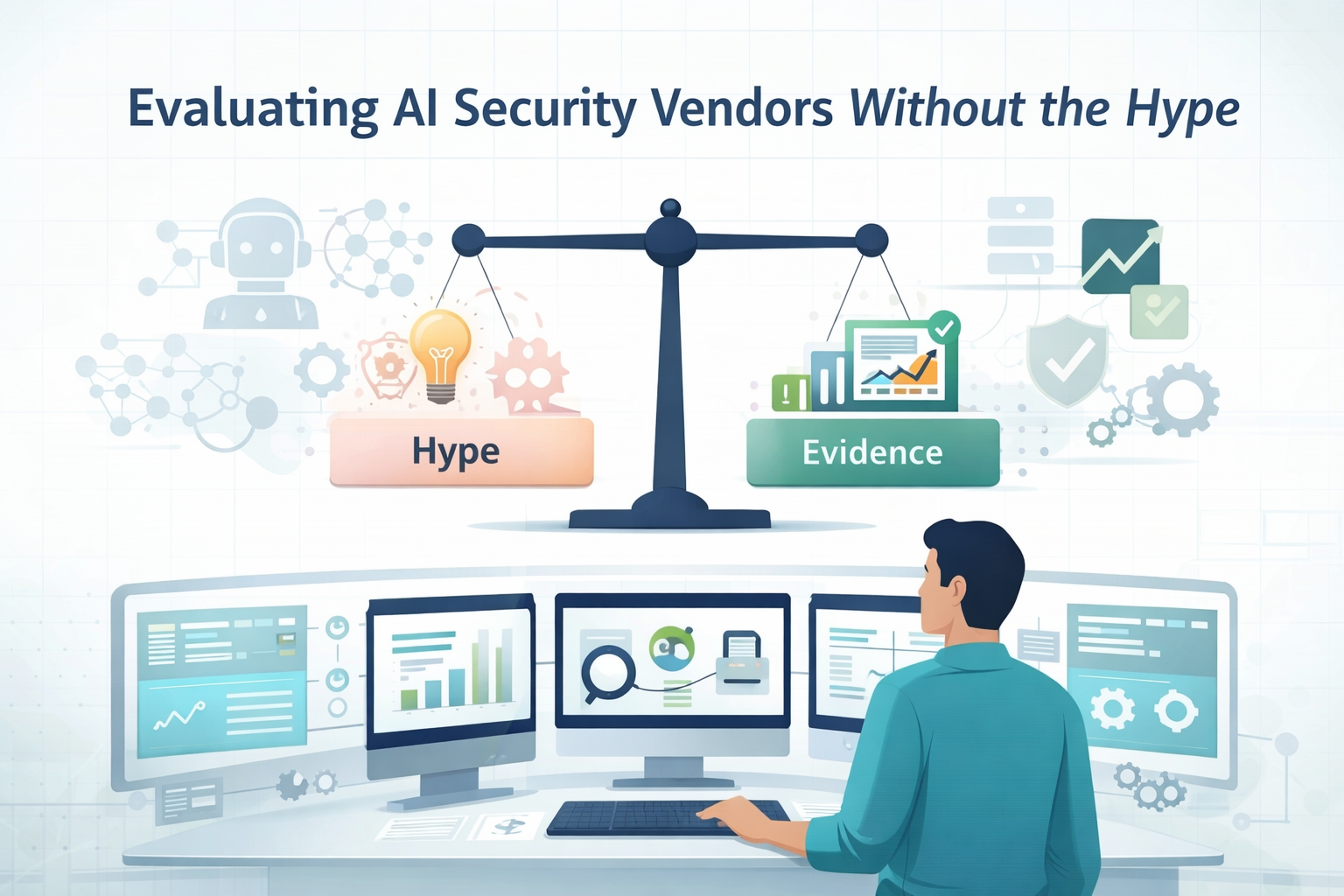
Choosing the right AI security vendor starts with cutting through noise and focusing on what actually improves your SOC.
You’re not just buying tools, you’re deciding who will sit at the heart of your detection, triage, and response workflows every day.
That means measuring vendors on outcomes, not adjectives, and on how well they fit your environment, not just their demo reel.
A structured evaluation framework starts with mapping your SOC pains to measurable KPIs, then stress‑tests each vendor’s technical depth, deployment reality, and ongoing support. If you want a partner that adds clarity instead of chaos, keep reading.
Key Takeaways
- Prioritize vendors with transparent AI models and proven integration capabilities with your existing security stack.
- Validate all performance claims, especially around false positive reduction, through a structured proof of concept.
- Assess the vendor’s business stability and commitment to AI governance, including explainability and bias mitigation.
Start by Defining What Success Looks Like
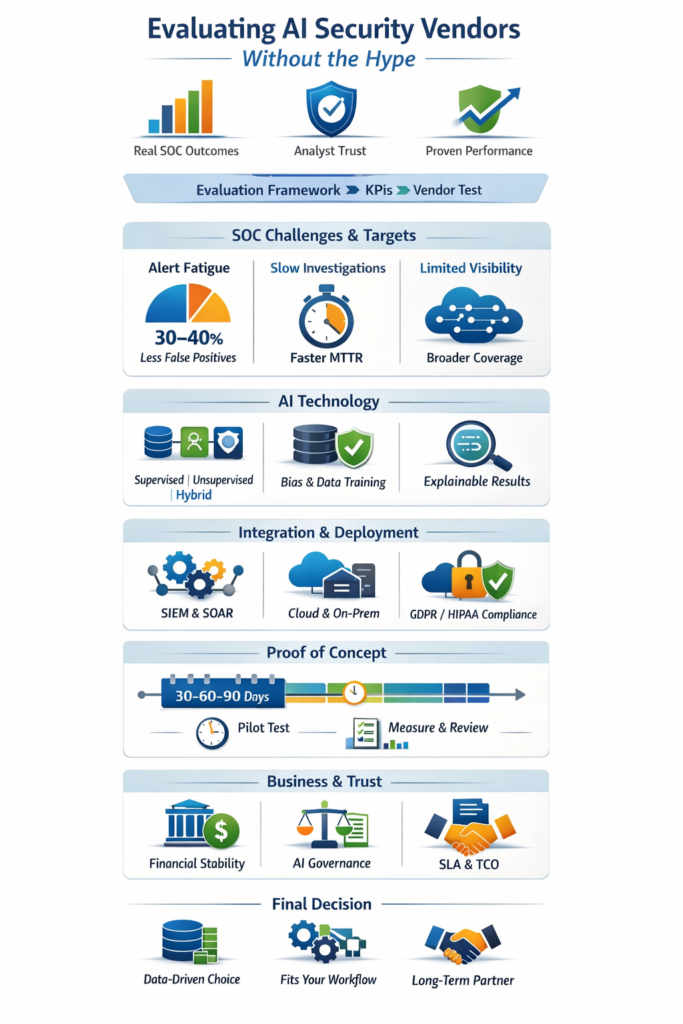
Before you look at a single vendor dashboard, you have to know what problem you’re solving. Is it alert fatigue drowning your analysts? Is it the slow response to endpoint threats? Maybe it’s the blind spots in cloud or network traffic.
A vendor perfect for your environment should understand how to leverage machine learning cybersecurity to reduce noise and focus on real threats.
Your evaluation criteria must flow directly from these specific operational pains. A vendor perfect for a financial services firm with strict compliance needs might be overkill for a tech startup focused on rapid cloud deployment.
This initial scoping prevents you from being swayed by flashy features that don’t align with your SOC’s reality. It grounds the entire process in your team’s daily experience.
You are not just buying a product. You are integrating a new component into a living, breathing security organism.
The best AI security tool is the one your team will actually use and trust. This means the vendor’s technology must fit your workflow, not force a complete overhaul of it. Consider the human element from the very beginning.
How will this tool make your analysts’ jobs easier, faster, more accurate? If you cannot answer that simply, the vendor probably can’t either.Sales demos impress, but poor fit can lead to deployment failures seen in 40% of security projects.
- Alert Fatigue Reduction: Quantify your current false positive rate.
- Investigation Speed: Measure your Mean Time to Respond (MTTR).
- Coverage Gaps: Identify specific areas like cloud or identity threats.
This checklist forces specificity. Instead of saying “we need better detection,” you can say “we need to cut network false positives by 40% within six months.” This clarity becomes your yardstick for measuring every vendor demo and datasheet.
| SOC Challenge | Current Indicator | Target Outcome | Why It Matters |
| Alert fatigue | High false positive rate | 30–40% reduction in false positives | Reduces analyst burnout and missed threats |
| Slow investigations | High MTTR | Faster containment time | Limits attack impact and lateral movement |
| Limited visibility | Gaps in cloud or identity logs | Broader detection coverage | Prevents blind spots attackers exploit |
Scrutinize the AI, Not Just the Marketing
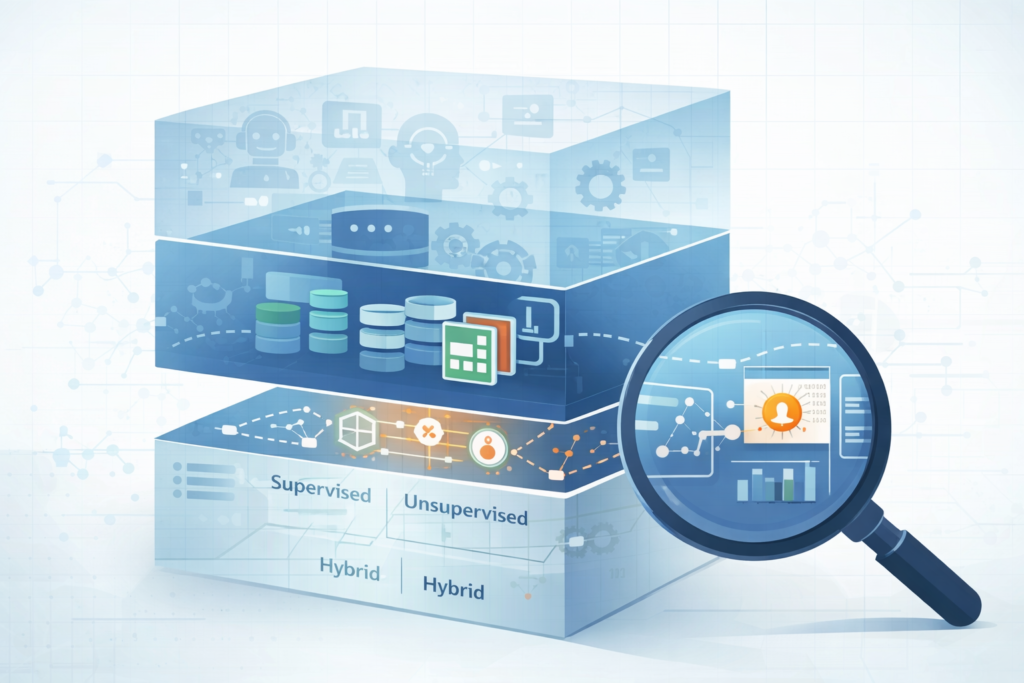
The word “AI” gets thrown around so casually now that it can feel more like a costume than a capability.
Your job is to pull that costume off and see what’s actually underneath for each vendor. The best systems employ deep learning intrusion detection models such as autoencoders and LSTMs, which adaptively learn network behavior and detect anomalies missed by traditional methods.
That means getting specific about the technology, not just nodding along to high-level claims. Start by pressing into how their AI actually works:
- What types of models are they using: supervised, unsupervised, or some hybrid approach?
- What data were those models trained on, internal logs, public datasets, customer telemetry, synthetic data?
- How do they handle bias in that training data, especially where it might skew detections or generate noisy alerts?
A serious vendor should be ready to talk through techniques like differential privacy (for example, how they anonymize or protect sensitive data used for model training).
They should also be able to walk you through how the system handles changing environments and evolving attacker behavior, often framed as handling concept drift, without needing constant manual retuning by your team.
You do not need to become an expert in deep neural networks, but you do need enough detail to tell the difference between marketing spin and real engineering.
Explainability, in security, is not optional. An AI that shouts “threat detected” without any usable context doesn’t just fail you; it burns analyst time and attention. You want to see how the system grounds its decisions in observable evidence:
- Does it highlight which user actions were suspicious?
- Does it point to specific network packets, connections, or flows?
- Does it surface the exact process executions, commands, or files that triggered the alert?
That “why” is what turns a model from a black box into something your analysts can actually trust. If they cannot see the reasoning, they will ignore the tool during real investigations, and the platform becomes yet another dashboard that no one opens when it actually matters.
Then there is the proof question: you need more than promises. Ask for concrete evidence of effectiveness:
- Third-party validation or independent testing results, if any exist.
- Model cards or similar documentation that describe where the AI works well, where it struggles, and what tradeoffs were made.
- Accuracy or effectiveness scorecards based on real deployments, false positive rates, detection coverage, time-to-detect, or case studies from comparable customers.
Be cautious with vendors who speak in sweeping terms but go quiet when you press for details. That can signal a product that looks broad on a slide but turns out shallow in practice.
Flashy AI fails without interpretable outputs integrated into workflows, act on it, and fold it into daily workflows.
The stronger vendors design their systems to support human analysts, not push them aside, surfacing clear context, explaining decisions, and giving your team better starting points for investigation rather than trying to “replace” them. That’s the kind of AI that actually gets used, and that justifies its place in your security stack.
The Devil is in the Integration Details
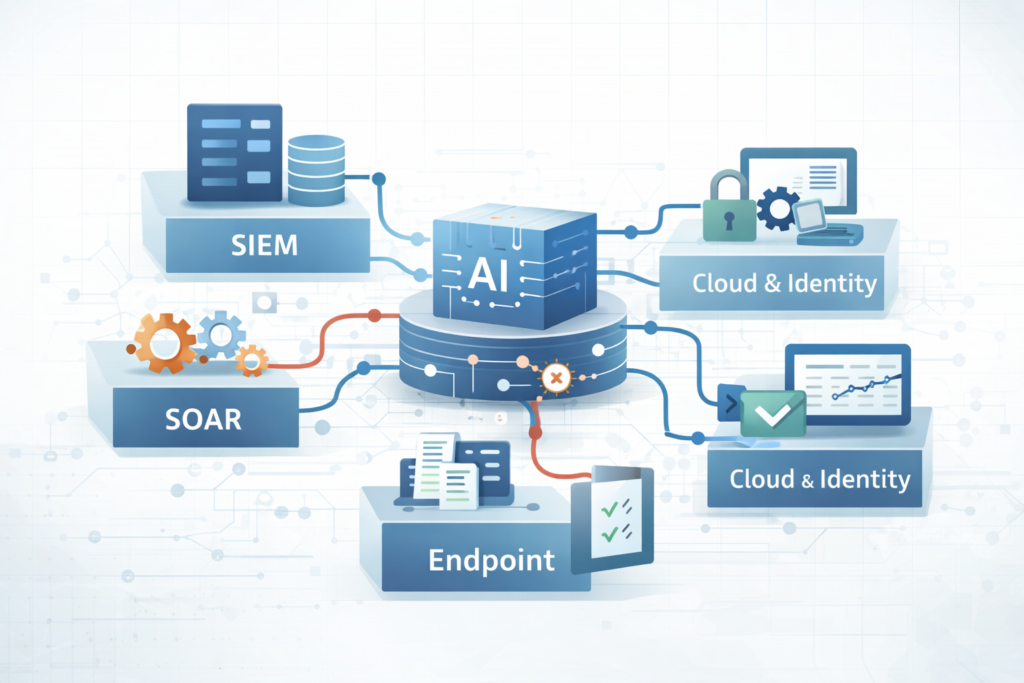
A vendor’s standalone demo might look like magic. The true test is how its magic works with your existing castle. You must pore over their API documentation and list of pre-built connectors.
How does it feed alerts into your SIEM, like Splunk or IBM QRadar? Can it trigger playbooks in your SOAR platform? If you have endpoint tools from CrowdStrike or SentinelOne, does the AI platform ingest that data seamlessly? Integration headaches are the primary reason security projects fail [1].
A vendor that requires you to rip and replace half your stack is proposing a revolution, not a solution. Think about data gravity.
Where will the AI processing happen? Some vendors offer cloud-native platforms that analyze data in their environment, while others provide on-premise or virtual appliances.
Each approach has implications for data privacy, latency, and cost. A cloud-based AI might be faster to deploy, but you need absolute confidence in their data handling security and compliance with regulations like GDPR or HIPAA.
Ask about encryption, access controls, and data retention policies. The most elegant AI algorithm is pointless if it creates a compliance nightmare.
Scalability is another silent killer. A solution that works perfectly for your 500 employees today might choke when you hit 5,000. Ask the vendor to explain their architecture’s limits.
How does performance degrade under heavy load? Can they provide reference customers of a similar size and complexity to your organization? You are making a long-term bet.
The vendor’s technical foundation needs to be as robust as their AI models. A flashy car with a weak engine won’t get you where you need to go.
Put Them to the Test with a Focused Proof of Concept
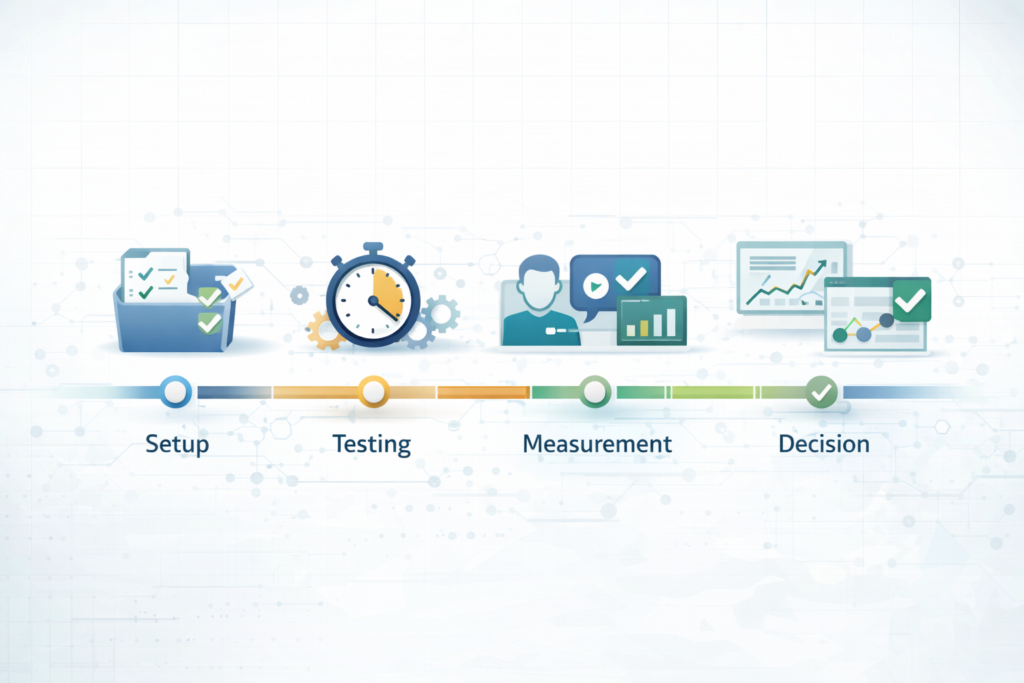
A sales presentation is theater. A proof of concept (PoC) is reality. Never sign a contract based on promises alone.
A properly structured pilot will show how the AI system applies applying machine learning cybersecurity principles to your real data, helping you validate false positive reductions and true threat detections in your environment.
Insist on a time-boxed pilot, typically 30 to 90 days, with clearly defined success metrics that mirror the objectives you set initially.
This is where you test their claims about false positive reduction and detection accuracy in your own environment, with your own data. The vendor should be willing to collaborate on setting up this PoC, it shows they are confident in their technology.
Structure the PoC like a scientific experiment. Define a control period where you measure your current performance metrics. Then, run the vendor’s tool alongside your existing systems. Compare the results.
Does the AI tool detect threats you missed? Does it generate fewer noisy alerts for the same set of events? Pay close attention to the user experience for your analysts.
Is the interface intuitive, or does it require weeks of training? The goal is to gather tangible data that proves, or disproves, the vendor’s value proposition.
- Deployment Time: How long did it take to get meaningful results?
- Analyst Feedback: Survey your team on usability and trust.
- Operational Impact: Measure any change in MTTR or investigation depth.
This data is your most powerful negotiating tool. It moves the conversation from hypothetical benefits to proven outcomes.
It also protects you from vendors whose solutions look good on paper but fail in practice. A successful PoC builds internal buy-in from your security team, making the eventual rollout much smoother.
Look Beyond the Technology to the Business
Credits: Lenovo UK & Ireland
The most advanced technology can fail if the company behind it is unstable. You are entering a partnership, not just making a purchase.
Investigate the vendor’s financial health. Are they profitable, or burning through venture capital? What is their customer retention rate? A high churn rate is a massive red flag, indicating that customers are not finding long-term value.
Talk to reference customers, especially those in your industry. Ask them about the vendor’s support responsiveness and their track record for delivering on roadmap promises. Consider the vendor’s commitment to AI ethics and governance.
Do they have public policies on bias mitigation? How do they handle model drift and ensure their AI remains fair and effective over time? In the evolving regulatory landscape, with developments like the EU AI Act, a vendor’s proactive approach to governance is a sign of maturity.
It shows they are thinking long-term about the responsible use of their technology. A vendor that treats AI as a mere feature, rather than a core responsibility, poses a significant risk. Finally, examine the contract and service level agreements (SLAs) with a fine-toothed comb.
What are the guarantees for uptime and support response times? Are there penalties for missing these SLAs? Understand the total cost of ownership beyond the initial license fee, including costs for data ingestion, professional services, and future upgrades. The cheapest option upfront can often be the most expensive over three years.
Making Your Final Decision
There’s a moment, near the end of any vendor search, where all the slide decks blur together and you’re really just weighing risk against trust. Choosing an AI security vendor is exactly that, a risk decision.
You’re trying to match the promise of new technology with the less glamorous parts: how it fits into your stack, what it costs over time, and whether the company behind it will still pick up the phone in three years. At this stage, the “right” vendor usually has a few clear traits:
- They understand your environment well enough to talk in specifics, not slogans.
- They can show, not just claim, how they reduce risk, through data, demos, or real customer outcomes.
- They give you a realistic plan for rollout, not a magic switch that “just works.”
- They feel like a partner you could work with through incidents, audits, and leadership changes [2].
You are not just buying a platform, you are choosing who you’re going to argue with during a live incident, who you’ll trust when they say, “We’ve contained it,” and who will adapt when your architecture shifts again. To keep the process grounded, it helps to:
- Start with a short, written list of security goals (tied to threats, compliance needs, or business priorities).
- Use those goals as the lens for every demo, proof-of-concept, and reference call.
- Ask every vendor to map their features to your specific risks, not to a generic “AI security” story.
- Push for evidence: performance data, failure modes, support SLAs, and what happens when things break.
When you do this, the hype gets quieter. The vendor that lines up best with your goals, proves their claims, and earns your trust, that’s the one that actually strengthens your security posture over the long run.
Set your goals early. Keep them visible. Let them be the thread that pulls you through each step of the evaluation.
FAQ
What is the first step in AI security vendor evaluation?
The first step in AI security vendor evaluation is defining your actual security problems. When evaluating AI security platforms, teams should compare AI cybersecurity vendors and enterprise AI security vendors against clear goals.
Use an AI security vendor checklist to guide AI security vendor selection. Early AI security vendor due diligence, clear AI security RFP criteria, and AI security roadmap evaluation help prevent poor-fit tools.
How should teams compare different AI threat detection vendors?
Teams should use AI security solutions comparison to evaluate differences across AI threat detection vendors.
An AI security product comparison should include AI-based intrusion detection vendors, machine learning security vendors, and behavioral analytics security providers.
Review how AI-powered threat analytics providers detect threats, reduce noise, and support investigations. Every AI security software review should focus on operational results, not marketing claims.
Why are testing and metrics critical before choosing AI SOC vendors?
AI security proof of concept and AI security pilot testing reveal how AI SOC vendors perform in real environments.
Teams should test AI-driven security tools using AI security performance metrics. Measure AI security false positive reduction, alert quality, and AI security alert prioritization. Use these results for AI security ROI analysis. Testing reduces risk and shows real operational value before purchase.
What integration factors matter when evaluating AI security platforms?
An AI security architecture review confirms whether tools fit existing systems. Verify AI security integration with SIEM and AI security integration with SOAR platforms.
Review AI security data sources, AI security scalability, and AI security real-time detection capabilities. Evaluate AI network security vendors, AI endpoint security vendors, and AI cloud security vendors to ensure AI security platform features support automation and human-in-the-loop workflows.
How do trust and governance affect long-term AI security success?
Long-term success depends on trust and governance. Teams should review AI explainability security tools and explainable AI security vendors for AI security transparency. Assess AI model governance security, AI security compliance tools, and AI risk management vendors.
Use AI security maturity assessment and AI security audit readiness to confirm regulatory alignment. Strong AI security ethical considerations and AI security bias mitigation improve trustworthiness, resilience, and behavioral modeling accuracy.
From Hype to Hard Decisions
Evaluating AI security vendors doesn’t require chasing the newest algorithm or the loudest promise. It requires discipline.
By anchoring every decision to real SOC outcomes, demanding transparency, testing claims in your own environment, and assessing long-term partnership risk, you turn a noisy market into a manageable choice.
The right vendor will reduce friction, earn analyst trust, and measurably improve response, not add complexity. If you’re ready to see how an outcome-driven approach to AI security works in practice, join here.
References
- https://torq.io/blog/ai-soc-evaluation/
- https://www.pwc.com/gx/en/news-room/assets/analyst-citations/idc-worldwide-artificial-intelligence-2025.pdf