
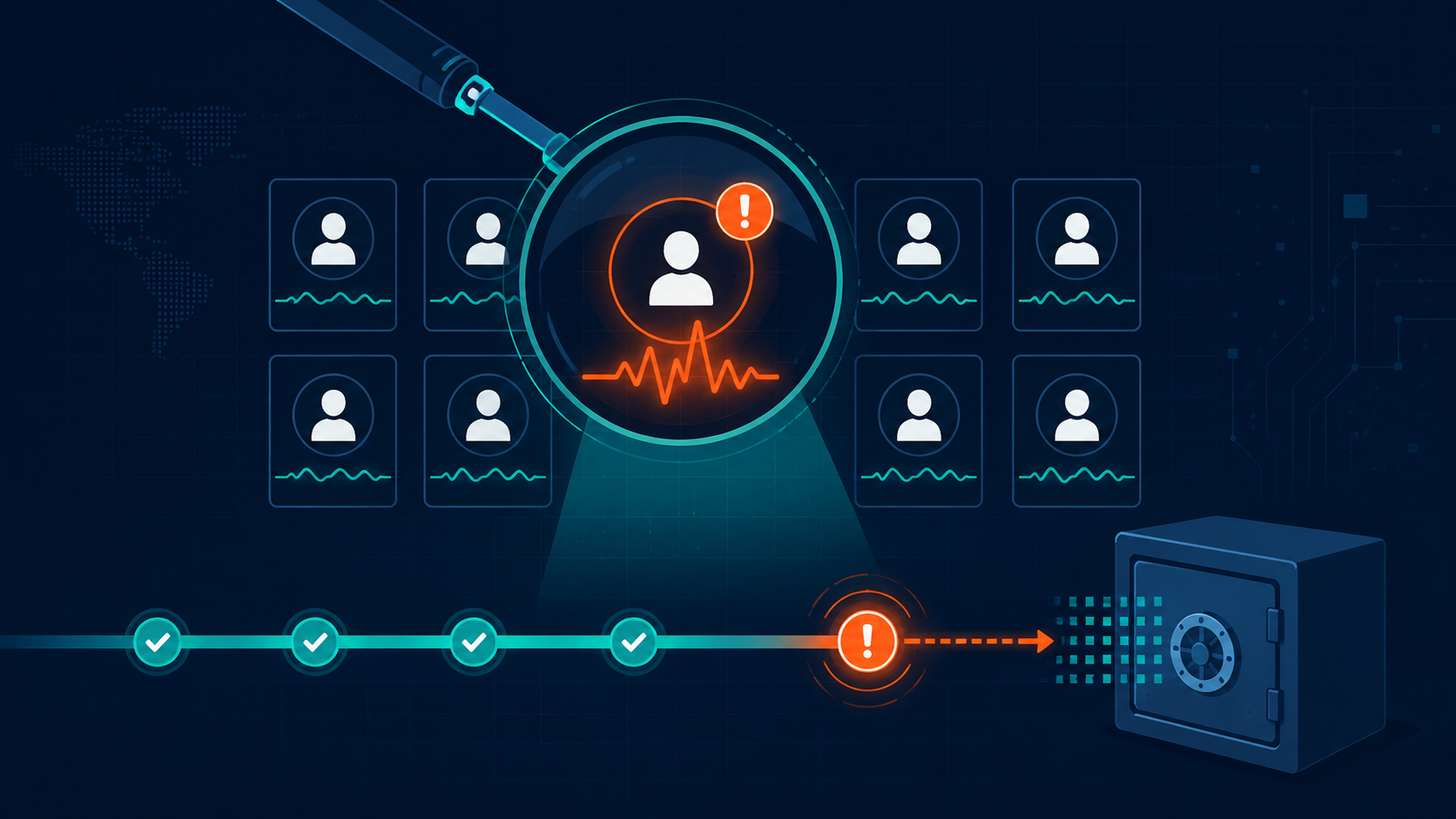
An insider threat rarely begins with obvious warning signs. Most malicious users and compromised accounts continue performing actions that appear legitimate on the surface. That is why understanding how UEBA detects insider threats anomalies is so important.
Instead of relying only on known attack signatures, UEBA studies normal behavior and highlights subtle changes that deserve attention. Combined with Network Threat Detection, organizations gain broader visibility into suspicious activity, helping security teams identify hidden risks before they escalate into serious incidents.
What You’ll Learn
Before exploring each concept, it helps to understand that insider threats are rarely identified by a single suspicious event.
- UEBA detects insider threats by spotting subtle deviations from a user’s established “pattern of life.”
- It focuses on sequences and correlations of otherwise normal actions that tell a malicious story.
- Effective detection requires rich data, especially from the network, to build a credible behavioral baseline.
How Does UEBA Establish a “Normal” Baseline for Detection?
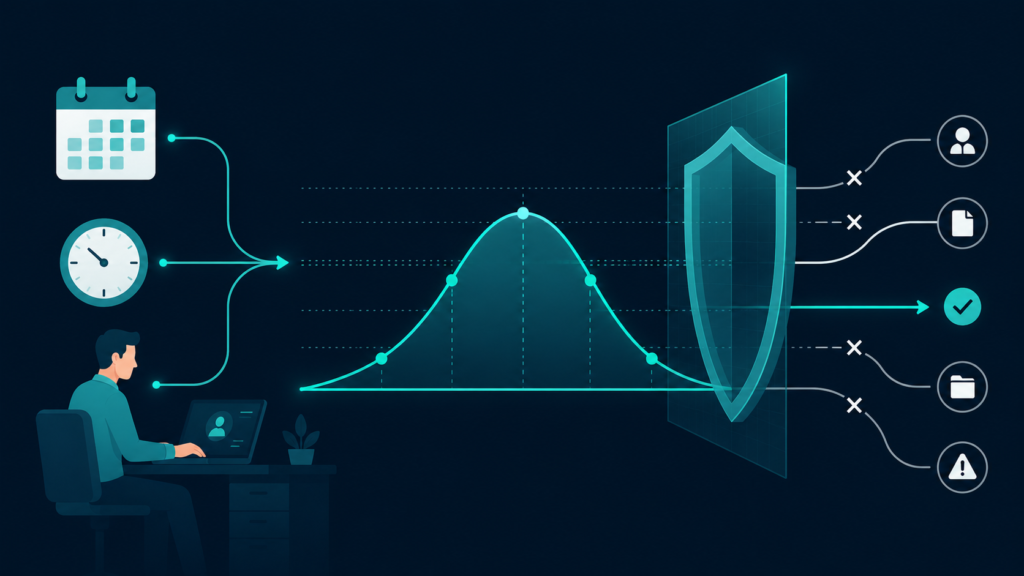
You can’t find what’s strange until you know what’s standard. UEBA begins by observing. For 30, 60, 90 days, it watches. It isn’t judging, it’s learning. It sees that Maria in accounting logs in at 8:30 from her suburban home IP, accesses the general ledger by 9, and never touches the source code repository. It sees that the backup server transmits 2 TB of data to offsite storage every night at 2 a.m.
This baseline isn’t a single rule. It’s a multi-dimensional profile. It includes timing, volume, location, and sequence. The system builds this for every unique entity, a user, a server, a service account. We’ve found the most truthful data for establishing baseline user entity behavior comes from a foundational layer: Network Threat Detection.
The baseline is alive. It adapts slowly to legitimate change, a user moving to a new city, a server taking on a new function. But it reacts sharply to sudden, radical shifts. That’s the space where threats live.
What Specific Anomalies Signal an Insider Threat?
An insider threat rarely looks like a movie hacker. It looks like a slightly exaggerated version of normal work. Advanced platforms specializing in user and entity behavior analytics ueba are tuned to spot the specific sequences where that exaggeration tells a story.
The classic signal is “impossible travel.” A user’s account shows a login from New York at 9 a.m., and then from London at 9:15 a.m. Physically impossible. This strongly suggests compromised credentials. Another is data hoarding.
An employee who typically accesses 10 MB of files per day suddenly downloads 10 GB from sensitive project folders. This is especially telling if it happens in the weeks before a resignation, a pattern we’ve documented more than once.
But the most insidious signals are in the correlations. It’s not one strange thing, it’s a chain of slightly-off things that together form a high-risk picture.
Common anomaly sequences include:
- Access Aggregation: A user accessing multiple unrelated sensitive systems in a short time window, like HR records, then financials, then R&D servers.
- Behavioral Velocity: Acting with unusual speed or at odd hours, like logging in and immediately executing large database queries at 3 a.m.
- Peer Group Deviation: Acting completely differently from colleagues in the same role. If every other developer commits code daily, and one stops for two weeks while logging massive network activity, that’s a signal.
- Privilege Use Anomaly: A privileged admin performing routine, non-admin tasks, or using their high-level access for simple data retrieval.
How Does UEBA Connect Disparate Events to Reveal a Threat?
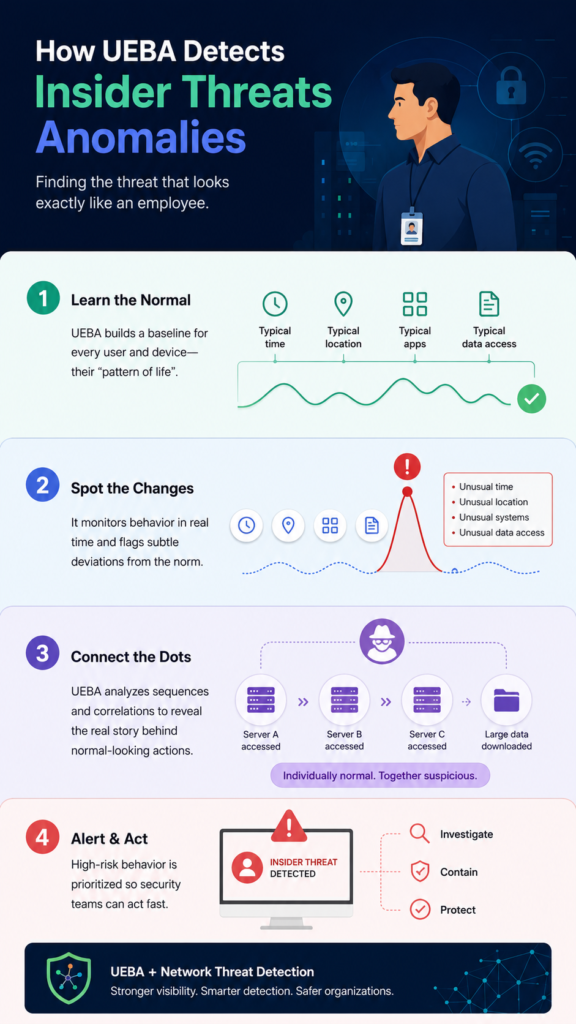
This is the core genius of the approach. Weighing the capabilities of ueba vs traditional security monitoring, a legacy tool sees events in isolation. A login is a login. A file download is a download. UEBA sees a timeline.
“Insider Threat Recognition: By monitoring user activities, UEBA can identify both deliberate and inadvertent insider threats, enhancing internal security measures. Mitigation of False Positives: Contextual analysis and risk scoring capabilities reduce false positives, allowing security teams to focus on genuine threats. Sustained Monitoring: UEBA provides continuous oversight of user and entity behaviour, adapting to evolving threats and ensuring ongoing security vigilance.” – Wikipedia
It uses a risk-scoring engine. Each anomalous event gets points. A login from a new country: 20 points. That same session accessing a server never touched before: +40 points. Downloading 500 files from that server: +50 points.
The system doesn’t alert on the 20-point event. It waits, watches, and aggregates. When the total risk score for that user session crosses a threshold, say, 80 points, it creates a high-fidelity alert. It’s built a narrative from the chapters.
What Role Does Machine Learning Play in This Detection?
The machine learning in UEBA isn’t a single trick. It’s a toolbox. Unsupervised learning is fundamental. It analyzes massive amounts of data without being told what to look for, clustering similar behaviors and flagging outliers. It finds the strange login time or the unusual data transfer volume that no human ever wrote a rule to catch.
Supervised learning models can be trained on known examples of malicious insider activity, helping the system recognize complex patterns like data staging, where files are first copied to a temporary location before exfiltration. But perhaps the most practical model is peer group analysis.
These models work together to reduce false positives. A login after hours might be normal for an IT admin on-call, but highly anomalous for a graphic designer. The ML models understand context.
They weigh factors, adjust probabilities, and constantly refine the baseline. They automate the intuition of a seasoned security analyst who says, “Huh, that doesn’t seem right for that person.”
Why Is Network Data So Critical for Insider Threat Detection?
Credits: CyberTable Talks
Logs can lie. Or, more commonly, they can be incomplete. An attacker with stolen credentials creates perfect authentication logs. A malicious insider using their own credentials creates perfect access logs. But network data tells a different story, the story of what actually happened.
When we integrate Network Threat Detection data, we get the ground truth. We see the full conversation between machines, not just the login handshake. We can see if a user’s workstation, after accessing a sensitive database, immediately initiated a large, encrypted transfer to an external IP address.
This data is also excellent for detecting lateral movement. An insider probing other systems will generate unique network traffic patterns, sequential connections to multiple internal IPs, spikes in failed connection attempts, or the use of unusual protocols. These patterns are vividly clear in network flow data, but often invisible in other logs.
| Data Source | What It’s Good For | Where It Can Be Misleading |
| Authentication Logs | Proving who logged in. | If credentials are stolen, the “who” is wrong. |
| Endpoint Logs | Showing activity on a specific device. | Can be disabled or tampered with by a privileged user. |
| Network Traffic | Showing what actually happened between devices. | Requires analysis to translate traffic into intent. |
Network data provides the unbiased, corroborating evidence. It answers the question, “I see what the logs say you did, but what did you actually do?”
What Are the Common Pitfalls in Tuning UEBA for Insider Threats?
The biggest pitfall is expecting magic on day one. Deploying UEBA and immediately hunting for a malicious insider is like turning on a camera in a crowded room and expecting to spot a liar. It takes time for the system to learn the room.
“By leveraging the power of machine learning, UEBA analyzes diverse data sources like user logins, file accesses, event logs, business context, external threat intelligence, and network activity, to unveil hidden threats most traditional methods could miss. By using various analytics techniques like supervised learning, unsupervised learning, and statistical modeling, UEBA solutions can detect subtle anomalies that deviate from established behavior baselines.” – Wikipedia
The initial learning period will generate noise. You’ll get alerts for benign anomalies, the CFO working late on a quarterly report, the IT team performing an unscheduled backup. This is not failure. This is the tuning process.
Another pitfall is focusing too narrowly. An insider threat isn’t always a person. It can be a compromised service account used by an automated process, or a server that’s been taken over. Ensure your UEBA deployment is modeling these non-human entities with the same rigor as your users. Their behavioral shifts can be even more telling.
Finally, avoid the “set and forget” mentality. Your organization changes. New applications are deployed, employees change roles, business processes evolve. The UEBA system needs periodic review to ensure its baselines are still relevant. A model that isn’t updated will slowly become blind to new normal behaviors, and eventually, to new threats.
How Should Security Teams Investigate a UEBA Insider Threat Alert?
When a high-fidelity UEBA alert fires, it should come with a story, not just a line in a log.
A good alert will say: “High Risk: Possible data staging by user jdoe. In the last 90 minutes, jdoe has: 1) Logged in from an unusual residential IP, 2) Accessed 15 different project directories they haven’t used in 6 months, 3) Copied 4.7 GB of mixed file types to a local temporary folder, 4) Initiated an encrypted SCP session to an external cloud IP.”
The investigation starts with that narrative. The analyst’s job is to validate and contextualize. First, they confirm the facts. Can the user verify the login? Was the external transfer authorized? A quick call can often resolve a false positive.
Next, they use the UEBA platform’s investigation workbench. This should show a visual timeline of the user’s activity, linking all the correlated events. They can pivot to see what other machines the user connected to, what other accounts were active from the same source IP, or if the destination cloud IP has been seen in other suspicious events.
What Are the Ethical and Privacy Considerations?

Monitoring employee behavior for security walks a razor’s edge. The power to detect a malicious insider also creates the power for surveillance. Navigating this requires clear policy, transparency, and legal oversight.
The principle should be “purpose limitation.” UEBA must be configured and used strictly for security anomaly detection, not for monitoring performance, productivity, or personal behavior. It looks for statistical deviations, not content.
It might flag that an employee is printing an abnormal number of documents, but it should never be configured to capture what is on those documents.
Involving HR and Legal from the outset is non-negotiable. Employees must be informed, typically via an acceptable use policy, that their digital activity may be monitored for security purposes. The policy should define what data is collected, how it is used, who can access it, and how long it is retained. In many jurisdictions, this is a legal requirement.
FAQ
Can UEBA differentiate between a malicious insider and a compromised account?
It tries to, but its primary job is to flag high-risk behavior, regardless of intent. The investigation that follows determines intent. However, certain patterns lean one way.
Rapid lateral movement and use of exploitation tools suggest a compromised account being used by an external attacker. Slow, careful data aggregation over weeks, especially during business hours, is more typical of a malicious insider.
How do you handle false positives without missing real threats?
You accept that some false positives are the cost of high detection sensitivity. The key is a tuning workflow. When a false positive occurs, you analyze why. Was it a one-time business process? If so, you might just note it.
Is it a recurring benign activity (like a monthly report generation)? You create a targeted exception or adjust the sensitivity for that specific user or system during that activity.
Does UEBA work for small companies, or is it just for large enterprises?
The underlying threat exists at any size. A disgruntled employee in a 50-person company can do catastrophic damage. Modern, cloud-based UEBA solutions have made the technology more accessible and manageable for smaller teams.
For them, it acts as a force multiplier, providing 24/7 behavioral monitoring that a small IT team could never perform manually.
What’s the first step if we think we have an active insider threat right now?
If you have a live alert or strong suspicion, immediately involve your legal and HR departments. Do not confront the individual directly. Begin discreetly preserving evidence using your UEBA and logging systems.
Limit the user’s access if possible, but do so in a way that doesn’t tip them off, often by disabling specific high-risk privileges rather than their entire account. Follow your incident response plan.
Seeing the Person Behind the Anomaly
Detecting an insider threat with User and Entity Behavior Analytics is ultimately human-centric. By observing the natural rhythm of work, this technology spots the digital shadow that doesn’t match the person, identifying fractured patterns caused by malice, compromise, or accident.
To bridge this data with proactive defense, NetworkThreatDetection.com provides SOCs and CISOs with real-time threat modeling, automated risk analysis, and visual attack path simulations. Expose your network’s blind spots before attackers do: Explore the Platform Feature.
References
- https://en.wikipedia.org/wiki/User_behavior_analytics
- https://en.wikipedia.org/wiki/User_behavior_analytics