

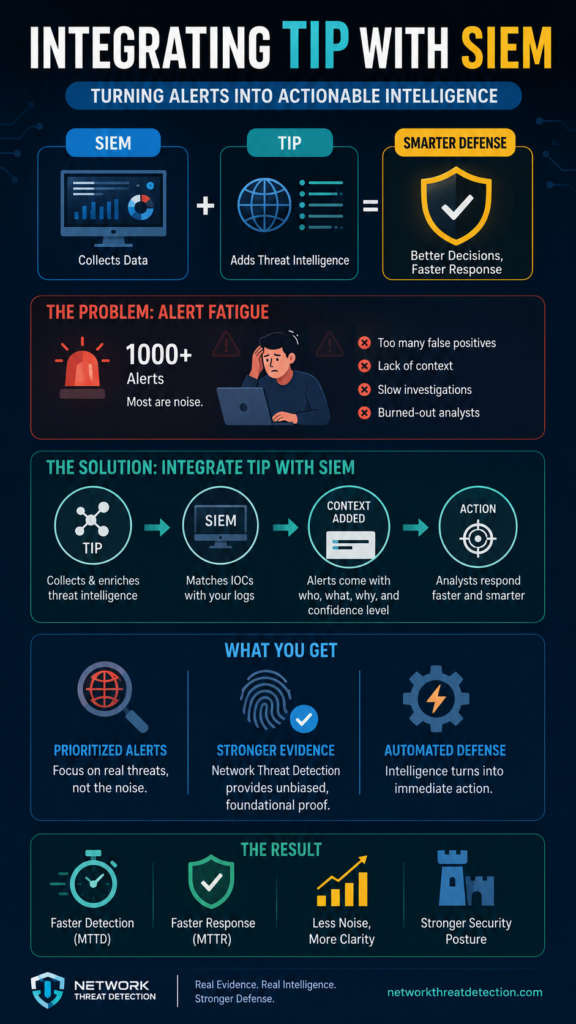
Your SIEM collects massive amounts of security data, but data alone does not stop attacks. Integrating TIP Threat Intelligence Platform SIEM adds the context needed to separate real threats from routine activity, helping analysts focus on what matters most.
Combined with Network Threat Detection, which delivers reliable network evidence, this integration creates faster, more accurate security operations with fewer wasted investigations. Keep reading to see how this approach strengthens every stage of threat detection and response.
From Raw Alerts to Confident Decisions
A SIEM becomes far more valuable when it works alongside a Threat Intelligence Platform. Here’s what this integration delivers:
- A TIP transforms generic SIEM alerts into prioritized, context-rich incidents.
- Network Threat Detection provides the unbiased, foundational evidence of an attack.
- The integration automates defense, turning intelligence into immediate action.
The Alert Fatigue Problem (And Why Your SIEM Can’t Solve It Alone)

You’ve seen it. The SIEM console flashes, a cascade of events from firewalls, endpoints, servers. Each one could be nothing, or it could be the start of something very bad. The team scrambles, cross-referencing IPs and domains manually, trying to remember if they’ve seen this hash before.
“Tests demonstrated that our proposed framework shortens the threat validation time by up to 97.7%, compared to manual processes. Additionally, our system reduces false positives by capitalizing on contextual threat intelligence, thus allowing SOC teams to prioritize critical alerts.” – IJECES
It’s reactive, it’s slow, and it burns people out. The SIEM is doing its job, collecting and correlating logs. But without external context, it’s like a detective with a pile of evidence but no access to criminal databases.
The core issue is a lack of prioritization. An alert from a user workstation in marketing looks the same as an alert from your domain controller. But they aren’t the same, not even close. One might be a false positive from a weird but legitimate download, the other could be the first step in a lateral movement attack.
What a Integrating TIP Threat Intelligence Platform SIEM Actually Brings to the Table?
Here’s what a threat intelligence platform really does.
A TIP is a central hub for your security data. It pulls in threat intelligence feeds from open sources, paid vendors, and industry partners.
The platform adds crucial context to raw data. For example, it can tell you:
- That a suspicious IP address is tied to a specific ransomware gang.
- Whether a new domain was registered just for a phishing campaign.
- If a file hash matches malware known to attack banks.
This context turns basic alerts into clear stories. When your security tools flag something, the TIP can instantly attach a report. Instead of just “host contacted bad IP,” you get “host contacted an IP used by Emotet malware in the last 72 hours, with 95% confidence.” You immediately know the threat level and what to do next.
The Integration: Where Data Becomes Action?
So how do these two systems talk? It’s typically via APIs. The TIP pushes its enriched intelligence, the lists of bad IPs, domains, hashes, into the SIEM as a dynamic reference list. The SIEM’s correlation rules are then configured to watch for any log entries that match these known-bad indicators.
It’s a continuous loop. New intelligence flows in, and the SIEM immediately begins hunting for indicators and IOCs across your environment.
This automation is the killer app. Instead of an analyst having to manually look up every suspicious item, the context is delivered alongside the alert. The workflow shifts from “investigate if this is bad” to “respond because this is bad.” The table below shows the stark contrast in the analyst’s experience before and after integration.
| Analyst Task | Without TIP Integration | With TIP Integration |
| Alert Triage | Manually query multiple external sources for each IOC. | Context (source, confidence, campaign) is appended to the alert automatically. |
| Prioritization | Based on asset value or gut feeling; easy to miss critical alerts. | Driven by intelligence confidence score and known threat actor tactics. |
| Initial Investigation | Starts from zero, building a timeline from internal logs only. | Begins with a hypothesis (“This looks like TrickBot infrastructure”) based on enriched data. |
| Response Time | Slowed by research; critical minutes or hours can be lost. | Accelerated; focus shifts immediately to containment and eradication steps. |
The result is a faster mean time to detect (MTTD) and a dramatically faster mean time to respond (MTTR). You’re not just finding threats quicker, you’re understanding them instantly.
Why Network Threat Detection Is the First Place to Look
Credits: Adam Goss
Logs from endpoints and servers can be manipulated by a skilled attacker. Processes can be hidden, files renamed, traces wiped. But the network, that’s a different story. It’s the unbiased witness. Every connection, every packet transfer, every DNS query leaves a trace in your network logs.
“Blindly integrating threat intelligence into your SIEM can often lead to more issues than it solves… Without careful management all it does is create a flood of new alerts, incorrectly categorize existing alerts as high priority, or in some cases provide a multitude of false positive alerts.” – Anomali
This is where we focused our integration efforts first. By feeding threat intelligence, especially lists of known malicious IPs and domains, directly into our network security monitoring tools (which then fed the SIEM), we created a tripwire at the perimeter and inside the network.
It provided a clear, objective starting point for any investigation. You can argue about what a process was doing, but you can’t argue with a firewall log showing a connection to a bulletproof hosting provider in a country you have no business with. Starting with Network Threat Detection grounds your response in hard evidence, not speculation.
Building a More Proactive Security Posture
Integration doesn’t just make you faster at reacting. It slowly changes your entire stance from reactive to proactive. With the TIP feeding ongoing campaign data into the SIEM, you can start hunting for threats before they trigger a high-fidelity alert.
You can search your logs for IOCs related to the latest vulnerabilities, like those in Log4j or the recent ConnectWise flaws, even if you have no direct evidence of an attack.
You begin to see patterns. Maybe you notice low-volume data exfiltration attempts to the same geographic region every Tuesday night. The SIEM can correlate these events over time, and the TIP can confirm the destination IPs are linked to a specific APT group.
This intelligence also informs your broader strategy. If your TIP shows a sharp rise in phishing campaigns targeting your specific industry, you can adjust.
You might tighten email filtering rules in the SIEM, launch a focused user awareness campaign, or simulate similar attacks in your next penetration test. The intelligence becomes a feedback loop, shaping your defenses to match the real threats you face, not the hypothetical ones.
Common Pitfalls and How to Sidestep Them
The integration isn’t a set-it-and-forget-it magic bullet. One major pitfall is intelligence overload. If you connect every possible feed to your SIEM without filtering, you’ll overwhelm it with low-quality IOCs, creating the very alert fatigue you sought to solve.
Start with a few high-confidence, curated feeds. Balance trusted community sources with commercial threat intel, and focus on intelligence relevant to your industry and geography.
Another mistake is poor tuning. The first week after integration might see a spike in alerts as the systems learn your environment. You need to tune the correlation rules. If your marketing team uses a legitimate cloud service that shares an IP block with a malicious actor, you’ll need to create an exception.
Finally, don’t neglect the human element. The analysts need to understand what the enriched data means. A “confidence score of 80%” needs to be translated into a response procedure.
Regular review sessions on closed alerts help the team learn from the intelligence and improve their own judgement calls. The tool empowers the analyst, it doesn’t replace them.
FAQ
Doesn’t this just create more alerts for my team to handle?
Initially, it might surface hidden issues, but its primary goal is to add context. This transforms a hundred vague alerts into five high-priority, well-understood incidents. The volume of actionable work often decreases, even if total detections rise.
Can’t I just use open-source intelligence feeds directly in my SIEM?
Technically, yes. But a TIP does the heavy lifting: aggregating, deduplicating, scoring, and normalizing data from hundreds of sources (open and closed). Managing that volume and quality directly in a SIEM is an operational nightmare.
How does this help with zero-day attacks?
While a true zero-day won’t have known IOCs, the TIP provides contextual awareness. It can highlight suspicious behavior that aligns with the tactics of an attack group, even if the specific malware hash is new. It also speeds response once initial IOCs are published.
Is this integration complex and expensive?
The complexity varies by vendor, but modern APIs have made it more straightforward than ever. The cost is not trivial, but it must be weighed against the cost of a breach that could have been stopped faster. Start small, with a single high-value use case like network detection.
The Sharpened Edge
The shift from forensic archaeology to proactive defense changes everything, transforming security operations into an intelligence-driven capability.
Network Threat Detection empowers your team with real-time threat modeling, automated risk analysis, and visual attack path simulations to expose blind spots before attackers do. Stop reacting to the past and start neutralizing threats as they emerge. Gain the clarity you need to prioritize risks and strengthen your defenses, join us today to see how it works.
References
- https://ijeces.ferit.hr/index.php/ijeces/article/view/4327
- https://www.anomali.com/blog/siem-and-threat-intelligence-a-match-made-in-heaven