
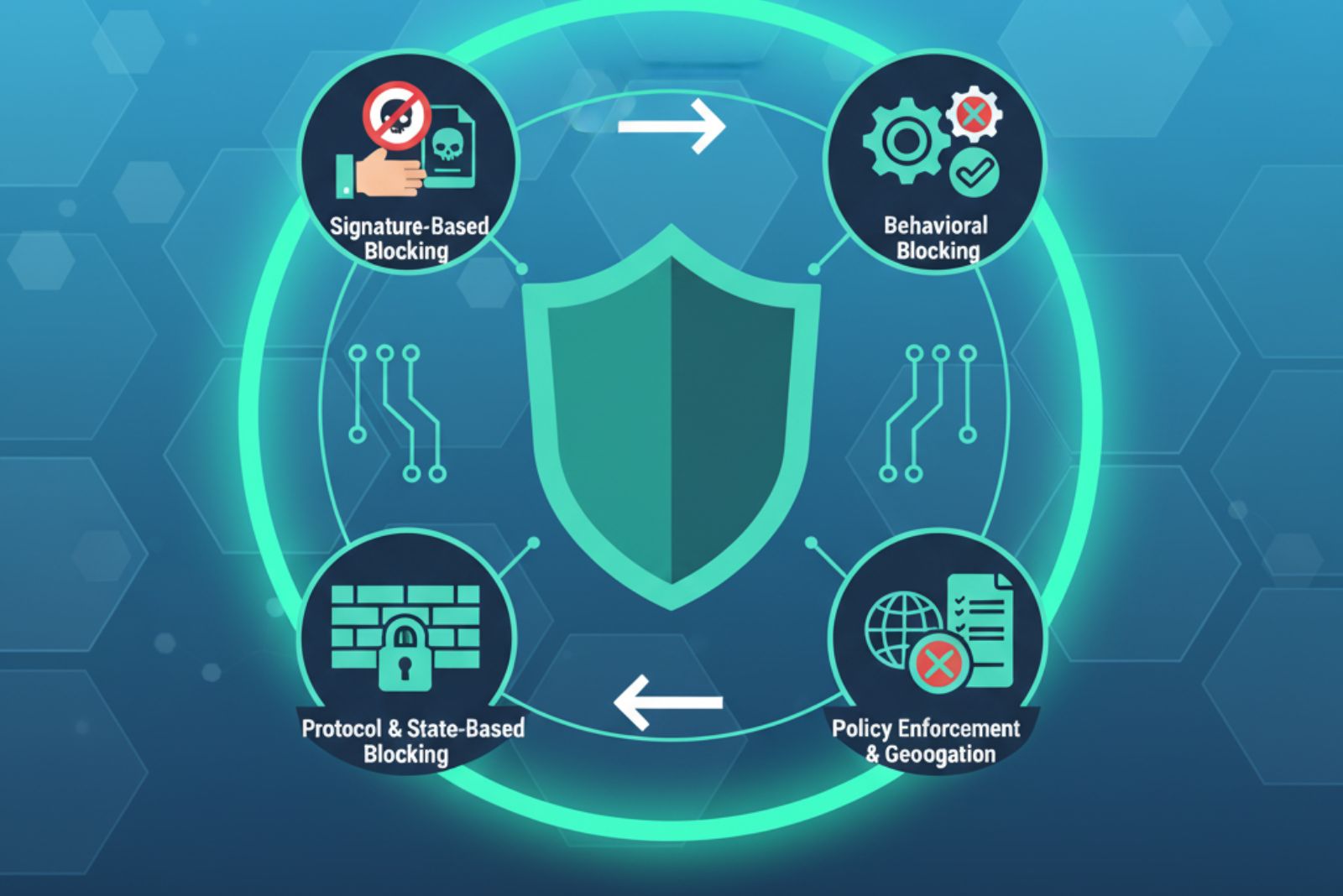
When it comes to protecting a network, IPS blocking mechanisms explained stand as a frontline shield. They act swiftly to stop suspicious traffic, drop malicious packets, and block attacker IPs long before damage happens. We’ve seen firsthand how these systems, especially when paired with powerful platforms like Network Threat Detection, transform network defense.
They don’t just alert you to threats; they stop them in real time. We’ll walk through the key blocking techniques IPS uses to shield organizations from breaches, malware, and intrusion attempts. Keep reading to find out how these mechanisms work and why they’re essential to modern network security.
Key Takeaways
- IPS blocks threats instantly by inspecting network traffic inline and applying signature and anomaly detection methods.
- Automated blocking actions include packet drops, IP blocking, session termination, and dynamic firewall updates.
- Combining signature and behavior-based techniques reduces false positives and improves attack prevention.
What IPS Blocking Mechanisms Actually Do
We often hear terms like “intrusion prevention system” tossed around, but what does IPS blocking really mean? To fully grasp how these systems operate, it helps to understand the core IPS functionality that allows them to analyze traffic and stop threats in real time.
At its core, IPS blocking involves stopping malicious network activity as it happens. Instead of waiting for alerts or logs to be reviewed, these mechanisms analyze every piece of network data flowing through a connection, searching for anything that looks suspicious or dangerous.
One way this happens is through inline deployment. The IPS is placed directly in the path where data travels between the internet and your internal network. Because it sits right in the middle, this setup lets the IPS inspect every packet passing through.
- Inline placement means no delay in spotting threats.
- Real-time packet inspection stops attacks mid-flight.
- Inline IPS can prevent malware spread instantly.
Our experience shows the power of inline IPS deployment. We’ve seen networks drastically reduce breach attempts simply because suspicious traffic never reaches vulnerable endpoints. It’s like having a vigilant gatekeeper who never blinks.
Signature-Based Blocking: Matching Known Threats

One of the oldest yet still most effective IPS strategies is signature-based blocking. Imagine a library of known attack patterns. Each signature represents a malicious payload, exploit, or behavior previously seen by security researchers.
Incoming traffic is scanned against this library. When a match appears, the IPS acts immediately by dropping the packet or blocking the source IP.
Signature-based blocking excels at stopping known threats fast. If attackers reuse malware or exploit a known vulnerability, the IPS recognizes it instantly.
But signature methods have limits, they rely on prior knowledge. New or modified attacks can slip through unless the signature database updates frequently.
- Signature-based systems rely on a comprehensive threat library.
- Automatic updates keep detection current.
- Best suited for stopping well-documented malware and exploits.
We use signature-based blocking as a foundation, but our teams know it’s only part of the defense puzzle. That’s why integrating platforms like Network Threat Detection, which constantly update signatures and add intelligence, is crucial. It keeps your defense sharp and up to date.
One way this happens is through IPS placement in network inline mode, which positions the IPS directly in the traffic path so it can inspect and block threats instantly.
Anomaly-Based Detection: Catching the Unknown

Where signature-based blocking looks for known threats, anomaly detection watches for the unusual.
The IPS first learns what “normal” network behavior looks like, traffic volumes, connection types, protocols, and typical user activity. When it spots deviations, such as unexpected spikes or strange protocol requests, it flags and blocks those anomalies (1).
This method is vital for catching zero-day attacks or clever intrusions that don’t match known signatures. Anomaly detection is a bit like a guard dog sensing something’s wrong even if it can’t identify the exact threat.
- Anomaly detection builds baselines for normal network behavior.
- It spots deviations that could indicate new or unknown attacks.
- Helps reduce risk from emerging threats signature systems miss.
We’ve often witnessed anomaly-based blocking catch subtle attacks before they escalate. Combining this with signature defenses creates a layered approach that’s harder for attackers to bypass. Our use of advanced risk analysis tools helps refine these baselines, minimizing false alarms and focusing on real threats.
For organizations looking to go beyond traditional detection, next-generation IPS (NGIPS) features offer deeper inspection, adaptive intelligence, and better false positive reduction.
Protocol Analysis and Traffic Inspection: Digging Deeper
Not all threats come disguised in obvious ways. Some exploit protocol weaknesses or send malformed packets to slip past defenses. IPS blocking mechanisms include protocol and traffic analysis to inspect the structure and content of network communications (2).
For example, if HTTP traffic tries to send strange headers or FTP commands look abnormal, the IPS can block these protocol violations. This scrutiny extends to DNS queries and other protocols frequently targeted by attackers.
- Protocol analysis detects malformed or suspicious requests.
- Blocks attempts to exploit protocol vulnerabilities.
- Enhances overall traffic inspection beyond signature matching.
This layer of inspection requires deep technical knowledge and often uses heuristic detection methods. Our teams rely on platforms like Network Threat Detection to provide context-aware analysis, helping spot these subtle signs of attack and automatically respond.
Automated Blocking Actions: Speed Saves
Once a threat is detected, speed is everything. IPS systems do not wait for human intervention to act. They initiate automated blocking actions that include:
- Dropping malicious packets immediately.
- Blocking attacker IP addresses or ports dynamically.
- Terminating suspicious sessions or connections.
- Updating firewall and ACL (Access Control List) rules on the fly.
- Logging and alerting security teams for follow-up.
This automation drastically reduces attacker dwell time, limiting damage and preventing lateral movement. It also frees up security analysts to focus on investigation rather than firefighting.
- Automated blocking reduces response time from hours to seconds.
- Dynamic firewall updates prevent repeat attacks.
- Logs and alerts inform SOCs for deeper analysis.
We’ve integrated automated IPS blocking with our ongoing threat modeling efforts to build tighter feedback loops. When a threat triggers blocking, its data feeds real-time risk analysis, improving detection accuracy and blocking policies continuously.
Quarantine and Isolation: Containing the Threat
Some IPS platforms offer the option to quarantine or isolate infected hosts or user accounts. This containment stops threats from spreading internally after initial detection.
- Isolates compromised systems to prevent lateral movement.
- Helps SOC teams focus remediation efforts.
- Strengthens network segmentation and access control.
Our experience shows quarantine features work best when combined with strong network segmentation policies. Using Network Threat Detection’s risk models, teams can prioritize which assets to isolate and for how long, balancing security and operational impact.
Advanced Blocking Techniques: Beyond Basics
IPS blocking also involves more granular techniques:
- IP address blocking: Targeting suspicious source or destination IPs.
- Session termination: Ending suspicious or unauthorized connections.
- Packet filtering: Dropping packets based on header or payload criteria.
- Port blocking: Preventing traffic on vulnerable or unused ports.
- ACL and VACL blocking: Using access control lists and VLAN ACLs to enforce policies.
- Shun command: Temporarily blocking hostile IPs at the command line.
- Dynamic blocking: Automatically adjusting block times and rules based on threat severity.
Each technique adds a layer of control that helps tailor defenses to an organization’s unique environment. It’s vital to balance blocking aggressiveness with false positive reduction to avoid disrupting legitimate traffic.
The Role of IPS in Network Security Ecosystems

An IPS doesn’t operate in isolation. It integrates with firewalls, SIEM (Security Information and Event Management), SOAR (Security Orchestration, Automation, and Response), and other security infrastructure. This integration supports comprehensive network protection, incident response, and policy enforcement.
- Real-time threat intelligence enriches IPS detection.
- Logs feed security analytics platforms for correlation.
- Automated responses escalate blocking as needed.
We recommend pairing IPS with platforms like Network Threat Detection to leverage rich threat models, MITRE ATT&CK mappings, and continuous intelligence updates. This partnership ensures your IPS stays ahead of evolving attacker tactics, techniques, and procedures.
Practical Advice for Optimizing IPS Blocking
Source: Wes
If you’re setting up or refining IPS blocking:
- Start with inline deployment for real-time packet inspection.
- Use signature-based blocking to cover known threats aggressively.
- Layer anomaly detection to catch new or unknown attacks.
- Regularly update your threat intelligence and signature databases.
- Tune blocking policies carefully to reduce false positives.
- Integrate IPS with your firewall and security monitoring tools.
- Employ automated blocking but maintain alerting for oversight.
- Use risk modeling tools to prioritize which alerts require immediate blocking.
Our own teams rely heavily on continuous risk analysis and simulation tools from Network Threat Detection. These help maintain balance between tight security and minimal disruption.
FAQs
What is the difference between IPS blocking and IDS alerting?
IPS blocking actively stops malicious traffic by dropping packets, blocking IPs, or terminating sessions in real time. IDS (Intrusion Detection System) alerting, on the other hand, only monitors and reports suspicious activity without taking direct action.
While IDS provides valuable visibility, IPS adds a proactive defense layer by interrupting attacks before they reach critical systems, reducing response time and limiting damage.
How does signature-based blocking keep up with new threats?
Signature-based blocking relies on continually updated threat databases. Security vendors and platforms like Network Threat Detection regularly gather and analyze new malware, exploits, and attack patterns.
These signatures are then pushed to IPS devices to maintain current detection capabilities. This constant updating ensures the IPS can recognize and block even recently discovered threats, although it may miss novel attacks without known signatures.
Can anomaly detection cause false positives in IPS blocking?
Yes, anomaly detection can sometimes trigger false positives since it flags behavior deviating from normal baselines, even if that behavior is benign. Proper tuning and baselining are crucial to minimize disruptions.
Using advanced risk analysis and intelligence platforms helps refine anomaly detection thresholds, reducing false alarms while maintaining sensitivity to real threats. Combining anomaly detection with signature-based methods improves overall accuracy.
How does IPS integrate with firewalls?
IPS often works hand-in-hand with firewalls by sharing blocking rules and threat intelligence. While firewalls control general network access based on ports and IPs, IPS inspects traffic content more deeply.
When IPS detects a threat, it can dynamically update firewall rules to block malicious IPs or ports, creating a unified defense that controls both network access and packet-level threats.
What role does automated blocking play in reducing incident response time?
Automated blocking drastically cuts down incident response time by immediately stopping malicious traffic without waiting for human intervention. This rapid reaction limits attacker dwell time and potential damage.
Security teams can then focus on investigation and remediation while the IPS maintains network protection. Automation is key to effective, real-time defense in fast-moving attack scenarios.
How does packet filtering contribute to IPS blocking?
Packet filtering allows the IPS to inspect header information or payload content and drop packets matching suspicious criteria. It’s a fundamental blocking mechanism that weeds out harmful traffic based on rules tied to IP addresses, ports, or packet contents.
This helps stop unwanted traffic early, reduces network load, and prevents many attacks from progressing further.
What is the significance of session termination in IPS blocking?
Session termination ends suspicious or unauthorized network connections immediately upon detection of malicious activity. This prevents attackers from maintaining or escalating access within a network.
Terminating sessions can also stop data exfiltration or command-and-control communication quickly, limiting attack impact. It’s a proactive way to cut off threats in motion.
How do blocking policies impact IPS effectiveness?
Blocking policies define what kinds of traffic get blocked, for how long, and under what conditions. Well-crafted policies balance security with minimizing false positives.
They allow customization for trusted networks, prioritize high-risk threats, and define escalation procedures. Effective blocking policies ensure IPS systems respond appropriately without disrupting legitimate business operations.
Can IPS blocking mechanisms be bypassed by attackers?
While no defense is foolproof, IPS blocking mechanisms make bypassing difficult. Attackers may try to evade detection using encryption, obfuscation, or zero-day exploits.
However, combining signature, anomaly, and protocol analysis, along with continuous threat intelligence updates, significantly raises the bar.
Platforms like Network Threat Detection enhance IPS by modeling attack paths and exposing blind spots, closing gaps before attackers can exploit them.
How does host blocking differ from IP address blocking in an IPS?
IP address blocking stops traffic to or from a specific IP, which can be effective against external threats. Host blocking goes further by isolating or restricting specific devices within the network, preventing compromised hosts from spreading threats internally.
Host blocking supports network segmentation and containment strategies, helping maintain internal security alongside perimeter defense
Final Thoughts on IPS Blocking Mechanisms Explained
IPS blocking mechanisms are the unsung heroes of network defense. They analyze traffic in real time, compare it to known attacks, spot anomalies, and react instantly with automated blocking actions. These mechanisms don’t just detect threats, they stop them cold, dropping packets, blocking IPs, terminating sessions, and isolating compromised hosts.
We’ve seen how combining signature-based and behavior-based techniques, supported by platforms like Network Threat Detection, creates a dynamic and resilient security posture. When your IPS works with powerful risk modeling and threat intelligence, you gain deeper situational awareness and faster, smarter responses.
For anyone serious about network security, mastering IPS blocking is essential. It’s about more than just technology, it’s about continuously evolving your defenses to meet today’s threats with confidence.
If you want to strengthen your network defenses with real-time threat modeling and automated risk analysis, check out Network Threat Detection. Their tools are designed to help security teams proactively block attacks and stay ahead of emerging threats.
References
- https://medium.com/@adnanmasood/model-context-protocol-mcp-attacks-threats-taxonomy-and-defenses-for-tool-using-llms-de65fbffedd3
- https://www.sciencedirect.com/topics/computer-science/intrusion-protection-systems