

The right tool in 2026 fits your job, not the hype. For big data catalogs, you need an AI-driven enterprise system. For threat hunting or tracking social media trends, you need a precise, fast extraction tool. This isn’t about features. It’s about what works in your daily routine without causing delays. We’ve broken down the options for SEO specialists, data teams, and security experts based on real-world use. See which category you’re in and find your match. Pick your tool and keep reading to get started.
Core Insights for Metadata Analysis Tools Comparison
- Enterprise platforms automate governance but require heavy investment, while open-source tools offer deep forensic control for technical users.
- Reddit’s raw JSON data is now a critical source for real-time metadata, revealing trends long before they hit mainstream analytics.
- Your primary choice hinges on a simple trade-off: cloud convenience for collaboration versus on-premise control for security and cost.
The Two Worlds of Metadata Analysis

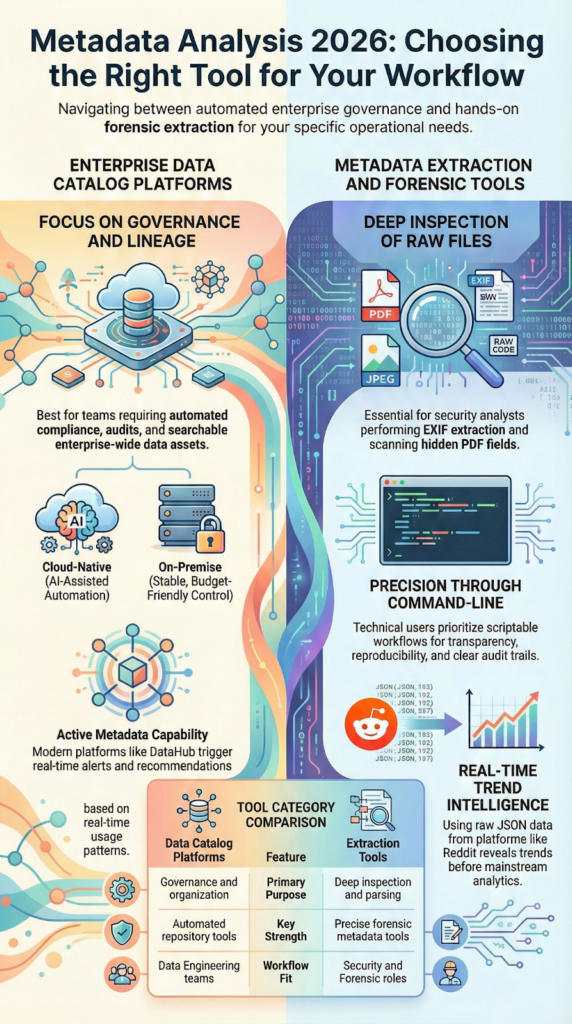
The market splits into two camps. First, all-in-one data catalog platforms that organize, govern, and track lineage across datasets. Teams rely on them for compliance, audits, and searchable data assets that quietly run in the background.
“Apache Atlas enjoys a special status amongst all the open-source data cataloging tools… [It is] best for organizations with significant technical resources that want to build a customized governance solution. In contrast, modern platforms like DataHub and OpenMetadata focus on ‘active metadata’, metadata that can trigger alerts, updates, and recommendations based on real-time usage.” – Atlan guide on open-source data catalog tools
Second, hands-on metadata extraction tools built for deep inspection. They focus on raw files, hidden fields, and forensic detail rather than dashboards, making them highly effective for identifying communication patterns metadata within complex datasets and investigations.
- Extract EXIF data from large image sets
- Parse hidden metadata in PDFs or suspicious files
- Use command-line tools for precise control
Most teams use both: catalogs for governance, extractors for investigation and evidence.
| Category | Primary Purpose | Key Strength | Typical Use Case | Workflow Fit |
| Data Catalog Platforms | Governance, lineage tracking, and data organization | Strong automation and searchable metadata repository tools | Compliance audits, enterprise data governance, and data discovery platforms | Best for data governance and engineering teams |
| Metadata Extraction Tools | Deep inspection and structured metadata analysis | Precise metadata parsing software and metadata inspection tools | Forensic analysis, EXIF extraction, and hidden metadata scanning | Best for security analysts and technical investigators |
How Leading Platforms Stack Up on Paper

Comparison tables help, but daily use tells the real story. In 2026, metadata platforms generally fall into three groups based on deployment and purpose.
“Alation, Collibra, and Informatica provide enterprise-grade features with robust data governance, integration, and compliance management… While Alation focuses on intelligent data discovery and user-friendly collaboration, Collibra excels in environments where governance rigor is the primary driver, often used by large enterprises with strict regulatory or compliance needs.” – DevOpsSchool comparison of enterprise metadata tools
- Cloud-native, AI-assisted tools: connect to warehouses and BI stacks, auto-tag data, detect schema changes, and suggest relationships.
- On-premise platforms: stable, budget-friendly, strong for governance, lineage mapping, and business glossaries.
- Open-source and forensic tools: flexible and powerful, but require skill, setup time, and ongoing maintenance.
Cloud tools favor automation, on-premise options favor control, and open-source tools reward technical teams needing deep, customizable analysis.
Why Reddit Data Becomes Your Secret Trend Engine

Reddit offers a different kind of signal: live conversation metadata. By adding /.json to a thread URL, you can access structured data like comments, timestamps, and votes, which reflect how people actually discuss problems and support deeper understanding network metadata analysis across real user discussions.
- Turn discussions into grounded content angles
- Notice recurring questions and evolving concerns
- Capture natural language your audience already uses
When analyzed thoughtfully, this data helps teams understand sentiment and intent in context. It doesn’t replace traditional research or other tools, but it complements them by adding real-time, human-centered insight to SEO and content planning.
The Forensic Mindset Versus Dashboard Hype
Credits: Palle de Groot-Poulsen
In technical and OSINT circles, there’s a preference for tools that show raw metadata rather than only polished summaries. Command-line utilities and scriptable workflows are valued because they provide transparency, reproducibility, and clear audit trails, particularly when utilizing network metadata session records for verification and investigation.
- Direct access to complete, unfiltered metadata
- Exportable data for verification and documentation
- Detailed logs that support audits and investigations
Dashboards and automated platforms still have their place, especially for scale and accessibility. But for compliance, security, or deep analysis, many teams prioritize tools that balance visualization with full access to the underlying data and traceable workflows.
Picking Your Tool: A Workflow-First Approach
Start with your real workflow, not feature lists. Think about where you lose time: searching datasets, tagging files, or tracing pipeline changes. Those friction points point to the right type of tool.
- SEO and marketing teams often need fast analysis, integrations, and scalable metadata insights.
- Data governance and engineering teams prioritize automation, lineage, and reliable cataloging.
- Security and forensic roles usually prefer precise extractors, scripts, and flexible toolkits.
Most teams benefit from a mix. The goal isn’t the most advanced platform, but one that fits your daily processes and reduces manual effort without overcomplicating your stack.
FAQ
How do I choose the right metadata analysis software for my organization?
You should begin by identifying your primary objective, such as compliance, visibility, or automation. Effective metadata analysis software must integrate smoothly with metadata management tools, data catalog platforms, and data governance tools. It should also support automated metadata analysis, metadata visualization tools, and data lineage tools. These features provide clear insight into data flow, improve traceability, and enable more informed and consistent decision-making.
What features matter most in metadata management tools for large datasets?
The most important features include metadata indexing tools, metadata repository tools, and strong metadata lifecycle management. Reliable metadata management tools should also offer metadata classification software, metadata enrichment tools, and metadata validation software. When combined with data profiling tools and big data metadata tools, these capabilities help maintain data structure, improve data quality, and ensure scalable handling of both structured and unstructured data.
How do metadata tracking systems improve data governance and compliance?
Metadata tracking systems improve governance by creating transparent records of data changes and usage. They support metadata auditing software, metadata compliance tools, and metadata audit trail tools to ensure accountability. In addition, metadata compliance monitoring and metadata policy management help enforce internal and regulatory standards. This structured approach strengthens metadata security analysis and aligns with established metadata governance frameworks for consistent oversight.
Can AI metadata analysis tools enhance data discovery and intelligence?
AI metadata analysis tools significantly enhance data discovery by automating pattern detection and classification. They work alongside metadata mining software, metadata insight platforms, and data discovery platforms to reveal hidden relationships within datasets. When integrated with data intelligence platforms and metadata analytics platforms, they improve metadata tagging software and metadata optimization tools, which enables faster search, clearer organization, and more efficient data utilization.
How do metadata monitoring solutions support ongoing data quality and performance?
Metadata monitoring solutions support continuous data quality by tracking changes, anomalies, and performance metrics in real time. They integrate with data quality monitoring tools, data observability platforms, and metadata monitoring dashboards to provide consistent visibility. Using metadata diagnostics software, metadata performance analysis, and metadata evaluation tools, organizations can conduct accurate metadata risk analysis, maintain traceability, and ensure reliable reporting across data environments.
Your Next Step with Metadata Tools
The comparison ends with clarity, not a winner. The right tool should match your workflow, not force adaptation. Reflect on your last major data challenge, identify the tool category designed to solve it, and begin your trial there. The best choice feels like finally using the right solution for a long-standing problem. Get started with NetworkThreatDetection.com to model threats, prioritize risks, and strengthen defenses with real-time intelligence and automated analysis.
References
- https://atlan.com/open-source-data-catalog-tools/
- https://www.devopsschool.com/blog/top-10-metadata-management-tools-in-2025-features-pros-cons-comparison/