

Predictive threat analytics flips cybersecurity from reaction to foresight, using AI to study your systems and flag trouble before it turns into a breach.
Instead of waiting for alerts about known malware, it watches patterns over time, learns what “normal” looks like, and calls out the quiet, early signals of new and unknown threats.
That means fewer surprises from known patterns, with reduced but not eliminated blind spots, and more control over how you respond. If you’re ready to move from chasing alerts to actually anticipating risk, keep reading to see how this approach can anchor your next stage of cyber defense.
Key Takeaways
- AI identifies subtle behavioral anomalies that signal future attacks.
- It prioritizes risks dynamically, cutting through alert noise significantly cutting through alert noise while requiring tuning.
- The system continuously learns, adapting to new attacker methods.
The Problem with Waiting for an Alarm
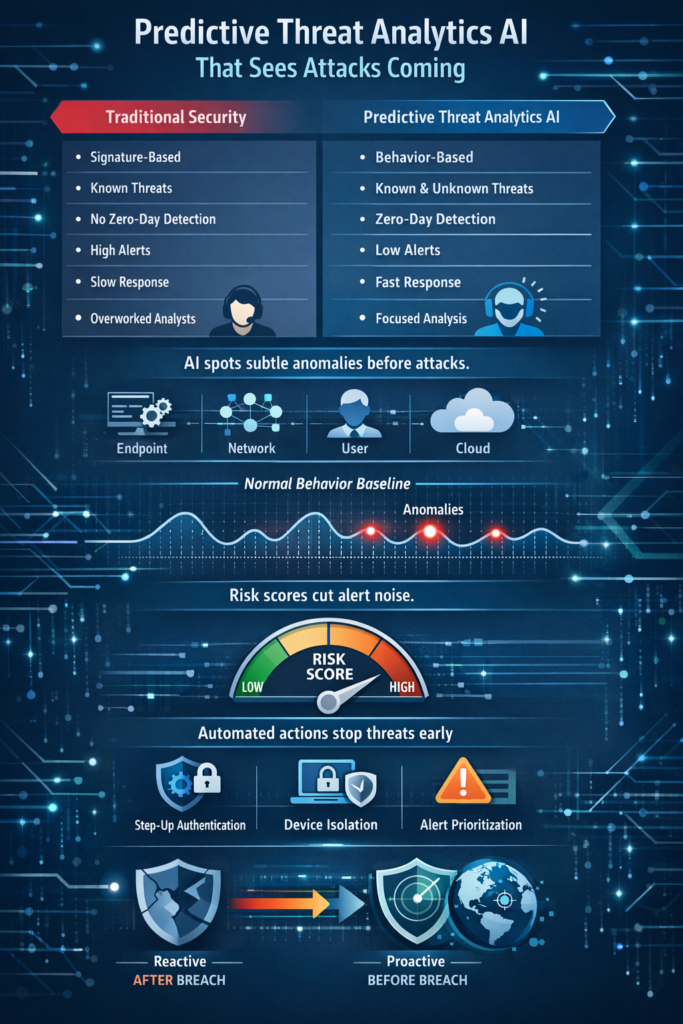
Imagine a security guard who only reacts after a window is smashed. That is traditional cybersecurity. It relies on signatures, known patterns of malicious code.
The problem is, attackers are not using the same old code. They are constantly innovating. By the time a new threat is identified and a signature is created, the damage might already be done [1].
This reactive model creates a dangerous lag, a window of vulnerability that sophisticated attackers exploit with ease. The cost of this delay is measured in millions of dollars and irreparable reputational harm.
You cannot defend against what you do not know. Signature-based systems are blind to zero-day exploits and novel attack vectors.
They generate a flood of alerts, many of them false positives, which overwhelm security teams. Analysts spend their days sifting through noise, often missing the truly critical signals buried within.
This alert fatigue is a real and present danger, leading to missed detections and extended breach lifecycles. The digital battlefield has evolved, but the defenses have not kept pace.
Predictive threat analytics addresses this fundamental flaw. It does not look for what is known to be bad.
It looks for what is abnormal, for behaviors that deviate from an established baseline. This approach is inherently more flexible and intelligent.
It is based on the principle that attacks leave traces long before the main event, like tremors before an earthquake. Detecting those tremors is the key to prevention. This shift is not just an upgrade, it is a necessary revolution in how we think about security.
- Signature Dependency: Relies on known malicious patterns.
- Alert Overload: Generates high volumes of false positives.
- Zero-Day Blindness: Cannot detect novel, unpublished attacks.
The goal is to stop the crime before it happens, not just report on it afterwards.
| Aspect | Traditional Security | Predictive Threat Analytics AI |
| Detection method | Signature-based and rule-driven | Behavior-based and data-driven |
| Threat visibility | Known threats only | Known and unknown threats |
| Zero-day detection | Very limited | Strong through anomaly detection |
| Alert volume | High, noisy, many false positives | Reduced through risk scoring |
| Response timing | After compromise | Before or early in the attack |
| Analyst workload | Manual review and alert fatigue | Prioritized and focused analysis |
How AI Learns Your Digital Normal
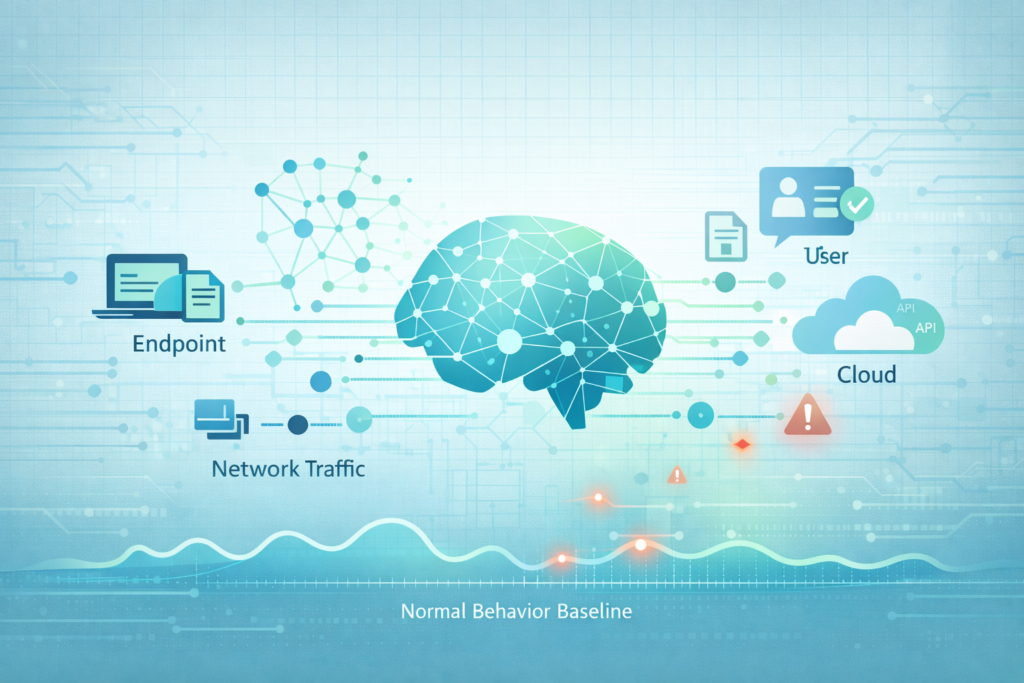
Every network has a rhythm, even if it feels chaotic up close. The power of machine learning and AI’s real job is to listen to that rhythm long enough that it can tell when something sounds off. The base layer is data. A lot of it. The system pulls telemetry from across your environment:
- Endpoint behavior (processes, file changes, USB use)
- Network traffic (flows, destinations, ports, volumes)
- User activity (logins, MFA prompts, privilege use)
- Cloud and SaaS access (APIs, admin actions, session details)
All of this becomes fuel. Not for one big guess, but for building a picture of what “normal” actually looks like in your world, not some generic template. For each entity, the AI shapes a baseline:
- For a user:
Typical login hours, usual locations, regular devices, and the applications they touch most days. - For a server:
Common internal and external connections, normal bandwidth ranges, and routine process behavior. - For an application:
Usual API call patterns, expected error rates, and standard usage peaks.
That baseline isn’t frozen. It shifts as your business shifts, new tools, new schedules, new teams, so the model doesn’t panic every time something changes for a valid reason.
Once that living baseline is in place, the real pattern-spotting begins. The system watches live data, scanning for behavior that doesn’t fit the learned norm. On their own, some events might look harmless:
- A login from a foreign country at 3 a.m.
- A server reaching out to an external IP it’s never contacted before.
- A process suddenly spiking CPU on a workstation.
- An internal host starting a quiet scan of nearby machines.
Any one of these might be explainable. Combined, or lined up in a certain order, they can start to mirror the early stages of an attack: recon, credential misuse, lateral movement, data staging.
That’s where correlation matters more than any single event. Under the hood, different types of models handle different angles:
- Supervised learning trains on labeled historical data, past incidents, known malware behavior, real compromise timelines. It learns what “bad” has looked like in your environment and others.
- Unsupervised learning doesn’t wait for labels. It clusters behavior, surfaces outliers, and spots strange groupings that no one has named yet, useful for zero-days or new tactics.
Together, they let the system catch both familiar patterns and weird, first-time behavior that still smells wrong.
In a sense, the AI is learning the language of your business so it can tell when someone starts speaking with an attacker’s accent. All of this runs at a speed and scale no human team can match. The models chew through:
- Millions of events per second across capable systems, prioritizing data quality
- Across identity, endpoint, network, and cloud data
- While tracking relationships over time, not just one-off blips
A single failed login in HR is boring. A failed login in HR, followed by unusual outbound traffic from a marketing laptop, plus a spike in privilege use on a file server, that’s a story.
The AI doesn’t just see the dots, it connects them across domains that are usually siloed in separate tools and dashboards. The end result isn’t just a wall of alerts. The system turns its findings into risk scores for entities:
- Users
- Devices
- Applications
- Service accounts
- Even specific sessions or processes
Those scores shift in real time based on what’s happening and how serious it looks. A higher score means “look here first.” That kind of prioritization is where predictive analytics becomes practical, not just impressive. It lets your analysts:
- Focus on the highest-risk users or assets
- Triage faster with richer context baked into each alert
- Spend more time hunting and less time clicking through noise
You’re not replacing human judgment. You’re giving it a map, with the trouble spots already circled in red.
From Forecast to Action: Stopping Attacks Early
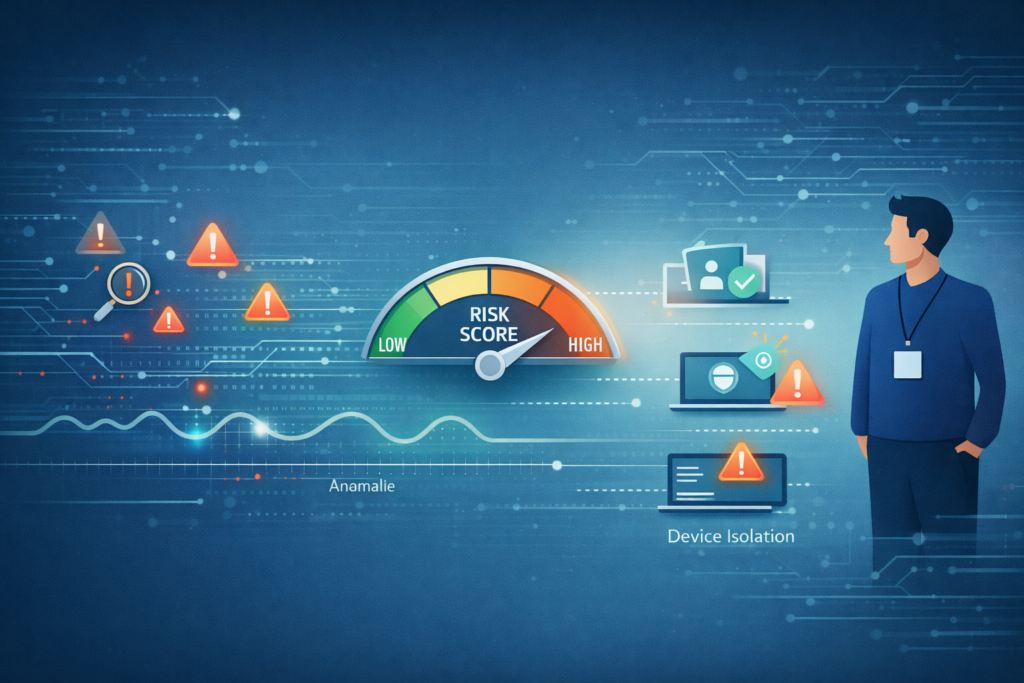
What good is a prediction if you cannot act on it? The true power of this technology lies in its integration with response workflows.
A key feature is the AI-powered threat intelligence that enhances situational awareness and automates response based on enriched context.
A high risk score can trigger automated or semi-automated actions designed to contain a potential threat before it escalates.
For example, if a user account exhibits behavior highly indicative of a compromise, the system can automatically enforce step-up authentication, requiring a second factor to proceed. This simple action can often block an attacker early, pending human review.
In more severe cases, the system might temporarily isolate a suspicious device from the network. This containment strategy, often called network segmentation, prevents lateral movement.
It stops an attacker who has gained a foothold on one machine from spreading to more critical systems.
This dramatically reduces the potential “blast radius” of an attack. Instead of a company-wide breach, you might have an isolated incident on a single, non-critical workstation. The difference in impact is monumental.
These actions are not taken blindly. They are guided by the enriched context provided by the AI. The system does not just say “this is bad.” It explains why. It might show that the suspicious activity matches a known ransomware precursor pattern from an external threat intelligence feed.
This context allows security operators to make informed decisions quickly, whether they are approving an automated action or launching a manual investigation. It builds trust in the system, which is essential for adoption.
- Automated Containment: Isolate devices or block network traffic.
- Step-Up Authentication: Require additional verification for risky logins.
- Alert Prioritization: Route high-risk alerts to the top of the analyst queue.
The system also enhances threat hunting. Instead of searching blindly, hunters can use the AI’s predictions as a starting point.
They can query the system for all entities showing signs of a specific attack technique, like credential dumping or lateral movement.
This makes threat hunting more efficient and targeted. It is a force multiplier for your most skilled security personnel, allowing them to focus their expertise where it is most likely to find real threats. The technology does not replace humans, it empowers them.
Making It Work For You
Most security teams don’t fail because of a lack of tools, they struggle because the tools don’t really work together, or they’re running half-blind.
A critical challenge is training ML security models effectively to handle evolving threats and concept drift. Predictive threat analytics is no exception. It only works when the basics are solid.
The first anchor is data. You need wide, honest visibility across your environment. If you’re only pulling logs from a slice of your servers or skipping cloud workloads, the AI is effectively guessing with one eye closed.
And it’s not just about volume. Data quality matters just as much. Incomplete, noisy, or inconsistent logs make it hard to build a clean baseline of “normal,” and that leads to predictions you can’t trust. So before anyone turns on a model, you tighten the data foundation:
- Inventory where your logs actually come from (servers, endpoints, cloud, SaaS, identity).
- Fix gaps: missing sources, short retention windows, or broken log forwarding.
- Normalize formats so similar events look the same across systems.
- Monitor data health: dropped events, time sync problems, or duplicated records.
Once the pipeline is stable and broad, the AI has something real to learn from. The next step is making sure this doesn’t become just another box in the corner.
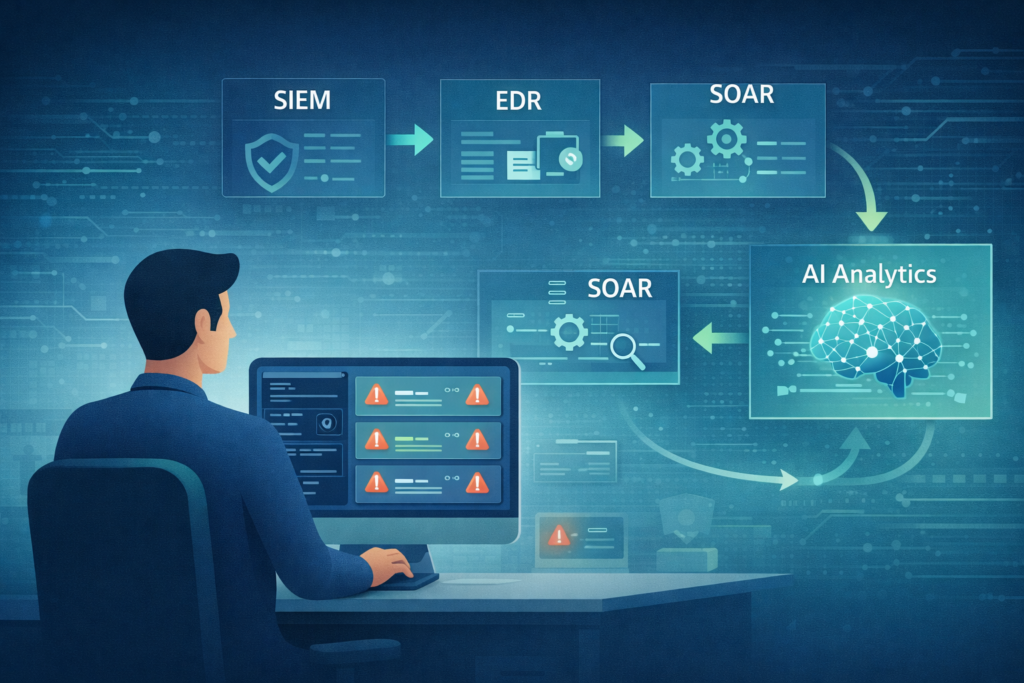
Integration is where predictive analytics either helps your team, or just adds more dashboards no one checks. The system should plug into what you already use, your SIEM, your EDR tools, your SOAR or orchestration platform, so the predictions can turn into real actions. You want a loop, not islands:
- Predictions feed into your SIEM as enriched alerts or risk scores.
- High-risk events can trigger EDR actions (like isolating a host or killing a process).
- Your SOAR playbooks can kick off automated investigations based on model output.
- The outcomes of those actions, true positive, false positive, missed context, flow back into the model as feedback.
When that loop runs well, the technology stops feeling like a novelty and starts to feel like part of the normal SOC rhythm.
There’s also the question of trust. Governance and explainability are where that trust is built. If the AI flags a user as high risk, your analysts need to see why, unusual login locations, off-hours access, sudden privilege use, or a sharp change in behavior compared to their own baseline.
Without that, the model becomes a black box, and people will quietly ignore it. Two principles help here:
- Explainability: Analysts can drill into the specific signals, events, or patterns behind a prediction.
- Oversight: Humans review and approve significant actions, especially early on (account lockouts, network blocks, or changes to policies).
This human-in-the-loop model keeps accountability clear and gives your team room to adjust thresholds, correct mistakes, and tune the system with real-world judgment.
Trying to predict every type of attack on day one is a recipe for frustration. A focused starting point works better. Pick a single, high-impact use case where prediction can actually change outcomes. For example, you might:
- Start with identity security:
Use predictive analytics to forecast likely account compromise based on behavior, login patterns, and device context. - Then expand to network anomaly detection:
Spot unusual east–west movement, odd data transfers, or new communication paths inside the network. - Later, move into application security:
Flag abnormal API calls, access sequences, or usage spikes that don’t match typical app behavior.
This phased rollout gives your team space to adapt, measure, and iterate. It also proves value early, which makes it much easier to justify deeper integration and more ambitious use cases.
The real goal here isn’t a perfect system. It’s a security operation that keeps learning, catching more subtle threats over time, and wasting less effort on noise. Predictive analytics just becomes the engine that makes that learning faster and more consistent.
Your Proactive Defense Blueprint
Credits: Covenant Technology Solutions, Inc.
Predictive threat analytics doesn’t feel sci-fi anymore, it feels necessary. It’s already changing how security teams work, shifting defense from constant firefighting to something closer to weather forecasting. Instead of staring at alerts after the storm hits, you start to see the clouds forming.
By learning what “normal” looks like in your network, these systems can flag the quiet, early signals of an attack, the odd login pattern, the strange data access, the small change in timing, before they swell into a full-blown incident [2].
The goal isn’t to replace your analysts or engineers. It’s to give them sharper instincts, backed by data, so they’re not always stuck reacting when it’s already too late.
The real turning point is this move from reactive to proactive defense. That shift, more than any shiny new tool, is what pulls your security program into the present. You can start in a grounded, methodical way:
- Check how much visibility you truly have into your data and traffic.
- Map where logs are missing or incomplete.
- Make sure you can actually feed consistent data into any AI system.
- Pick one focused use case (like failed logins or lateral movement) instead of trying to solve everything at once.
- Measure the impact: fewer false positives, faster detection, better triage.
From there, you expand. Add more data sources, refine the models, tighten your response playbooks. You don’t need a grand, all-or-nothing rollout. You need a working loop: observe, learn, adjust, repeat.
Attackers are already experimenting with automation and AI-assisted attacks. They’re not waiting for anyone to catch up. So the real question is whether your defenses are learning as quickly as your adversaries are.
FAQ
How does predictive threat analytics AI know an attack is coming early?
Predictive cybersecurity analytics uses AI threat prediction and machine learning threat detection to learn normal system behavior.
It applies behavioral threat analytics, anomaly detection algorithms, and threat pattern recognition to find unusual changes. With predictive security intelligence, cyber threat forecasting, and future attack modeling, teams build proactive cyber defense instead of reacting after damage occurs.
What data does predictive threat analytics AI need to work well?
Predictive threat analytics AI needs data-driven threat analysis from logs, user activity, networks, cloud systems, and endpoints.
Predictive user behavior analytics, security behavior modeling, and predictive network analytics create strong context. AI-driven risk analysis, cyber risk modeling, and predictive vulnerability analysis support accurate attack surface prediction and reliable security risk prediction.
How is predictive threat analytics AI different from regular monitoring tools?
AI-powered security monitoring looks beyond simple alerts. AI anomaly detection systems, threat intelligence analytics, and AI threat correlation enable predictive intrusion detection and predictive malware detection.
Unlike static tools, adaptive security analytics and real-time threat forecasting support advanced threat prediction, predictive ransomware detection, and predictive breach analytics before attackers spread.
Can predictive threat analytics AI help security teams respond faster?
Predictive SOC analytics connects insights directly to predictive incident response. AI-enhanced security operations use AI-powered threat scoring, predictive endpoint security, and predictive attack analytics to guide fast action.
AI-based threat hunting and predictive threat visibility help analysts focus on real risks, while cyber defense prediction models reduce delays and confusion.
What risks can predictive threat analytics AI help reduce?
It helps reduce cyber attack prediction gaps, predictive fraud detection failures, and cyber anomaly forecasting errors.
With AI-based cyber forecasting, AI-driven threat insights, threat anticipation models, and threat trend analysis, teams improve predictive network analytics and AI-enabled security prediction, lowering missed threats and reducing business disruption.
Staying Ahead of the Next Attack
Predictive threat analytics doesn’t promise a world without risk, it delivers something more valuable: time and clarity.
By learning continuously, surfacing early signals, and sharpening response with every interaction, security teams gain momentum against attackers who never stop adapting. In an environment defined by speed and uncertainty, foresight becomes the real advantage.
Ready to move from reactive defense to proactive insight? Join the predictive security advantage.
References
- https://www.sentinelone.com/blog/what-is-a-malware-file-signature-and-how-does-it-work/
- https://www.meegle.com/en_us/topics/predictive-analytics/predictive-analytics-in-cybersecurity-analytics