
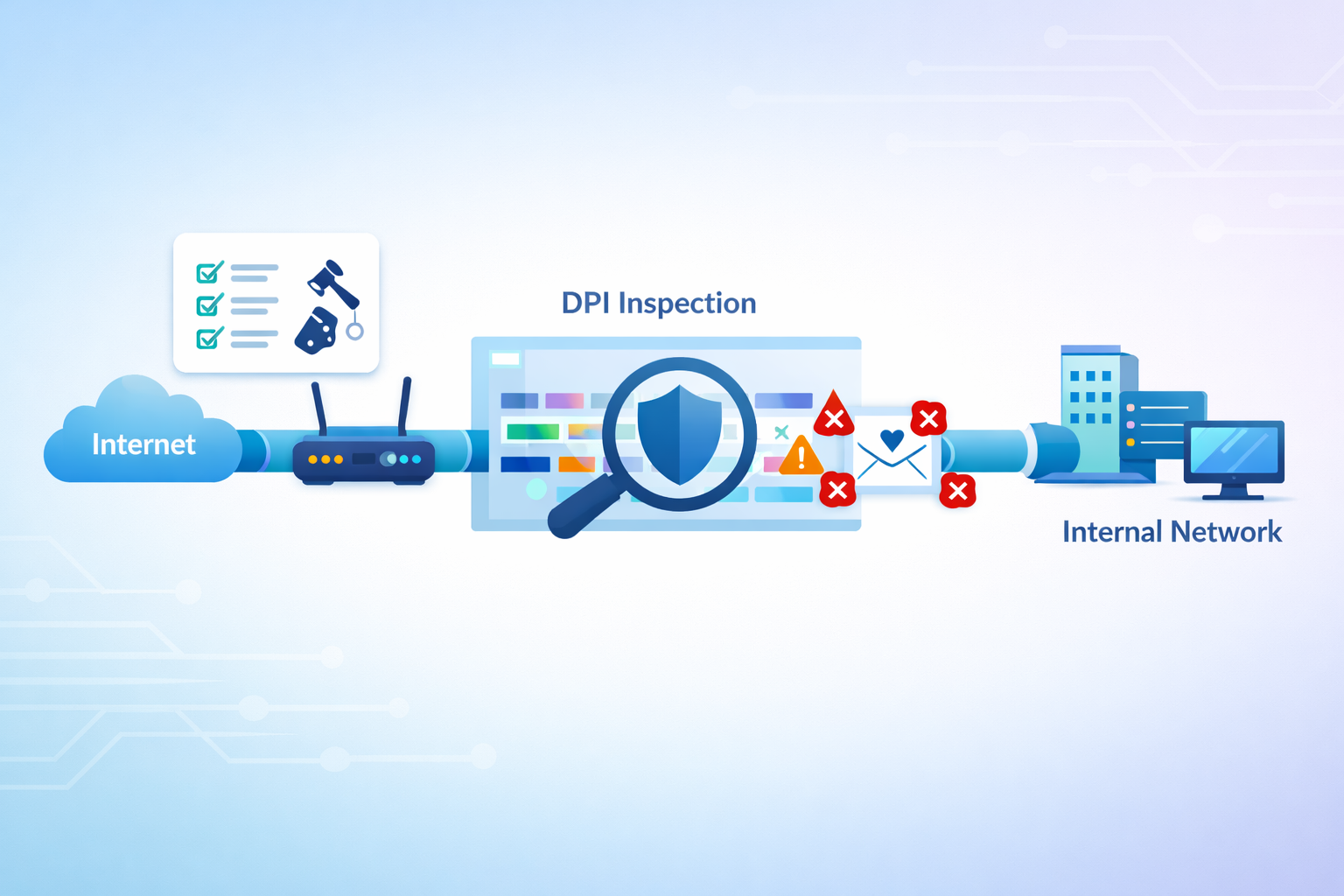
Deep Packet Inspection (DPI) is like opening the box, not just staring at the label on the outside. While basic firewalls only scan packet headers, DPI actually inspects the payload, looking closely at what’s being sent and received across your network.
That deeper view lets security teams spot malware patterns, data exfiltration attempts, and policy violations before they turn into full incidents.
Instead of waiting to react after damage is done, DPI helps you stop threats at the threshold. If you want to see how this changes your whole security posture, keep reading.
Key Takeaways
- DPI analyzes the full content of data packets, not just headers, for true threat visibility.
- It enables real-time enforcement of security policies and data loss prevention.
- Effective DPI requires managing performance impact and encrypted traffic challenges.
The Digital Siege and the Limits of the Moat
The modern network is under constant siege. Threats don’t just knock on the front gate anymore, they slip through cracks, disguised as legitimate traffic.
Traditional security, the kind that only looks at where a packet is coming from and going to, is like a castle moat [1].
It’s useful, but it can’t stop someone who has already made it across the drawbridge. The real danger lives inside the packets themselves, in the application data and protocol commands. This is the domain of Deep Packet Inspection. It’s the sentry who patrols the castle halls, not just the walls.
You need a tool that can understand context. A simple port number might say “web traffic,” but DPI can tell if it’s a legitimate business application or a hidden command-and-control channel for a botnet.
This shift from shallow to deep inspection is fundamental. It’s what separates basic network filtering from intelligent security enforcement. Without it, you’re operating with a significant blind spot.
- Identifies applications accurately, regardless of the port they use.
- Detects threats hidden within encrypted tunnels like HTTPS.
- Enforces policies based on actual content, not just network addresses.
DPI provides the context needed to make intelligent security decisions. It moves beyond simple allow/deny lists into the realm of behavioral and content-aware control.
What Deep Packet Inspection Actually Does
Credits: Security First Corp
Deep Packet Inspection (DPI) is basically the point where “looking at traffic” turns into “understanding traffic.”
Instead of just checking where packets are coming from and where they’re going, DPI breaks them open and studies what’s inside as they pass through a firewall or a dedicated security device.
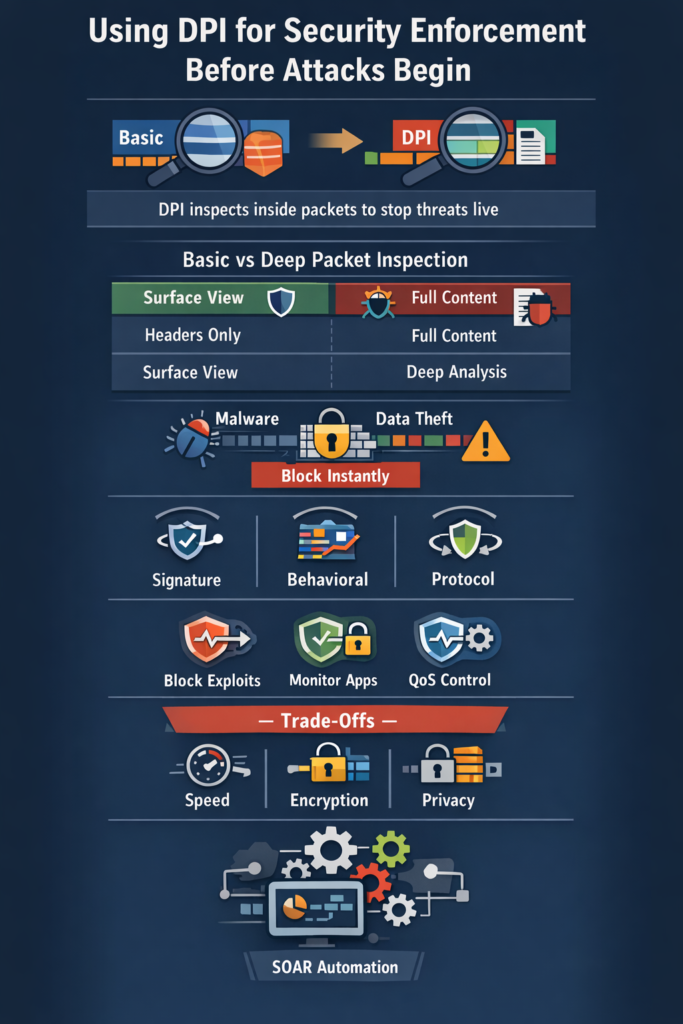
Basic inspection focuses on packet headers: source IP, destination IP, port numbers. DPI goes deeper. It examines the payload, the actual data being moved. That extra layer of visibility lets it:
- Identify which application is generating the traffic
- Confirm which protocols are actually being used, this application awareness is what separates DPI from basic filters and enables intelligent security enforcement.
- Detect malicious signatures or suspicious patterns in the data stream
So, what looks like “just HTTPS on port 443” can be recognized as a specific app, a file transfer, or a command-and-control channel pretending to be normal traffic. To pull this off, DPI leans on a mix of detection techniques, each one aimed at a different kind of risk:
- Signature-based inspection
Compares packet contents with a library of known threat fingerprints, things like virus patterns, exploit payloads, or known command strings used in attacks. - Behavioral analysis
Watches for abnormal activity over time, like a server that suddenly starts pushing out large volumes of data, or a client talking to an IP address it has never touched before. - Protocol analysis
Checks whether a protocol is being used the way it’s supposed to be. This is where abuses like DNS tunneling show up, when attackers hide data inside what should be simple DNS queries.
Underneath all of that is a simple goal: enforcement. DPI helps decide whether to allow, block, or log traffic based on what it truly is, not what its header suggests.
That difference matters when attackers try to disguise malicious actions inside trusted channels, or when risky behavior hides under a harmless-looking service.
The real strength of DPI shows up in everyday scenarios that most users never see. It can tell when what appears to be normal web browsing is actually an employee quietly pushing a sensitive customer list to a personal cloud account.
It can notice the slow, careful patterns of an advanced persistent threat moving laterally inside the network, where everything seems fine on the surface.
That kind of awareness is why DPI sits at the heart of many next-generation firewalls and intrusion prevention systems. It’s the engine that makes content-aware policies possible, policies that don’t just say “block port X” but instead say:
- Block known exploit payloads, even over allowed ports
- Flag uploads containing regulated data types
- Allow only approved apps for specific users or segments
By turning raw traffic into understandable context, DPI gives security teams a clearer view of what their network is actually doing, not just what it claims to be doing.
| Aspect | Basic Packet Inspection | Deep Packet Inspection (DPI) |
| Inspection depth | Packet headers only | Full packet payload analysis |
| Visibility level | Limited to IPs and ports | Application layer (Layer 7) visibility |
| Application awareness | Cannot reliably identify applications | Accurately identifies applications regardless of port |
| Threat detection | Misses hidden or disguised threats | Detects malware, policy violations, and suspicious behavior |
| Policy enforcement | Based on addresses and ports | Based on actual content and behavior |
| Effectiveness against evasion | Low | High |
Stopping Intrusions and Data Theft in Real-Time
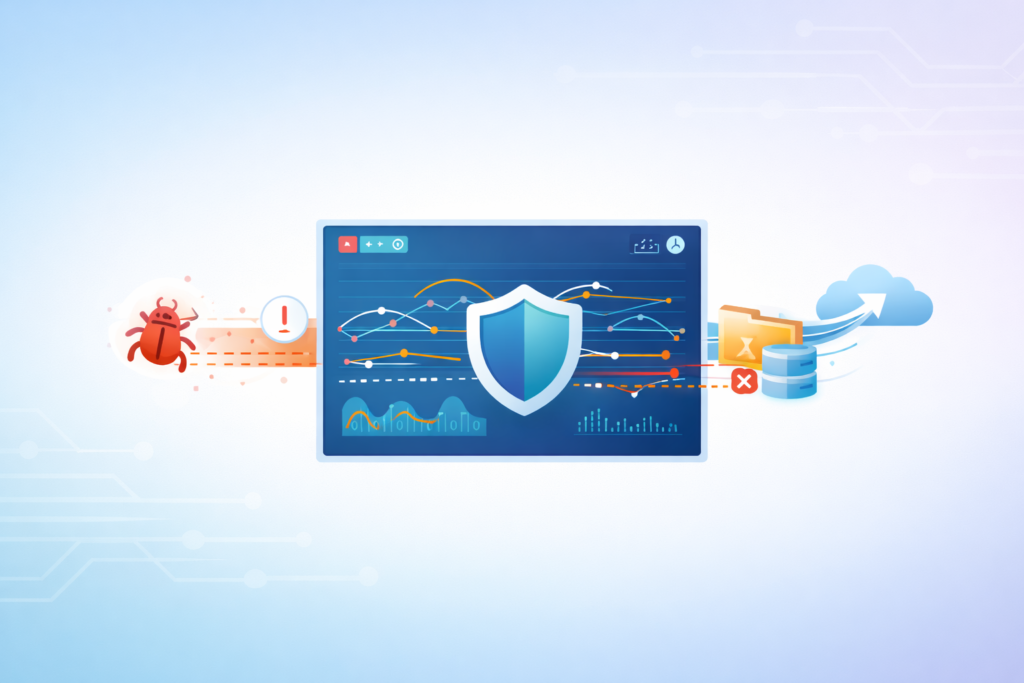
Perhaps the most critical application of DPI is in threat detection and prevention. By examining packet payloads, DPI can identify and block malicious activity that would otherwise pass unnoticed.
For example, it can detect the code of a new piece of malware being downloaded onto a user’s machine, even if that malware has never been seen before, by recognizing its behavior.
It can identify a distributed denial-of-service (DDoS) attack in its early stages by analyzing the volume and type of requests flooding a server, allowing for mitigation before services are disrupted.
This proactive approach aligns with a comprehensive threat detection strategy, strengthening intrusion prevention and reducing the window for attackers to cause damage.
Data Loss Prevention (DLP) is another powerful use case. DPI can be configured with policies to scan all outbound traffic for specific patterns, like credit card numbers, social security numbers, or proprietary source code.
If it detects an unauthorized transfer of this sensitive information, it can block the packet immediately, preventing a potentially catastrophic data breach.
This enforces a zero-trust model at the data level, ensuring that even if an attacker gains access to a system, they cannot easily exfiltrate its valuable data.
The real-time nature of this enforcement is what makes it so effective. It’s not about generating an alert for an analyst to investigate later, it’s about stopping the threat inline, as it happens.
This proactive approach drastically reduces the window of opportunity for an attacker and minimizes potential damage. DPI acts as a highly knowledgeable, ever-vigilant gatekeeper for your most critical digital assets.
Enforcing Rules Beyond Simple Blocking
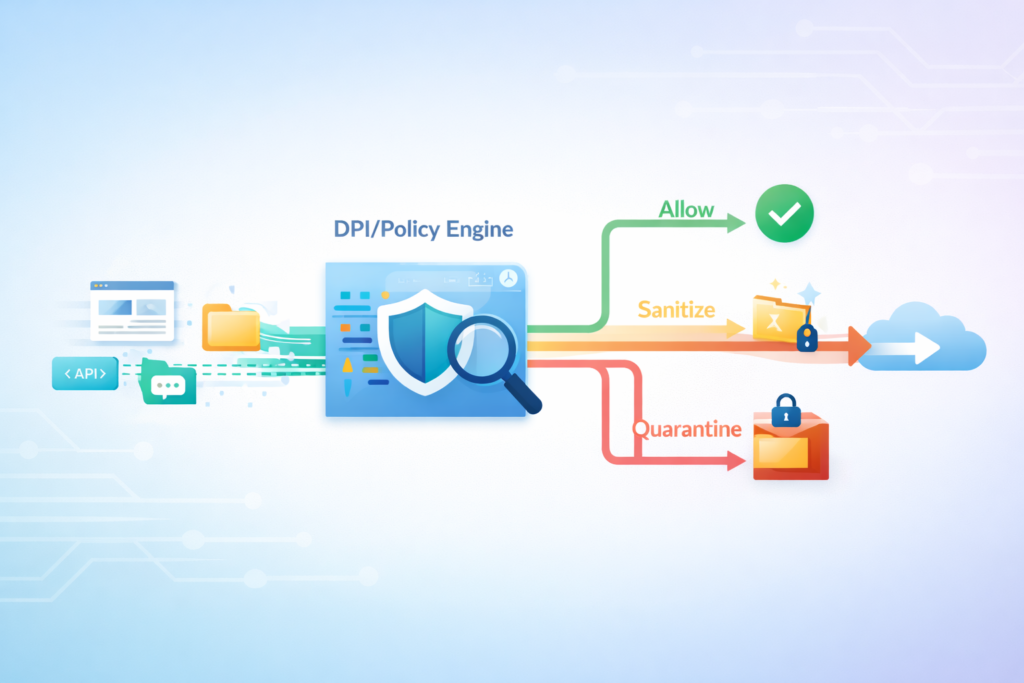
Security enforcement with DPI extends far beyond just stopping viruses. It’s about controlling the entire network environment according to business policies.
Consider an organization that needs to ensure productivity. DPI can enforce a policy that restricts access to social media platforms or streaming services during work hours, not by blocking the entire internet, but by intelligently identifying and limiting those specific applications [2].
In a Bring-Your-Own-Device (BYOD) environment, DPI can prevent the spread of spyware by blocking suspicious file uploads or connections from personal devices to known malicious domains.
Bandwidth management is another form of enforcement. DPI can identify bandwidth-heavy applications like video conferencing or large file transfers and apply Quality of Service (QoS) rules.
This ensures that mission-critical applications always have the necessary network resources, even during periods of high congestion. It’s a security measure in its own right, preventing resource exhaustion that could be caused by a misconfigured application or a deliberate attack.
This granular control, based on a deep understanding of the traffic, allows network administrators to create a secure, efficient, and policy-compliant digital workspace.
- Application-specific blocking for non-work-related software.
- QoS prioritization to ensure critical apps have the bandwidth they need.
- User activity monitoring to detect insider threats or policy violations.
These policies create a layered defense, where security is woven into the normal operation of the network.
The Inevitable Trade-Offs and Challenges
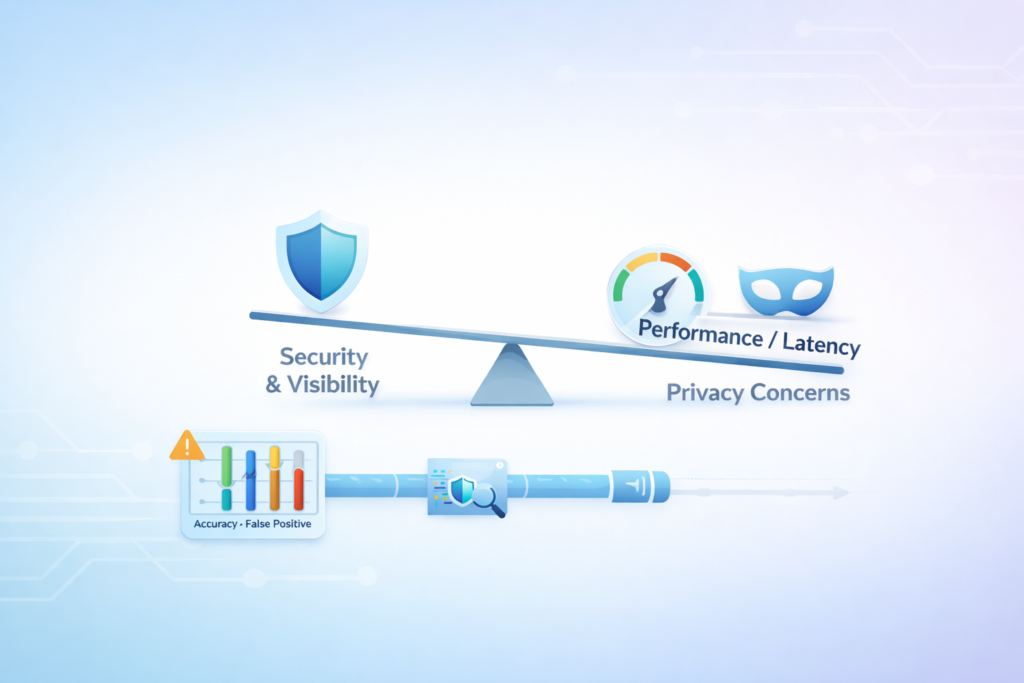
No security technology is a silver bullet, and DPI is no exception. Its primary strength, deep analysis, is also the source of its main weakness: performance impact. Examining the contents of every single packet requires significant processing power.
In very high-traffic networks, this can introduce latency, slowing down legitimate business applications.
Modern DPI engines are heavily optimized to mitigate this, often using dedicated hardware, but it remains a consideration, especially for latency-sensitive environments like financial trading platforms.
Privacy is another significant concern. Because DPI looks inside packets, it can, in theory, see everything: emails, web browsing history, and file contents.
This raises obvious legal and ethical questions. The use of DPI for security enforcement must be clearly defined by organizational policy and comply with local regulations and employee agreements.
It should be used strictly for security purposes, not for indiscriminate employee surveillance. Transparency about its use is key to maintaining trust.
Then there’s the challenge of encryption. A large portion of internet traffic is now encrypted with SSL/TLS (the “S” in HTTPS). Basic DPI cannot see into this encrypted traffic; it’s just a scrambled stream.
To inspect it, the DPI device must act as a man-in-the-middle, decrypting the traffic, inspecting it, and then re-encrypting it before sending it on.
This requires the DPI appliance to hold the necessary security certificates, and it can be complex to implement without breaking applications. Furthermore, techniques like VPNs and increasingly strong encryption can be used to evade DPI entirely, a constant cat-and-mouse game in cybersecurity.
Making DPI Work for You
Deep Packet Inspection (DPI) works best when it’s treated as one piece in a larger security system, not as a lone hero. On its own, it can see a lot. Connected to other tools, it can act. That’s where it really starts to matter.
When DPI flags a policy violation or a potential threat, it doesn’t have to stop at an alert in a dashboard. Tied into a Security Orchestration, Automation, and Response (SOAR) platform, it can help trigger automated actions, such as:
- Triggering endpoint isolation via SOAR integration
- Blocking a malicious IP address across the network
- Updating firewall rules in real time
- Kicking off an incident-response workflow
Those kinds of responses can cut reaction time from minutes or hours down to seconds. The hard part isn’t just turning DPI on, it’s knowing what you want it to protect. That starts with a clear strategy:
- Which systems and services are truly critical to your business?
- Which data, if exposed, would cause legal, financial, or reputational damage?
- Which regulations apply to you, such as HIPAA for medical records or PCI DSS for cardholder data?
Your answers shape how you design and tune your DPI policies. Instead of scanning everything at full depth right away, a more practical path is to:
- Focus first on the most sensitive data flows (such as payment channels or patient information).
- Watch how those policies affect latency, throughput, and user experience.
- Adjust rules to reduce noise and false positives.
- Expand coverage step by step to more parts of the network.
This kind of gradual rollout helps you find a middle ground where security is strong but:
- Network performance stays usable
- Privacy expectations are respected
- Admins aren’t drowning in alerts
DPI can feel like a bright spotlight on your network’s behavior: what enters, what leaves, and what tries to move in ways it shouldn’t.
Handled carelessly, it can be heavy-handed. Handled thoughtfully, it turns into a quiet, steady guardian, watching your traffic, feeding context to your other tools, and giving you a much clearer view of what’s really moving through your digital space.
FAQ
How does using DPI for security enforcement differ from basic traffic filtering?
Using DPI for security enforcement goes beyond basic network traffic inspection that relies on IP addresses and ports.
It performs packet payload analysis and application layer inspection to achieve Layer 7 visibility. This allows accurate protocol identification and deep traffic visibility, so security policies are enforced based on actual content and behavior rather than connection metadata alone.
Can DPI detect malware hidden inside normal-looking network traffic?
Yes, deep packet inspection security detects malware in network traffic by examining packet contents as data moves across the network.
It uses signature-based inspection, behavioral traffic analysis, and anomaly detection in packets. This enables intrusion detection with DPI and strengthens intrusion prevention systems by identifying threats that hide within legitimate-looking sessions.
How does DPI support data loss prevention and compliance requirements?
DPI security enforcement supports data loss prevention DPI by inspecting outbound traffic for sensitive data detection patterns.
It enables content filtering enforcement, network policy enforcement, and compliance monitoring of network traffic. This approach helps organizations meet regulatory policy enforcement requirements by stopping unauthorized data transfers before sensitive information leaves the network.
What challenges does DPI face when inspecting encrypted traffic?
Encrypted traffic inspection challenges exist because SSL TLS inspection requires secure traffic decryption. DPI systems often rely on man-in-the-middle inspection to analyze encrypted payloads.
This process must be carefully managed to avoid performance degradation and privacy violations while maintaining visibility, especially in environments that rely on network security analytics and hybrid network inspection.
Can DPI improve visibility into advanced and internal threats?
Yes, DPI enables packet-level threat analysis that supports advanced persistent threat detection, command and control traffic detection, and lateral movement detection.
By combining real-time traffic monitoring, network forensics DPI, and insider threat monitoring, DPI identifies policy violations and internal attack activity that traditional perimeter defenses frequently fail to detect.
Proactive Security Starts with Deep Visibility
Deep Packet Inspection shifts security from guessing to knowing. By revealing what traffic truly contains, DPI empowers teams to stop threats, data leaks, and policy violations before damage occurs.
Its real value lies in context-aware enforcement that works in real time, not after the fact. When deployed carefully, balancing performance, privacy, and encryption challenges, DPI becomes a powerful force multiplier, strengthening firewalls, supporting automation, and turning network visibility into decisive, proactive defense. Integrate DPI strategically for proactive defense? Join now to unlock advanced DPI-powered security.
References
- https://www.paloaltonetworks.com/blog/2024/12/8-trends-network-security-in-2025/
- https://en.wikipedia.org/wiki/Deep_packet_inspection