
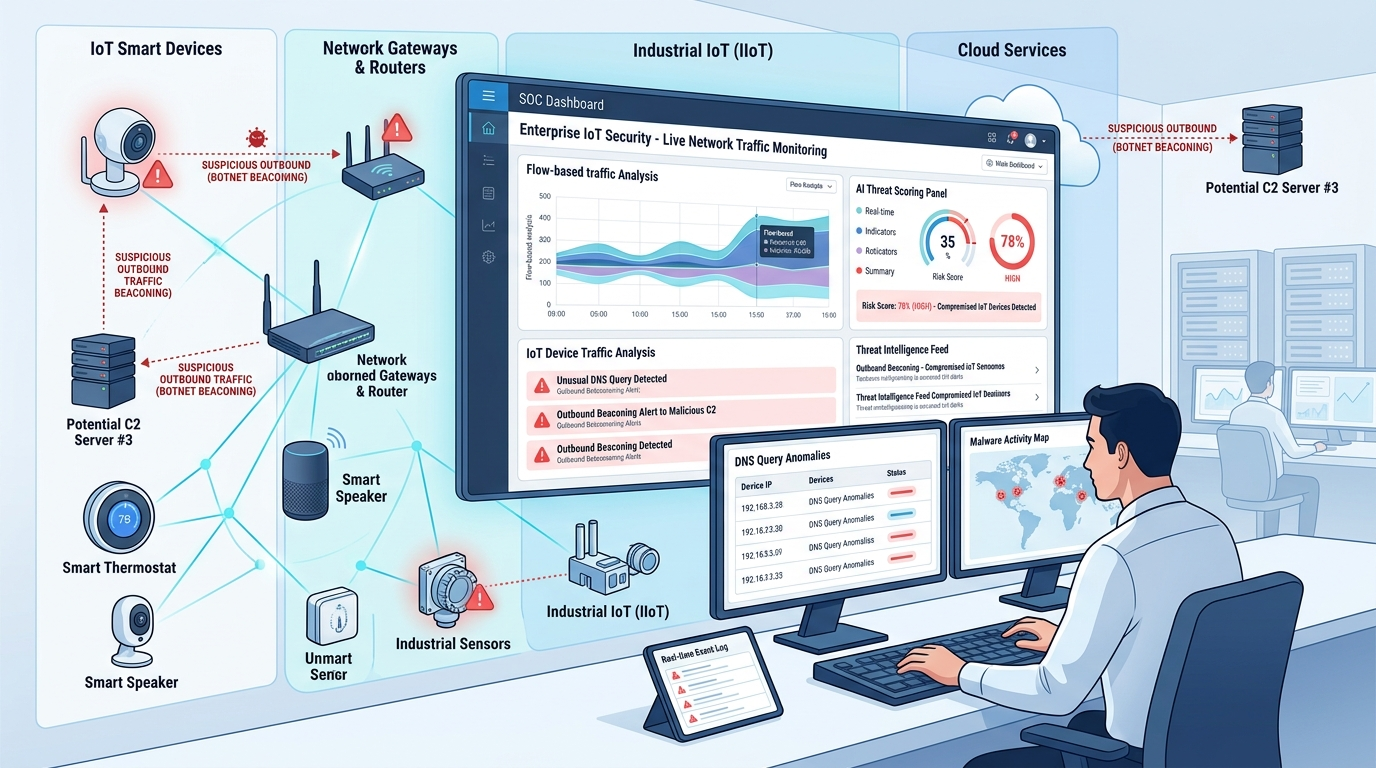
Detecting compromised IoT devices botnets requires monitoring for unusual traffic patterns, repeated outbound connections, and devices that suddenly behave differently. We have seen unmanaged cameras and routers generate low-volume beaconing traffic for days before security teams identified an infection.
Many modern botnets avoid immediate disruption and instead hide command-and-control traffic within normal DNS and HTTPS activity. At Network Threat Detection, we regularly find these warning signs before major incidents occur. Keep reading to learn which indicators matter most and how to detect infections earlier.
Early Warning Signs Security Teams Should Not Ignore
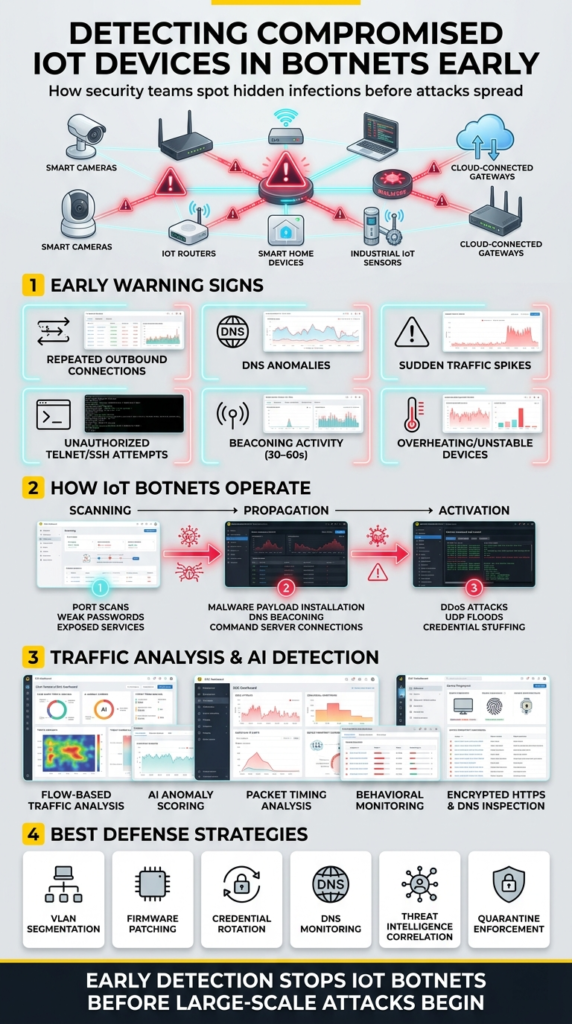
Modern IoT botnets often stay hidden by blending into normal traffic patterns. This guide explains how early detection, traffic analysis, AI monitoring, and segmentation help stop infections before they spread.
- Most IoT infections start with weak passwords, outdated firmware, or exposed services like Telnet.
- The first signs are often subtle traffic changes, like a device suddenly talking to dozens of unknown IPs.
- Flow-based monitoring can spot suspicious behavior within just a few packets during an early infection.
How IoT botnets take over devices
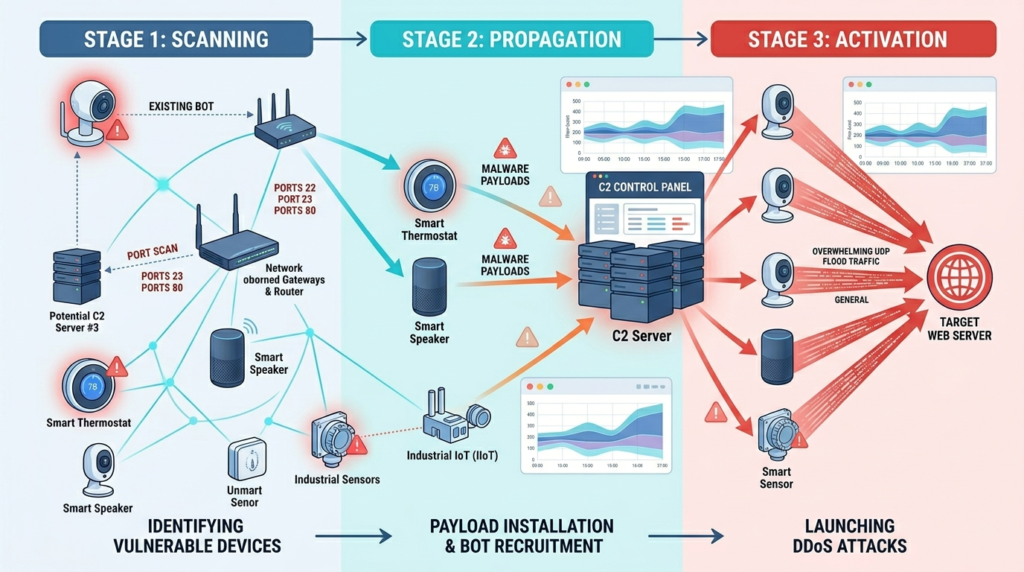
IoT malware spreads by scanning for vulnerable devices, installing malicious code, and linking those infected systems to a central command hub. Research shows most botnets aim for weak logins and exposed management services.
The first stage is usually automated scanning. The malware hunts for devices with Telnet, SSH, UPnP, or outdated APIs left open. These ongoing security challenges monitoring IoT devices continue to create easy entry points for large-scale infections
Next comes propagation. Malware like Mirai and Gafgyt installs small payloads that live long enough to set up outbound calls to command servers. In several of our investigations, we noticed compromised devices making outbound DNS requests every few seconds, long before any attack traffic showed up.
The final phase kicks off the actual attacks. The devices become “zombies” in a distributed botnet, ready to launch DDoS floods, credential stuffing, or new scanning campaigns.
IoT Botnet Infection Stages
| Stage | Activity | Common Indicators |
| Scanning | Searches for vulnerable devices | Port scans, repeated login attempts |
| Propagation | Installs the malware payload | Firmware changes, outbound beaconing |
| Activation | Executes the attacks | UDP floods, DNS anomalies, polling its command server |
A few weaknesses keep popping up in our reviews:
- Default credentials that nobody changed.
- Outdated firmware with known holes.
- Open Telnet or SSH ports.
- Weak API authentication.
- UPnP enabled on consumer gadgets.
That mix keeps feeding the lifecycle of modern IoT botnets, in both business and home networks.
What are the first signs of a compromised IoT device?
Credits: TECHtalk
A compromised IoT device usually starts acting odd before it joins any attack. It might send abnormal outbound traffic, repeat certain DNS lookups, or just behave differently. Guidance from agencies like CISA consistently points to unexpected network chatter as a prime warning.
One early indicator is anomalous traffic. A smart camera that normally talks to one cloud service might suddenly start contacting dozens of strange IP addresses. That shift is a red flag.
Another common signal is repeated beaconing. In our own network threat detection work, infected devices often created traffic spikes every 30 to 60 seconds while quietly waiting for remote orders.
Physical symptoms can appear too. Devices might overheat, reboot without reason, or slow down noticeably because malware processes are eating up resources in the background.
Security teams should watch for these early warnings:
- Too much outbound UDP or TCP traffic.
- Repeated DNS queries to shady domains.
- Unauthorized SSH or Telnet login tries.
- Communication with unknown outbound IPs.
- Sudden jumps in packet transmission rates.
- Unexpected firmware changes.
- Data being sneaked out through the IoT device.
In discussions about detecting the Mirai botnet, infected devices often produced high-volume SYN floods while preparing for a DDoS. Some attacks churn out millions of packets per second from a swarm of ordinary consumer hardware.
Two useful public resources for defenders are the guidance from CISA on IoT security and the operational recommendations from NIST on IoT device cybersecurity.
These signs rarely show up alone. Seeing a few of them together matters more than any single alert.
How can network traffic analysis detect botnet activity?
Flow-based traffic analysis finds IoT botnets by watching communication behavior, timing patterns, packet characteristics, and odd outbound connections before attacks become visible.
Just inspecting packets isn’t enough anymore. Modern malware hides well. What exposes it is behavioral inconsistency.
During several of our traffic reviews, we spotted infected IoT devices sending outbound requests at mathematically regular intervals. Humans don’t create that kind of perfect timing. Malware does.
Tools that analyze flow statistics, instead of just relying on seeing the payload, are key. This is especially important for encrypted IoT traffic, where you can’t always safely decode what’s inside the packets. Many teams improve visibility by analyzing IoT device telemetry data alongside traditional packet inspection to uncover hidden command-and-control behavior.
Common clues in botnet traffic include:
- Periodic beaconing to a command server (suggests remote polling).
- High SYN or UDP floods (points to DDoS prep).
- Random outbound IPs (could mean propagation attempts).
- Abnormal DNS requests (might indicate domain generation algorithms).
A few operational indicators we see again and again:
- Short, repetitive beacon intervals.
- Traffic bursts outside the device’s normal schedule.
- Communication with rare geographic regions.
- Unusual MQTT or CoAP protocol behavior.
- IPv6 scanning activity.
- Mismatches in device fingerprints.
One tricky problem talked about in forums is infections hidden behind NAT. Malware sitting behind a consumer router often looks like plain outbound traffic from a single public IP address. That makes figuring out which device is infected much harder.
We’ve worked in environments where only proper network threat detection baselines revealed the infected devices, because traditional endpoint monitoring tools simply weren’t installed on the constrained IoT hardware.
Flow analysis also helps with:
- Spotting botnets in industrial IoT settings.
- Protecting smart home networks.
- Monitoring router-based IoT security gateways.
- Enabling ISP-level botnet blocking.
- Feeding cloud-based IoT security analytics.
That visibility is crucial for catching infections in their early stages.
Can AI and machine learning detect unknown IoT botnets?
Machine learning helps security teams spot suspicious behavior that traditional signatures miss. Instead of searching for known malware patterns, AI models learn what normal device behavior looks like and flag activity that falls outside expected ranges.
We have seen unsupervised models detect suspicious DNS beaconing long before standard alerts appeared. In one review, an unmanaged router generated low-volume outbound traffic that looked harmless at first. The anomaly model flagged it because the communication timing stayed unusually consistent across several days.
Most modern detection models analyze traffic features such as:
- Packet counts
- Flow duration
- Port activity
- Packet timing
- Jitter measurements
- Protocol distribution
- Behavioral sequences
Supervised learning models train on datasets that include known botnet traffic. Unsupervised models work differently. They learn normal traffic patterns first, then assign higher risk scores to unusual behavior.
Security teams increasingly use AI because IoT malware changes rapidly. Static rules often fall behind. Behavioral models adapt faster and can uncover hidden threats that look ordinary on the surface.
Even so, AI works best when paired with human investigation. Analysts still need context, threat intelligence, and network visibility to confirm whether unusual traffic is truly malicious.
Why old-school IDS often misses modern IoT botnets
Traditional signature-based intrusion detection systems (IDS) have a hard time with modern IoT botnets. Attackers are better at disguising malicious traffic as legitimate, encrypted communication. There’s a lot of skepticism in technical forums about relying solely on these old IDS alerts.
Signature engines work well against known malware fingerprints. They compare traffic against predefined rules and can quickly spot older threats like some Mirai variants.
Research from ScienceDirect shows
“Rule-based approaches demand extensive domain expertise… It is difficult for rule-based approaches to detect new and unknown threats (e.g., zero-day attacks).” – ScienceDirect
The problem comes when attackers change their traffic patterns or encrypt their command channels. Modern IoT command-and-control detection often involves HTTPS, DNS tunneling, or randomized packet timing designed to avoid matching any signature.
We’ve seen cases where compromised smart devices generated traffic that looked statistically similar to normal cloud syncing. Standard rule sets missed the behavior completely.
Detection Method Comparison
| Method | Strength | Weakness |
| Signature-based IDS | Fast at catching known threats | Misses new variants and zero-days |
| Anomaly-based IDS | Can detect unknown behaviors | Needs good baselines of “normal” |
| Explainable AI models | Helps interpret suspicious patterns | More complex to set up |
Research using explainable AI techniques trained on normal IoT traffic behavior reported very high detection accuracy.
Modern detection models now focus heavily on:
- Behavioral analysis of IoT devices.
- Flow-based IoT traffic analysis.
- DNS-based botnet detection.
- Inspecting encrypted IoT traffic.
- Pulling out statistical features.
- Time-series analysis of traffic.
That’s why network-based IoT botnet detection is moving away from static signatures and toward adaptive anomaly analysis.
How should SOC teams detect and contain IoT botnets?
Most IoT incidents become harder to control because organizations lack visibility across unmanaged devices. Cameras, printers, routers, and sensors often sit outside standard endpoint monitoring. SOC teams reduce that risk by combining centralized logging, network monitoring, segmentation, and rapid isolation workflows.
DNS anomalies, outbound beacon traffic, and lateral movement attempts together usually paint a clearer picture. Organizations that prioritize collecting telemetry data IoT platforms often gain faster insight into abnormal device behavior before attacks escalate.
Insights from National Institutes of Health (NIH) indicate
“Attack execution refers to the malicious behavior executed after the attack accesses the target. This step contains 9 tactics and 33 techniques.” – National Institutes of Health (NIH)
Recommended SOC response workflow
| Step | Action |
| Detect | Identify abnormal traffic |
| Investigate | Review logs and traffic flows |
| Isolate | Quarantine infected devices |
| Remediate | Patch firmware and rotate credentials |
| Monitor | Watch for reinfection |
Several containment steps consistently make the biggest difference:
- VLAN segmentation
- DNS monitoring
- Firewall blocking rules
- Firmware patching
- Credential rotation
- Threat intelligence correlation
- Quarantine enforcement
One issue appears repeatedly after cleanup efforts. Devices get reset but never patched. A few days later, the infection returns through the same exposed service. We have seen this happen many times with unmanaged camera deployments. Containment only works when monitoring and remediation happen together.
Why segmentation and firmware patching are still your best defense
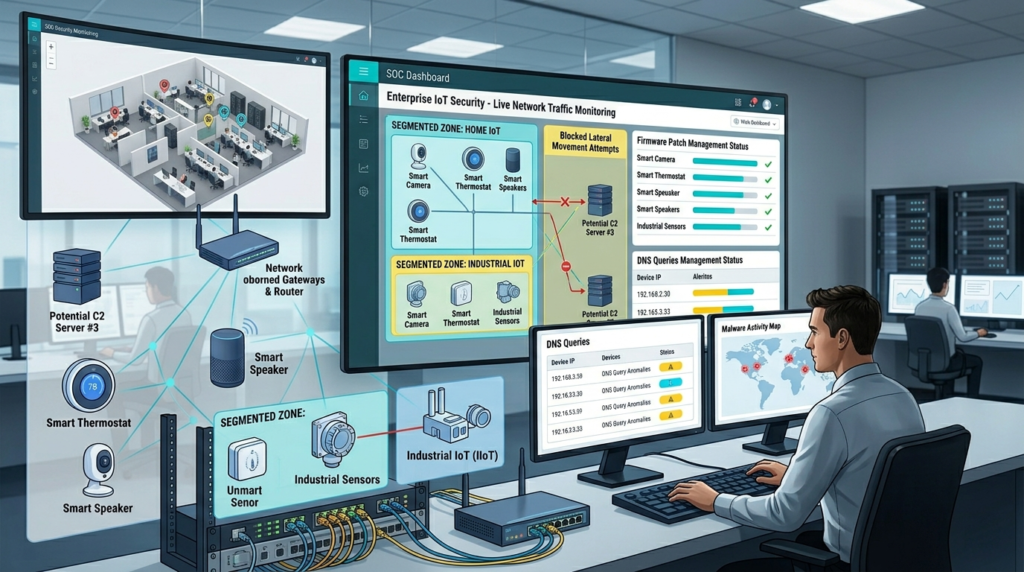
Segmentation and firmware patching remain the strongest defenses because most IoT botnets still exploit weak passwords, exposed services, and unpatched vulnerabilities.
The tech community says this constantly. Forum discussions, briefing videos, and incident reports all describe the same pattern. Doing a factory reset without patching does very little.
Botnets keep targeting:
- Default credentials.
- Exposed Telnet services.
- Weak API authentication.
- Vulnerable firmware.
- UPnP-enabled routers.
According to guidelines, organizations should isolate IoT systems from critical workloads whenever possible. That matches what many SOC teams already do.
VLAN segmentation cuts down on lateral movement through IoT devices. If a hacked camera can’t reach production servers, attackers lose a useful path.
Changing credentials matters too. We reviewed one environment where dozens of devices still shared the same admin password years after being installed. The malware spread almost instantly once scanning started.
Strong prevention strategies usually include:
- Turning off unnecessary services.
- Enforcing a firmware lifecycle management plan.
- Monitoring for DNS anomalies.
- Restricting outbound communication.
- Implementing a multi-layer IoT security setup.
Most botnets still succeed because basic operational hygiene breaks down when you have too many devices to manage.
FAQ
How does device fingerprinting improve IoT botnet detection?
Device fingerprinting IoT security methods help security teams understand how devices normally behave on a network. When traffic patterns suddenly change, detecting compromised IoT devices becomes much easier.
Analysts often combine flow-based IoT traffic analysis with behavioral analysis of IoT devices to identify hidden threats. This method also supports network-based IoT botnet detection by exposing unusual communication patterns before attacks spread across the network.
Can encrypted IoT traffic still reveal malware activity?
Yes, encrypted IoT traffic inspection can still reveal signs of malware activity. Security teams study traffic timing, packet sizes, and connection behavior, even when they cannot read the encrypted content.
Anomalous network traffic IoT patterns often expose hidden botnet operations. Analysts also use time-series analysis of IoT traffic and IoT command and control detection methods to identify suspicious outbound communication linked to malware infections.
Why do researchers use honeypots for IoT malware analysis?
IoT honeypot monitoring helps researchers safely observe attacks targeting connected devices. These systems attract malicious scanning activity, telnet brute-force IoT attacks, and weak authentication IoT exploitation attempts.
Researchers use the collected traffic for IoT malware analysis and botnet traffic classification. Honeynet for IoT botnets environments also improve threat intelligence for IoT botnets and help security teams build stronger detection strategies against future attacks.
What makes anomaly-based IDS useful for IoT security?
IoT anomaly-based IDS platforms learn how devices normally behave and alert teams when unusual activity appears. This approach improves early-stage IoT infection detection because it can identify threats that signature tools may miss.
Security teams often combine machine learning for IoT botnets, one-class SVM IoT anomaly detection, and deep learning IoT threat detection models to improve visibility and strengthen SIEM-based IoT security monitoring across connected environments.
How do datasets improve IoT botnet detection models?
Datasets help researchers train and test detection systems using realistic attack traffic. N-BaIoT dataset analysis and Bot-IoT dataset detection are widely used to measure IoT intrusion detection system accuracy.
Researchers also study packet-level feature extraction IoT methods and statistical feature selection IoT security techniques to improve detection quality. These datasets support explainable AI for IoT security and improve the accuracy of real-time IoT botnet detection systems.
Stop Compromised IoT Devices Before They Spread Across the Network
Most compromised IoT devices don’t cause obvious problems right away. They stay quiet, blend into normal traffic, and wait for the right moment to trigger larger attacks. By the time unusual behavior becomes visible, the damage can already be spreading across connected systems and critical infrastructure.
We help security teams uncover hidden risks earlier with behavioral analysis, attack path visibility, and real-time monitoring built for modern IoT environments. If you want faster detection without adding unnecessary complexity. Explore the advanced IoT threat monitoring solution designed for security operations teams.
References
- https://www.sciencedirect.com/science/article/abs/pii/S0167404825002202
- https://pmc.ncbi.nlm.nih.gov/articles/PMC11513456/