

Connected devices are now common in offices, factories, hospitals, retail stores, and homes. Sensors, cameras, gateways, and smart controllers improve efficiency, but they also create new security concerns. Many organizations deploy IoT quickly without planning how those devices will be monitored long term.
As device numbers grow, visibility becomes harder and risks increase. Understanding the main security challenges monitoring IoT devices helps teams build stronger defenses. Keep reading to learn practical solutions for safer IoT operations.
Key Insights: Security Challenges Monitoring IoT Devices
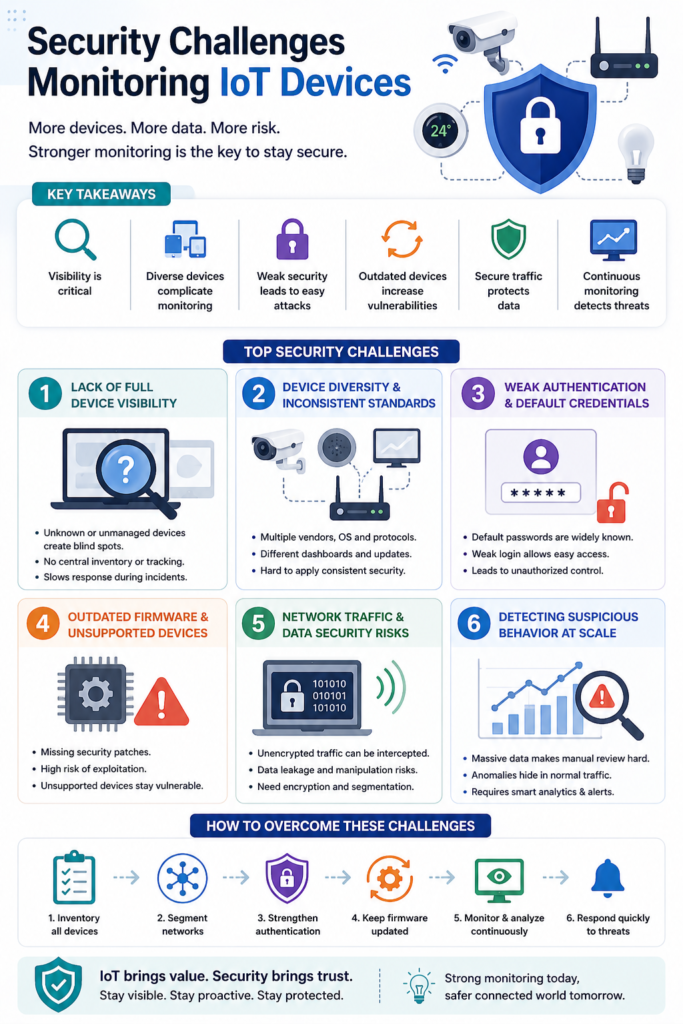
Monitoring IoT environments is difficult because many devices were designed for convenience, not enterprise-grade security.
- Limited visibility creates blind spots
- Diverse devices complicate management
- Weak authentication increases risk
Lack of Full Device Visibility
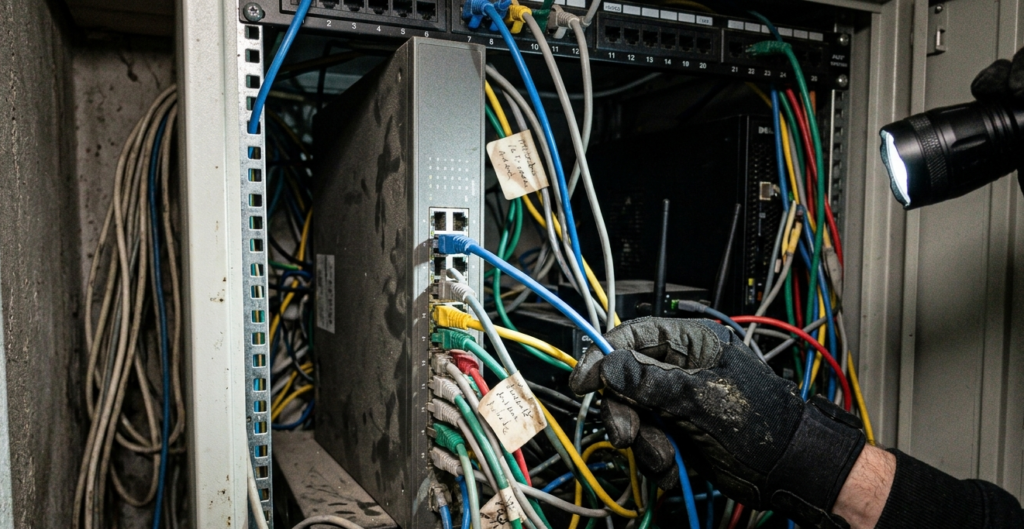
Many organizations do not know exactly how many IoT devices are connected or where they are located. By implementing IoT device security best practices, teams can better identify shadow devices that often appear without approval.
Common visibility issues:
- Unknown cameras or sensors on Wi-Fi
- Devices moved between sites
- Missing ownership records
- No centralized inventory
- Limited logging features
Without clear visibility, incident response becomes slow and incomplete. Asset discovery tools and network scanning can help teams identify unmanaged devices before they become security gaps.
Device Diversity and Inconsistent Standards
IoT ecosystems often include products from many vendors, each using different operating systems, interfaces, and update methods.
This creates challenges such as:
- Separate dashboards for each brand
- Different patch processes
- Inconsistent security settings
- Mixed protocol support
- Uneven log quality
“The Internet of things describes physical objects with sensors, processing ability, software and other technologies.” – Wikipedia
Because device types vary widely, standardizing monitoring policies is more difficult than in traditional IT environments.
Weak Authentication and Default Credentials
Credits: Issa Ahmed
Many IoT devices still ship with weak passwords or basic login controls. If credentials are never changed, attackers may gain access quickly.
Best practices include:
- Replace default passwords immediately
- Use strong unique credentials
- Enable multi-factor authentication where supported
- Restrict admin accounts
- Rotate passwords regularly
Weak authentication remains one of the most common causes of preventable IoT compromise.
Outdated Firmware and Unsupported Devices
Some IoT devices remain in service for years without updates. Others lose vendor support while still connected to production networks.
Main risks include:
- Known exploitable vulnerabilities
- Malware infection opportunities
- Stability issues
- No security patches available
- Compliance concerns
“Firmware is a specific class of computer software.” – Wikipedia
A lifecycle replacement plan is essential when vendors stop providing updates.
Network Traffic and Data Security Risks
IoT devices constantly exchange telemetry, commands, and status data. When analyzing IoT device telemetry data, if traffic is poorly secured, attackers may intercept or manipulate communications.
Use controls such as:
- TLS encryption
- Secure VPN tunnels
- Segmented IoT networks
- Firewall allowlists
- Protocol monitoring
Encrypted communication is especially important for cameras, healthcare devices, and industrial sensors transmitting sensitive information.
Detecting Suspicious Behavior at Scale
As device counts rise, manually reviewing logs becomes unrealistic. Threats may hide inside normal traffic patterns.
Watch for:
- Sudden outbound traffic spikes
- Repeated login failures
- Connections to unknown IP addresses
- Unexpected reboots
- Unusual data transfer times
Automated analytics and behavior baselines help security teams identify anomalies faster and reduce alert fatigue.
Security Challenges Monitoring IoT Devices Summary
| Challenge | Security Impact |
| Poor Visibility | Unknown risks and blind spots |
| Device Diversity | Complex management |
| Weak Credentials | Unauthorized access |
| Old Firmware | Vulnerability exposure |
| Unsecured Traffic | Data interception |
| Limited Monitoring | Delayed threat detection |
Build a Stronger IoT Monitoring Strategy
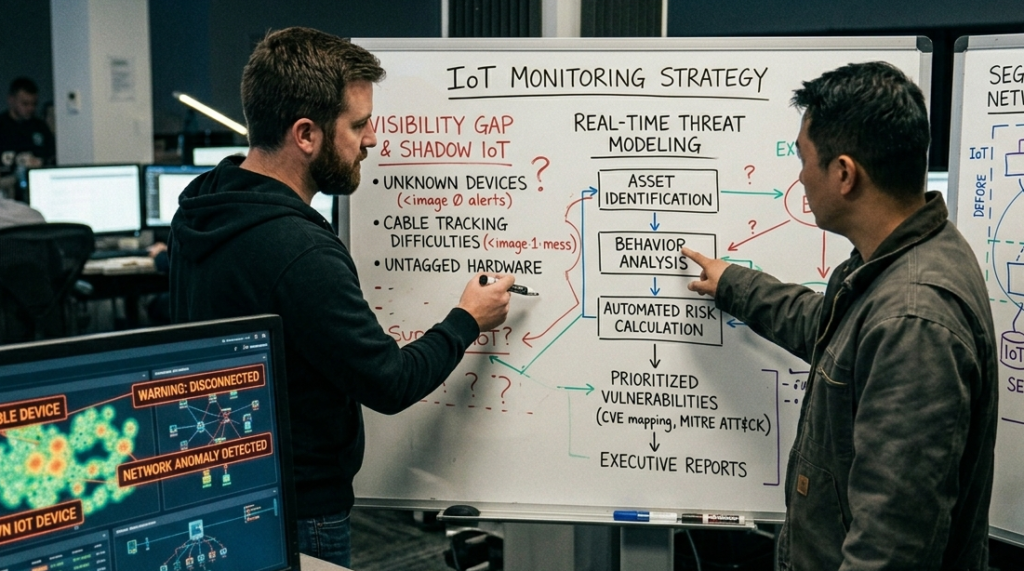
Organizations improve results when monitoring and collecting telemetry data IoT platforms becomes a continuous program rather than a one-time project.
Recommended actions:
- Maintain complete device inventory
- Centralize alerts and logs
- Patch supported devices regularly
- Replace unsupported hardware
- Review network policies often
- Use threat detection tools
Strong governance helps connected environments remain secure as they scale.
FAQ
Why is monitoring IoT devices more difficult than laptops or servers?
IoT devices often have limited interfaces, minimal logging, and different vendor tools. This makes standard monitoring processes harder to apply consistently across all assets.
What is the biggest IoT security challenge?
For many organizations, lack of visibility is the biggest issue. You cannot secure devices you do not know exist or cannot properly track.
How often should IoT devices be reviewed?
Critical environments should review devices continuously through monitoring systems, with formal monthly audits for firmware, ownership, and network activity.
Can small businesses face IoT risks too?
Yes. Even a few insecure cameras, routers, or smart devices can be used for unauthorized access, downtime, or data theft.
Security Challenges Monitoring IoT Devices for Long-Term Protection
Protecting IoT devices is difficult due to limited visibility, complex patching, and weak authentication. As these networks grow, monitoring behavior and segmenting traffic become vital to reducing cyber risk.
Network Threat Detection simplifies this by offering real-time threat modeling, automated risk analysis, and visual attack simulations. It helps teams identify blind spots and prioritize vulnerabilities using frameworks like MITRE ATT&CK. Ready to secure your connected environment? Join Network Threat Detection
References
- https://en.wikipedia.org/wiki/Internet_of_things
- https://en.wikipedia.org/wiki/Firmware