

Importance security data enrichment context lies in helping security teams determine which alerts require attention and which do not. Most organizations already collect large amounts of data from firewalls, cloud platforms, endpoint tools, and SIEM systems. A failed login event alone provides limited value without context about the user, device, location, and related activity.
Attackers move quickly, while disconnected alerts slow investigations and increase workload. At Network Threat Detection, we regularly see enriched data improve prioritization and reduce unnecessary analysis. Keep reading to learn how security data enrichment strengthens modern SecOps workflows and supports faster response decisions.
Quick Reads: Why Security Context Changes SecOps
Better security data enrichment helps analysts understand which alerts actually matter, reduce false positives, and respond to threats faster. These takeaways summarize how stronger context improves investigations, risk prioritization, and daily security operations.
- Security data enrichment adds business, user, and network context to raw alerts, helping analysts understand risk faster and make better decisions during investigations.
- Better enrichment reduces alert fatigue by lowering false positives, improving prioritization, and giving security teams clearer visibility into suspicious activity.
- Organizations that combine threat modeling, risk analysis, and enriched telemetry often respond to attacks faster because analysts spend less time gathering context manually.
What is security data enrichment?
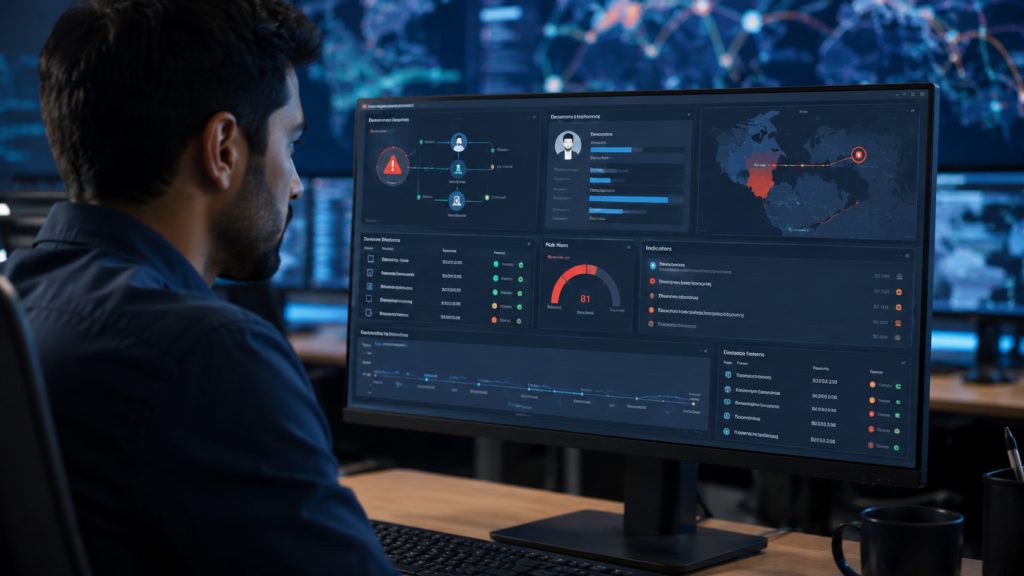
Security data enrichment means adding context to raw security data. The goal is to help analysts understand threats faster.
A failed login alert is a simple example. Alone, it may look harmless. Add user role data, device history, and geolocation details, and the same alert may become high risk.
We often see the biggest improvements in network monitoring workflows. DNS records, traffic data, and identity mapping help analysts connect activity across systems without switching between multiple dashboards. It’s more valuable when teams apply data enrichment for contextual analysis across cloud, endpoint, and network telemetry together.
The difference becomes clear quickly.
| Raw alert | Enriched alert |
| Failed login | Failed login from admin account |
| Unknown IP | IP tied to suspicious activity |
| Generic server alert | Production payment server alert |
| DNS request | DNS activity linked to malware |
| Malware detection | Malware found on finance laptop |
Most enrichment pipelines include:
- User identity data
- Asset ownership
- Threat intelligence
- Past behavior history
- Location and time details
Raw logs create visibility. Enriched logs help teams understand risk faster.
Why context matters for security decisions
Credits: Dirk van der Linden
Context changes how analysts judge risk. The same alert can mean very different things depending on the system, user, and timing involved.
A large file transfer during work hours may be normal for a developer. The same transfer from a payment database at 2 AM is a different story.
We have seen teams waste hours collecting details from several tools before deciding whether an alert mattered. That delay hurts response times and burns out analysts.
Network traffic often fills those gaps early. DNS requests, traffic flows, and unusual connections can expose suspicious behavior before endpoint tools raise a serious alert.
Several signals help teams prioritize risk:
- Admin accounts versus regular users
- Production systems versus test systems
- Corporate VPN versus foreign locations
- Normal work hours versus unusual activity
Missing one piece of context can change the entire investigation.
Weak enrichment also creates other problems:
- More false positives
- Slower investigations
- Analyst burnout
- Missed threats
- Too much manual work
Good context helps analysts understand not only what happened, but why it matters.
How security data enrichment reduces alert fatigue
Alert fatigue happens when security teams receive too many alerts without enough detail attached. Analysts end up reviewing the same harmless activity again and again.
We hear this often during security reviews. Many teams automate alerts, but they do not automate understanding. Thousands of alerts still need manual review because the context is weak or incomplete.
Things improve once enrichment gets better.
Identity data, asset details, and behavior history help systems separate normal activity from real threats. Analysts spend less time chasing low-risk alerts.
Several enrichment signals help reduce noise:
- Trusted IP addresses
- Business hours activity
- User role data
- Device reputation
- Production system tags
The operational difference becomes clear fast.
| Without enrichment | With enrichment |
| Too many false positives | Better alert accuracy |
| Constant manual reviews | Faster investigations |
| Weak prioritization | Clearer risk scoring |
| Too many dashboards | Unified investigations |
Network telemetry also helps quietly in the background. Strange DNS requests, unusual traffic patterns, and lateral movement often reveal attacks early. Good enrichment removes noise instead of creating more confusion.
Risk-based context matters more than more tags
Some teams think enrichment means adding endless tags and metadata to alerts. That usually creates more confusion, not better security.
We have seen environments filled with duplicate data, old threat feeds, and low-value fields that analysts ignore completely. More data does not always help. Strong enrichment focuses on information that changes risk.
As noted by CISA (Cybersecurity and Infrastructure Security Agency)
“Simply knowing a vulnerability exists is rarely enough to act. As cybersecurity practitioners, researchers, and defenders, we need context. We need clarity. And most importantly, we need actionable insights that can help prioritize patching efforts and mitigate risks.” – CISA
A simple framework helps:
- Who triggered the action?
- What system was affected?
- Where did it come from?
- How serious is the risk?
That approach keeps investigations focused.
Common enrichment problems include:
- Inflated risk scores
- Duplicate data sources
- Broken asset mapping
- Old threat feeds
- Too many API dependencies
We learned early that high-confidence signals matter most. Asset criticality, admin access, and network exposure usually provide the strongest value.
Good enrichment narrows the investigation path. Bad enrichment slows teams down.
What are the operational benefits of enriched security data?
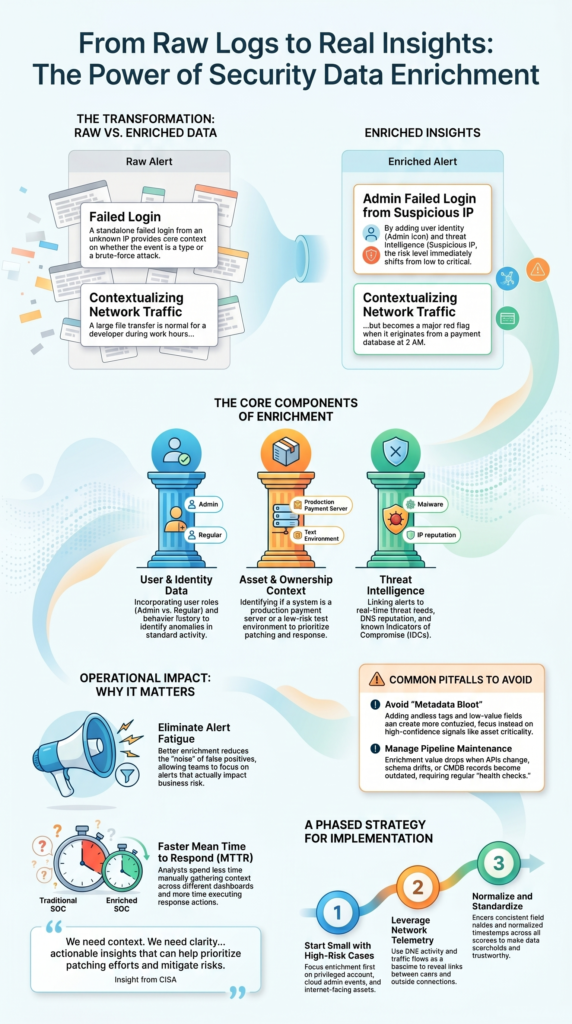
Enriched data improves security operations in practical ways. Analysts work faster, automation improves, and threat detection becomes more accurate.
We have seen teams reduce investigation time once identity data, cloud activity, and network telemetry entered the same workflow. Analysts no longer needed to switch between many tools to understand one alert. Many organizations combine these workflows with modern cloud native security monitoring tools to improve visibility across distributed environments.
Several benefits appear quickly.
| Benefit | Operational impact |
| Faster investigations | Less manual work |
| Better prioritization | Focus on serious threats |
| Smarter automation | Better response actions |
| Better analytics | Stronger anomaly detection |
| Fewer false positives | Less alert fatigue |
Teams also notice:
- Faster phishing investigations
- Better ransomware detection
- Stronger IOC matching
- Improved lateral movement tracking
- Better attack visibility
Network monitoring also helps here. DNS activity, packet inspection, and traffic flows often expose suspicious behavior before endpoint alerts escalate.
Insights from National Institute of Standards and Technology (NIST) indicate
“By enriching network traffic data with vulnerability and threat intelligence, an analyst can differentiate between an ‘active scan’ and an ‘attempted exploit,’ reducing false positives and accelerating incident response.” – NIST
The biggest improvement is confidence. Analysts trust investigations more when they see clear context attached to alerts.
The maintenance cost of security enrichment pipelines
Security enrichment pipelines need regular care. APIs change, asset inventories fall out of date, and identity mappings break over time. We have seen this happen while working with cloud telemetry, DNS visibility, and user identity systems. Even a well-built pipeline can lose value when the data stops matching real-world activity.
During one investigation, a broken identity mapping connected alerts to the wrong employee account. That small error slowed the response and created confusion across the security team. Teams handling sensitive environments also face additional challenges around securing cloud storage logs because poorly protected telemetry can create visibility gaps.
Common issues usually include:
- Schema drift
- API rate limits
- Old CMDB records
- Broken identity mapping
- Inconsistent asset tags
Trust becomes the real problem when enrichment quality drops. Analysts stop relying on automation when servers appear mislabeled or admin accounts lose important context. Once confidence disappears, teams often start double-checking everything by hand.
From our experience building threat models and risk analysis workflows, it makes more sense to start small. We usually focus first on high-confidence data like asset criticality, user identity, and network exposure. Reliable enrichment gives security teams more value than large amounts of noisy context.
How security data enrichment supports compliance and governance
Compliance depends on clear visibility. Raw logs rarely provide enough detail for audits, investigations, or risk reviews on their own. Security teams need context that links activity to users, systems, and business ownership. That is where enrichment becomes valuable.
In our work with threat models and risk analysis tools, we often see organizations struggle during audits because their logs lack ownership details or proper environment labels. Investigations slow down when analysts cannot tell who owns a system or whether a server belongs to production or testing.
Several governance benefits usually appear early:
- Easier audit preparation
- Clear asset ownership
- Better incident tracking
- Stronger risk visibility
- More consistent reporting
Network telemetry also adds useful evidence during reviews. DNS history, traffic patterns, and connection logs help investigators rebuild timelines faster. We have seen these records close important visibility gaps during security incidents.
Good enrichment also improves consistency across security workflows. Timestamp alignment and field normalization make data easier to trust and search. When context already exists inside the investigation process, teams respond faster and spend less time chasing missing details.
Governance becomes much simpler when telemetry maps clearly to systems, users, and business risk.
How to start a security data enrichment strategy
Many organizations run into problems because they try to enrich every data source at the same time. That usually adds complexity before the security team can prove real value. We have seen projects slow down quickly when analysts receive too much low-quality context at once.
A smaller rollout often works better. In our experience building threat models and risk analysis workflows, teams gain trust faster when enrichment supports a few high-risk use cases first. Network telemetry is usually a strong place to begin because DNS activity and traffic flows reveal useful links between users, systems, and outside connections.
Good starting points often include:
- Privileged account activity
- Production system alerts
- Cloud admin events
- Internet-facing assets
Several enrichment fields also provide quick value:
- Asset criticality
- User role
- Geo IP data
- Threat reputation
- Environment labels
Over time, we learned that consistency matters more than adding endless data sources. A phased rollout keeps the process manageable and easier to maintain.
Several habits also help reduce future problems:
- Normalize timestamps early
- Standardize field names
- Test source reliability often
- Review enrichment quality regularly
- Remove low-value context
The goal is not collecting more data. The goal is helping analysts understand risk faster.
Security data enrichment as a competitive security advantage

Organizations with mature enrichment workflows often respond to threats much faster. Analysts already have the context they need, so they spend less time jumping between disconnected tools and dashboards. We have seen investigations slow down badly when cloud logs, endpoint alerts, and network telemetry stay isolated from each other.
Attackers benefit from that lack of visibility. Small warning signs are easier to miss when teams cannot connect user activity, system exposure, and network behavior into one view. In our experience, security teams work more effectively when threat modeling, risk analysis, and enriched telemetry are part of the same workflow.
Several advantages become clear over time:
- Faster response times
- Better detection accuracy
- Less analyst fatigue
- Stronger behavior tracking
- More reliable automation
Network telemetry quietly strengthens these workflows in the background. DNS activity, traffic flows, and unusual outbound connections often reveal suspicious behavior before a major incident begins. We regularly use these signals to improve visibility into emerging threats and risky network activity.
The biggest advantage is not only technical. Teams become more confident during incidents because the context already exists. Strong security operations now depend on enriched data, not raw alerts alone.
FAQ
How does data enrichment improve alert triage accuracy?
Data enrichment adds useful security context to alerts. Analysts can review threat intelligence, user behavior, asset inventory, and IP geolocation data to understand whether activity looks risky or normal.
SIEM enrichment also improves log correlation and contextual analysis. This helps security teams respond faster and spend less time reviewing disconnected alerts and incomplete event data during investigations.
Why do normalization processes and field mapping matter in SecOps?
Normalization processes help security teams organize logs into one consistent format. Field mapping, timestamp alignment, and parsing methods make event enrichment and log correlation more accurate.
Without proper source validation and aggregation techniques, analysts may miss important details during forensic analysis. Structured security context also improves compliance reporting, anomaly detection, and daily risk scoring across security operations.
How does threat intelligence support real-time enrichment workflows?
Threat intelligence improves real-time enrichment by adding context from threat feeds, reputation scoring, WHOIS lookup, DNS resolution, and IOC matching data. Analysts can spot suspicious IP addresses, malware signatures, phishing indicators, and ransomware activity much faster.
Real-time enrichment also speeds up incident response because alerts already contain useful context before analysts begin deeper investigations and contextual analysis.
What role does behavioral analytics play in anomaly detection?
Behavioral analytics helps security teams detect unusual activity by comparing user behavior, endpoint telemetry, network metadata, and flow data against normal patterns. User entity behavior analytics (UEBA) also helps identify privilege escalation, lateral movement detection, and exfiltration patterns over time.
Combined with device profiling and IAM context, behavioral analytics gives analysts clearer security context during investigations and threat-hunting activities.
How do API integration and batch processing affect enrichment quality?
API integration helps security tools collect vulnerability data, cloud metadata, file hash lookup results, and threat feeds automatically. Batch processing supports large enrichment workflows for historical logs and forensic analysis.
Strong API integration also improves session correlation, protocol decoding, packet inspection, and certificate validation accuracy. Reliable enrichment pipelines reduce missing context and improve event enrichment consistency across security operations.
Build Security Context Analysts Can Actually Use
Security alerts become a problem when analysts spend more time jumping between dashboards than investigating the threat itself. Missing context slows decisions, creates alert fatigue, and forces teams to rebuild incidents manually from disconnected systems. That friction adds up quickly during active investigations.
Many organizations improve detection workflows with platforms like Network Threat Detection into one operational view. If you want faster investigations with clearer incident context. Explore the analyst-focused threat visibility platform designed to reduce investigation time and improve response accuracy.
References
- https://www.cisa.gov/news-events/news/unlocking-vulnrichment-enriching-cve-data
- https://csrc.nist.gov/pubs/sp/800/150/final