

Enriching logs IP geolocation data gives security and operations teams the context needed to interpret network activity more accurately. Instead of reviewing raw IP addresses, analysts can quickly identify countries, Autonomous System Numbers (ASNs), hosting providers, and infrastructure linked to suspicious behavior.
We have seen investigations move faster when this information is added directly to log pipelines. With IPv4 exhaustion, address reuse, and carrier-grade NAT becoming more common. At Network Threat Detection, we often use geolocation enrichment to improve visibility and prioritization. Keep reading to learn how it works and where it delivers the most value.
Quick GeoIP Wins
These core insights summarize how enriching logs with IP geolocation data improves investigations, visibility, and operational consistency across modern security environments.
- Geo-enriched logs help security teams spot suspicious infrastructure, VPN traffic, and unusual ASN activity faster.
- Country-level geolocation is usually reliable, but city-level accuracy often breaks because of VPNs, mobile routing, and carrier networks.
- Centralized enrichment pipelines are easier to maintain and create more consistent analytics across security and observability workflows.
Quick GeoIP Insights
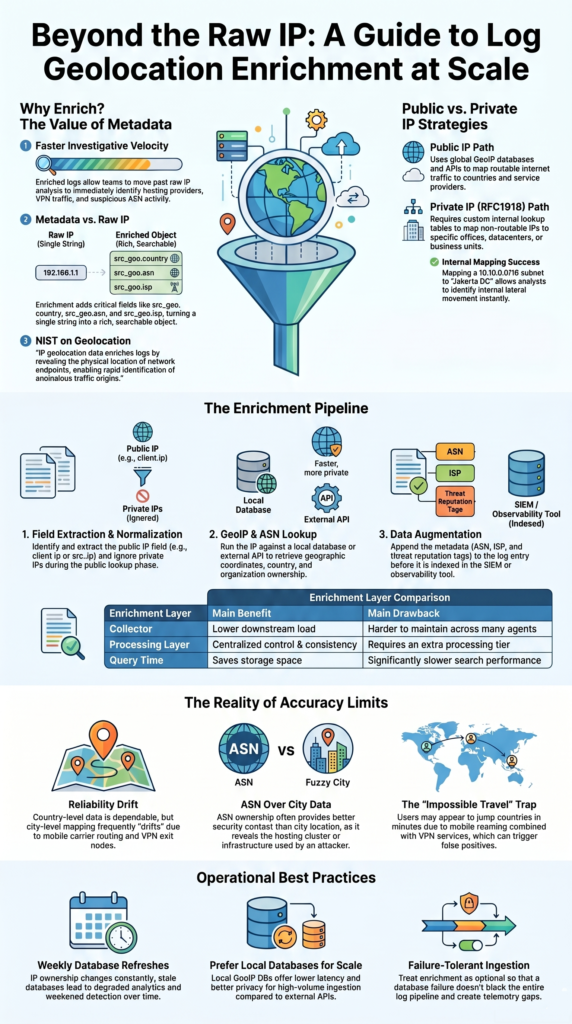
Most organizations enrich logs in a centralized processing layer. It keeps field naming consistent and avoids duplicate logic across collectors and agents. We normally recommend this approach because it scales well and reduces operational headaches later.
A few lessons appear in almost every deployment:
- Country-level data is usually dependable
- City-level mapping can drift badly
- VPNs and mobile carriers distort locations
- Private IPs need internal lookup tables
- ASN enrichment often helps more than city mapping
- Local databases keep lookup latency low
- Query-time enrichment saves storage but adds CPU load
As noted by National Institute of Standards and Technology (NIST)
“IP geolocation data enriches logs by revealing the physical location of network endpoints, enabling rapid identification of anomalous traffic origins.” – National Institute of Standards and Technology (NIST)
Teams also learn quickly that geolocation is not exact science. It works best as supporting context. During one network review, our analysts tracked repeated login attempts from what looked like random countries. ASN enrichment later showed the traffic came from the same hosting provider cluster. That discovery mattered more than the mapped cities.
Good enrichment pipelines focus on consistency. They normalize fields early, enrich logs before indexing, and keep databases updated on schedule.
What does IP Geolocation Enrichment Add to Logs?
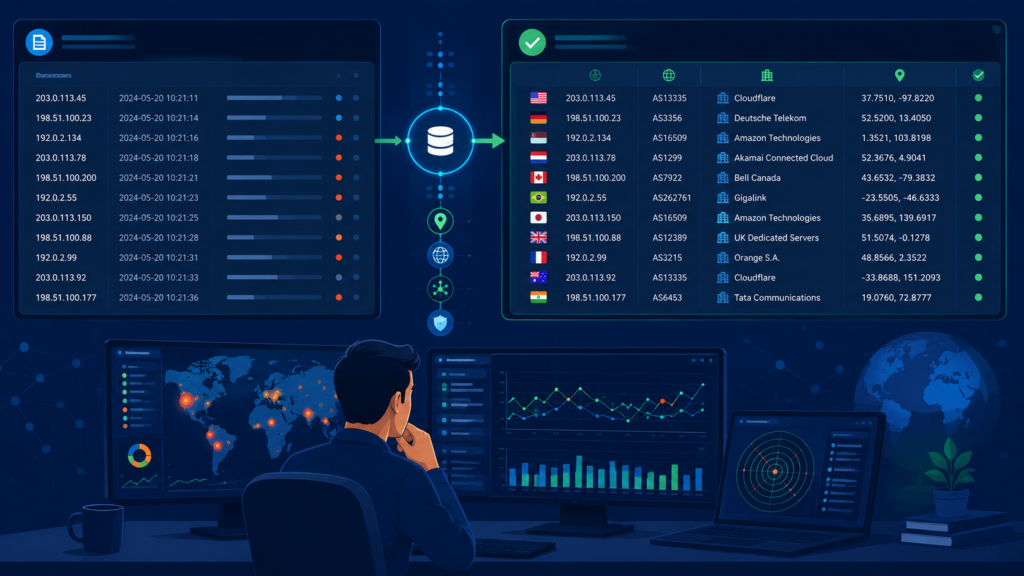
Geo enrichment converts raw IP addresses into readable and searchable metadata. Instead of a single IP field, analysts can see country, ASN, ISP, coordinates, and organization ownership tied to the traffic. That added context changes how teams investigate events.
Once enrichment happens, logs become easier to search, group, and visualize. We have watched investigations speed up after teams added ASN and hosting-provider details to authentication logs. Many organizations now treat the importance of security data enrichment context, because enriched telemetry improves visibility and investigation speed.
Many organizations enrich both source and destination IPs at the same time. That helps security teams understand traffic direction and infrastructure relationships.
Common enrichment data includes:
- Country and region
- ASN ownership
- ISP or hosting provider
- Latitude and longitude
- VPN or proxy indicators
- Threat reputation tags
| Raw Field | Enriched Field | Example |
| src_ip | src_geo.country | Japan |
| src_ip | src_geo.asn | ASN 2914 |
| src_ip | src_geo.isp | Telecom provider |
| src_ip | src_geo.hosting | True |
In our experience, ASN enrichment often delivers the quickest operational value. Analysts recognize suspicious infrastructure much faster when ownership data appears directly inside alerts.
Where Should GeoIP Enrichment Happen?
GeoIP enrichment can happen at several points in the pipeline. Some teams enrich logs at the collector. Others enrich during processing or at query time. Most large environments eventually move enrichment into a centralized processing layer because it is easier to manage.
Early deployments often start simple. One collector gets enrichment logic, then another, then dozens more. Over time, field mismatches and outdated databases create problems. We ran into this during a multi-region deployment where inconsistent agent versions produced different geo fields inside the SIEM.
Centralized processing solves much of that drift. It keeps enrichment logic in one place and simplifies updates.
| Layer | Main Benefit | Main Drawback |
| Collector | Lower downstream load | Harder maintenance |
| Processing Layer | Centralized control | Extra processing tier |
| Query Time | Lower storage usage | Slower searches |
Most pipelines follow a similar process:
- Extract the IP field
- Run the GeoIP lookup
- Add ASN and ISP details
- Normalize geo fields
- Forward enriched logs
We usually prefer centralized enrichment because it supports both security analytics and observability workflows without duplicating processing rules everywhere.
How Engineers Implement GeoIP Enrichment
Most implementations follow a simple pattern. Teams extract IP fields from logs, run lookups against a local database, then append normalized geo fields before indexing the data. The workflow sounds easy, but operational details often cause trouble.
One application may log client.ip while another writes src_ip or source.address. We have seen this happen during large migrations where different logging teams followed different naming standards. This is where data enrichment for contextual analysis becomes important because standardized enrichment improves detection reliability across platforms and teams.
A typical workflow includes:
- Parse raw logs
- Extract public IP addresses
- Ignore private IPs when needed
- Run local GeoIP lookups
- Add ASN metadata
- Store geo coordinates
- Forward logs into the SIEM
Local lookup databases remain popular because they keep latency low during heavy ingestion. Weekly database refreshes also matter. IP ownership changes often, and stale mappings reduce accuracy over time.
Common normalized fields include:
- src_geo.country
- src_geo.city
- src_geo.location
- src_geo.asn
- src_geo.organization
One rollout taught us an important lesson. Query-time enrichment doubled dashboard latency during peak traffic. Once the lookup moved into the processing layer, search performance stabilized immediately.
Why GeoIP Accuracy has Limits
IP geolocation works well for broad regional visibility, but it struggles with precise location accuracy. VPNs, mobile networks, cloud routing, and carrier infrastructure constantly shift traffic paths. Because of that, city-level mapping is often unreliable.
Many engineers describe geolocation as “good enough” instead of precise. We agree with that view. Country-level data usually helps. Exact city attribution often does not.
Several issues create problems:
- VPN exit nodes hide real locations
- Mobile carriers reroute traffic
- CDN edge networks distort geography
- Hosting providers map to datacenters
- WHOIS records may show headquarters only
During one fraud review, a user appeared to jump across multiple countries within minutes. At first glance, it looked like an account compromise. After deeper analysis, the activity traced back to mobile roaming combined with a VPN service.
Security teams learn a few practical truths quickly:
- Country-level context is useful
- City-level mapping can mislead
- VPN traffic breaks assumptions
GeoIP should support investigations, not replace them. We treat location data as one signal among many. ASN ownership, device behavior, authentication patterns, and threat intelligence usually provide stronger evidence than mapped coordinates alone.
Handling Private IP Addresses and Internal Networks
Credits: CyberTutor
Public GeoIP databases cannot resolve private IP ranges accurately. Internal addresses require custom lookup tables built from organizational knowledge. This catches many newer teams off guard during their first enrichment projects.
Private IPv4 ranges exist only inside internal environments. Because those addresses are not routable on the public internet, external GeoIP providers cannot map them to offices or datacenters.
Organizations usually build internal subnet mappings tied to locations, business units, or infrastructure groups.
| Internal Subnet | Site Mapping | Business Unit |
| 10.10.0.0/16 | Jakarta DC | Infrastructure |
| 172.16.0.0/16 | Singapore Office | Operations |
| 192.168.5.0/24 | Remote Branch | Finance |
Most hybrid workflows separate enrichment into two paths:
- Public IPs use GeoIP databases
- Private IPs use internal lookup tables
- ASN enrichment supports internet traffic
- Internal tagging maps offices and datacenters
We have seen this improve investigations significantly. During one incident review, analysts identified suspicious traffic in minutes because subnet mapping showed the activity came from a remote branch office instead of production infrastructure.
Internal enrichment also helps observability teams. Dashboards become easier to read when traffic maps to business locations instead of raw subnet ranges.
How Security Teams Use Geo-enriched Logs
Geo enrichment becomes valuable when security teams combine it with identity data, ASN ownership, and threat intelligence. A map alone rarely improves security. Correlation does.
Modern SOC workflows use geo-enriched logs to detect suspicious behavior faster. Login anomalies, impossible travel, VPN usage, and hosting-provider abuse become easier to spot once enrichment is part of the pipeline.
Common use cases include:
- Impossible-travel detection
- VPN and proxy monitoring
- ASN anomaly tracking
- TOR exit-node correlation
- Hosting-provider abuse detection
- Regional attack trend analysis
We often prioritize ASN enrichment because it exposes attacker infrastructure quickly. During one phishing investigation, several login attempts looked unrelated at first. ASN data later showed the traffic came from the same hosting provider network.
Another case involved brute-force attacks spread across multiple countries. Country filtering created too many false positives. ASN clustering narrowed the activity almost immediately.
Mature security teams avoid treating geolocation as proof. Instead, they use it alongside behavioral analysis, device fingerprints, and authentication telemetry. Geo context supports detection logic, but it should never stand alone as final evidence during investigations.
What Observability Teams Learn from GeoIP Data
GeoIP enrichment also helps operations and product teams understand how users interact with infrastructure. Once geo fields enter dashboards, regional traffic patterns become easier to track.
Latency-sensitive services rely heavily on regional visibility. Streaming platforms, SaaS environments, gaming networks, and financial applications often monitor traffic by country, ASN, or continent.
Geo context helps teams understand where demand originates and where bottlenecks appear. Teams responsible for searching and analyzing large log volumes also benefit because enriched geo fields improve filtering, aggregation, and traffic correlation.
Common observability use cases include:
- Regional traffic heatmaps
- API latency tracking
- CDN demand analysis
- Capacity forecasting
- Regional error monitoring
- User concentration analysis
We used geo-enriched telemetry during a Southeast Asia outage investigation. Packet latency increased only for users routed through one ISP cluster. Without ASN and location enrichment, isolating the problem would have taken much longer.
Dashboards become messy when teams use different geo field structures across services. We encourage organizations to standardize fields early so both security and observability teams can work from the same telemetry.
Good enrichment pipelines support multiple use cases at once. The same data can power threat detection, traffic analysis, capacity planning, and outage response without separate processing systems.
GeoIP Risks and Privacy Concerns
IP-based geolocation creates risks when organizations treat it as the exact truth. VPNs, carrier routing, and mobile networks can easily misrepresent where a user is physically located. That becomes a problem when systems expose location labels publicly or rely on them too heavily.
Many users now route traffic through VPN services daily. Mobile traffic also shifts constantly between gateways and carrier infrastructure. Because of that, location data can change rapidly even when the user stays in the same place.
Several risks appear repeatedly:
- User mislabeling
- Privacy concerns
- False attribution
- Regulatory exposure
- Trust issues
We noticed strong reactions from security professionals whenever platforms presented IP-based locations as definitive. Most engineers already understand the technical limits behind geolocation accuracy.
GeoIP works best as supporting context. It helps analysts narrow investigations and understand traffic trends, but it should not be treated as verified identity evidence.
Privacy teams also pay closer attention to retention policies now. In some regions, geolocation data may fall under personal data rules when combined with authentication or identity records. That means organizations need clear retention controls and careful access management around enriched telemetry.
Choosing GeoIP Databases and APIs
Most organizations choose between local databases and external APIs for enrichment. The right option depends on scale, budget, and how much intelligence the team needs from the lookup process.
Insights from The Apache Software Foundation indicate
“Local GeoIP databases offer lower latency and better privacy for high-volume log processing compared to external API-based resolution.” – The Apache Software Foundation
Local databases remain popular because they provide predictable latency and low operational cost. High-volume pipelines benefit from local lookups since they avoid external API delays during ingestion.
Teams usually choose local databases for:
- High-throughput environments
- Offline enrichment workflows
- Lower infrastructure cost
- Stable lookup performance
External APIs become useful when organizations need deeper intelligence signals such as:
- VPN detection
- Threat scoring
- Hosting-provider classification
- Residential IP identification
- Rapid metadata updates
We usually recommend starting with local enrichment plus ASN mapping. That setup covers most operational needs without adding too much complexity. API-based intelligence can then support high-risk workflows where additional context matters.
One lesson stands out across nearly every deployment. Reliability matters more than feature count. A fast and consistent enrichment pipeline helps analysts far more than a complex system that fails during peak ingestion periods.
Keeping GeoIP Enrichment Reliable

Reliable enrichment depends on maintenance and consistency more than advanced features. Even strong enrichment systems fail when databases become stale or field normalization drifts between teams.
IP ownership changes constantly across providers. If databases stop updating, analytics quality slowly degrades. We have watched detections weaken over time simply because nobody maintained refresh schedules.
Reliable pipelines usually include:
- Consistent IP field normalization
- Scheduled database refreshes
- ASN synchronization
- API response caching
- Failure-tolerant ingestion
- Geo-point validation
- Retention policy reviews
A few operational habits make a big difference:
- Normalize IP fields early
- Separate public and private workflows
- Monitor enrichment failures
- Cache API lookups aggressively
- Avoid blocking ingestion during outages
We learned this the hard way during a database corruption event. Enrichment failed unexpectedly, but the pipeline kept forwarding logs because enrichment was treated as optional instead of mandatory. That decision prevented a major telemetry gap during an active investigation.
Security and observability teams both depend on stable telemetry. Enrichment should improve visibility, not create another fragile dependency inside the logging stack.
FAQ
How does ASN enrichment improve GeoIP investigations?
ASN enrichment helps analysts identify the organization behind an IP range instead of relying only on IP to country mapping. A simple ASN lookup can reveal hosting providers, cloud infrastructure, or suspicious networks connected to attacks.
We often see ASN to organization data expose patterns that standard GeoIP lookup workflows miss. ASN enrichment also improves enrich logs for security workflows and supports better anomaly detection by country.
Why do VPNs and carrier NAT issues affect IP location accuracy?
VPN detection becomes difficult because many users share the same VPN exit nodes across different regions. Carrier NAT issues create similar problems because mobile users may appear in locations far from their real devices.
This lowers IP location accuracy and increases false positives geolocation alerts. Mobile carrier geolocation and roaming IPs also change traffic paths often, which makes city-level inaccuracy common during investigations and login risk scoring.
What is the difference between local GeoIP DB and remote GeoIP API?
A local GeoIP DB provides faster lookups and reduces rate limiting lookups during high-volume ingestion. A remote GeoIP API often supplies newer intelligence, including residential IP flag data, proxy detection, and TOR exit node tracking.
Many teams use both methods inside the enrichment pipeline to balance enrichment latency, GeoIP DB updates, and the cost of API lookups while keeping searches reliable.
How do teams handle private IP geolocation internally?
Public GeoIP database tools cannot resolve RFC1918 mapping because private IP ranges do not exist on the public internet. Most organizations build an internal lookup table for internal network mapping instead.
This process helps analysts identify office locations, datacenters, or business units connected to private traffic. Private IP geolocation also improves geo dashboards, enriches logs for analytics, and tagging enriched fields across security platforms.
Why is client IP extraction important for GeoIP enrichment?
Many applications sit behind proxies, CDN edge location services, or load balancers. Without proper client IP extraction, GeoIP lookup results may point to shared infrastructure instead of the real user.
Teams usually rely on X-Forwarded-For parsing and real client IP validation before enrichment begins. This process improves WHOIS enrichment, hosting provider identification, and testing geolocation accuracy across SIEM geo enrichment workflows.
Build a GeoIP Enrichment Strategy That Actually Scales
GeoIP enrichment becomes difficult when teams expect perfect accuracy that nobody maintains properly. Over time, that creates messy telemetry, slower investigations, and inconsistent visibility across security and infrastructure environments. Simple normalization and reliable enrichment workflows usually solve more problems than oversized pipelines.
We rely on platforms like Network Threat Detection to improve visibility with normalized geo context, ASN intelligence, and threat-focused analytics that support faster investigations. If you want cleaner telemetry and better operational insight. Explore the GeoIP enrichment and threat analysis platform built for modern security operations.
References
- https://csrc.nist.gov/glossary/term/geolocation
- https://logging.apache.org/log4j/2.x/manual/lookups.html#GeoIpLookup