

IoT-specific threat intelligence feeds help security teams identify threats targeting connected devices that general threat feeds often overlook. They provide visibility into risks affecting cameras, sensors, routers, medical devices, and industrial systems. We often see organizations collecting thousands of indicators of compromise yet struggling to determine to their environment.
In practice, the challenge is usually filtering noise and focusing on activity that impacts actual assets. At Network Threat Detection, we find that context, device behavior, and actionable intelligence deliver better results than large IOC lists alone. Keep reading to learn how these feeds improve visibility and reduce alert fatigue.
IoT Threat Intel Quick Wins
Strong IoT threat intelligence depends on context, visibility, and smarter filtering instead of massive IOC lists. Teams that combine telemetry, enrichment, and behavioral analysis usually improve detection accuracy and reduce alert fatigue faster.
- IoT threat feeds focus on threats tied to connected devices, including Mirai variants, weak Telnet exposure, firmware flaws, and IoT malware.
- Modern detection workflows rely more on context, device behavior, and fingerprinting than huge IOC lists.
- Teams using IoT feeds with MISP, SIEMs, and SOAR platforms often cut false positives and improve threat hunting.
What Are IoT-Specific Threat Intelligence Feeds?
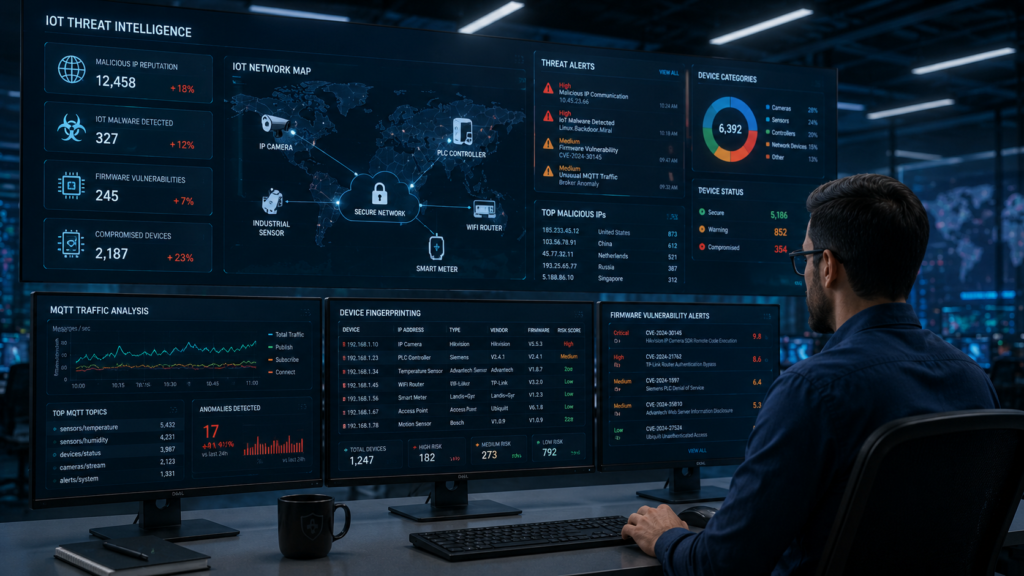
IoT threat intelligence feeds collect indicators and behavior data tied to connected devices such as routers, cameras, PLCs, and smart sensors.
Unlike traditional cyber threat feeds, IoT-focused feeds track attacks aimed at embedded systems and device protocols. They monitor issues tied to MQTT, CoAP, Bluetooth LE, Zigbee, Telnet, and firmware tampering.
Most modern feeds also connect indicators to:
- Device types
- Firmware versions
- Exploitability scores
- Known botnets
- Network behavior
In many environments, Network Threat Detection becomes the first tool that shows suspicious traffic coming from unmanaged IoT devices. We have seen teams discover beaconing cameras, exposed gateways, and unknown sensors that were invisible to endpoint tools.
Some IoT security platforms now focus heavily on OT and embedded threats. Many of them support STIX/TAXII and JSON APIs so teams can automate data sharing and enrichment.
Common IoT attacks include:
- Default password attacks on cameras and routers
- Open SSH and Telnet scanning
- Credential stuffing against IoT web panels
- Mirai-based malware campaigns
- MQTT abuse and rogue broker activity
The attack surface expanded fast after 2020, especially in healthcare, manufacturing, logistics, and smart infrastructure.
How IoT threat feeds differ from traditional threat intelligence
Traditional threat intelligence often focuses on phishing, ransomware, and enterprise malware. IoT feeds focus on connected devices, firmware flaws, and embedded system abuse.
That difference matters because many industrial IoT devices stay active for 10 years or more. A short IOC lifecycle does not work well in those environments.
| Traditional TI | IoT-specific TI | Operational impact |
| Focuses on phishing and ransomware | Focuses on Mirai, MQTT abuse, and embedded attacks | Better IoT visibility |
| Short IOC lifespan | Long-lived firmware intelligence | Better patch planning |
| Endpoint-focused detection | Device fingerprinting and network analysis | Covers unmanaged devices |
| Generic IP reputation | Protocol-aware detection | Safer OT monitoring |
| Enterprise malware signatures | IoT botnets and firmware threats | Fewer blind spots |
Frameworks like IEC 62443 also shape many OT and IoT security programs because industrial systems require passive monitoring and uptime protection.
Why most threat intel feeds fail in IoT environments
Credits: RSAC Cybersecurity
Many generic feeds flood SOC teams with indicators that do not matter to their actual devices. We hear the same complaint again and again during deployments and risk reviews. Teams collect millions of indicators every day, but only a small number affect the devices inside their environment.
Meanwhile, unmanaged cameras or industrial systems keep talking to suspicious infrastructure without anyone noticing. The main problem is context.
Most generic feeds ignore:
- Device inventory
- Firmware risks
- Embedded protocols
- OT-safe monitoring limits
- Long-running IoT malware campaigns
Communities using open-source CTI tools often complain about stale indicators and false positives. Some teams push every IOC into the SIEM without validation. That usually creates alert fatigue.
We have seen environments where analysts ignored alerts because the signal quality became too poor. Once the organization added Network Threat Detection with device-aware filtering, investigations became easier to manage. Stronger visibility strategies tied to IoT device security best practices also help reduce unmanaged exposure before threats escalate.
Behavior matters more than raw IOC volume. A strange MQTT publishing pattern from an industrial sensor can matter far more than another recycled malicious IP.
Why IoT context matters more than IOC volume
A single trusted IoT indicator tied to a vulnerable device can be more useful than thousands of random IPs.
For example, if analysts know an IOC matches a vulnerable DVR model running default credentials, the response becomes clear right away.
High-value enrichment usually includes:
- Device fingerprinting
- Firmware versions
- CVE tracking
- Beaconing behavior
- Protocol mapping
- Risk scoring
Some newer botnets also avoid simple blocklists. That makes context even more important.
One strong indicator tied to active exploitation can outperform 10,000 weak indicators.
What data exists inside an IoT threat intelligence feed?
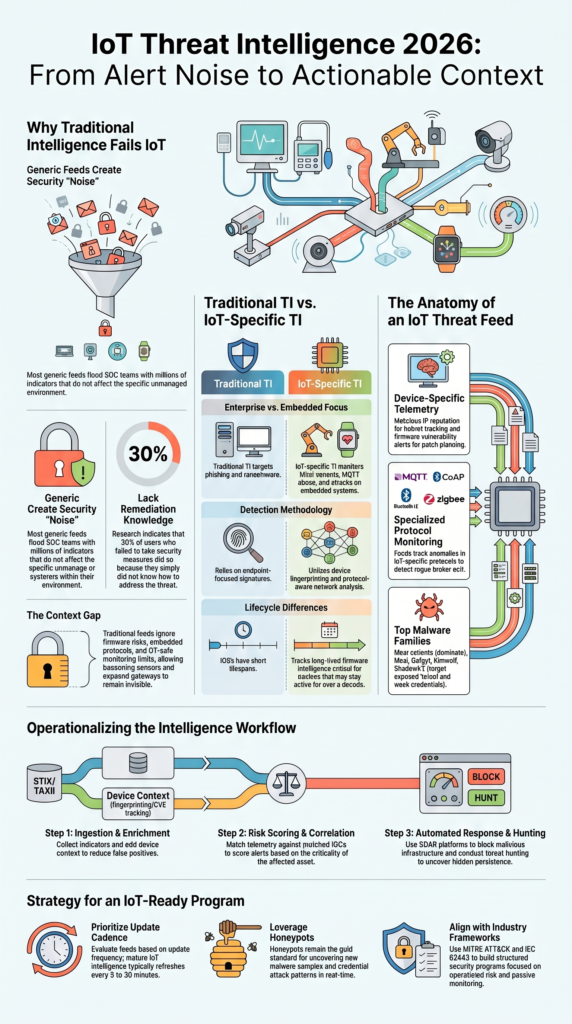
IoT threat feeds combine classic indicators with device-specific telemetry and behavior data.
Most feeds include:
- Malicious IP addresses
- Suspicious domains
- Malware hashes
- Firmware vulnerability alerts
- Honeypot telemetry
- DNS activity
- Sinkhole data
- Credential leak information
- CVE intelligence
We often see Network Threat Detection pipelines enrich this data before forwarding it into SIEM workflows. That extra context helps analysts decide what matters. Teams focused on analyzing IoT device telemetry data typically gain better visibility into suspicious beaconing, firmware anomalies, and device communication patterns.
| Indicator type | Example | IoT use case |
| Malicious IP reputation | Mirai scanner infrastructure | Botnet tracking |
| Firmware vulnerability alerts | Vulnerable camera firmware | Patch planning |
| Malware hashes | ARM malware samples | IoT malware detection |
| DNS telemetry | Beaconing domains | C2 detection |
| Protocol anomalies | MQTT abuse | Device monitoring |
| Credential leaks | Default admin credentials | Credential attack defense |
Modern IoT feeds also support automated intelligence sharing between distributed environments.
Which IoT botnets and malware families appear most often?
Mirai variants still dominate many IoT threat feeds.
Researchers continue finding new botnets built from modified Mirai code. We still see these campaigns targeting cameras, routers, industrial devices, and edge systems.
Common malware families include:
- Mirai variants
- Mozi
- Gafgyt
- Kimwolf
- ShadowV2
Many of these attacks rely on weak passwords, exposed Telnet services, or old firmware.
Some threat feeds process hundreds of new IoT indicators every day. The volume keeps growing as connected devices spread across more industries.
From firehose to signal: Operationalizing IoT threat feeds in MISP and SIEMs
Strong security teams filter and enrich IoT feeds before forwarding alerts into SIEMs or SOAR workflows. This step matters more than many organizations expect.
We have worked with teams that pushed every indicator directly into detection systems. Analysts quickly became overwhelmed. Once asset-aware filtering and Network Threat Detection enrichment were added, the signal quality improved fast.
Most mature workflows include:
- Feed ingestion
- IOC enrichment
- Risk scoring
- Behavioral correlation
- Automated blocking
- Threat hunting
Organizations often connect these workflows with:
- MISP
- Splunk
- SOAR platforms
- IDS pipelines
- NDR systems
| Workflow stage | Purpose | Operational benefit |
| Feed ingestion | Collect IoT indicators | Central visibility |
| IOC enrichment | Add device and firmware context | Fewer false positives |
| Alert correlation | Match telemetry against IOCs | Faster detection |
| Automated response | Block malicious infrastructure | Lower dwell time |
| Threat hunting | Review past activity | Better awareness |
Teams that reduce irrelevant indicators usually improve incident response speed.
What does an IoT threat intel workflow look like?
Most workflows follow a simple sequence:
- IoT sensors and Network Threat Detection tools collect telemetry.
- External feeds deliver updated indicators every few minutes.
- Enrichment engines compare indicators against device inventory and vulnerabilities.
- SIEM and SOAR workflows score alerts by risk.
- IDS or NDR systems trigger blocks or escalations.
- Analysts investigate suspicious activity and persistence attempts.
Mature teams avoid sending every IOC downstream without filtering first.
How are IoT-specific threat intelligence feeds built?
IoT feeds collect data from many sources at once.
Most pipelines gather information through:
- IoT honeypots
- Malware analysis
- DNS telemetry
- Sinkhole analysis
- Darknet monitoring
- CVE tracking
- Device fingerprinting
- Customer telemetry
Researchers and security teams also combine threat intelligence with vulnerability data to improve anomaly detection.
We often use Network Threat Detection telemetry as part of enrichment workflows. Organizations improving their visibility pipelines frequently prioritize collecting telemetry data from IoT platforms. So enrichment engines can correlate device behavior with firmware exposure and active threat indicators more accurately.
Machine learning also plays a larger role now because IoT botnets change infrastructure quickly.
Why honeypots still matter for IoT threat intelligence?
Honeypots remain one of the best ways to watch real IoT attacks. A poorly protected Telnet service can attract scans and credential attacks within minutes.
Researchers tracking Mirai activity often see thousands of login attempts every day against fake IoT devices.
These systems help uncover:
- New malware samples
- Exploit kits
- Beaconing behavior
- C2 infrastructure
- Credential attack patterns
Many IoT threat feeds still depend heavily on honeypot telemetry because embedded malware evolves fast.
Designing an IoT-ready threat intelligence program
A strong IoT CTI program connects threat feeds with asset visibility, vulnerability management, and SOC workflows. Threat intelligence alone is not enough.
We regularly find unmanaged devices during passive monitoring deployments. Forgotten cameras, industrial sensors, and exposed gateways are common.
Good IoT security programs usually include:
- Asset-aware intelligence
- Passive OT-safe monitoring
- Firmware vulnerability tracking
- SIEM enrichment
- Threat hunting workflows
- False-positive testing
Frameworks like MITRE ATT&CK and IEC 62443 help organizations build structured security programs around operational risk.
Operational priorities often include:
- Mapping indicators to critical assets
- Tracking exploit chains
- Monitoring remote access attacks
- Prioritizing active vulnerabilities
- Validating intelligence sharing
Teams that connect CTI with asset inventory usually spend less time chasing unnecessary alerts.
What should teams evaluate before buying an IoT threat feed?
Organizations should focus on operational value, not feed size.
Important evaluation areas include:
- MQTT and OT protocol coverage
- Vulnerability intelligence quality
- IOC enrichment depth
- Update frequency
- STIX/TAXII support
- SIEM and SOAR integration
- False-positive handling
Another useful benchmark is update cadence. Mature IoT feeds often refresh every 5 to 30 minutes depending on the threat type.
According to the Cybersecurity and Infrastructure Security Agency, organizations should prioritize continuous monitoring and asset visibility in connected environments.
Demo vs reality: Lessons from real IoT threat intelligence deployments
Real deployments struggle more with tuning and staffing than data collection. Most organizations already have too much data. The harder part is filtering, enrichment, and triage.
We often hear the same operational complaints:
- Alert overload
- Visibility gaps
- Integration friction
- Staffing shortages
- Manual tuning overhead
Some SOC teams process thousands of IoT alerts every day with very limited staff. Product demos rarely show that reality.
In several environments, we watched teams forward every IoT IOC directly into the SIEM. Analysts eventually stopped trusting the alerts. Once filtering and Network Threat Detection enrichment were added, the workflows became far more manageable.
Another common issue is incomplete asset inventory data. Without visibility into connected devices, IOC correlation becomes unreliable.
Data from researchers conducting a large-scale operational study demonstrates
“Of the users who did not attempt to take measures, 30% of users answered that they did not know how to take measures.” – arXiv
The future of IoT-specific threat intelligence feeds

IoT threat intelligence is moving toward smarter enrichment and behavior-based analysis.
The future looks less like giant IOC lists and more like connected intelligence graphs.
Research efforts now focus on:
- AI-assisted enrichment
- Automated sharing
- Knowledge graph correlation
- Behavioral analytics
- OT and IT convergence
- Autonomous response workflows
In a recent analysis by academic researchers exploring next-generation cyber threat intelligence,
“Traditional CTI approaches often lack the adaptability needed to tackle the evolving nature of attack vectors… Recent advancements in… Generative Artificial Intelligence (GenAI), Federated Learning (FL), and Blockchain… could offer promising solutions.” – Taylor & Francis
We expect future Network Threat Detection systems to connect:
- Device behavior
- Firmware exposure
- Threat actor activity
- Protocol anomalies
- Exploit chains
- Historical telemetry
The shift is already happening. Security teams want context, not another dashboard full of disconnected indicators.
According to the National Institute of Standards and Technology, connected environments require continuous risk assessment because IoT ecosystems change constantly.
FAQ
How do IoT threat intelligence feeds improve smart device security?
IoT threat intelligence feeds help security teams spot suspicious activity linked to connected cameras, industrial sensors, and other smart devices. These feeds track threat indicators tied to IoT botnet campaigns, malicious IP reputation, and firmware tampering attempts.
Many organizations also use device fingerprinting and connected device monitoring to reduce blind spots across growing IoT environments and unmanaged devices.
Why are firmware vulnerability alerts important for industrial IoT threats?
Firmware vulnerability alerts help organizations find outdated software before attackers can exploit it. These alerts are important for industrial sensors, medical IoT security devices, and other connected systems that often run for years without updates.
They also support patch prioritization, CVE monitoring, and vulnerability intelligence efforts that help security teams reduce risks in industrial and remote environments.
How does IoT malware detection help stop DDoS botnets?
IoT malware detection helps security teams identify Mirai variants, DDoS botnets, and command and control activity before attacks spread across connected devices. Behavioral analytics, packet inspection, and DNS telemetry can reveal beaconing activity tied to exploit kits or credential stuffing attempts.
Many organizations also use anomaly detection and threat hunting to find hidden malware inside vulnerable IoT systems.
What causes unsecured Telnet and open SSH exposure risks?
Unsecured Telnet and open SSH exposure risks usually happen when connected devices use weak passwords or outdated remote access settings. Attackers constantly scan the internet for exposed smart home security systems, connected cameras, and industrial IoT devices.
Regular device inventory checks, threat monitoring, and firmware vulnerability alerts can help organizations reduce unauthorized access and exploit chaining risks.
How do STIX/TAXII feeds support automated indicator sharing?
STIX/TAXII helps security teams share machine-readable indicators between SIEM enrichment, SOAR workflows, and security orchestration systems. These feeds often include domain reputation data, file hash intelligence, ransomware indicators, and adversary tactics tied to IoT threat feeds.
Faster intelligence sharing improves incident response, alert correlation, risk scoring, and cyber defense visibility across connected environments.
Turn IoT Threat Intelligence Into Faster Security Decisions
Most security teams are already overloaded with alerts, dashboards, and disconnected threat feeds that rarely improve response times. The real problem is the lack of useful context that helps analysts understand which IoT activity actually matters during an investigation.
Many teams focus on platforms like Network Threat Detection to connect IoT telemetry, threat intelligence, and behavioral analytics into a clearer operational view. If you want stronger visibility without adding another noisy dashboard. Explore the IoT threat intelligence and detection workflows designed to reduce alert fatigue and improve investigation speed.
References
- https://ar5iv.labs.arxiv.org/html/2501.07326
- https://www.taylorfrancis.com/chapters/edit/10.1201/9781003597476-12/toward-next-generation-cyber-threat-intelligence-edge-iot-wissal-lazraq-samia-el-haddouti